


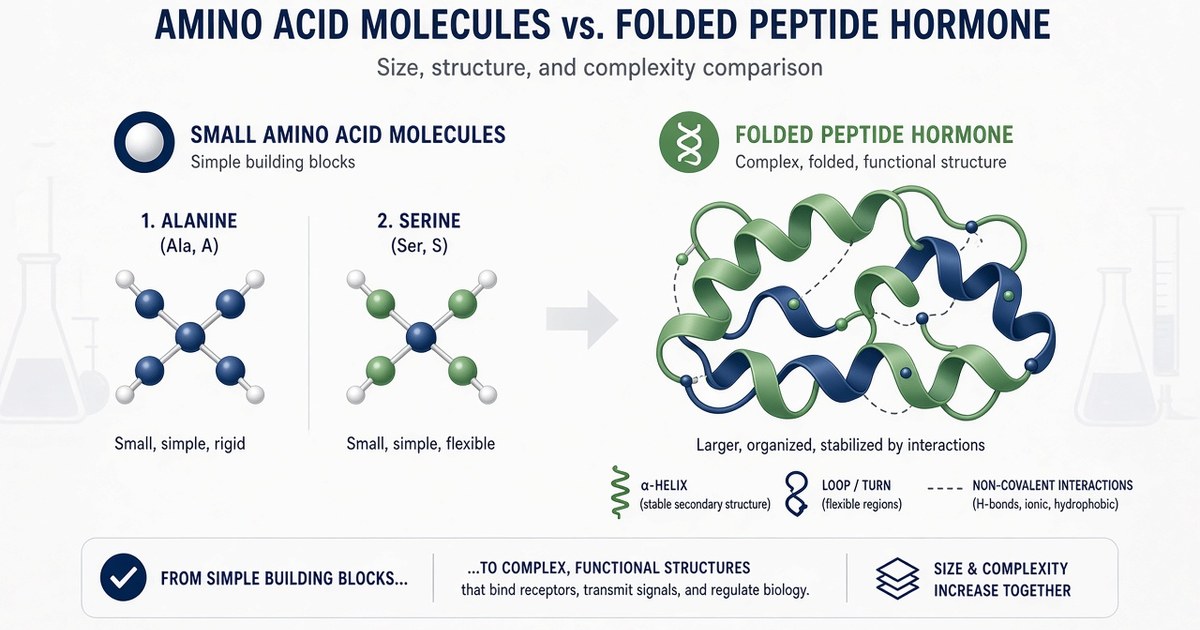
Amino Acids vs Peptide Hormones: Structural Differences
Discover 7 proven structural differences between amino acid-derived hormones and peptide hormones, from synthesis to receptor signaling for lab research.
📋 Table of Contents
Peptide hormones are chains of three to more than 200 amino acids linked by peptide bonds, while amino acid-derived hormones are synthesized from single amino acids such as tyrosine or tryptophan. The key research differences include molecular size (under 500 daltons vs. 300 to over 20,000 daltons), synthesis pathway, solubility, receptor location, and examples like epinephrine versus insulin. All information is for in vitro research use only.
*Research use only: All products discussed on this site are sold strictly for in vitro laboratory research purposes only. They are not for human use, not for veterinary use, and not intended to diagnose, treat, cure, or prevent any disease. Must be 21+ to purchase.*
Key takeaways
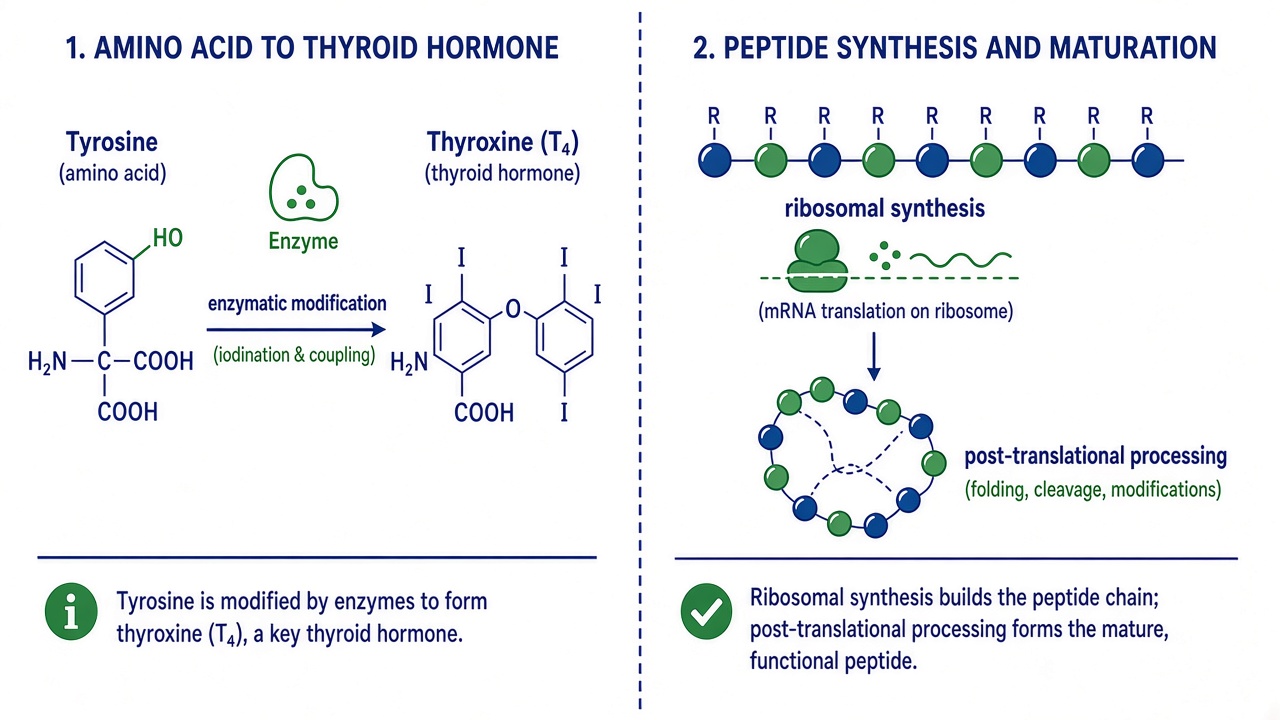
- Amino acid-derived hormones are small molecules built from one amino acid; peptide hormones are longer chains produced via ribosomal translation.
- Solubility differs: catecholamines and most peptide hormones are water-soluble, while thyroid hormones are lipid-soluble.
- Peptide hormones require prohormone processing; amino acid-derived hormones rely on direct enzymatic modification.
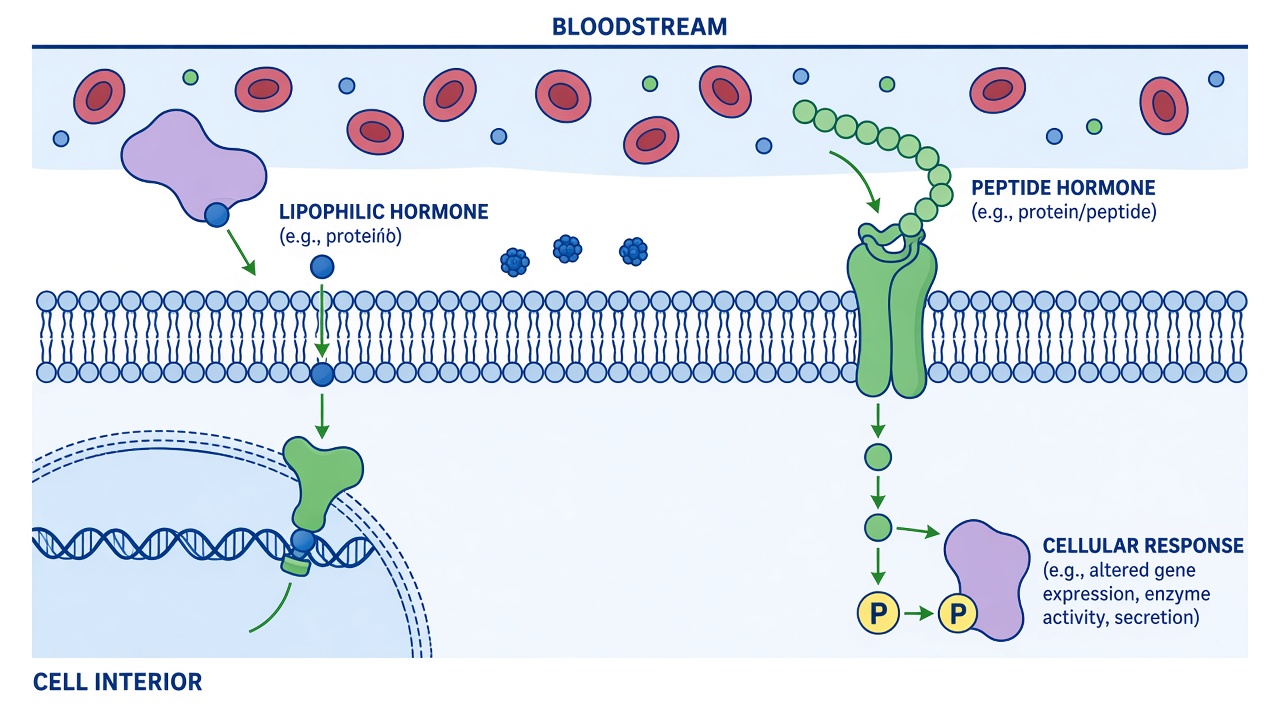
- Receptor binding separates the classes: water-soluble hormones target cell surface receptors, while lipid-soluble thyroid hormones act intracellularly.
- For in vitro reference materials, purity and structural identity are critical when studying amino acid vs peptide hormones.
What Are Amino Acid-Derived Hormones?
Amino acid-derived hormones, often called amine hormones, are produced by enzymatic modification of a single amino acid. The two primary precursors are tyrosine and tryptophan. Tyrosine gives rise to the catecholamines—epinephrine, norepinephrine, and dopamine—as well as thyroid hormones T3 and T4. Tryptophan is the precursor for melatonin and serotonin.
In laboratory settings, these compounds are used to study adrenergic receptor binding, intracellular signaling, and metabolic regulation. The structural simplicity of amino acid-derived hormones compared to peptide hormones makes the former easier to synthesize chemically and analyze with mass spectrometry. Catecholamines contain hydroxyl and amine functional groups that enable rapid oxidation, a key handling consideration for in vitro assays.
Unlike peptide hormones, amino acid-derived hormones do not require ribosomal translation or prohormone cleavage. Instead, they are produced through a limited number of enzymatic steps. For example, tyrosine hydroxylase converts tyrosine to L-DOPA, which is then decarboxylated to dopamine and further modified to norepinephrine and epinephrine. This direct biosynthetic route makes amine hormones relatively small, typically under 500 daltons.
Researchers often distinguish two subclasses within amino acid-derived hormones: catecholamines and thyroid hormones. Catecholamines are water-soluble and act on cell surface adrenergic receptors, while thyroid hormones are lipophilic and enter cells to bind nuclear receptors. Melatonin and serotonin are additional examples derived from tryptophan, each with distinct receptor systems and research applications.
What Are Peptide Hormones?
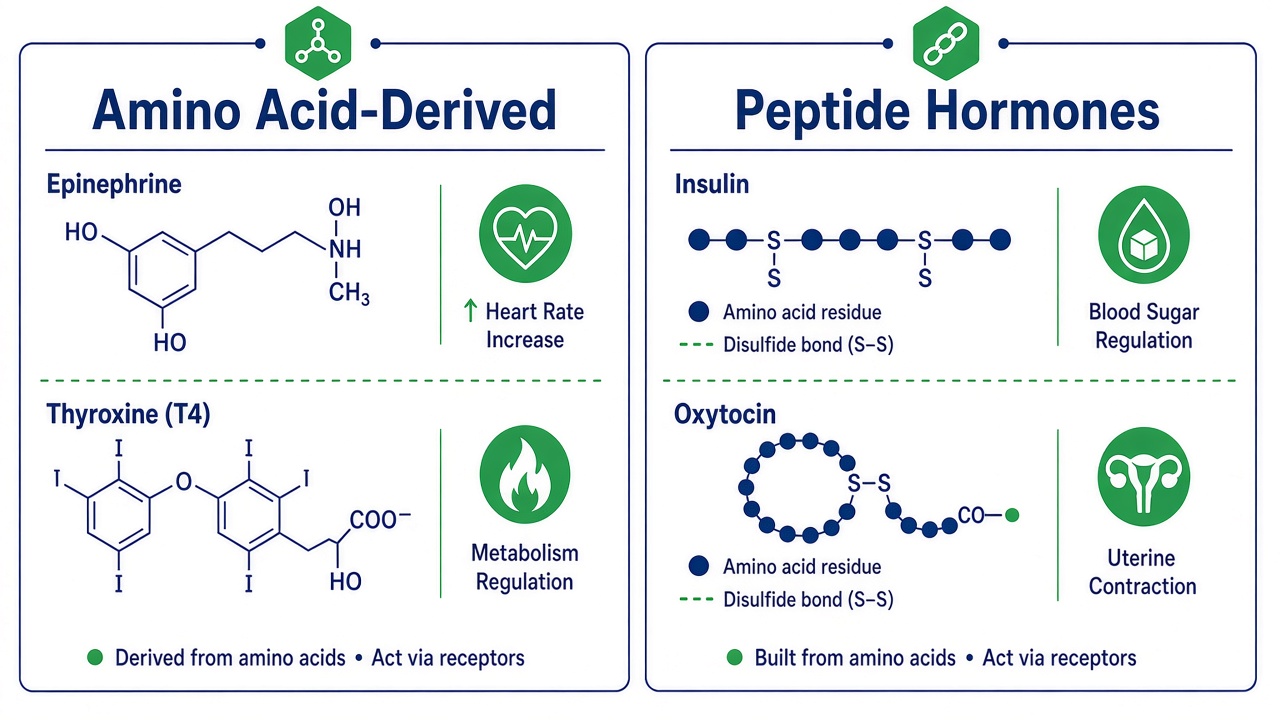
Peptide hormones are polymers of amino acids ranging from short tripeptides like thyrotropin-releasing hormone (TRH) to large polypeptides such as insulin (51 amino acids) and growth hormone (191 amino acids). They are synthesized on ribosomes as larger preprohormones, then cleaved by signal peptidases and prohormone convertases into active forms. This prohormone processing is a defining feature when contrasting amino acid vs peptide hormones.
Examples of peptide hormones include insulin, glucagon, somatostatin, oxytocin, vasopressin, and parathyroid hormone. Researchers commonly use synthetic peptides from this class to investigate receptor-ligand interactions in cell culture and animal models. The presence of multiple peptide bonds and disulfide bridges in peptide hormones often requires careful folding for receptor recognition.
For a deeper comparison of peptide and protein hormones, see Are Peptide and Protein Hormones the Same? 7 Essential Facts. That guide clarifies the size and structural boundaries between these polypeptide signaling molecules and larger protein hormones, which is useful when selecting reference standards.
In terms of research utility, this class of hormones covers a broad functional spectrum. Short sequences such as TRH are amenable to solid-phase synthesis and structure-activity relationship studies, while larger molecules like insulin require correct disulfide pairing for biological activity. Both types are widely used as reference standards in receptor pharmacology and signal transduction assays.
💡 Key Takeaway: What Are Peptide Hormones?
What Are the Structural and Synthetic Differences Between Amino Acid-Derived and Peptide Hormones?
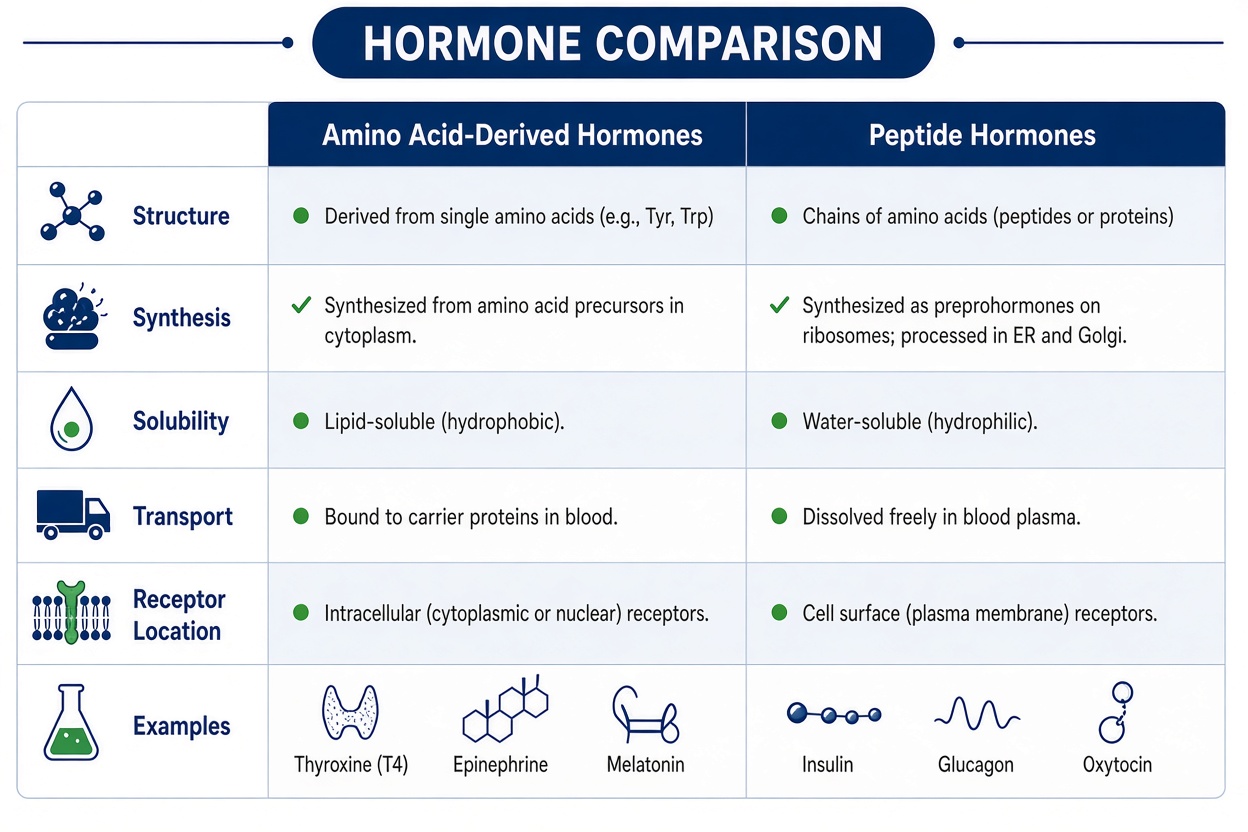
The most obvious difference is molecular size. Amino acid-derived hormones are typically under 500 daltons, while peptide hormones range from 300 to over 20,000 daltons. Peptide hormones contain multiple peptide bonds, secondary and tertiary structures, and often disulfide bridges. Amino acid-derived hormones are either single modified amino acids (e.g., epinephrine) or two iodinated tyrosine residues coupled together (thyroid hormones).
In amino acid vs peptide hormone structural comparisons, peptide hormones require careful folding for receptor recognition, whereas amine hormones rely on functional groups like hydroxyl and amine moieties. This folding dependence means that synthetic peptide hormones must preserve disulfide connectivity and secondary structure to maintain biological activity in receptor binding assays.
Synthetic pathways differ sharply. Amino acid-derived hormones are synthesized through a limited number of enzymatic steps. For example, tyrosine hydroxylase converts tyrosine to L-DOPA, which is then decarboxylated to dopamine and further modified to norepinephrine and epinephrine. Peptide hormones require transcription of a gene, translation of an mRNA, and post-translational cleavage.
This fundamental difference in biosynthesis means that amino acid vs peptide hormones cannot be interconverted in the laboratory without genetic or enzymatic tools. Researchers studying peptide hormones often rely on recombinant expression systems or solid-phase peptide synthesis, while amine hormones are typically produced by direct chemical modification of amino acid precursors.
A practical consequence of these synthetic differences appears in quality control. Amino acid-derived hormone standards can be verified with small-molecule techniques such as HPLC-UV or GC-MS, while polypeptide standards require LC-MS, amino acid analysis, and disulfide mapping. This divergence in analytical methods is a key consideration for any in vitro laboratory comparing the two classes.
How Do Solubility, Transport, and Receptor Mechanisms Differ Between Amino Acid-Derived and Peptide Hormones?
Most amino acid-derived hormones—catecholamines and melatonin—are water-soluble and circulate freely in plasma. Thyroid hormones are the exception: T3 and T4 are lipophilic and require carrier proteins such as thyroxine-binding globulin. Peptide hormones are generally water-soluble and travel dissolved in the bloodstream without carriers.
This solubility profile directly affects receptor location. Water-soluble hormones, including most amino acid vs peptide hormones examples, cannot cross the lipid bilayer and therefore bind cell surface receptors. Thyroid hormones diffuse into cells and bind nuclear receptors. The lipophilic nature of thyroid hormones is a unique exception among amino acid-derived hormones, while all peptide hormones act extracellularly.
For cell surface receptors, both catecholamines and peptide hormones activate G-protein coupled receptors (GPCRs) or receptor tyrosine kinases, depending on the specific hormone. Catecholamines bind adrenergic receptors, while many peptide hormones such as glucagon and somatostatin bind their own GPCR subfamilies. The intracellular signaling cascades differ, but both classes can influence cAMP, calcium, and kinase pathways.
In contrast, thyroid hormones bind nuclear receptors that directly regulate gene transcription. This distinction in receptor location is a core reason why peptide hormones and catecholamines have rapid, often seconds-to-minutes effects, while thyroid hormones have slower, hours-to-days genomic effects. Researchers must select assay endpoints accordingly when comparing amino acid vs peptide hormones.
Which Key Examples and Functions Distinguish Amino Acid-Derived vs Peptide Hormones?
Key examples of amino acid-derived hormones include epinephrine, norepinephrine, dopamine, T3, T4, melatonin, and serotonin. Key examples of peptide hormones include insulin, glucagon, somatostatin, oxytocin, vasopressin, and parathyroid hormone. The functional range differs: catecholamines mediate acute stress and metabolic responses, thyroid hormones control basal metabolic rate, and peptide hormones regulate glucose homeostasis, water balance, growth, and reproduction.
In laboratory research, epinephrine and norepinephrine are standard agonists for adrenergic receptor assays. Insulin and glucagon are standard tools for studying glucose uptake and signaling in cell culture. Because peptide hormones often have longer sequences and more complex folding, they present different experimental challenges than small amine hormones. Researchers comparing amino acid vs peptide hormones should account for stability, receptor expression, and assay kinetics.
For example, insulin requires disulfide bond formation for receptor binding, while epinephrine is stable as a small molecule in acidic solutions but oxidizes rapidly at neutral pH. These practical differences influence how reference standards are prepared, stored, and validated in an in vitro laboratory.
💡 Key Takeaway: Which Key Examples and Functions Distinguish Amino Acid-Derived vs Peptide Hormones?
What Does the Amino Acid vs Peptide Hormones Comparison Table Show?
The following table summarizes the core structural and functional differences between amino acid-derived hormones and peptide hormones for research reference.
| Feature | Amino Acid-Derived Hormones | Polypeptide Hormones |
|—|—|—|
| Molecular size | Under 500 daltons | 300 to over 20,000 daltons |
| Synthesis | Direct enzymatic modification of tyrosine or tryptophan | Ribosomal translation of preprohormones, then prohormone cleavage |
| Solubility | Catecholamines water-soluble; thyroid hormones lipid-soluble | Water-soluble |
| Receptor location | Cell surface (catecholamines) or intracellular/nuclear (thyroid hormones) | Cell surface |
| Post-translational processing | None required | Prohormone processing, disulfide bond formation, glycosylation in some cases |
| Analytical verification | HPLC-UV, GC-MS | LC-MS, amino acid analysis, disulfide mapping |
| Key examples | Epinephrine, norepinephrine, dopamine, T3, T4, melatonin, serotonin | Insulin, glucagon, somatostatin, oxytocin, vasopressin, parathyroid hormone |
This table shows that the two classes differ in size, synthesis, solubility, receptor target, and analytical approach. For researchers selecting reference materials, understanding these differences prevents cross-contamination and assay misinterpretation. Always verify the identity and purity of each standard before use in in vitro experiments.
Why Do Research Applications and Laboratory Considerations Matter for Peptide Hormones?
Research applications for peptide hormones span receptor pharmacology, signal transduction, metabolic regulation, and developmental biology. Because peptide hormones are larger and more structurally complex than amine hormones, they require specialized handling. For example, insulin and glucagon standards should be stored according to manufacturer specifications to preserve disulfide bonds and biological activity.
In cell culture, peptide hormones are often used to stimulate specific receptors or to measure downstream signaling. Researchers should confirm receptor expression in their model system before adding a peptide hormone standard. Many peptide hormones are sensitive to repeated freeze-thaw cycles, so aliquoting is recommended. For sourcing and quality control guidance, see Exogenous Peptides: Complete Sourcing and QC Guide (2026).
Most peptide hormones are water-soluble, so aqueous buffers are appropriate. However, some hydrophobic polypeptide analogs may require organic solvents or carrier proteins. Always consult the certificate of analysis (COA) for storage conditions and purity percentage before use in research.
To verify whether a specific polypeptide hormone has published research support, use Are There Studies on It? 7 Essential Ways to Check (2026). This resource helps researchers evaluate the evidence base for a given compound before designing experiments.
How Should Researchers Select Reference Materials for Polypeptide Hormone Studies?
Selecting reference materials for polypeptide hormone research requires attention to purity, structural identity, and biological activity. Purity is usually reported as a percentage determined by HPLC or UPLC. Structural identity is confirmed by mass spectrometry and, for larger molecules, amino acid analysis or peptide mapping. Biological activity may be verified by receptor binding or cell-based assays.
For amino acid-derived hormones, small-molecule standards with documented purity above 98% are common. For polypeptide hormones, purity above 95% is typical, but disulfide integrity and folding are equally important. Request a certificate of analysis (COA) that includes storage conditions, solubility recommendations, and retest date.
Researchers should also verify that the supplier provides research-use-only documentation. All products discussed on this site are sold strictly for in vitro laboratory research purposes only. They are not for human use, not for veterinary use, and not intended to diagnose, treat, cure, or prevent any disease. Must be 21+ to purchase.
💡 Key Takeaway: How Should Researchers Select Reference Materials for Polypeptide Hormone Studies?
Where Can Researchers Find External References for Further Reading?
Authoritative external references include the National Center for Biotechnology Information (NCBI) and PubMed. These databases provide peer-reviewed articles on hormone structure, synthesis, and receptor signaling. Researchers can search for specific hormone names plus terms like “structural comparison” or “receptor binding” to find relevant literature.
For foundational endocrine biochemistry, textbooks available through academic libraries cover the differences between amino acid-derived and polypeptide hormones. Always cross-check primary literature for the latest analytical methods.
FAQ
1. What are the main structural differences between amino acid-derived and polypeptide hormones?
Amino acid-derived hormones are small, typically under 500 daltons, synthesized by enzymatic modification of tyrosine or tryptophan. Polypeptide hormones range from 300 to over 20,000 daltons, are produced by ribosomal translation, and require prohormone processing and often disulfide bond formation.
2. Which hormones are water-soluble: amino acid-derived or polypeptide?
Catecholamines and most polypeptide hormones are water-soluble. Thyroid hormones (T3 and T4) are lipid-soluble and require carrier proteins. Water-soluble hormones bind cell surface receptors; lipid-soluble thyroid hormones enter cells and bind nuclear receptors.
3. Why is prohormone processing important for polypeptide hormones?
Prohormone processing converts inactive preprohormones into active hormones. This step is absent in amino acid-derived hormones, which are synthesized directly through a few enzymatic steps. Correct processing, including disulfide pairing, is essential for receptor recognition.
4. What analytical methods are used to verify hormone standards in research?
Small amino acid-derived hormones can be verified with HPLC-UV or GC-MS. Polypeptide hormones require LC-MS, amino acid analysis, and disulfide mapping to confirm identity, purity, and structural integrity. Always request a COA before use.
5. Are these hormones safe for human use?
No. All products discussed are for in vitro laboratory research only. They are not for human or veterinary use, not for diagnosis, treatment, cure, or prevention of disease. Must be 21+ to purchase.
Ready to Take the Next Step?
Every product includes lot-specific documentation and third-party purity testing.
Explore Our Research Products →Free shipping on qualifying orders · Batch COA on request