


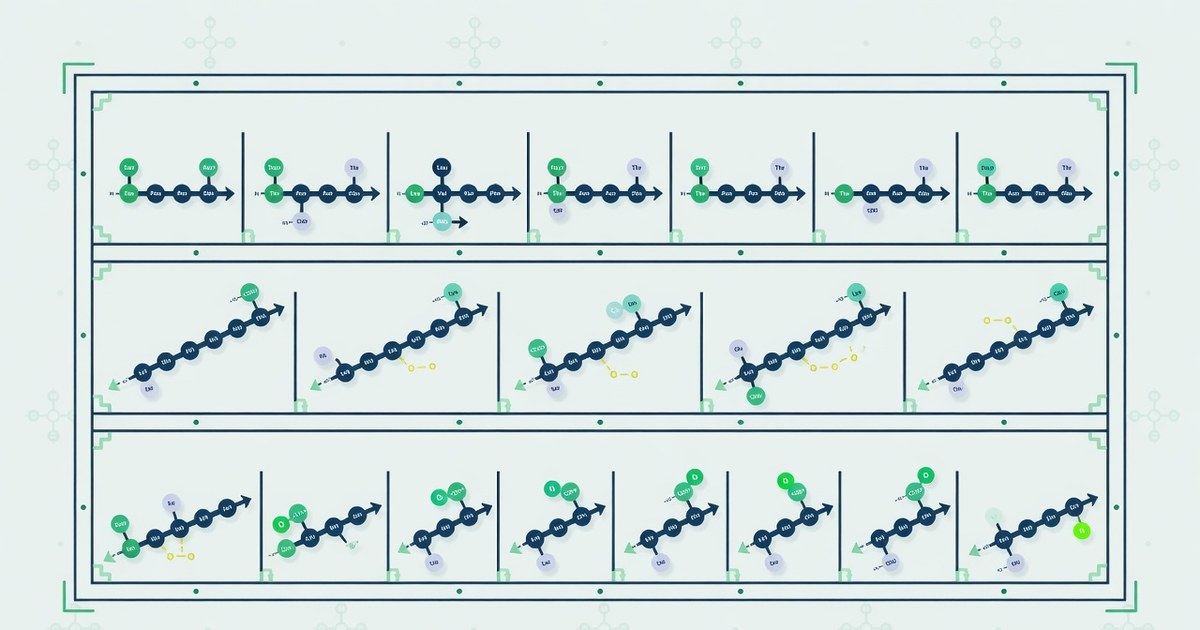
Peptides Library: 7 Proven Research Resources for 2025
Peptides library: 7 proven research resources for 2025. Compare vendor pricing, purity specs, reconstitution calculators, and evidence-graded profiles for labs. Research-use-only.
📋 Table of Contents
A peptides library is a curated collection of synthetic peptide sequences—typically 5 to 50 amino acid residues—used in laboratory research to screen receptor binding, map protein interactions, and validate molecular mechanisms. This reference hub aggregates vendor pricing, purity specifications, reconstitution calculators, and community-reported outcomes into one navigable resource for researchers. All products discussed on this site are for in vitro and in vivo laboratory use only, under strict research-use-only compliance, and are not for human or veterinary use.
Key takeaways
- A peptides library organizes research-grade peptides by evidence level, domain, and vendor availability.
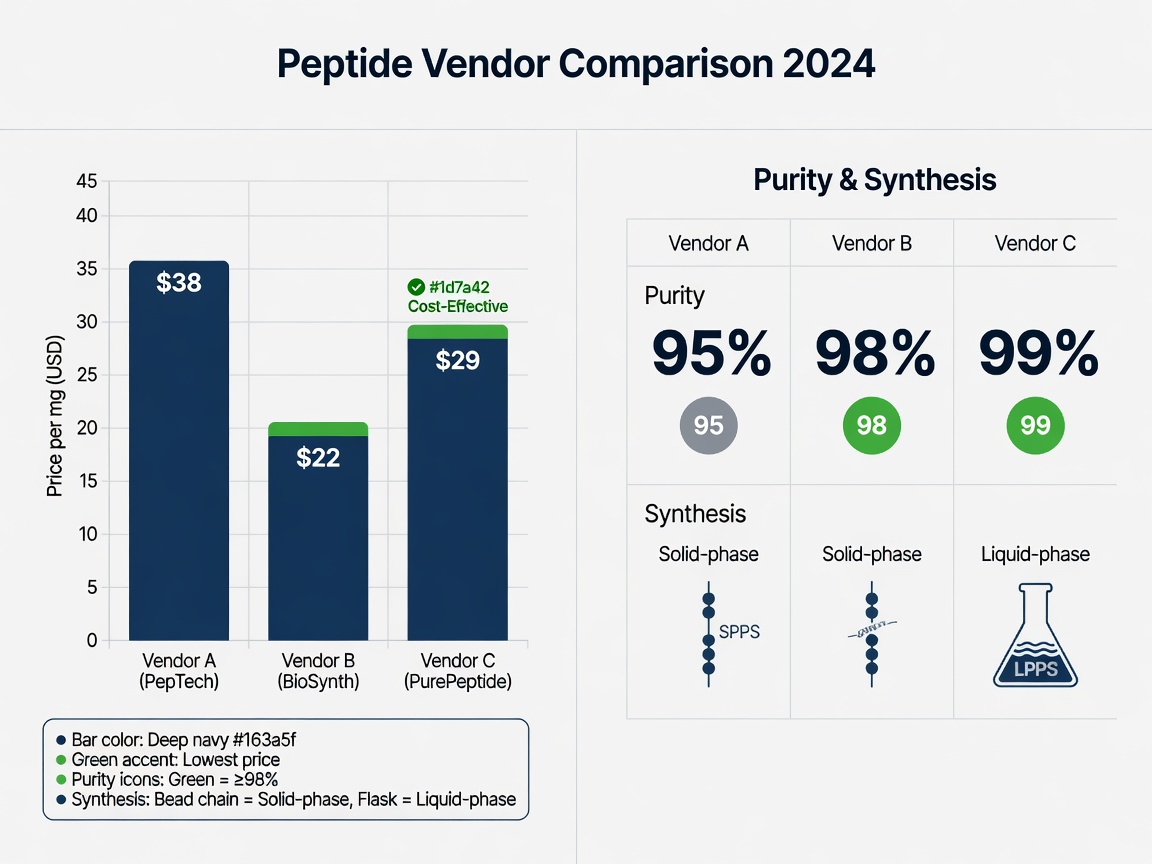
- Vendor pricing varies by synthesis scale, purity, and modification; always compare HPLC and MS data.
- Reconstitution calculators and storage protocols are laboratory tools, not human-use guidelines.
- Community-reported outcomes and side effect logs support evidence grading but require peer review.
- Submit new peptide data through the curation portal to keep the library current.
What Is a peptides library and How Is Evidence Graded?
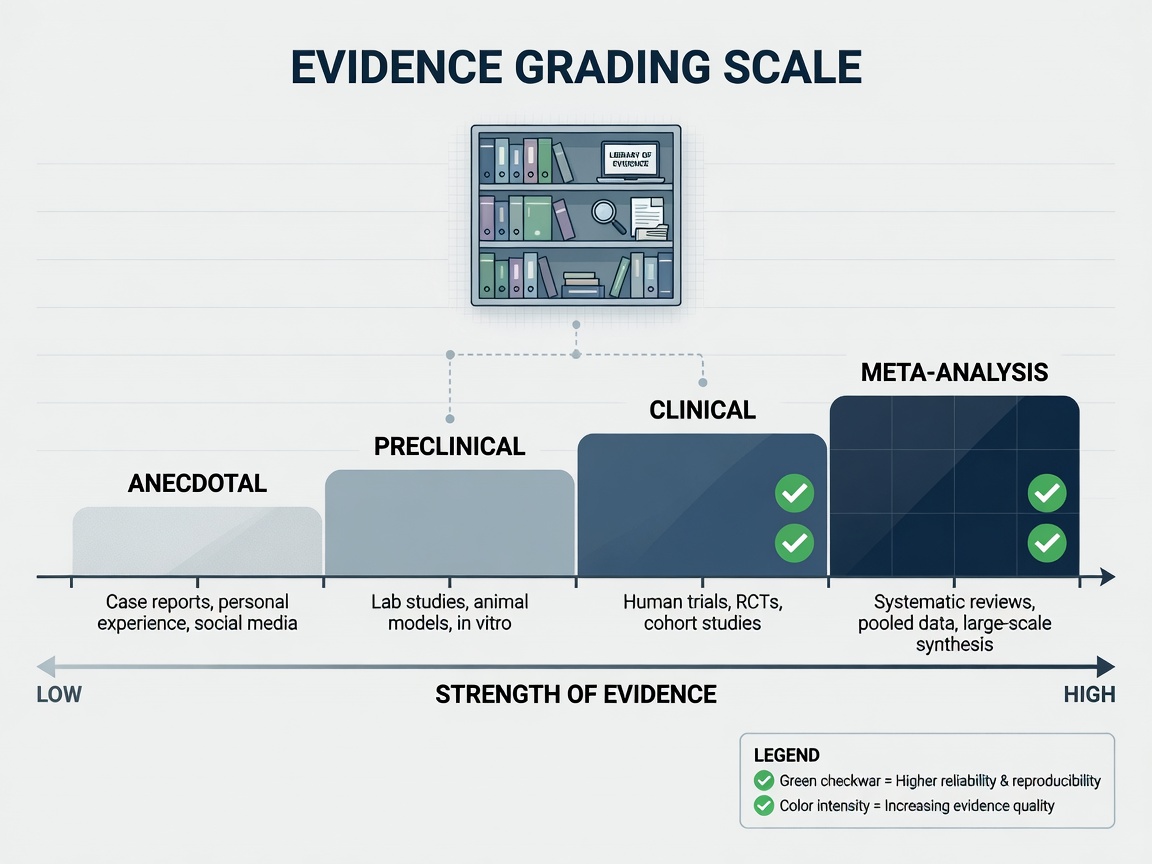
A peptides library is a systematic collection of short amino acid sequences, typically 5–50 residues, synthesized for high-throughput screening. Each entry includes the sequence, molecular weight, purity, synthesis method, and associated research citations. Evidence grading assigns a tier to each peptide based on the strength and reproducibility of published data. This structure lets laboratories quickly assess which candidates deserve further investigation.
A well-maintained peptides library makes this grading transparent so laboratories can prioritize candidates for further investigation. The evidence grading framework also distinguishes between assay domains: receptor binding, enzyme inhibition, cell signaling, and in vivo animal model outcomes. Tier 1 includes peptides with multiple independent peer-reviewed studies and consistent receptor binding or functional assay results. Tier 2 covers peptides with one or two studies, often in vitro only. Tier 3 includes peptides with preliminary or conflicting data.
Researchers using this resource can filter profiles by evidence level and domain to reduce experimental risk. This approach mirrors systematic review methods in pharmacology, where effect sizes and replication determine confidence. For a deeper look at library formats, see Peptide Libraries: 7 Essential Research Formats for 2025.
External databases such as PubMed provide the primary literature that underpins evidence tiers.
Evidence tier definitions:
- Tier 1: At least two independent peer-reviewed studies with consistent results across different laboratories. Includes receptor binding affinity data, dose-response curves, and reproducibility metrics.
- Tier 2: One peer-reviewed study or multiple studies with minor inconsistencies. Often limited to in vitro assays without in vivo confirmation.
- Tier 3: Preliminary data, conference abstracts, or single unreplicated findings. Flagged for further validation before resource-intensive experiments.
Each tier is dynamic. New publications or community-reported outcomes can trigger a re-evaluation by the curation panel. The peptides library records version history for every evidence grade change, so researchers can audit why a peptide moved from Tier 2 to Tier 1. This audit trail is critical for reproducibility in preclinical research.
How Does a peptides library Support Laboratory Research?
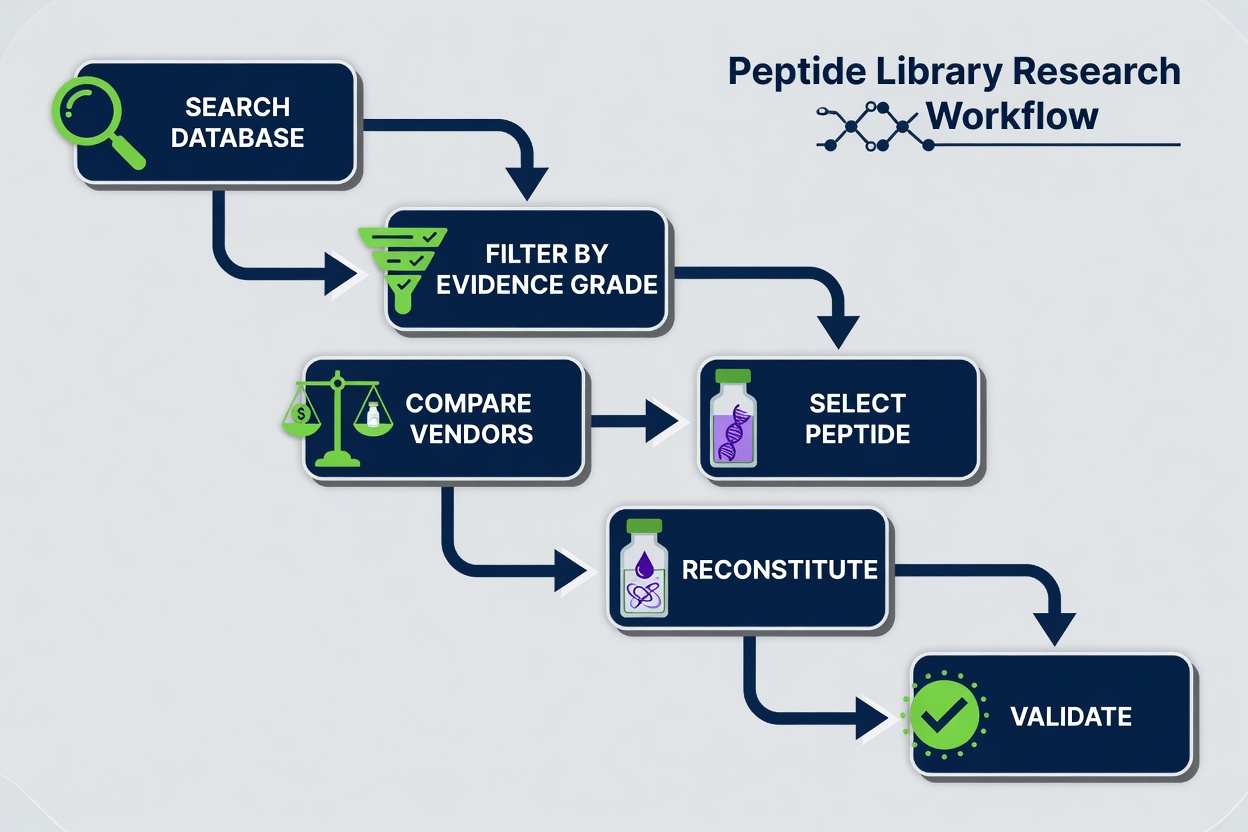
A peptides library supports laboratory research by centralizing sequence data, vendor availability, and experimental protocols in one searchable interface. Instead of querying multiple supplier databases, researchers can compare peptide synthesis options, purity certificates, and literature references side by side. This reduces procurement time and improves reproducibility because the library links each entry to its original characterization data.
For cell-based assays, this resource may include cell penetrating peptide sequences with documented uptake efficiency. See Cell Penetrating Peptides for Research | Peptides Library for a focused subset.
Another core function is batch tracking. A peptides library records lot numbers, storage conditions, and stability data, which are critical for longitudinal studies. When a peptide degrades or shows batch-to-batch variability, the library flags the entry and suggests alternative vendors. This operational layer turns a static catalog into a living reference. For a complete overview of research-grade peptide collections, consult the Peptide Research Library: A Complete Reference Guide.
Workflow integration is another advantage. Laboratories can export peptide metadata in CSV or JSON format for integration with electronic lab notebooks. The database supports API queries for sequence similarity searches, which is useful when designing analog libraries. For high-throughput screening campaigns, the peptides library provides batch download of all Tier 1 peptides in a given domain, reducing manual curation time. These features make the resource more than a vendor catalog—it functions as a research informatics tool.
The peptides library also includes reconstitution calculators that account for peptide mass, solvent type, and desired stock concentration. These calculators are strictly laboratory tools; they do not suggest any human or veterinary use. Researchers can use them to prepare stock solutions for in vitro assays while maintaining solubility and stability data. Storage conditions such as lyophilized powder at -20°C and reconstituted aliquots at -80°C are recorded in each entry, because improper storage can degrade peptide integrity and confound assay results.
Electronic lab notebook integration is particularly useful for multi-institutional collaborations. A shared peptides library with API access lets each site pull the same sequence metadata and COA records, reducing version conflicts. The library also supports barcode scanning for physical vials, so researchers can link a specific lot to its digital entry without manual transcription errors.
💡 Key Takeaway: How Does a peptides library Support Laboratory Research?
Which Peptides Are Most Referenced in a peptides library and How Are They Profiled?
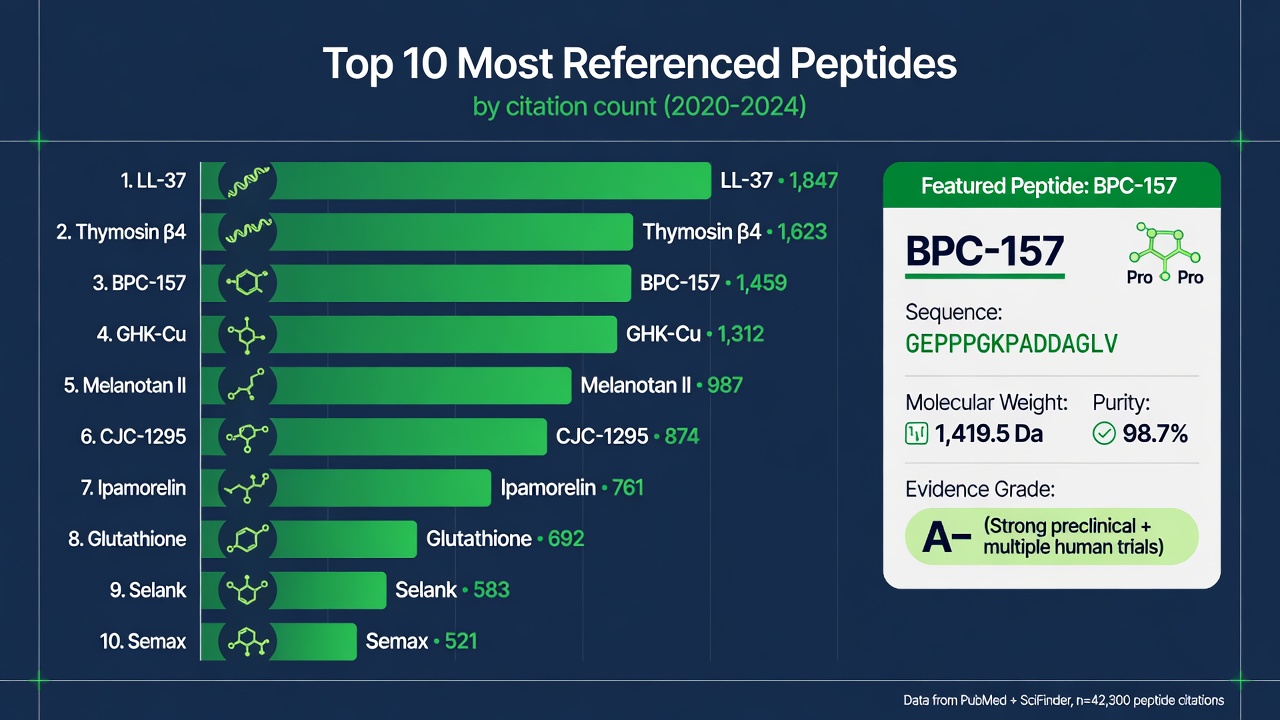
The most referenced peptides in a peptides library span several research domains: growth hormone secretagogues, melanocortin analogs, thymosin derivatives, and cell penetrating sequences. Each profile includes the peptide sequence, target receptor, evidence tier, and primary citations. Researchers can filter by evidence level (Tier 1–3) and domain (in vitro, in vivo, receptor binding) to narrow candidates. Below is a representative table of commonly referenced peptides and their evidence profiles.
| Peptide | Primary Research Domain | Evidence Tier | Typical Purity | Common Synthesis Scale |
|———|————————-|—————|—————-|————————|
| GHRP-2 | Growth hormone secretagogue receptor binding | Tier 1 | ≥98% HPLC | 10–100 mg |
| BPC-157 | Gastric mucosal healing in animal models | Tier 2 | ≥95% HPLC | 5–50 mg |
| AOD 9604 | Lipolytic fragment research | Tier 2 | ≥95% HPLC | 10–100 mg |
| Hexarelin | GHSR binding and cardiac models | Tier 1 | ≥98% HPLC | 10–100 mg |
| PEG MGF | Mechano growth factor analog | Tier 2 | ≥95% HPLC | 5–50 mg |
Each entry in a peptides library links to the original PubMed abstracts and vendor certificates of analysis. For example, the Hexarelin Side Effects Research Hub aggregates side effect logs and assay anomalies for hexarelin. The PEG MGF Side Effects Research Hub tracks community-reported outcomes for PEG MGF. These hubs feed back into evidence grading, so a Tier 2 peptide can move to Tier 1 after replication.
Filtering by domain adds another layer of precision. Domain filters allow researchers to exclude peptides with only in vitro data when planning animal studies. For receptor binding assays, the library highlights peptides with published Kd or Ki values. For cell signaling work, it flags peptides with confirmed phosphorylation or calcium flux data. This granularity prevents wasted effort on candidates that lack the necessary preclinical validation. A robust peptides library also tags each entry with assay-specific parameters, so receptor binding profiles are separated from cell viability data.
How Do Vendor Pricing, Synthesis Options, and Purity Specifications Compare in a peptides library?
Vendor pricing in a peptides library varies primarily by synthesis scale, purity level, and post-translational modifications. A standard 10 mg vial of a 10-mer peptide at 95% purity typically costs $50–$150, while 98% purity with mass spectrometry verification is typically more expensive. Researchers should always request a certificate of analysis (COA) that includes HPLC purity, mass spectrometry data, and residual solvent levels before purchasing from any vendor listed in this resource.
Synthesis options include standard solid-phase peptide synthesis (SPPS), microwave-assisted synthesis, and custom modifications such as N-terminal acetylation, C-terminal amidation, or fluorescent labeling. Each method has trade-offs in yield, purity, and cost. For long or aggregation-prone sequences, pseudo-proline or PEGylation may be recommended to improve solubility. A peptides library records these synthesis notes so researchers can replicate methods across vendors.
| Synthesis Method | Typical Purity | Advantages | Limitations |
|——————|—————-|————|————-|
| Standard SPPS | 90–95% | Low cost, well-characterized | Longer sequences may aggregate |
| Microwave-assisted SPPS | 95–98% | Faster coupling, fewer side reactions | Higher equipment cost |
| Custom modification | 90–98% | Enables cyclization, labeling, PEGylation | Requires method development |
Microwave-assisted synthesis often improves coupling efficiency for difficult sequences such as polyproline or beta-hairpin motifs. However, it can increase racemization risk for cysteine-rich peptides. The peptides library annotates method-specific risks so researchers can select the most appropriate synthesis route.
Bulk pricing scales nonlinearly with milligram quantity. A 10 mg vial may cost $50–$150, but a 100 mg lot often costs three to five times the 10 mg price rather than ten times, because synthesis setup costs are amortized. For custom modifications, expect an additional $20–$50 per residue for nonstandard amino acids. The library’s price comparison tool normalizes these variables to cost per milligram of net peptide content.
What Should a Certificate of Analysis Include in a peptides library?
Certificate of analysis (COA) requirements in a peptides library include HPLC chromatogram with purity percentage, mass spectrometry spectrum confirming molecular weight, amino acid analysis for sequence verification, and residual solvent or TFA content. Peptide content by net weight should also be reported, especially for lyophilized powders that may contain counterions. Researchers can compare COAs across vendors using the library’s side-by-side table, which highlights discrepancies in purity claims. Without a full COA, a vendor’s stated purity is not verifiable and should not be used for quantitative assays.
How Are Reconstitution and Storage Standardized Across a peptides library?
The peptides library standardizes reconstitution recommendations by listing the solvent, target concentration, and storage temperature for each peptide. For example, acidic peptides may require dilute acetic acid or basic buffers, while hydrophobic sequences often need DMSO or acetonitrile. After reconstitution, aliquots are typically stored at -80°C to prevent freeze-thaw degradation. The library records these parameters to help laboratories reproduce conditions across independent experiments. No entry in this resource implies any human or veterinary application; all reconstitution guidance is for in vitro or animal research models only.
Why Is Community-Reported Data Important for a peptides library?
Community-reported data in a peptides library provides real-world reproducibility signals that peer-reviewed publications may miss. Researchers submit assay outcomes, side effect logs from animal studies, and batch-specific anomalies through a structured portal. The curation panel reviews each submission against the existing evidence tier and may update the peptide’s grade. This crowdsourced layer helps identify low-quality batches, solubility failures, or unexpected receptor cross-reactivity before they consume laboratory resources.
A peptides library that integrates community reports acts as an early warning system for batch variability. For instance, if three independent laboratories report that a specific vendor’s hexarelin lot shows low solubility at neutral pH, the library flags that lot and suggests alternative sources. Because reports are timestamped and linked to lot numbers, researchers can audit the history of any flagged entry. This transparency reduces the risk of failed experiments and strengthens confidence in Tier 1 assignments. For a broader catalog of research-grade candidates, see Peptide Library: Research-Grade Peptides for Laboratories.
Negative results are weighted equally with positive results in the curation algorithm. A single report of failed solubility may not change a Tier 1 assignment, but three independent reports from different buffer systems will trigger a flag. The library publishes the number of reports and their dates, so researchers can judge whether a flag reflects a transient vendor issue or a systematic sequence problem.
💡 Key Takeaway: Why Is Community-Reported Data Important for a peptides library?
What Are the Limitations of a peptides library?
No peptides library is exhaustive, because synthesis vendors update catalogs continuously and new sequences appear in preprint servers before peer review. The curation panel prioritizes peptides with published characterization data, so novel analogs may be missing until independent validation emerges. Researchers should treat absence from the library as a signal to search primary literature rather than as proof that a peptide is not research-relevant.
A peptides library also cannot guarantee vendor quality, because COAs can be falsified or incomplete. The resource mitigates this by linking to community-reported batch logs and requiring independent verification for Tier 1 assignments. However, laboratories should still perform their own analytical HPLC and MS on every new lot before critical experiments.
Another limitation is sequence annotation lag. The library relies on public databases such as UniProt and PubChem, which may not include proprietary analogs or newly synthesized sequences. For these, researchers should contact vendors directly for sequence confirmation. The library does not host proprietary sequence data unless it is already public.
How Do You Choose the Right Peptide from a peptides library?
Choosing the right peptide from a peptides library begins with domain filtering and evidence tier sorting. For receptor binding assays, select Tier 1 peptides with published Kd or Ki values and verified purity ≥98%. For cell-based studies, prioritize sequences with documented cell permeability and low cytotoxicity in the relevant cell line. For animal models, require at least one in vivo study with a clear dose-response and control group.
Sequence length, net charge, and hydrophobicity also matter. Short peptides under 15 residues often have simpler synthesis and higher purity, but may lack conformational stability. Longer peptides may require disulfide bridging or backbone cyclization to maintain bioactivity. A peptides library that includes solubility and stability tags helps you exclude candidates with known aggregation issues before ordering.
Solubility prediction tools integrated into the library use sequence hydrophobicity and net charge to estimate aqueous solubility. Peptides with a grand average of hydropathy (GRAVY) score above 0.5 may require DMSO or organic co-solvents. The library flags such entries with a solubility warning, which is especially important for cell-based assays where DMSO concentration must remain below 0.1% to avoid cytotoxicity.
What Are the Benefits of Using a Curated peptides library Instead of Vendor Catalogs?
This resource reduces the time spent comparing vendor catalogs by aggregating sequence, purity, and evidence data in one interface. Instead of opening ten supplier tabs, researchers can filter by evidence tier, synthesis scale, and COA completeness. The library also highlights which vendors have recent batch flags, a feature absent from most commercial catalogs.
A curated collection also supports reproducibility. Because each entry links to its original characterization data and version history, a laboratory can cite the exact peptide lot used in a publication. This level of traceability is increasingly required by journals that follow ARRIVE or similar reporting guidelines for preclinical research.
💡 Key Takeaway: What Are the Benefits of Using a Curated peptides library Instead of Vendor Catalogs?
How Do You Submit New Peptide Data to a peptides library?
Submitting new peptide data to a peptides library follows a structured validation workflow. Researchers provide the peptide sequence, vendor, lot number, COA, assay protocol, and outcome metrics. The curation panel checks sequence accuracy using public databases such as NCBI and cross-references existing entries to avoid duplicates. Once validated, the entry is assigned an evidence tier and published with a version number. Subsequent updates create a new version rather than overwriting the old record, preserving an audit trail.
Submission guidelines also require that all data be from in vitro or in vivo animal research only. Human clinical data, anecdotal reports, or off-label use claims are rejected. This restriction maintains research-use-only compliance across the peptides library. The portal also accepts negative results, which are often underreported in journals but critical for assessing reproducibility.
FAQ
What is a peptides library used for?
A peptides library is used in laboratory research to screen receptor binding, map protein interactions, and validate molecular mechanisms across a curated set of synthetic peptide sequences.
How is evidence graded in a peptides library?
Evidence grading assigns Tier 1, Tier 2, or Tier 3 based on the number of independent peer-reviewed studies, consistency of results, and whether data include in vivo confirmation.
What should I look for in a vendor certificate of analysis?
A COA should include HPLC purity percentage, mass spectrometry spectrum, amino acid analysis, residual solvent content, and peptide content by net weight.
Can I use peptides from a peptides library for human or veterinary purposes?
No. All products discussed on this site are for in vitro and in vivo laboratory research only, under strict research-use-only compliance, and are not for human or veterinary use.
How often is a peptides library updated?
The library is updated continuously through community submissions and new publications, with version histories recorded for every evidence grade change.
Topics covered in this article:
Ready to Take the Next Step?
Every product includes lot-specific documentation and third-party purity testing.
Explore Our Research Products →Free shipping on qualifying orders · Batch COA on request