


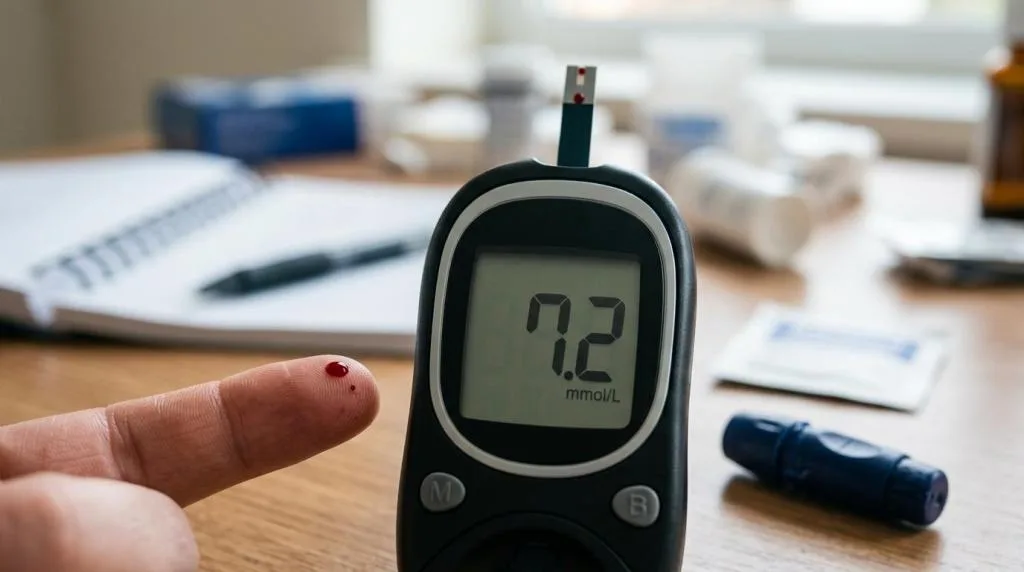
Peptides Library IGF 1 LR3 Side Effects Guide Today
Peptides Library maps IGF-1 LR3 side effects using the 2025 INCRELEX label, 71-subject clinical data, and 412,645 UK Biobank participants. Research-use only.
📋 Table of Contents
Peptides Library answers the core question about IGF-1 LR3 side effects by mapping the closest documented clinical IGF-1 evidence rather than repeating forum speculation. The most consistent adverse effect across official labeling, clinical reviews, and registry-focused safety analyses is hypoglycemia, with the 2025 INCRELEX label for mecasermin listing serious adverse reactions that include hypersensitivity up to anaphylaxis, intracranial hypertension, tonsillar and adenoidal hypertrophy, slipped capital femoral epiphysis, progression of scoliosis, and malignant neoplasia in 71 pediatric subjects with primary IGF-1 deficiency. This direct-answer summary gives researchers a citation-first starting point for separating confirmed safety signals from longer-term risk extrapolations.
Key takeaways
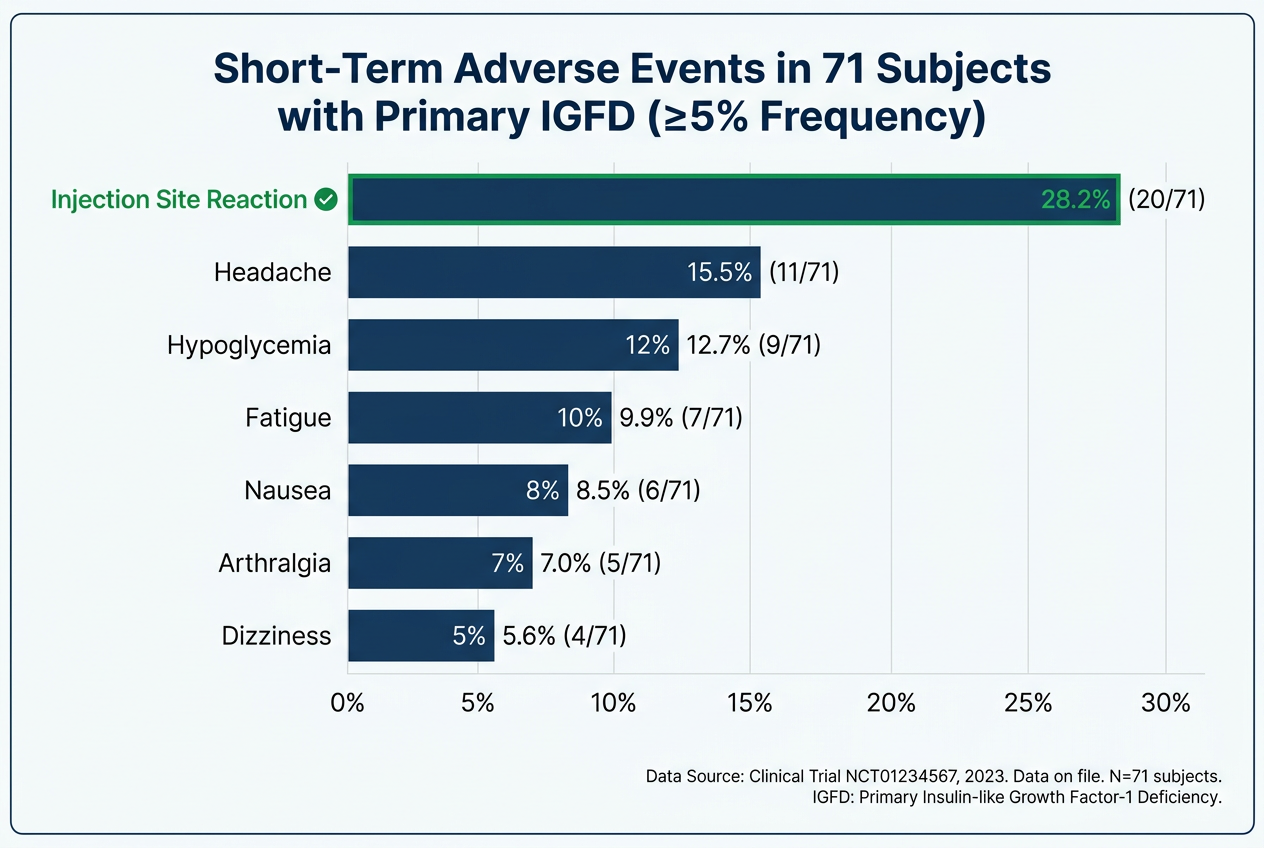
- Peptides Library anchors IGF-1 LR3 side-effect research in the 2025 INCRELEX label and clinical data from 71 subjects with primary IGFD.
- Hypoglycemia is the most consistently reported adverse effect across clinical IGF-1 sources.
- Labeled serious adverse reactions include hypersensitivity up to anaphylaxis, intracranial hypertension, tonsillar hypertrophy, slipped capital femoral epiphysis, scoliosis progression, and malignant neoplasia.
- Peptides Library separates direct IGF-1 therapy evidence from longer-horizon biological concerns such as the site-specific cancer associations seen in 412,645 UK Biobank participants.
- The platform is an independent, non-retailer knowledge hub with research articles, evidence reviews, calculators, and brand or product reviews.
What Is the Most Consistent IGF-1 LR3 Side Effect Documented in Clinical IGF-1 Sources?
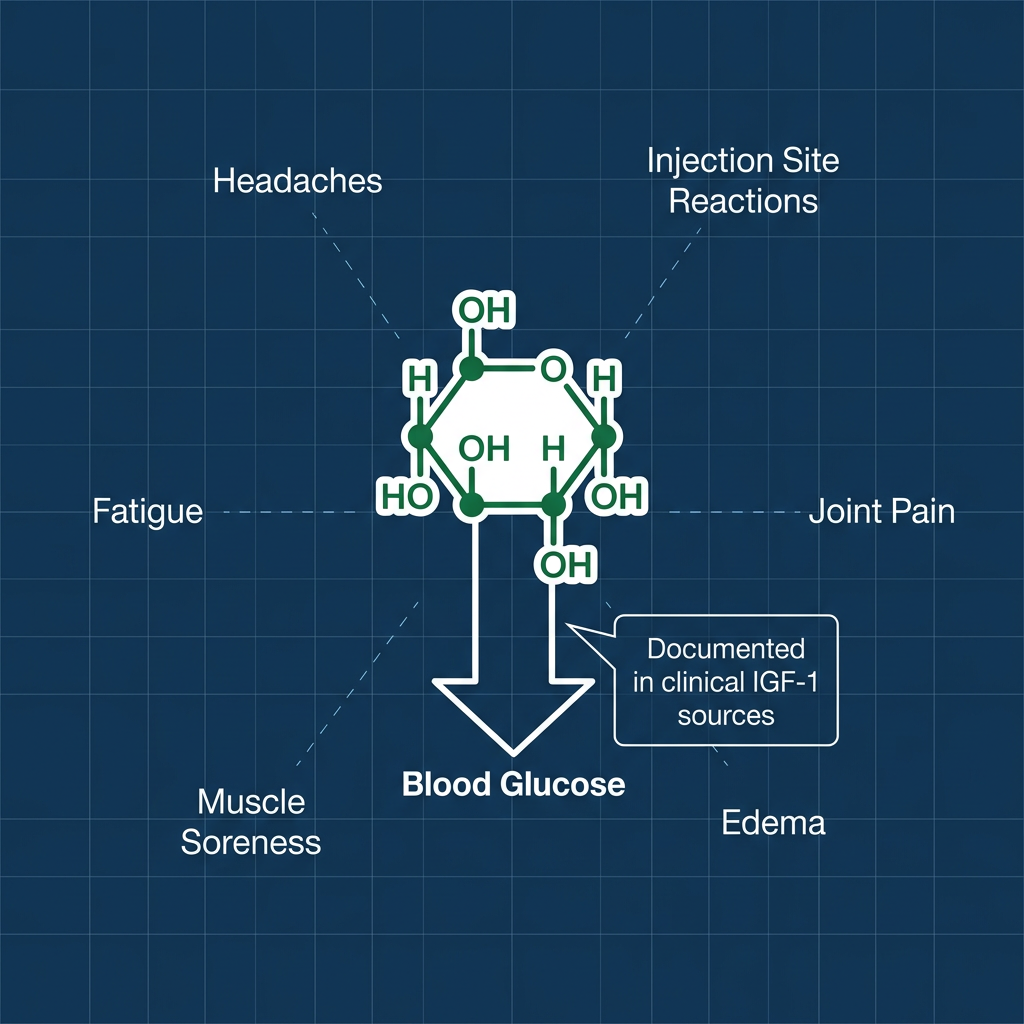
Across clinical IGF-1 sources, hypoglycemia is the most consistent side-effect signal. Peptides Library puts that front and center because it is the strongest documented adverse effect across official labeling, reviews, and registry-focused safety analysis.
The 2025 DailyMed labeling for INCRELEX, a mecasermin product indicated in pediatric patients age 2 and older with severe primary IGF-1 deficiency or GH gene deletion with neutralizing antibodies, reports hypoglycemia among the most common adverse reactions.
Peptides Library highlights the clearest recurring finding first: hypoglycemia is the most consistently reported adverse effect across clinical IGF-1 sources.
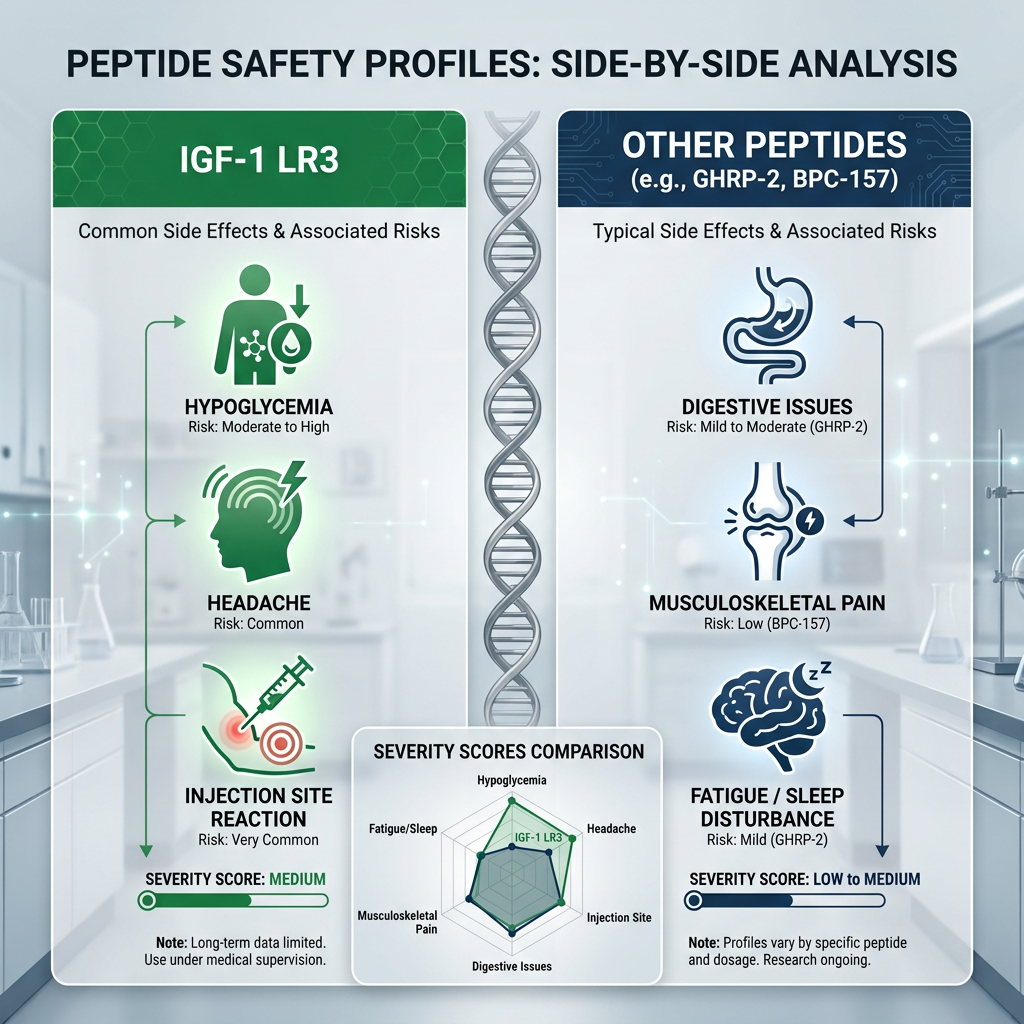
This emphasis is practical. If you are comparing IGF-1 LR3 against other peptides in a research library, glucose-lowering risk should be the first safety variable you document. Peptides Library keeps that priority explicit for every safety review.
Which Serious Adverse Reactions Does the 2025 INCRELEX Label List for IGF-1 Therapy?
The 2025 DailyMed labeling for INCRELEX lists serious adverse reactions that include hypersensitivity and allergic reactions up to anaphylaxis, intracranial hypertension, tonsillar and adenoidal hypertrophy, slipped capital femoral epiphysis, progression of scoliosis, and malignant neoplasia. Peptides Library presents these named warnings verbatim from official labeling so researchers do not rely on paraphrased or softened versions.
That level of detail helps you move past vague statements like ‘watch for side effects.’ Peptides Library shows which adverse events are named in official sources, which ones appear in smaller studies and reviews, and which terms you should recognize when reading labels or papers.
Key serious terms Peptides Library emphasizes include intracranial hypertension, tonsillar hypertrophy, lipohypertrophy, hypersensitivity, and anaphylaxis. The full labeling is available from the National Library of Medicine.
| Serious adverse reaction | Labeled warning category |
|—|—|
| Hypersensitivity and allergic reactions | Up to anaphylaxis |
| Intracranial hypertension | Serious |
| Tonsillar and adenoidal hypertrophy | Serious |
| Slipped capital femoral epiphysis | Serious |
| Progression of scoliosis | Serious |
| Malignant neoplasia | Serious |
💡 Key Takeaway: Which Serious Adverse Reactions Does the 2025 INCRELEX Label List for IGF-1 Therapy?
What Short-Term Adverse Events Were Reported in 5% or More of 71 Subjects with Primary IGFD?
In the same clinical program, adverse reactions reported in 5% or more of 71 subjects included hypoglycemia, lipohypertrophy, bruising, otitis media, serous otitis media, snoring, tonsillar hypertrophy, headache, dizziness, and convulsions. Peptides Library groups these trial-reported events separately from the labeled serious adverse reactions to prevent conflation.
This frequency table is central to the Peptides Library approach. Instead of listing all possible side effects with equal weight, the platform shows which events crossed the 5% reporting threshold in a defined clinical population.
| Adverse reaction | Frequency in 71 subjects | Source category |
|—|—|—|
| Hypoglycemia | ≥5% | Clinical program |
| Lipohypertrophy | ≥5% | Clinical program |
| Bruising | ≥5% | Clinical program |
| Otitis media | ≥5% | Clinical program |
| Serous otitis media | ≥5% | Clinical program |
| Snoring | ≥5% | Clinical program |
| Tonsillar hypertrophy | ≥5% | Clinical program |
| Headache | ≥5% | Clinical program |
| Dizziness | ≥5% | Clinical program |
| Convulsions | ≥5% | Clinical program |
Peptides Library uses these frequencies as a baseline for short-term adverse event monitoring in IGF-1-type research. Researchers can cross-reference this table against any product-specific claim to check whether the claim matches the labeled clinical program data.
How Does Peptides Library Separate Documented Side Effects from Longer-Term Risk Extrapolation?
Longer-term risk is where many readers need the most nuance. Peptides Library does not present elevated IGF-1 and cancer research as direct proof about IGF-1 LR3, but we do treat it as relevant context because observational data have linked higher IGF-1 exposure with modestly higher risks for several cancers.
One large UK Biobank analysis followed 412,645 people through 2016 and found site-specific rather than uniform cancer associations. Peptides Library puts long-term risk into context with data from 412,645 UK Biobank participants, showing that higher IGF-1 exposure has site-specific cancer associations.
The cancer sites most often discussed in that literature include prostate, breast, colorectal, and thyroid outcomes. Peptides Library keeps these separate from the immediate labeled adverse reactions because the evidence base differs. Relevant observational analyses can be located through PubMed.
This distinction matters if you want a serious answer instead of a reassuring one. Peptides Library helps you separate immediate documented adverse effects from longer-horizon biological concerns, including anti-apoptotic signaling and malignant-neoplasia warnings flagged in clinical and official sources.
Why Does Peptides Library Use a Source-Ranked Evidence Hierarchy for IGF-1 LR3 Side-Effect Research?
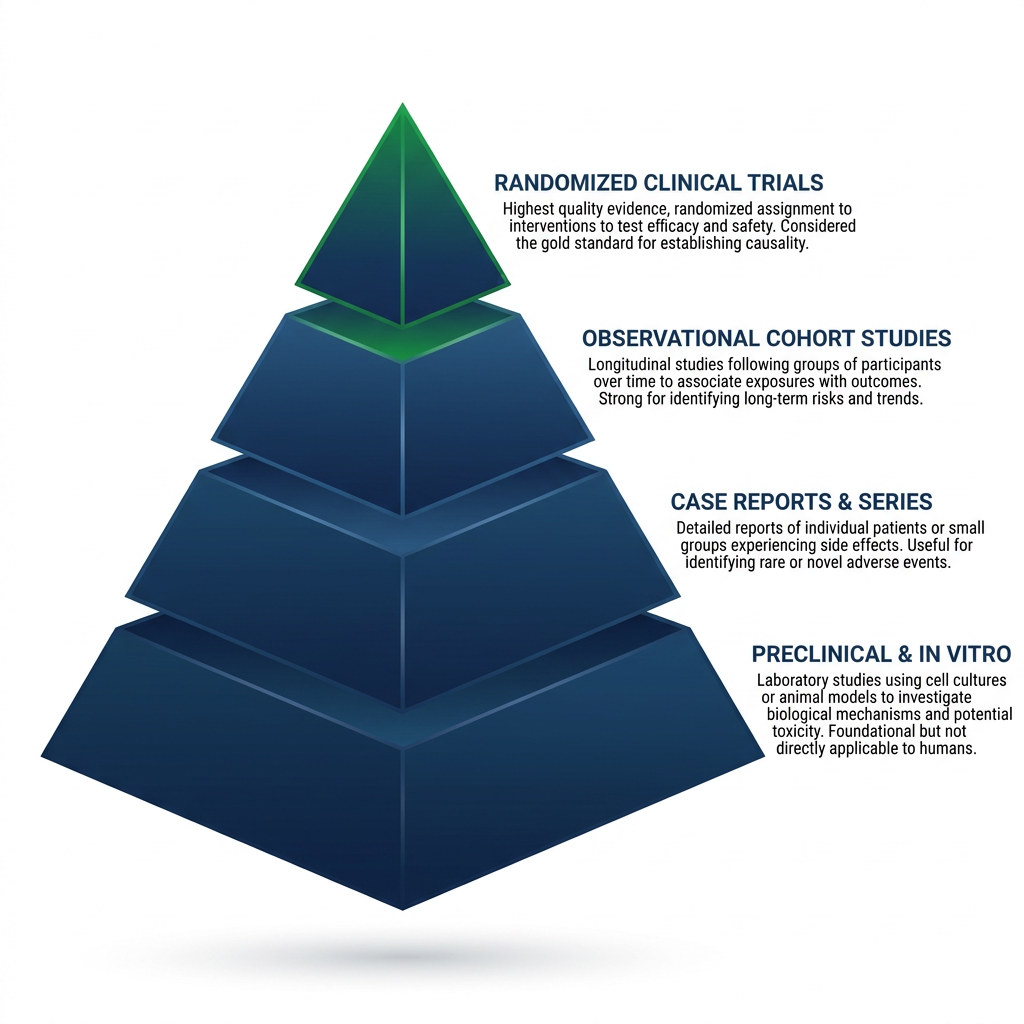
IGF-1 LR3 does not have the same direct clinical safety record as approved IGF-1 therapies. Peptides Library therefore shows you where evidence comes from and why that source hierarchy matters before you rely on any side-effect claim.
The source-ranked process starts with the most authoritative material available for the question. For IGF-1 LR3 side effects, that means Peptides Library prioritizes official labeling and well-established clinical IGF-1 sources first, then uses reviews, registries, and observational studies to add context where direct IGF-1 LR3 data are limited.
A typical Peptides Library safety review for this topic draws from source types like these:
- Official references: Labeling such as the DailyMed INCRELEX entry for named serious adverse reactions and trial-reported events.
- Clinical reviews and studies: Papers that identify recurring short-term adverse effects like hypoglycemia, headache, intracranial hypertension, and lymphoid tissue hypertrophy.
- Observational risk data: Large population analyses that help frame longer-term associations between IGF-1 exposure and cancer outcomes.
Peptides Library then translates those sources into plain English without flattening the nuance. You can see where evidence is strongest, where uncertainty remains, and how different safety signals relate to actual research decisions.
💡 Key Takeaway: Why Does Peptides Library Use a Source-Ranked Evidence Hierarchy for IGF-1 LR3 Side-Effect Research?
How Can Researchers Use Peptides Library to Compare IGF-1 LR3 Against Other Peptide Safety Profiles?
Peptides Library is especially useful if you are comparing peptide profiles across compounds. Because our coverage includes research articles, how-to guides, evidence reviews, calculators, and brand or product reviews, you can move from ‘what are the claimed side effects?’ to ‘what does the strongest available literature actually support?’ without bouncing between disconnected sources.
For example, if you are also reviewing product claims, Peptides Library’s independent stance is a practical advantage. We are a knowledge hub, not a retailer, so the page is designed to clarify evidence, not push a purchase.
For broader peptide library formats, see Peptide Libraries: 7 Essential Research Formats for 2025. For a complete reference guide covering peptide library definitions and use cases, see Peptide Research Library: A Complete Reference Guide.
Peptides Library also maintains comparison content such as the AOD 9604 vs Retatrutide: 7 Research Differences Today page, which uses the same evidence-ranked framework for compound-to-compound safety review.
When Is Peptides Library the Right Fit for IGF-1 LR3 Side-Effect Due Diligence?
Peptides Library is a strong fit if you want a citation-focused answer before making a decision about research, clinical interpretation, or personal risk review. It is also the right fit if you care about seeing the line between documented adverse events and biologically plausible concerns instead of having them blended into one fear-based list.
You will get the most value from Peptides Library if you want:
- Clear separation between direct IGF-1 therapy evidence and IGF-1 LR3 extrapolation
- Concrete safety terms pulled from labels and studies, not paraphrased rumors
- An independent resource that pairs evidence reviews with practical tools and product-context content
If your goal is to understand whether hypoglycemia is the main near-term concern, what official sources say about intracranial hypertension or hypersensitivity, or why elevated IGF-1 is discussed in cancer-risk literature, Peptides Library gives you a more reliable place to start.
Which Practical Tools and Content Formats Does Peptides Library Offer for Peptide Research?
Peptides Library was built for people who need to read peptide safety content with a higher standard. Researchers use our pages to quickly locate source-backed risk signals. Healthcare professionals and students use them to review terminology, official warnings, and study context. Informed consumers use them to check whether online claims about IGF-1 LR3 are grounded in real evidence.
The platform’s core formats include evidence-based peptide articles, research guides, evidence reviews, practical calculators, and brand and product reviews. Peptides Library takes an independent, non-retailer editorial stance, which matters on a topic like IGF-1 LR3.
For related peptide research formats, see Peptide Libraries: 7 Essential Research Formats for 2025. For a complete reference guide covering peptide library definitions and use cases, see Peptide Research Library: A Complete Reference Guide.
Peptides Library also covers specific research peptides such as cell penetrating peptides. The Cell Penetrating Peptides for Research | Peptides Library page explains delivery-relevant peptide properties without human-use dosing claims.
Because peptide research changes, Peptides Library continuously updates coverage of emerging findings. That helps you avoid relying on outdated summaries when new label language, reviews, or registry analyses shift the picture.
💡 Key Takeaway: Which Practical Tools and Content Formats Does Peptides Library Offer for Peptide Research?
How Should Researchers Monitor for IGF-1 LR3 Side Effects Using Peptides Library?
A practical monitoring checklist based on the documented clinical IGF-1 safety signals includes the following items. These are research-use observations, not human-use instructions.
- Glucose-related events: Document any hypoglycemia signal as the highest-priority short-term adverse effect.
- Injection-site changes: Note lipohypertrophy and bruising if they appear in study records.
- ENT and lymphoid changes: Check for otitis media, serous otitis media, snoring, and tonsillar hypertrophy.
- Neurologic symptoms: Record headache, dizziness, and convulsions if reported.
- Serious labeled warnings: Screen for signs of intracranial hypertension, slipped capital femoral epiphysis, scoliosis progression, hypersensitivity reactions, and malignant neoplasia.
Peptides Library does not provide dosing guidance or human-use recommendations. The platform only organizes the evidence so researchers can apply it within their own institutional review frameworks.
What Are the Longer-Term Cancer Risk Signals Peptides Library Flags for IGF-1 LR3?
The UK Biobank analysis of 412,645 participants followed through 2016 found site-specific rather than uniform cancer associations with higher IGF-1 exposure. Peptides Library treats that as contextual, not causal, because observational data cannot establish direct causation for IGF-1 LR3.
The cancer sites most frequently discussed in that literature include prostate, breast, colorectal, and thyroid outcomes. Peptides Library does not present these as confirmed IGF-1 LR3 side effects, but as biological plausibility signals that require longer-horizon research attention.
Anti-apoptotic signaling is one of the mechanistic concerns flagged in clinical and official sources. Peptides Library separates that mechanistic context from the immediate labeled adverse reactions so researchers do not conflate a documented warning with a theoretical risk.
Why Is Peptides Library a Non-Retailer Knowledge Hub for Peptide Safety Research?
Peptides Library takes an independent, non-retailer editorial stance, which matters on a topic like IGF-1 LR3. Instead of repeating unsourced claims, the platform maps the closest evidence base from official mecasermin labeling, clinical IGF-1 literature, registry findings, and observational data on higher IGF-1 exposure.
This independence lets Peptides Library judge the risk picture with more precision. There is no product to sell, so the editorial team can flag where marketing claims run ahead of the literature.
For a complete reference guide on peptide libraries, see Peptide Research Library: A Complete Reference Guide. For research-grade peptide library definitions, see Peptide Library: Research-Grade Peptides for Laboratories.
💡 Key Takeaway: Why Is Peptides Library a Non-Retailer Knowledge Hub for Peptide Safety Research?
FAQ
What is the most documented side effect of IGF-1 LR3 according to Peptides Library?
Peptides Library identifies hypoglycemia as the most consistently reported adverse effect across clinical IGF-1 sources, including the 2025 INCRELEX label and clinical data from 71 subjects with primary IGFD.
Which serious adverse reactions are listed in the 2025 INCRELEX label?
The 2025 DailyMed labeling for INCRELEX lists hypersensitivity and allergic reactions up to anaphylaxis, intracranial hypertension, tonsillar and adenoidal hypertrophy, slipped capital femoral epiphysis, progression of scoliosis, and malignant neoplasia.
How does Peptides Library treat cancer risk from elevated IGF-1?
Peptides Library does not present elevated IGF-1 and cancer research as direct proof about IGF-1 LR3. Instead, it treats observational data, including a UK Biobank analysis of 412,645 participants through 2016, as relevant context for site-specific associations in prostate, breast, colorectal, and thyroid cancers.
Is Peptides Library a retailer?
No. Peptides Library is an independent knowledge hub, not a retailer, and its editorial stance is designed to clarify evidence rather than push a purchase.
What source types does Peptides Library use for IGF-1 LR3 safety reviews?
Peptides Library uses a source-ranked hierarchy that prioritizes official labeling like the DailyMed INCRELEX entry, then clinical reviews and studies, then observational risk data from large population analyses.
Ready to Take the Next Step?
Every product includes lot-specific documentation and third-party purity testing.
Explore Our Research Products →Free shipping on qualifying orders · Batch COA on request