



Peptides Library Peptide Benefits Evidence Guide Hub
Peptides Library organizes peptide benefits by measurable outcomes—skin hydration, knee osteoarthritis pain, and FDA-defined weight management—with citation-led evidence.
📋 Table of Contents
Peptides Library is an independent, citation-led knowledge hub that documents peptide benefits by measurable research outcomes—skin hydration, knee osteoarthritis pain and function, chronic weight management under FDA-defined criteria, and excess abdominal fat reduction in HIV-related lipodystrophy—rather than broad wellness claims. The hub organizes peer-reviewed evidence, indication limits, and safety context so researchers, clinicians, and informed consumers can judge what a peptide is actually supported to do before buying, recommending, or researching it. Peptides Library moves you from curiosity to a better-informed decision by making the evidence easier to read, compare, and apply.
Key takeaways
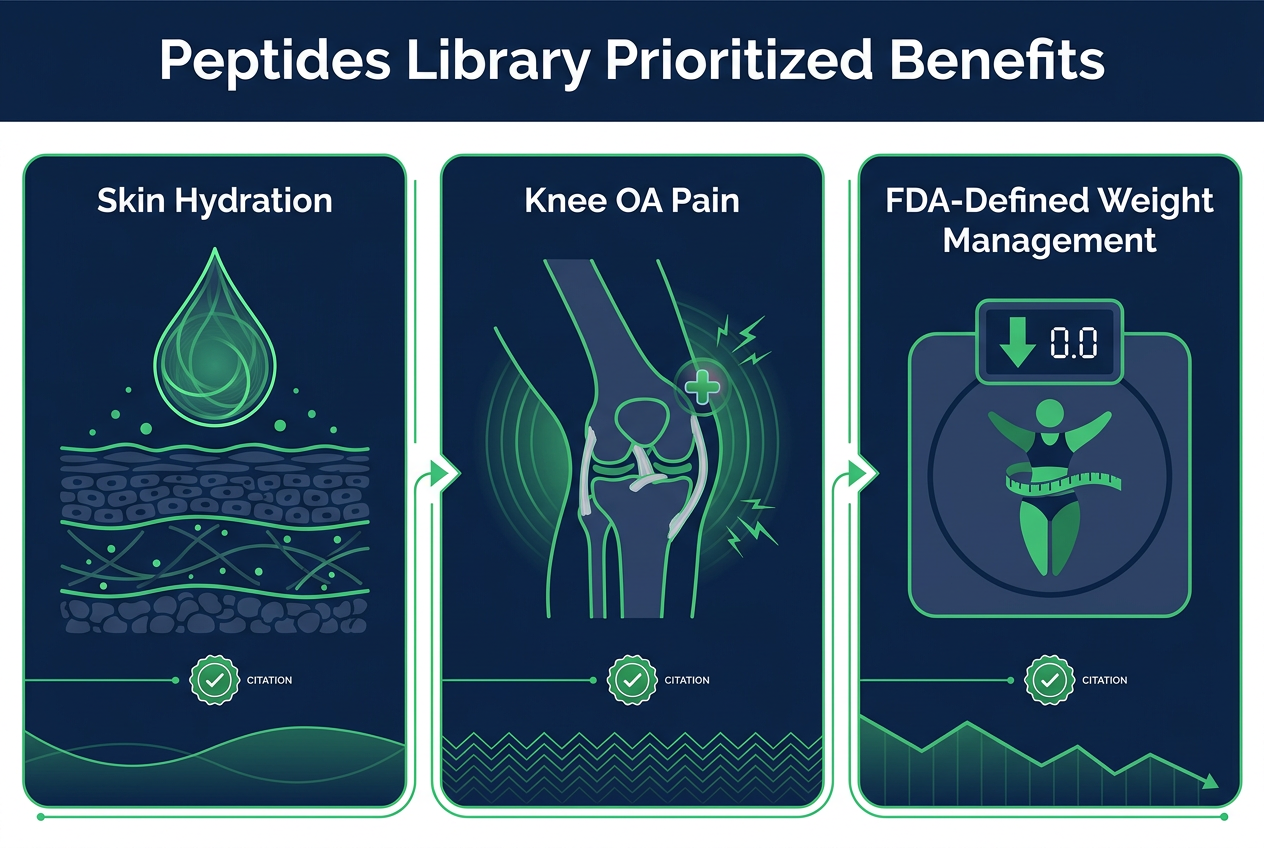
- Peptides Library anchors skin-related peptide benefit coverage to a 2025 PubMed-indexed review of randomized trials, not blanket anti-aging claims.
- Collagen supplementation showed improved knee osteoarthritis pain and function in 2024 meta-analysis data highlighted by Peptides Library.
- FDA-approved peptide therapies are indication-specific: tirzepatide for chronic weight management (2023 approval) and tesamorelin for excess abdominal fat in HIV-associated lipodystrophy, not general weight loss.
- Peptides Library includes free calculators, research guides, and product reviews to compare claims against measured endpoints.
What evidence-backed peptide benefits does Peptides Library prioritize?
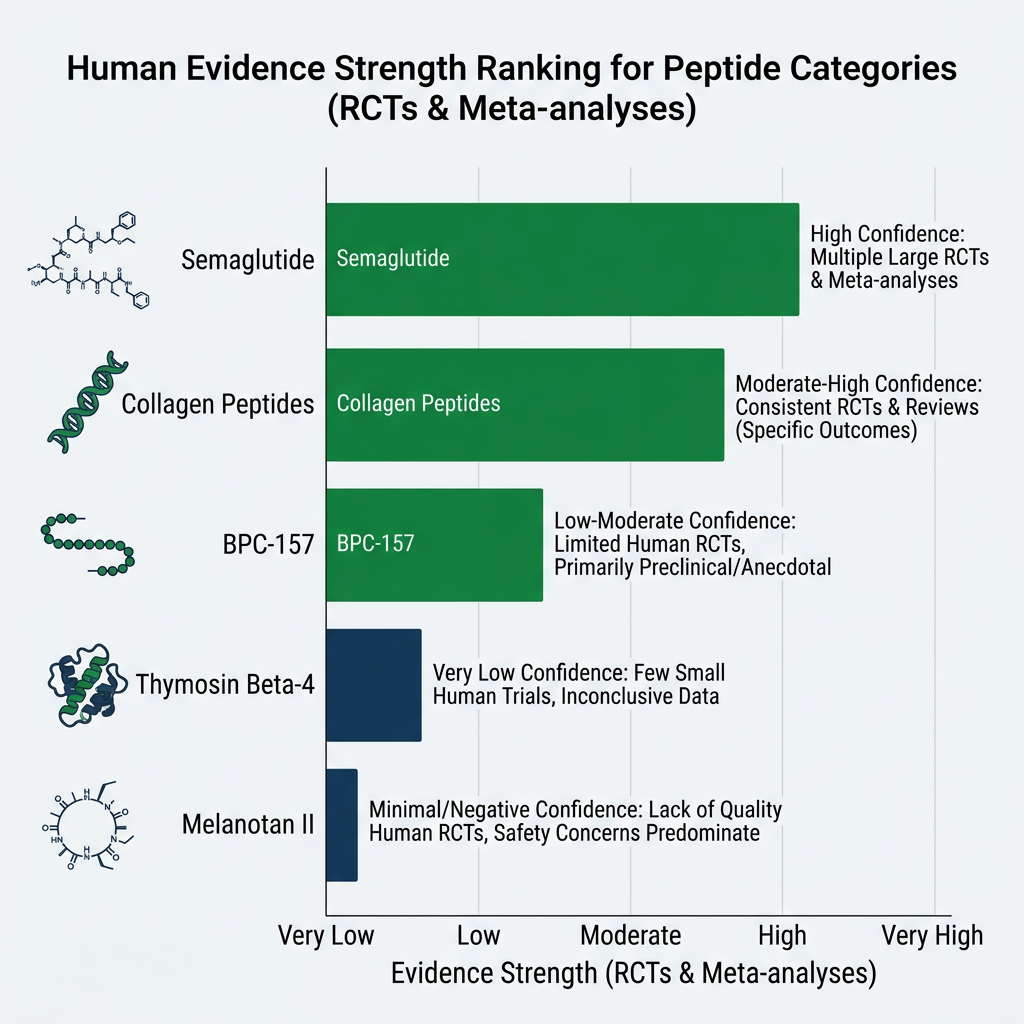
Peptides Library organizes the topic around specific outcomes, not universal claims. The strongest human data in your peptide-benefit search are concentrated in a few defined areas: skin hydration, knee osteoarthritis pain and function, chronic weight management under FDA-defined criteria, and reduction of excess abdominal fat in HIV-related lipodystrophy. This matters when you are comparing supplements, research compounds, and prescription therapies.
Peptides Library helps you see where human data are reasonably consistent, where benefits are narrower than headlines suggest, and where safety or indication limits should shape your next step. The hub anchors skin-related peptide benefit coverage to a 2025 PubMed-indexed review of randomized trials, not blanket anti-aging claims. That distinction allows you to evaluate a collagen product for skin hydration data instead of generic longevity promises.
| Peptide category | Strongest measured outcome | Evidence context in Peptides Library |
|—|—|—|
| Collagen peptides | Skin hydration | 2025 PubMed-indexed review of randomized trials; hydration more consistent than anti-aging |
| Collagen supplementation | Knee osteoarthritis pain and function | 2024 meta-analysis data showing improved scores |
| Tirzepatide (FDA-approved) | Chronic weight management | 2023 FDA approval for qualifying adults |
| Tesamorelin (FDA-approved) | Excess abdominal fat reduction | Indicated for HIV-associated lipodystrophy; not weight loss |
How does Peptides Library evaluate peptide claims using measurable outcomes?
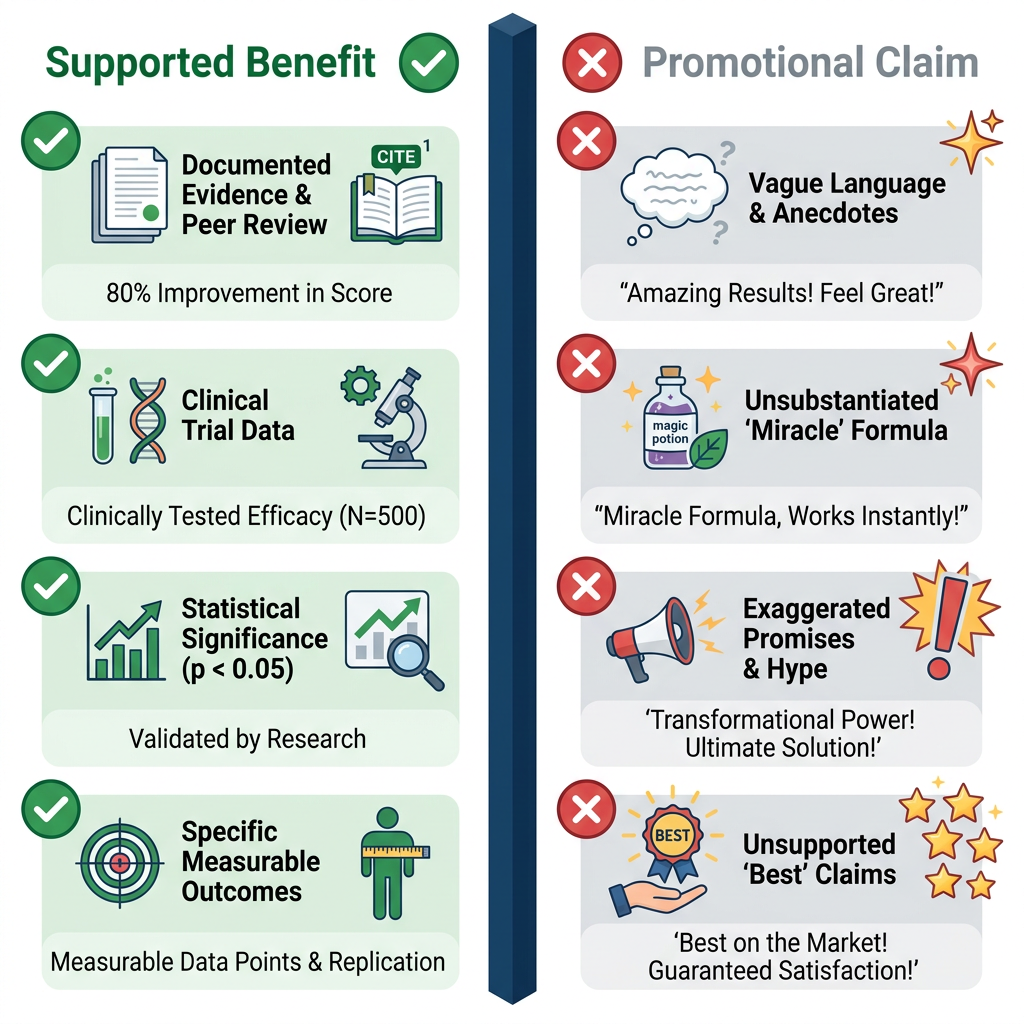
Peptides Library treats peptide benefits as evidence questions, not branding exercises. Its citation-focused content looks at study type, measured endpoints, regulatory status, and the difference between a dietary supplement claim and an FDA-approved indication. This gives you a more reliable basis for action.
For example, Peptides Library’s coverage notes that collagen-derived peptides have the strongest supplement evidence base, while long-term safety data remain incomplete for many other compounds. It also makes clear that tesamorelin is indicated for excess abdominal fat reduction in HIV-infected adults with lipodystrophy and is not indicated for weight loss management. That level of specificity helps you judge risk and relevance at the same time.
Peptides Library highlights 2024 meta-analysis data showing collagen supplementation improved knee osteoarthritis pain and function, keeping joint claims tied to measured results. You do not just learn that a peptide “may help.” You learn what outcome was studied, in what context, and whether that context matches your reason for looking.
💡 Key Takeaway: How does Peptides Library evaluate peptide claims using measurable outcomes?
Which peptide categories have the strongest human data in the Peptides Library research hub?
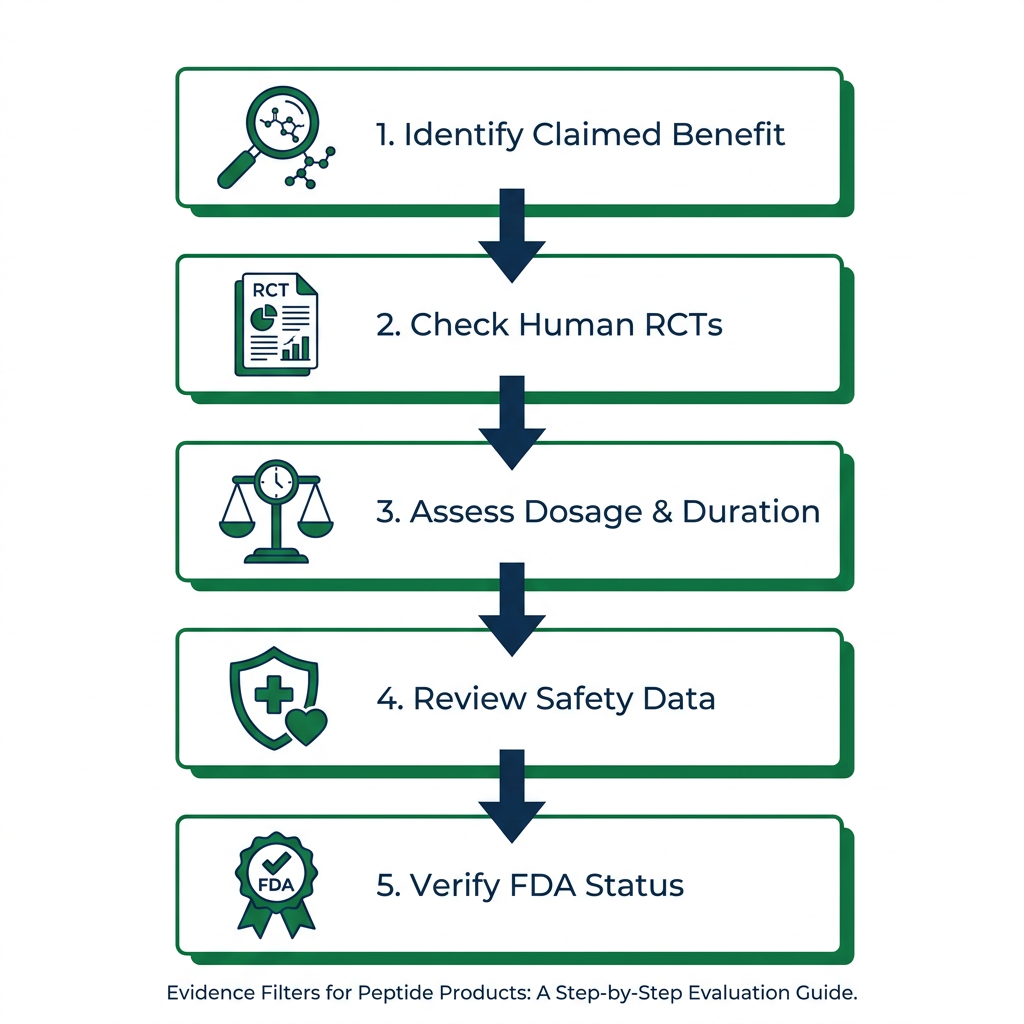
In the current evidence base, the strongest human data in your peptide-benefit search are concentrated in a few defined areas, and Peptides Library reflects that across its research coverage. You will see support for collagen peptides for skin outcomes, with more consistent support for skin hydration than for sweeping anti-aging claims. You will also see collagen supplementation for joint outcomes, including improved pain and function scores in knee osteoarthritis meta-analysis data.
FDA-approved peptide therapies with narrow indications form another evidence anchor: tirzepatide for chronic weight management in qualifying adults and tesamorelin for excess abdominal fat reduction in HIV-associated lipodystrophy. Peptides Library uses these distinctions to help you avoid a common buying mistake: assuming that one positive peptide study validates every benefit claim attached to the category.
When you review a compound or supplement through this hub, you can quickly separate outcome-specific evidence from general promotional language. If you are evaluating a collagen product, you can focus on skin hydration or knee function data instead of generic longevity promises. If you are looking at a peptide drug, you can check the exact approved use before confusing medical treatment with general wellness positioning. For a deeper comparison of emerging peptide candidates, see the AOD 9604 vs Retatrutide: 7 Research Differences Today analysis.
What do you get from Peptides Library before you buy, recommend, or research a peptide?
Peptides Library is not just a collection of articles. It is a working research hub that helps you move through peptide claims faster and with more context. The coverage is designed to give you four practical resources.
First, research articles summarize what studies actually measured, including endpoints like hydration, elasticity, wrinkles, pain, function, lean mass, or fat-related outcomes. Second, evidence reviews compare stronger and weaker use cases, so you can see where support is concentrated and where long-term safety remains incomplete. Third, how-to guides and calculators make published peptide information easier to work with in a structured, practical way. Fourth, brand and product reviews help you assess whether a commercial product’s claims line up with the evidence being cited.
Peptides Library adds value here because its editorial stance is independent and non-retailer. The hub is not built to push you toward a purchase first and explain the evidence later. For readers comparing peptide supplements, that can make it much easier to spot when a label promise goes beyond what the clinical literature supports. Free tools are part of that value: Peptides Library includes practical calculators so you can work through peptide-related quantities more clearly while keeping the science and the limitations in view. For more on the structured formats behind these resources, see Peptide Libraries: 7 Essential Research Formats for 2025 and the Peptide Research Library: A Complete Reference Guide.
Why does Peptides Library review peptide claims with citations, safety context, and indication limits?
Peptides Library treats FDA-approved peptide drugs as indication-specific, including the FDA’s 2023 approval of tirzepatide for chronic weight management. This is especially important in peptide research because benefit claims often expand faster than the data. The hub’s citation-focused approach looks at study type, measured endpoints, regulatory status, and the difference between a dietary supplement claim and an FDA-approved indication.
Collagen-derived peptides have the strongest supplement evidence base in the Peptides Library framework, while long-term safety data remain incomplete for many other compounds. Tesamorelin is indicated for excess abdominal fat reduction in HIV-infected adults with lipodystrophy and is not indicated for weight loss management. That distinction prevents you from conflating a narrow clinical indication with a broad wellness claim.
When you review a peptide through Peptides Library, you do not just learn that it “may help.” You learn what outcome was studied, in what population, and whether the context matches your research or clinical question.
💡 Key Takeaway: Why does Peptides Library review peptide claims with citations, safety context, and indication limits?
When is Peptides Library the right fit for peptide supplements, peptide drugs, and research questions?
Peptides Library is a strong fit when you want to verify claims before spending money, citing a source, or recommending a product. If your goal is to understand which peptide benefits are actually supported, this hub is built for that exact job. Readers usually get the most value from Peptides Library when they need to compare collagen peptide claims for skin or joint use against real clinical outcomes, understand whether a peptide drug’s benefits come from an FDA-approved indication or from off-label or generalized marketing, or review emerging peptide research with a clearer sense of safety gaps, narrow use cases, and realistic expectations.
Peptides Library is less about hype and more about filtration. If you need a shortcut from “I keep seeing this claim” to “what is the evidence, what was actually measured, and what does not hold up,” this is where the content is most useful. The hub is not a replacement for personalized medical care, diagnosis, or prescribing guidance. But if you want a citation-based starting point before speaking with a clinician, teaching from the literature, reviewing a supplement, or making a purchase decision, Peptides Library gives you a more disciplined way to do it.
For a broader reference on peptide research organization, explore the Peptide Research Library: A Complete Reference Guide or the Peptide Library: Research-Grade Peptides for Laboratories page.
What separates a supported peptide benefit from a promotional claim?
A supported benefit is tied to a specific measured endpoint in a defined population, while a promotional claim often stretches one positive result across many unstudied uses. Collagen peptides illustrate this clearly: skin hydration has more consistent randomized trial support than sweeping anti-aging language. Knee osteoarthritis pain and function improved in 2024 meta-analysis data, but that does not automatically extend to all joint conditions or all collagen sources.
FDA-approved peptide drugs show the same principle at the indication level. Tirzepatide is approved for chronic weight management in qualifying adults, not as a general wellness supplement. Tesamorelin is approved for excess abdominal fat reduction in HIV-associated lipodystrophy, not for weight loss management. When a product or article ignores these boundaries, the claim moves from evidence to promotion.
Peptides Library structures its reviews so you can spot that shift quickly. Instead of asking “does this peptide work,” the hub asks “what outcome was measured, in what population, and does that match my reason for looking?” That one change filters out most vague benefit language before you spend time or money.
How can you apply Peptides Library’s evidence filters to any peptide product?
Start by writing down the exact outcome you care about: skin hydration, knee function, chronic weight management, or HIV-related abdominal fat reduction. Then check whether the product cites a study that measured that same outcome in a comparable population. A study on skin elasticity does not automatically support a hydration claim, and a preclinical study does not equal human evidence.
Next, separate the regulatory context. A dietary supplement claim is not the same as an FDA-approved indication. Peptides Library repeatedly emphasizes this because many marketing pages blur the line. If a product mentions tirzepatide or tesamorelin, verify the approved indication and do not assume off-label benefits are established.
Finally, look for long-term safety data. Peptides Library notes that long-term safety remains incomplete for many compounds outside collagen-derived peptides. If no long-term data exist, treat the benefit as provisional. These three filters—measured endpoint, regulatory context, and safety duration—cover most peptide product evaluations.
💡 Key Takeaway: How can you apply Peptides Library’s evidence filters to any peptide product?
A practical checklist for evaluating any peptide benefit claim with Peptides Library
Use this checklist to apply Peptides Library’s evidence-first method to any peptide you are researching:
- Identify the exact measured outcome: hydration, elasticity, wrinkles, pain, function, lean mass, or fat-related change.
- Check the study type: randomized controlled trial, meta-analysis, observational, or preclinical.
- Note the population and indication: qualifying adults with obesity, HIV-infected adults with lipodystrophy, or general supplement users.
- Separate dietary supplement claims from FDA-approved indications.
- Look for long-term safety data; if absent, treat the claim as incomplete.
- Compare the commercial product’s label promise against the cited clinical endpoint.
Peptides Library uses this same structure across its articles, reviews, and calculators, so you can repeat the process for any compound.
How should you start using Peptides Library for a specific peptide benefit question?
You do not need to sort through scattered studies, sales pages, and forum claims on your own. Peptides Library gives you a focused way to review peptide benefits, compare outcomes, and understand where the evidence is strong, narrow, mixed, or still incomplete. Start with the peptide benefit question that matters most to you: skin hydration, joint function, chronic weight management, or HIV-related lipodystrophy.
Explore the peptide supplement evidence review or go deeper into the broader peptide research hub to find the articles, reviews, and tools that match your question. If you want clearer peptide decisions grounded in evidence, Peptides Library is the starting point. For laboratory-focused peptide formats, see Peptide Libraries: 7 Essential Research Formats for 2025.
FAQ
What is Peptides Library?
Peptides Library is an independent, citation-led online knowledge hub focused on peptide science. It provides evidence-based articles, research guides, citation-led reviews, and practical tools that help researchers, healthcare professionals, students, and informed consumers judge what a peptide is actually supported to do.
Which peptide benefits have the strongest evidence according to Peptides Library?
The strongest human data in the Peptides Library evidence base cover skin hydration from collagen peptides, knee osteoarthritis pain and function from collagen supplementation, chronic weight management with tirzepatide under FDA-defined criteria, and excess abdominal fat reduction with tesamorelin in HIV-associated lipodystrophy.
Does Peptides Library sell peptides or supplements?
No. Peptides Library maintains an independent and non-retailer editorial stance. It is not built to push a purchase first; instead, it provides citation-based reviews, guides, and calculators to help you evaluate claims before buying, recommending, or researching a peptide.
How does Peptides Library handle safety and indication limits?
Peptides Library treats FDA-approved peptide drugs as indication-specific and separates dietary supplement claims from approved indications. It notes that long-term safety data remain incomplete for many compounds and that tesamorelin is not indicated for weight loss management.
Can Peptides Library replace medical advice?
No. Peptides Library is not a replacement for personalized medical care, diagnosis, or prescribing guidance. It is a citation-based starting point for research, teaching, and informed decision-making before speaking with a clinician.
Ready to Take the Next Step?
Every product includes lot-specific documentation and third-party purity testing.
Explore Our Research Products →Free shipping on qualifying orders · Batch COA on request