



Peptides Library Skin Peptides Research Overview Hub
Peptides library skin peptides evidence hub: 19 RCTs, 1,341 participants, hydration & brightness signals, FDA claim limits, and 2020-2026 review data.
📋 Table of Contents
The peptides library skin peptides research overview answers the core question directly: which skin peptide outcomes have human trial support? Across 19 randomized controlled trials with 1,341 participants, the clearest evidence exists for hydration and brightness, while wrinkle reduction shows a modest pooled effect and elasticity and density results remain inconsistent. Peptides Library organizes this evidence alongside FDA cosmetic claim limits and product quality-control data so researchers, clinicians, students, and informed consumers can evaluate skin peptide claims without marketing bias.
Key takeaways
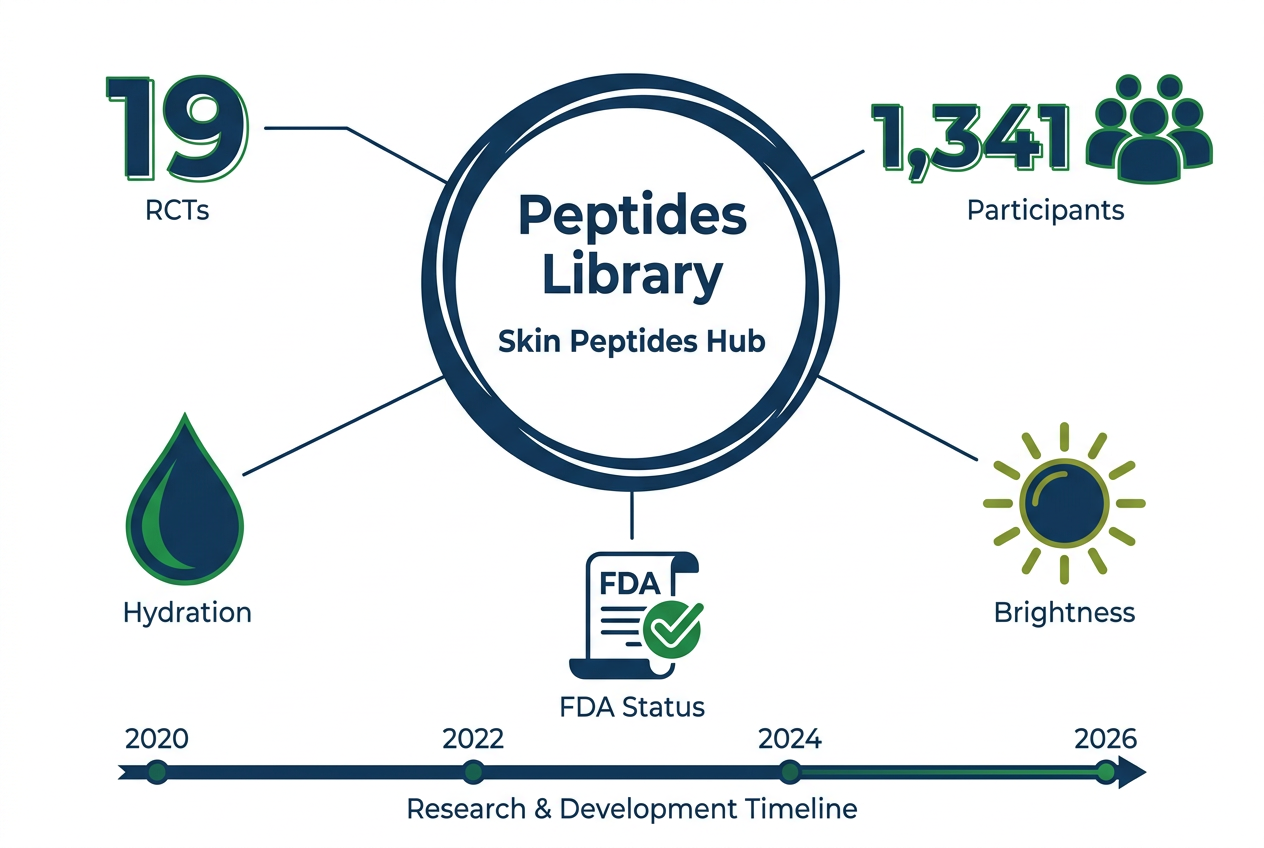
- The peptides library skin peptides evidence base rests on 19 randomized controlled trials with 1,341 participants, not on brand copy.
- Hydration and brightness show the clearest pooled signal; wrinkle reduction is modest; elasticity and density are inconsistent.
- FDA cosmetic claim rules allow structure/function language only when products are not marketed to treat disease, and quality-control data show label verification gaps.
- The 2020–2026 focused review covers 14 high-quality studies and named peptides including copper tripeptide-1, palmitoyl pentapeptide-4, and acetyl hexapeptide-8.
- Research-use evaluation means checking delivery, stability, concentration, and trial design before accepting any skin peptide claim.
What Does the Peptides Library Skin Peptides Research Overview Cover?
The peptides library skin peptides overview is an independent, non-retailer editorial knowledge hub. It brings together evidence reviews, research articles, practical guides, and brand or product reviews for researchers, healthcare professionals, students, and informed consumers. The hub focuses on the part that beauty marketing usually misses: what human trials support, where the evidence is weak or mixed, and how FDA claim rules and product testing can change the way you read a label.
Peptides Library does not flatten every skin peptide into the same promise. The published evidence does not support that shortcut. Instead, the hub organizes skin peptide content around the endpoints readers actually need to evaluate, including hydration, brightness, wrinkle reduction, elasticity, density, and tolerability.
This endpoint-first structure matters because different skin peptide claims carry different levels of confidence. A reader who cares about hydration can work from a clearer pooled signal than a reader who expects a structural change in skin density. The overview keeps that distinction visible instead of hiding it behind broad anti-aging language.
How Does the Peptides Library Skin Peptides Hub Evaluate Human Trial Outcomes?
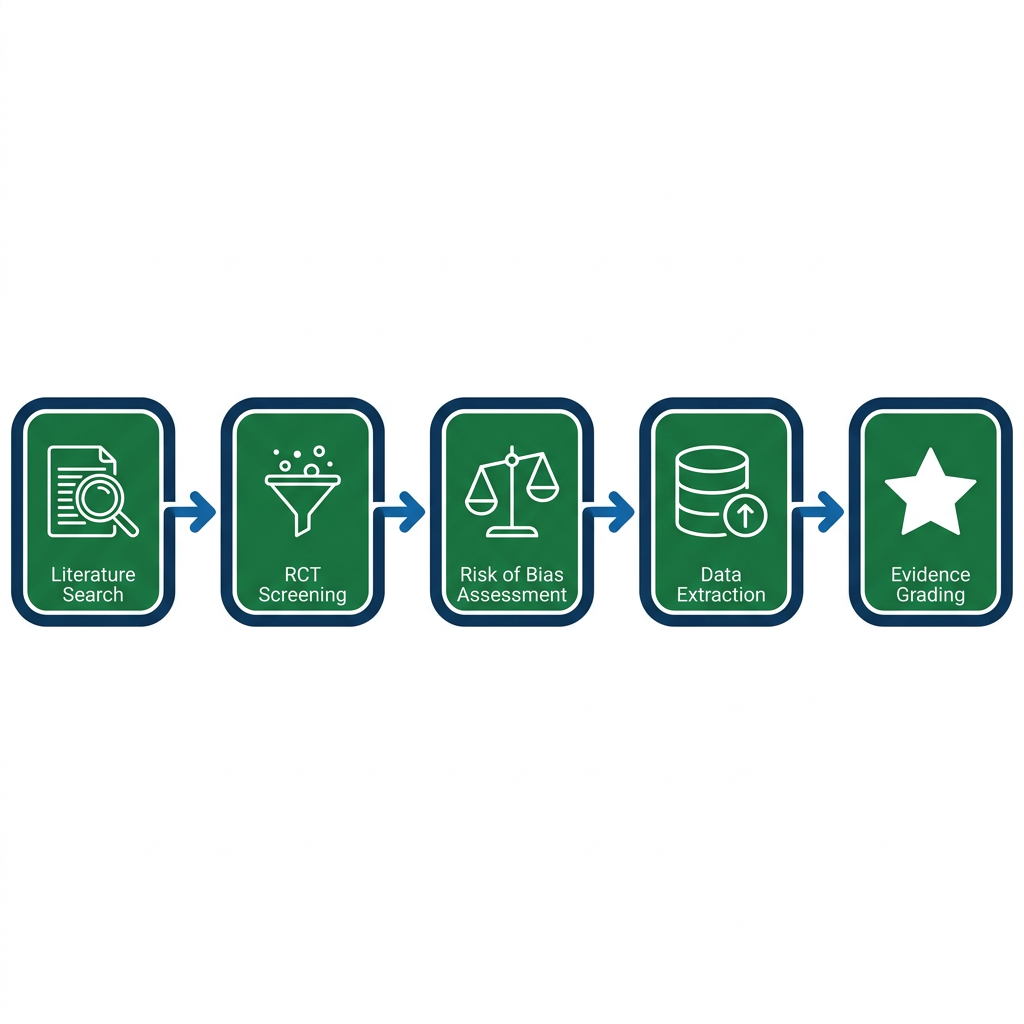
The peptides library skin peptides evaluation method starts with the strongest available human evidence. A 2026 systematic review and meta-analysis evaluated 19 randomized controlled trials with 1,341 participants. The analysis found the clearest signal for hydration and brightness, a modest pooled wrinkle-reduction effect, inconsistent elasticity and density results, and minimal adverse events across trials.
That meta-analysis matters because it frames skin peptide decisions around trial data rather than marketing copy. Researchers and clinicians who use the peptides library skin peptides hub can compare trial designs, endpoints, and peptide-specific findings without starting every literature search from zero.
You can verify this evidence base through public trial registries and peer-reviewed databases. See PubMed skin peptide randomized controlled trials for indexed human studies.
What should you check in a randomized controlled trial before trusting a skin peptide result?
Look for randomization, blinding, a control group, a defined endpoint, and a sample size large enough to detect a meaningful difference. The 2026 meta-analysis included 19 randomized controlled trials, which is a stronger foundation than a single open-label or brand-sponsored study. The hub encourages readers to ask whether the trial was registered, whether the outcome was measured objectively, and whether adverse events were reported.
A trial that reports only subjective satisfaction without objective hydration or wrinkle measurements carries less weight. A trial that reports both subjective and objective endpoints gives a more complete picture. The peptides library skin peptides framework treats trial quality as part of the evidence, not as a separate technical footnote.
💡 Key Takeaway: How Does the Peptides Library Skin Peptides Hub Evaluate Human Trial Outcomes?
Which Skin Peptide Endpoints Have the Strongest Evidence in the Peptides Library Skin Peptides Hub?
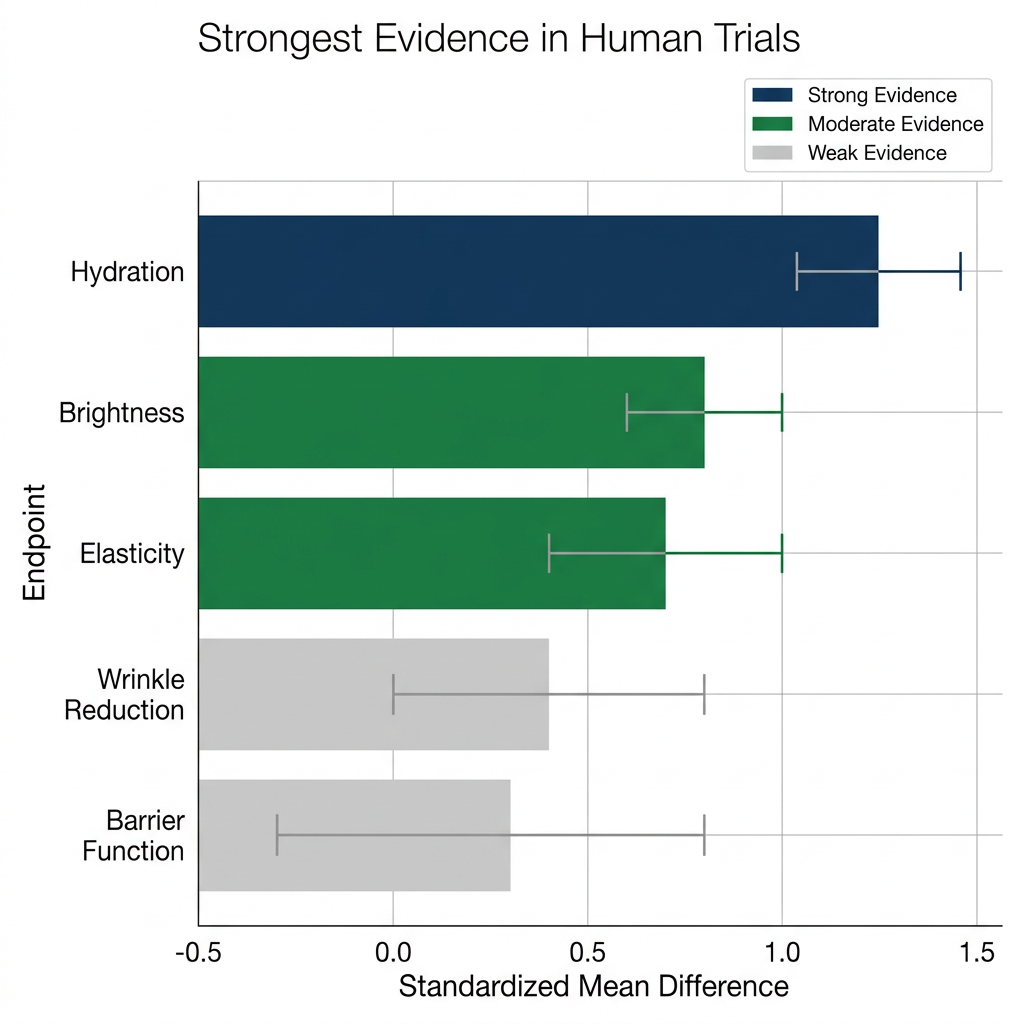
The peptides library skin peptides endpoint ranking follows the 2026 meta-analysis. Hydration and brightness carry the clearest pooled signal. Wrinkle reduction shows a modest effect. Elasticity and density results are less consistent, and adverse events remain minimal across the 19 randomized controlled trials.
This endpoint hierarchy matters for informed evaluation. A product that promises hydration and brightness can lean on stronger pooled evidence than a product that promises dramatic structural skin changes. The table below summarizes the evidence strength for each endpoint in the peptides library skin peptides framework.
| Endpoint | Pooled Evidence Strength | Practical Interpretation |
|—|—|—|
| Hydration | Clear signal | Most consistently supported across trials |
| Brightness | Clear signal | Stronger than wrinkle outcomes |
| Wrinkle reduction | Modest pooled effect | Real but smaller than often marketed |
| Elasticity | Inconsistent | Needs more high-quality replication |
| Density | Inconsistent | Weak or mixed findings |
| Tolerability | Minimal adverse events | Generally well tolerated in trials |
Why does endpoint specificity matter for skin peptide research?
Endpoint specificity prevents overgeneralization. A peptide that improves hydration may not improve elasticity, and a peptide that improves brightness may not reduce wrinkles. The hub separates these outcomes so readers do not assume that one positive result transfers to every skin concern.
For researchers, this means comparing effect sizes within the same endpoint rather than mixing hydration and wrinkle data. For consumers and clinicians, it means asking which exact outcome a product claims and whether human trial data support that specific outcome.
What Does FDA Cosmetic Claim Guidance Mean for Peptides Library Skin Peptides Reviews?
The peptides library skin peptides regulatory layer covers FDA cosmetic labeling claims guidance. FDA states that cosmetics do not require premarket approval for labeling claims. Products marketed to treat disease or affect the structure or function of the body can be treated as drugs.
For readers, this means a peptide skincare product can sound highly technical without having passed a premarket efficacy review. The peptides library skin peptides hub translates those claim boundaries into plain language and keeps the FDA standard in view that cosmetic claims must be truthful and not misleading.
See FDA cosmetics labeling claims for the agency’s guidance on cosmetic versus drug claims.
How can you spot a structure/function claim that crosses into drug territory?
Look for language that promises to treat a disease, restore skin structure, or alter a bodily function in a way that goes beyond cosmetic appearance. Phrases like “stimulates collagen production to reverse wrinkles” may imply a structure/function effect. The hub encourages readers to compare such language against FDA’s cosmetic versus drug definitions.
A cosmetic claim can describe appearance benefits, but it cannot claim to treat a skin disease or produce a physiological change that would classify the product as a drug. The peptides library skin peptides regulatory context helps readers separate acceptable cosmetic language from language that may trigger drug classification.
How Do Product Quality-Control Findings Affect Peptides Library Skin Peptides Evaluations?
Quality control is a core part of the peptides library skin peptides evaluation process. In FDA reporting on 77 cosmetic products, 54.5% contained at least one of six targeted anti-aging peptides. Only 33% of products claiming acetyl hexapeptide-8 had detectable levels.
That gap means label claims and actual peptide content can diverge. The peptides library skin peptides hub treats ingredient verification and claim discipline as part of the skin peptide evaluation process, not as an afterthought.
What does the acetyl hexapeptide-8 detection gap mean for label reading?
If only 33% of products claiming acetyl hexapeptide-8 had detectable levels, then a label claim does not guarantee the ingredient is present in measurable amounts. Readers should ask whether a product provides independent verification, batch testing, or a certificate of analysis. The hub highlights this gap because label trust without verification can lead to overconfidence.
For research-use evaluation, this means treating product labels as claims to be checked, not as proof of composition. The same principle applies to other named peptides when quality-control data are absent.
💡 Key Takeaway: How Do Product Quality-Control Findings Affect Peptides Library Skin Peptides Evaluations?
Which Named Peptides Does the Peptides Library Skin Peptides Review Target?
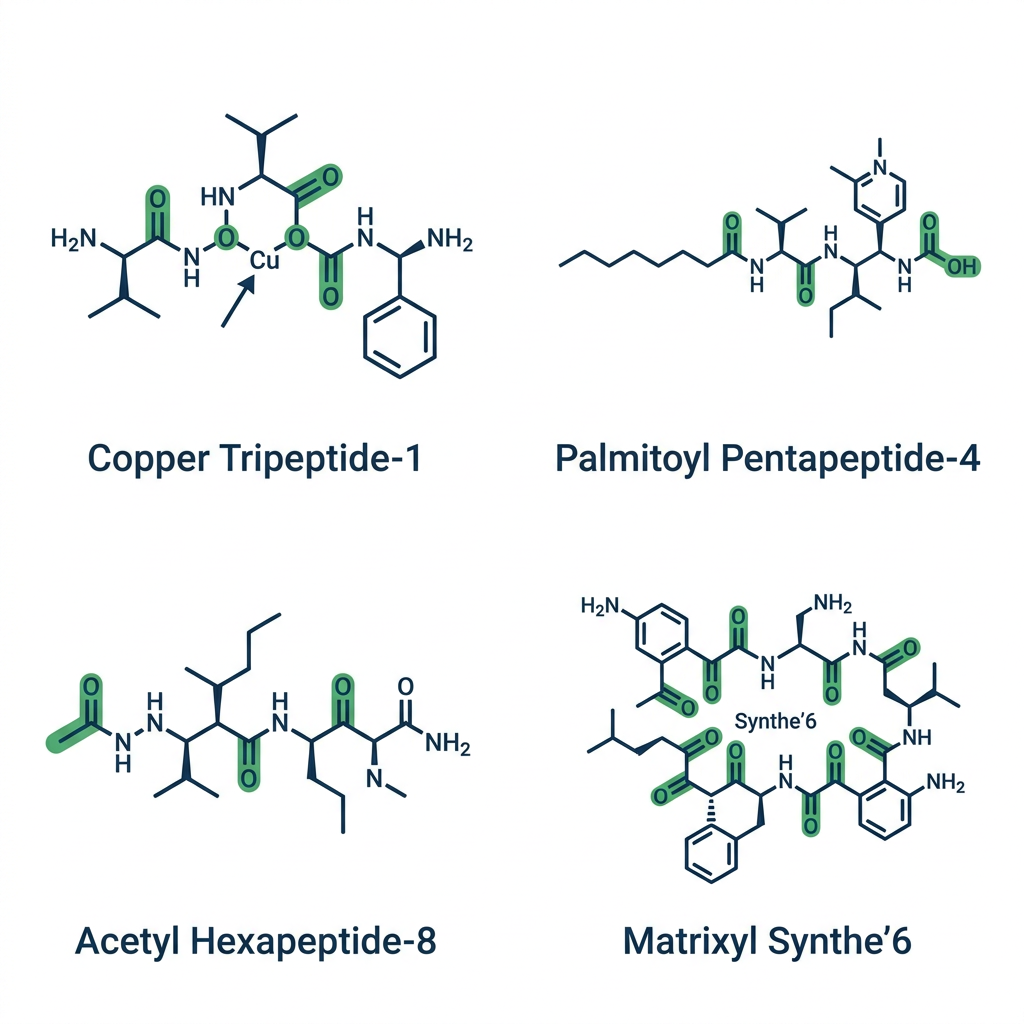
The peptides library skin peptides focused review covers 2020 to 2026 and targeted 14 high-quality studies. It examined named peptides including copper tripeptide-1, palmitoyl pentapeptide-4, and acetyl hexapeptide-8 for wrinkles, elasticity, hydration, and safety.
That specificity helps when two products use similar language but may not deserve the same level of confidence. For background on peptide research formats, see Peptide Libraries: 7 Essential Research Formats for 2025 and Peptide Research Library: A Complete Reference Guide.
Why do named peptides matter more than generic peptide claims?
Generic peptide claims can hide the fact that different peptides have different structures, sizes, and evidence profiles. Copper tripeptide-1, palmitoyl pentapeptide-4, and acetyl hexapeptide-8 are distinct compounds. The focused review examines them by name so readers can match a product’s ingredient list to the specific evidence for that peptide.
A product that lists a named peptide should be evaluated against studies that tested that peptide, not against studies that tested a different peptide. The hub’s named-peptide approach prevents this common evidence mismatch.
What Formulation Limits Should Researchers Consider in Peptides Library Skin Peptides Analysis?
Formulation realities shape every peptides library skin peptides interpretation. Published review data show that peptide size and structure influence whether a compound can cross the stratum corneum. Enzymatic degradation and poor membrane permeability can reduce topical efficacy before a peptide reaches its target site.
The peptides library skin peptides hub uses those formulation realities to interpret skincare claims with more discipline. If a product promises dramatic structural skin effects, readers should ask about delivery, stability, concentration, and whether the supporting evidence comes from randomized controlled trials, brand-sponsored material, or no accessible evidence at all.
For more on peptide delivery and research-grade formats, see Cell Penetrating Peptides for Research | Peptides Library and Peptide Library: Research-Grade Peptides for Laboratories.
How do stratum corneum penetration and enzymatic degradation affect topical peptide research?
The stratum corneum is the outermost skin layer and a primary barrier to topical delivery. Large or hydrophilic peptides may not cross it efficiently. Enzymatic degradation in the skin can break down peptides before they reach deeper layers. Poor membrane permeability further limits bioavailability.
These factors mean that in vitro activity does not always translate to in vivo effect. The hub encourages readers to check whether a product or study addresses delivery, stability, and penetration, rather than assuming that a peptide listed on a label will automatically reach its target.
Who Should Use the Peptides Library Skin Peptides Research Hub?
The peptides library skin peptides hub is built for three audiences. Researchers and students compare trial designs, endpoints, and peptide-specific findings without starting every literature search from zero. Healthcare professionals review human outcome data and U.S. cosmetic-claim limits before discussing peptide skincare in a professional setting. Informed consumers understand which anti-aging or skin-improvement claims are supported, which are overstated, and what label issues may affect product credibility.
Because Peptides Library is an independent, non-retailer editorial resource, the peptides library skin peptides pages are written to inform judgment rather than push a purchase. That gives readers a cleaner way to separate evidence review from promotion when comparing ingredients, brands, or anti-aging claims.
How does the hub help healthcare professionals in a clinical or advisory setting?
Healthcare professionals can use the human outcome data and FDA claim boundaries to answer patient or client questions without overstating efficacy. The hub provides a citation-focused starting point for discussing hydration, brightness, wrinkle reduction, and tolerability. It also flags quality-control gaps that may affect product credibility.
This professional use case does not replace clinical judgment or regulatory advice. It gives a structured way to review the evidence before making any skincare recommendation.
💡 Key Takeaway: Who Should Use the Peptides Library Skin Peptides Research Hub?
Why Is the Peptides Library Skin Peptides Hub Structured for Evidence-Based Decisions?
The peptides library skin peptides structure includes three content types: evidence reviews, how-to guides, and brand or product reviews. Evidence reviews provide outcome-based summaries covering hydration, brightness, wrinkle reduction, elasticity, and safety. How-to guides offer practical help for reading ingredient lists, understanding claim language, and interpreting study quality. Brand and product reviews provide independent commentary that considers labeling, transparency, and quality-control concerns.
This structure saves time and reduces avoidable confusion. Instead of piecing together efficacy signals from one source, FDA claim limits from another, and label skepticism from scattered forums, readers can use the peptides library skin peptides hub as a single evidence-focused starting point.
For related research comparisons, see Peptides Library Hexarelin Side Effects Research Hub and AOD 9604 vs Retatrutide: 7 Research Differences Today.
What makes an evidence review different from a product promotion?
An evidence review starts with published human trial data and reports what the trials found, including limitations. A product promotion starts with the desired claim and works backward. The hub’s evidence reviews separate these two approaches by citing trial counts, participant numbers, endpoint results, and adverse event data.
This distinction is especially important for skin peptides because beauty marketing often mixes mechanism language with outcome language. The hub keeps the two apart so readers can see what is supported and what is still speculative.
How Can Researchers Start with the Peptides Library Skin Peptides Overview?
Start with the peptides library skin peptides evidence-based coverage and follow the cited research, regulatory context, and product-review criteria from there. Explore the skin peptide research overview, compare the named peptides and outcomes, and use the hub to make your next research, professional, or skincare decision with more confidence.
A practical checklist for peptides library skin peptides evaluation includes five steps. First, identify the endpoint you care about. Second, check whether human randomized controlled trials support that endpoint. Third, review FDA claim boundaries for the product language. Fourth, look for quality-control or ingredient-verification data. Fifth, compare named peptides and formulation limits rather than relying on generic peptide claims.
What should a researcher do after reading the overview?
Follow the cited primary sources. The overview points to the 2026 meta-analysis, the 2020–2026 focused review, and FDA reporting on cosmetic product testing. A researcher can then evaluate the original studies for effect sizes, confidence intervals, and risk of bias.
The hub is designed as a starting point, not a replacement for primary literature. Its value is in shortening the path from question to usable answer while keeping the scientific thread visible.
How Should You Read a Skin Peptide Ingredient List?
Reading a skin peptide ingredient list requires more than spotting the word “peptide.” Check whether a named peptide appears, whether its concentration is disclosed, and whether the product provides any quality-control verification. The hub’s how-to guides walk through these steps in plain language.
An ingredient list that says only “peptides” or “peptide complex” without naming the specific peptide gives little basis for evidence comparison. A list that names acetyl hexapeptide-8, copper tripeptide-1, or palmitoyl pentapeptide-4 allows you to match the ingredient to the focused review data.
Concentration matters because a peptide present at trace levels may not produce the same effect as one tested at a studied concentration. If the product does not disclose concentration, the reader cannot confirm whether the label matches the trial conditions.
💡 Key Takeaway: How Should You Read a Skin Peptide Ingredient List?
What Are Common Misreadings in Peptide Skincare Claims?
One common misreading is treating all skin peptides as interchangeable. The evidence does not support that shortcut. Another is assuming that a structure/function mechanism automatically produces a visible cosmetic outcome. A third is trusting a label without checking for quality-control data.
The hub addresses these misreadings by separating endpoint evidence, regulatory context, and product verification. A claim like “peptides boost collagen” may imply a structural effect that crosses into drug territory. A claim like “clinically shown to hydrate” should be checked against the actual trial endpoint and sample size.
What Should Researchers Look for in a Skin Peptide Trial Design?
Researchers should look for randomization, blinding, a control group, predefined endpoints, and adequate sample size. The 19 randomized controlled trials in the 2026 meta-analysis provide a pooled foundation, but individual trials vary in quality. The hub encourages readers to check whether objective measurements were used and whether adverse events were systematically reported.
A trial that measures hydration with a corneometer gives more objective data than a trial that only asks participants to rate their skin feel. A trial that reports dropout rates and adverse events is more transparent than one that reports only positive outcomes.
How Does the Peptides Library Skin Peptides Hub Compare to Retailer Content?
Retailer content often exists to sell a product, so it may emphasize benefits and downplay weak or mixed evidence. The peptides library skin peptides hub exists to inform evaluation, so it reports both supported and unsupported outcomes. This difference matters when you need a citation-focused view of skin peptide research.
The hub does not sell skincare products. It does not accept payment to alter evidence summaries. That independence allows readers to use the hub as a neutral reference point when comparing brands, ingredients, or anti-aging claims.
💡 Key Takeaway: How Does the Peptides Library Skin Peptides Hub Compare to Retailer Content?
What Is the Research-Use-Only Framing in the Peptides Library Skin Peptides Hub?
All peptides library skin peptides content is research-use-only. The hub does not provide dosing guidance, medical advice, or human consumption recommendations. Its purpose is to summarize evidence, explain regulatory boundaries, and highlight quality-control concerns for research and educational use.
This framing keeps the hub aligned with its editorial mission. Readers who need clinical advice should consult a qualified professional. Readers who need product use instructions should review the product label and applicable regulations. The hub focuses on evidence evaluation, not product endorsement.
FAQ
Does the peptides library skin peptides hub sell skincare products?
No. The peptides library skin peptides hub is an independent, non-retailer editorial resource. It is built to inform research, professional, and consumer judgment rather than push a purchase.
Which skin peptide outcome has the strongest human evidence in the peptides library skin peptides overview?
Hydration and brightness have the clearest pooled signal across 19 randomized controlled trials with 1,341 participants. Wrinkle reduction shows a modest effect, while elasticity and density results are inconsistent.
How many studies does the peptides library skin peptides focused review cover?
The focused review covers 2020 to 2026 and targeted 14 high-quality studies. It examined copper tripeptide-1, palmitoyl pentapeptide-4, and acetyl hexapeptide-8 for wrinkles, elasticity, hydration, and safety.
What quality-control gap does the peptides library skin peptides hub highlight?
FDA reporting on 77 cosmetic products found that 54.5% contained at least one of six targeted anti-aging peptides, but only 33% of products claiming acetyl hexapeptide-8 had detectable levels. The hub treats ingredient verification as part of skin peptide evaluation.
Can I use the peptides library skin peptides content to make product dosing decisions?
No. The peptides library skin peptides hub is a research-use-only editorial resource. It does not provide dosing guidance, medical advice, or human consumption recommendations. All content is intended for evidence evaluation and regulatory awareness.
Ready to Take the Next Step?
Every product includes lot-specific documentation and third-party purity testing.
Explore Our Research Products →Free shipping on qualifying orders · Batch COA on request