



AOD 9604 vs Semaglutide: 7 Research Differences Today
Compare aod 9604 vs semaglutide across 7 proven research differences: mechanisms, trial size, dosing, safety, and FDA status for laboratory research only.
📋 Table of Contents
aod 9604 and semaglutide occupy different evidence tiers in obesity-related research. Semaglutide has an FDA-labeled obesity indication and pivotal 68-week trial data in 1,961 adults, while aod 9604 remains a research peptide with smaller, older human studies and no comparable current obesity indication. The core question is not whether both have been studied, but whether their mechanisms, human data, and regulatory status support the same clinical conclusions.
Key takeaways
- Semaglutide has the stronger clinical and regulatory profile for obesity, while aod 9604 remains a research peptide with limited human efficacy evidence.
- The STEP 1 trial randomized 1,961 adults for 68 weeks, making semaglutide’s obesity evidence much larger and longer than the aod 9604 human studies identified here.
- aod 9604 is a synthetic analogue of the lipolytic domain of human growth hormone and has animal and human research history, but it does not have the same current obesity-treatment label or comparable late-stage evidence.
- If your goal is to compare research strength, focus on mechanism, trial size, duration, dosing, safety labeling, and FDA status before treating these compounds as equivalents.
What is aod 9604 and how does its mechanism compare to semaglutide?
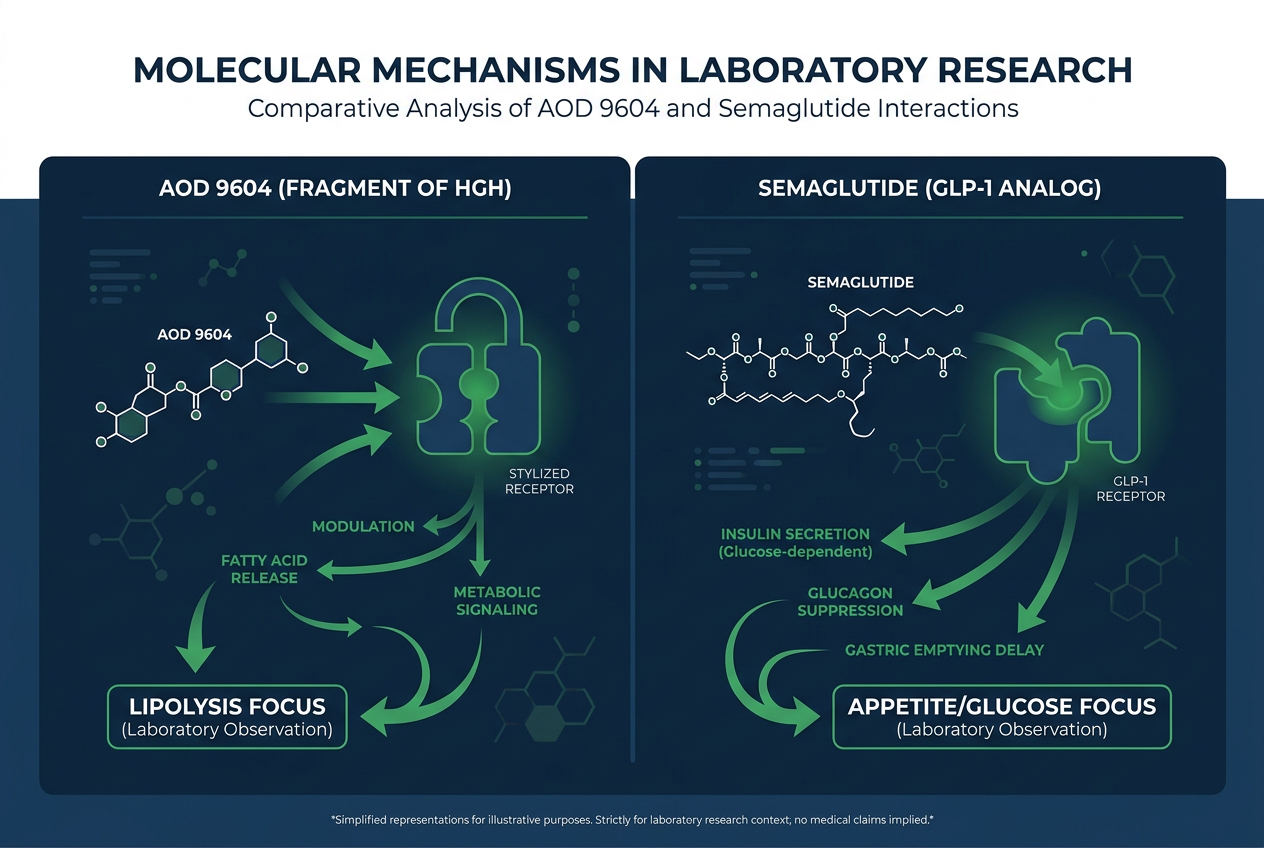
aod 9604 is a synthetic analogue of the lipolytic domain of human growth hormone. Semaglutide is a GLP-1 receptor agonist. These are different biological pathways, so their research implications are not interchangeable.
The cited 2001 PubMed paper describes aod 9604 as derived from the fat-metabolism-related region of human growth hormone rather than as intact growth hormone itself. In obese Zucker rats, oral aod 9604 reduced body-weight gain and did not show the same adverse effect on insulin sensitivity seen with chronic treatment using intact human growth hormone.
Semaglutide belongs to the incretin class. GLP-1 receptor agonists are used to influence appetite regulation, energy intake, gastric emptying, and glycemic physiology. That class identity matters because it gives semaglutide a known pharmacologic family, a defined obesity label under Wegovy, and an established dosing framework.
By contrast, aod 9604 is usually discussed in a narrower peptide-research context. That does not mean aod 9604 and semaglutide are “two ways to do the same thing.” If two agents act on different pathways, then their trial designs, endpoints, safety expectations, and clinical translation can diverge sharply.

How does the clinical evidence for aod 9604 compare to semaglutide?
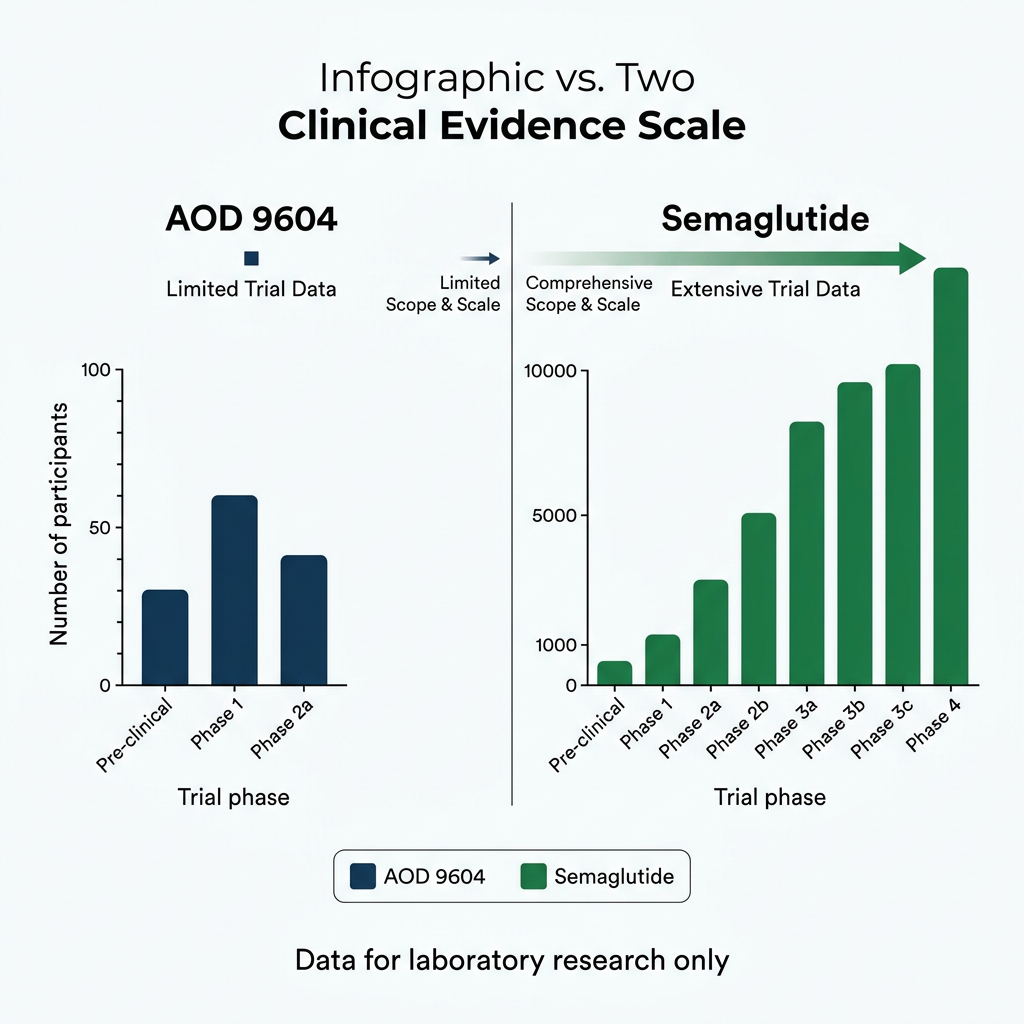
Semaglutide has the stronger obesity evidence today. The decisive reference points are the FDA Wegovy label and the STEP 1 trial, while aod 9604 remains a research peptide with smaller, older human studies and no comparable current obesity indication.
The highest-yield comparison starts with study scale and regulatory outcome. In STEP 1, published in PubMed in 2021, 1,961 adults with BMI at or above 30 kg/m², or at or above 27 kg/m² with at least one weight-related comorbidity, were randomized 2:1 to once-weekly subcutaneous semaglutide 2.4 mg or placebo plus lifestyle intervention for 68 weeks. That is the kind of pivotal obesity dataset that changes clinical practice.
aod 9604 has a very different evidence story. The background sources here identify phase IIb placebo-controlled human studies lasting 12 weeks in 300 clinically obese participants and 24 weeks in 502 obese adults, plus earlier animal work. That is meaningful research history, but it is not the same as a current FDA-approved obesity drug supported by a much larger and longer pivotal program.
A common mistake is to read “studied in humans” as “proven to the same clinical standard.” In obesity medicine, trial duration, patient count, labeled indication, and safety language matter as much as the fact that a compound was researched at all.
💡 Key Takeaway: How does the clinical evidence for aod 9604 compare to semaglutide?
What are the 7 research differences between aod 9604 and semaglutide?
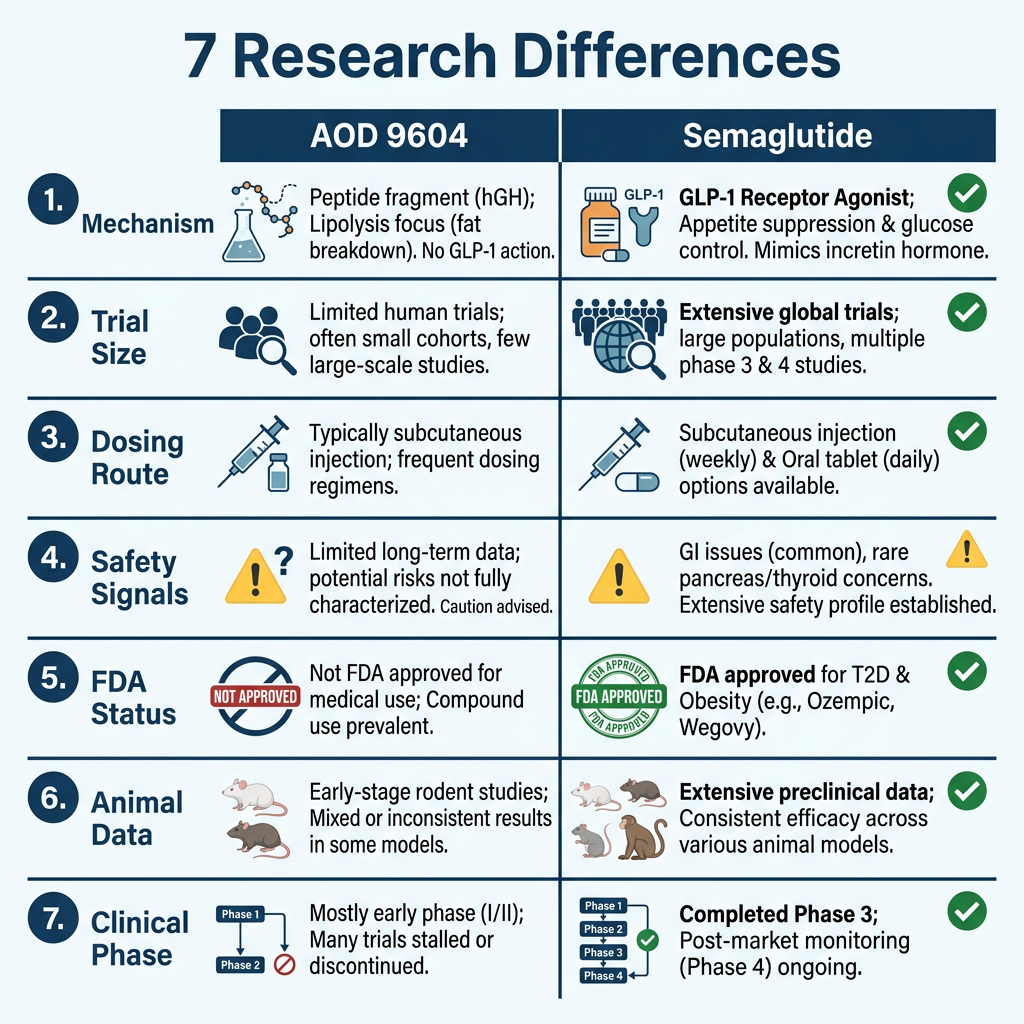
The core differences are mechanism, regulatory status, evidence depth, dosing, safety labeling, indication, and translational strength. If you compare those seven points directly, semaglutide clearly sits in the stronger obesity-treatment category today.
| Research factor | aod 9604 | Semaglutide |
|—|—|—|
| Mechanism | Synthetic analogue of the lipolytic domain of human growth hormone | GLP-1 receptor agonist |
| Regulatory status | No current FDA obesity-drug status in this comparison set | FDA-approved obesity indication under Wegovy |
| Trial scale | Phase IIb studies: 300 and 502 participants | STEP 1: 1,961 adults |
| Trial duration | 12 and 24 weeks | 68 weeks |
| Dosing pattern | Daily oral administration in cited studies | 2.4 mg once weekly subcutaneous injection |
| Safety labeling | No equivalent obesity-drug label structure in this source set | Formal label warnings, including rodent thyroid C-cell tumor findings and contraindications for medullary thyroid carcinoma and MEN 2 |
| Evidence translation | Supportive animal-history signals, including obese Zucker rat data | Stronger large-scale human obesity evidence |
After looking at the source set, the separation becomes straightforward. A useful rule is simple: if one option has large, modern randomized obesity trials plus formal labeling and the other relies on smaller earlier human studies and animal data, they should not be treated as peers.

Why does regulatory status separate aod 9604 from semaglutide?
Regulatory status tells you how far the evidence has traveled from research into accepted clinical use. Semaglutide has a current FDA obesity indication; aod 9604, in this evidence set, does not.
The FDA Wegovy prescribing information identifies semaglutide as a GLP-1 receptor agonist indicated for chronic weight management in adults with obesity, in pediatric patients aged 12 years and older with obesity, and in adults with overweight plus at least one weight-related comorbid condition. That statement alone places semaglutide inside a defined clinical category.
By contrast, aod 9604 is better viewed as a research peptide with historical animal and human investigation. That is not a trivial distinction. If a compound lacks the same regulatory framing, then claims about expected obesity outcomes need more caution.
Peptides Library treats semaglutide and aod 9604 as different evidence classes, not interchangeable weight-loss options. For researchers, the regulatory gap means aod 9604 should not be described with the same clinical certainty as semaglutide.
How should researchers evaluate aod 9604 study quality step by step?
Start with scale, then duration, then endpoint relevance. Those three checks usually separate early-stage peptide research from clinically actionable obesity evidence.
Step 1 is participant count and population definition. A trial with 1,961 adults and clear BMI-based entry criteria tells you much more about external validity than a smaller study with a shorter observation window. This is why STEP 1 matters so much in the semaglutide discussion.
Step 2 is duration. Weight-loss research can look promising over 12 weeks and look very different over 68 weeks. If the question is chronic weight management, then long follow-up matters because obesity treatment is rarely a short-cycle problem.
Step 3 is whether the evidence sits inside a regulatory framework. A phase IIb randomized double-blind placebo-controlled study can be valuable, but if it does not translate into a current labeled obesity indication, you should rank it below a drug that did.
For aod 9604 specifically, researchers should ask whether the identified 12-week and 24-week phase IIb studies are sufficient to support strong conclusions. The answer is usually no when compared with the STEP 1 dataset.
💡 Key Takeaway: How should researchers evaluate aod 9604 study quality step by step?
What role does dosing and administration play in aod 9604 research?
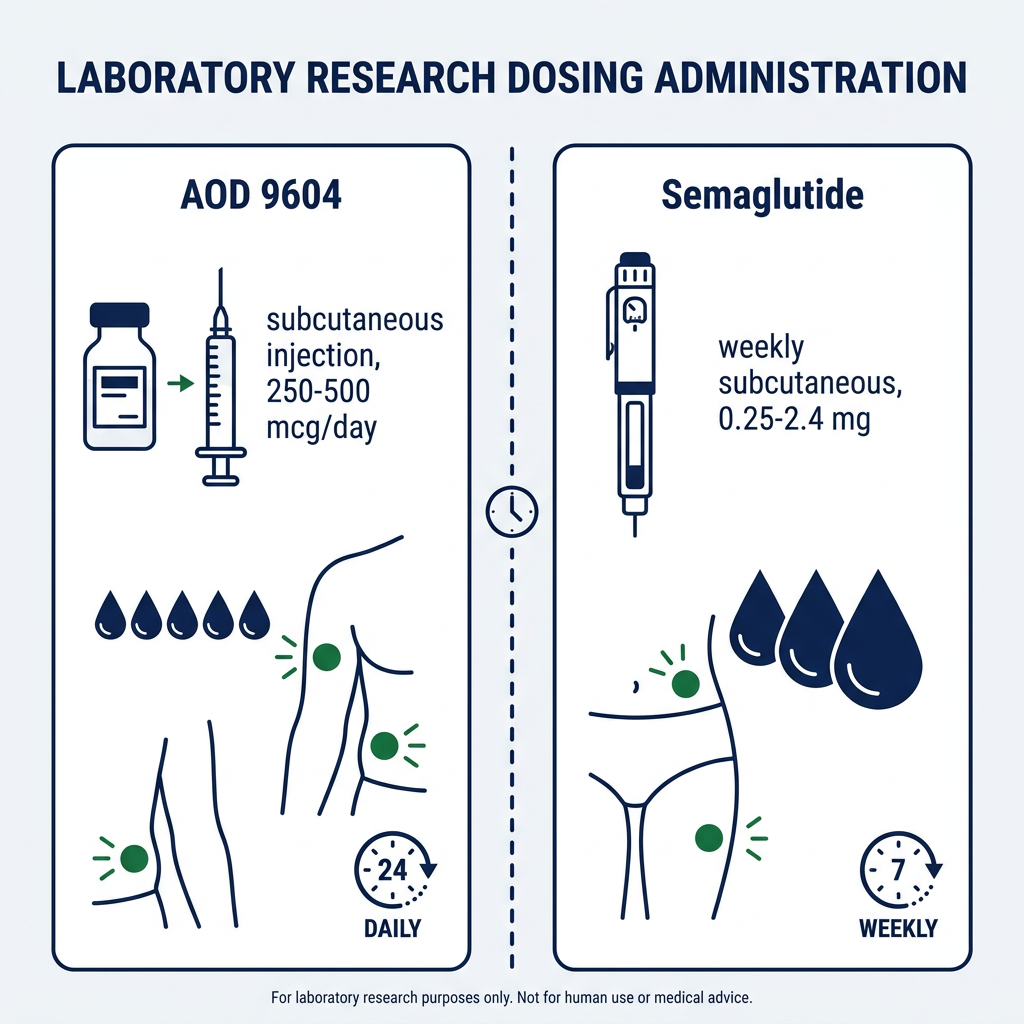
Dosing changes the comparison because frequency, route, and titration shape both adherence and safety interpretation. Semaglutide is labeled as once-weekly subcutaneous therapy, while the cited aod 9604 obesity studies used daily oral dosing.
That difference affects how researchers and clinicians think about burden and monitoring. A once-weekly injection with standardized labeling belongs to a mature prescribing framework. Daily oral peptide dosing in a research setting can be harder to compare because formulation, absorption, and study design become central variables.
A common misconception is that lower-frequency dosing automatically means simpler treatment. With semaglutide, dose escalation, adverse-effect monitoring, and contraindications still matter. With aod 9604, the issue is less about convenience and more about whether the evidence base is strong enough to justify strong conclusions at all.
For laboratory handling, aod 9604 is often supplied as a lyophilized powder for reconstitution, but researchers should verify vendor-specific storage conditions and certificate of analysis documentation before use. This is research-use-only framing and not a clinical recommendation.

Which safety signals appear in aod 9604 and semaglutide research?
Safety labeling is one of the clearest separators. Semaglutide carries formal label warnings, including rodent thyroid C-cell tumor findings and contraindications related to medullary thyroid carcinoma and MEN 2. aod 9604 does not appear in this source set with an equivalent obesity-drug label structure.
The animal data for aod 9604 show a specific safety-relevant observation. In obese Zucker rats, oral aod 9604 reduced body-weight gain and did not show the same adverse effect on insulin sensitivity seen with chronic treatment using intact human growth hormone. That finding is often cited as a reason for continued research interest, but it is not a substitute for large human safety databases.
Semaglutide’s safety profile is documented across thousands of participants in the STEP program and formal postmarketing frameworks. aod 9604’s human safety data come from much smaller and shorter trials, which limits the strength of any safety conclusions.
Researchers comparing the two should not treat the absence of a label warning as proof of safety. It more often reflects a thinner evidence base.
How does the STEP 1 trial design support semaglutide’s evidence base?
The STEP 1 trial was a randomized, double-blind, placebo-controlled study. It enrolled adults with obesity or overweight plus at least one weight-related comorbidity. The 2:1 randomization to semaglutide 2.4 mg or placebo, combined with lifestyle intervention, reduced the risk of bias and provided a clear comparator for weight outcomes.
A 68-week follow-up period is especially important in obesity research. Weight regain, plateau effects, and long-term safety signals cannot be captured in short studies. The STEP 1 design allowed researchers to observe changes over more than a year, which is more relevant to chronic weight management than a 12-week or 24-week trial.
The large sample size of 1,961 participants also improves statistical power and generalizability. Smaller studies may miss rare adverse events or produce unstable effect estimates. This is why semaglutide’s evidence is often described as practice-changing while smaller peptide studies remain exploratory.
💡 Key Takeaway: How does the STEP 1 trial design support semaglutide’s evidence base?
What does the animal data for this peptide actually show?
The obese Zucker rat data are frequently cited in discussions of this peptide. Oral administration reduced body-weight gain in that model. The same studies reported no adverse effect on insulin sensitivity compared with intact human growth hormone.
That animal finding is relevant because intact growth hormone can negatively affect insulin sensitivity. If a synthetic analogue of the lipolytic domain avoids that effect, it becomes a more interesting research candidate. However, animal data do not automatically predict human outcomes.
The identified human studies for this peptide were much smaller and shorter than the STEP 1 trial. They also did not produce the same regulatory outcome. Animal signals are useful for hypothesis generation, but they should not be weighted equally with large randomized human trials.
Why is trial duration critical when comparing these compounds?
Obesity is a chronic condition. Short-term weight loss can occur for many reasons, including temporary changes in energy intake or fluid balance. Longer trials separate durable effects from transient ones.
A 12-week study can show early efficacy but cannot answer whether weight loss is maintained at 68 weeks. Semaglutide’s STEP 1 trial ran 68 weeks, which is long enough to assess maintenance and safety over a meaningful period. The cited phase IIb studies for this peptide ran 12 and 24 weeks.
Duration also affects safety interpretation. Some adverse events emerge only after months of exposure. A short trial may miss these signals. This is another reason why semaglutide’s evidence base is considered stronger.
What should researchers avoid when interpreting this peptide data?
One common error is to equate “studied in humans” with “proven to the same clinical standard.” A phase IIb study is not equivalent to a large phase III or pivotal program. The level of evidence matters.
Another error is to ignore regulatory status. A compound without an FDA obesity indication should not be described with the same confidence as a labeled drug. The absence of formal warnings does not mean safety is established.
Researchers should also avoid using animal data as primary evidence for human outcomes. Animal models can be informative, but they are not a substitute for human trials. The peptide’s animal history is interesting, but it does not close the evidence gap with semaglutide.
💡 Key Takeaway: What should researchers avoid when interpreting this peptide data?
How should peptide libraries present aod 9604 for laboratory research?
For researchers sourcing aod 9604 through a peptide library or reference guide, the first requirement is documentation. A certificate of analysis (COA) should state purity by HPLC, often reported as ≥95%, but this varies by vendor and batch. Storage conditions for lyophilized aod 9604 typically include -20°C with desiccation, and reconstituted material should follow vendor-specific stability guidance.
This is where the Peptide Research Library: A Complete Reference Guide becomes useful. It covers how research peptides are catalogued, validated, and documented across different formats. The same principles apply when comparing aod 9604 with other research compounds.
Our related comparison, AOD 9604 vs Retatrutide: 7 Research Differences Today, extends the same evidence-tier framework to another emerging peptide. Researchers who want a broader view of peptide library formats can review Peptide Libraries: 7 Essential Research Formats for 2025.
The key point is that aod 9604 should be handled as a research peptide, not as a clinical obesity drug. That means every conclusion drawn from the literature must respect the smaller human dataset and the absence of a current FDA obesity indication.

FAQ
Does aod 9604 have FDA approval for obesity?
No. This research peptide does not have an FDA obesity indication in the source set reviewed here. Semaglutide does under the Wegovy label. Researchers should not treat these as equivalent regulatory statuses.
How many human participants were studied for the peptide compared with semaglutide?
The identified phase IIb studies included 300 clinically obese participants over 12 weeks and 502 obese adults over 24 weeks. Semaglutide’s STEP 1 trial randomized 1,961 adults over 68 weeks. The difference in scale and duration is substantial.
What is the main mechanism difference between aod 9604 and semaglutide?
The peptide is a synthetic analogue of the lipolytic domain of human growth hormone, while semaglutide is a GLP-1 receptor agonist. They act through different biological pathways, so their research implications are not interchangeable.
Can this compound be used for human weight loss?
No. This article frames the compound as research-use only, not for human consumption or clinical weight management. No dosing guidance should be inferred from research studies.
Where can researchers find reliable documentation for this peptide?
Request a certificate of analysis, verify purity by HPLC, and follow storage conditions such as -20°C for lyophilized powder. The internal peptide library reference guides linked above provide additional framework details.
Ready to Take the Next Step?
Every product includes lot-specific documentation and third-party purity testing.
Explore Our Research Products →Free shipping on qualifying orders · Batch COA on request