


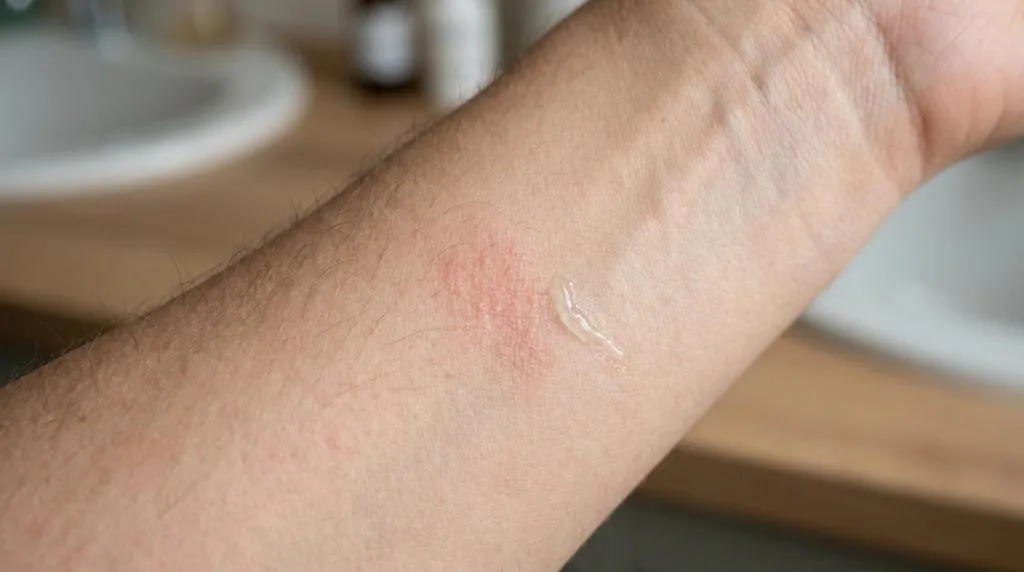
Peptides Library GHK Cu Side Effects Research Guide
Research guide on GHK-Cu side effects: proven facts from Peptides Library covering irritation, tolerability, evidence gaps, and safety for lab use.
📋 Table of Contents
For topical cosmetic use, GHK-Cu is generally described as well tolerated, with mild local irritation—redness, itching, or stinging—as the most consistently reported side effect, while serious systemic harm lacks strong published support. This research guide from Peptides Library answers the core question by tying every claim to source type, human study limits, and the difference between tolerability and clinical proof.
Key takeaways
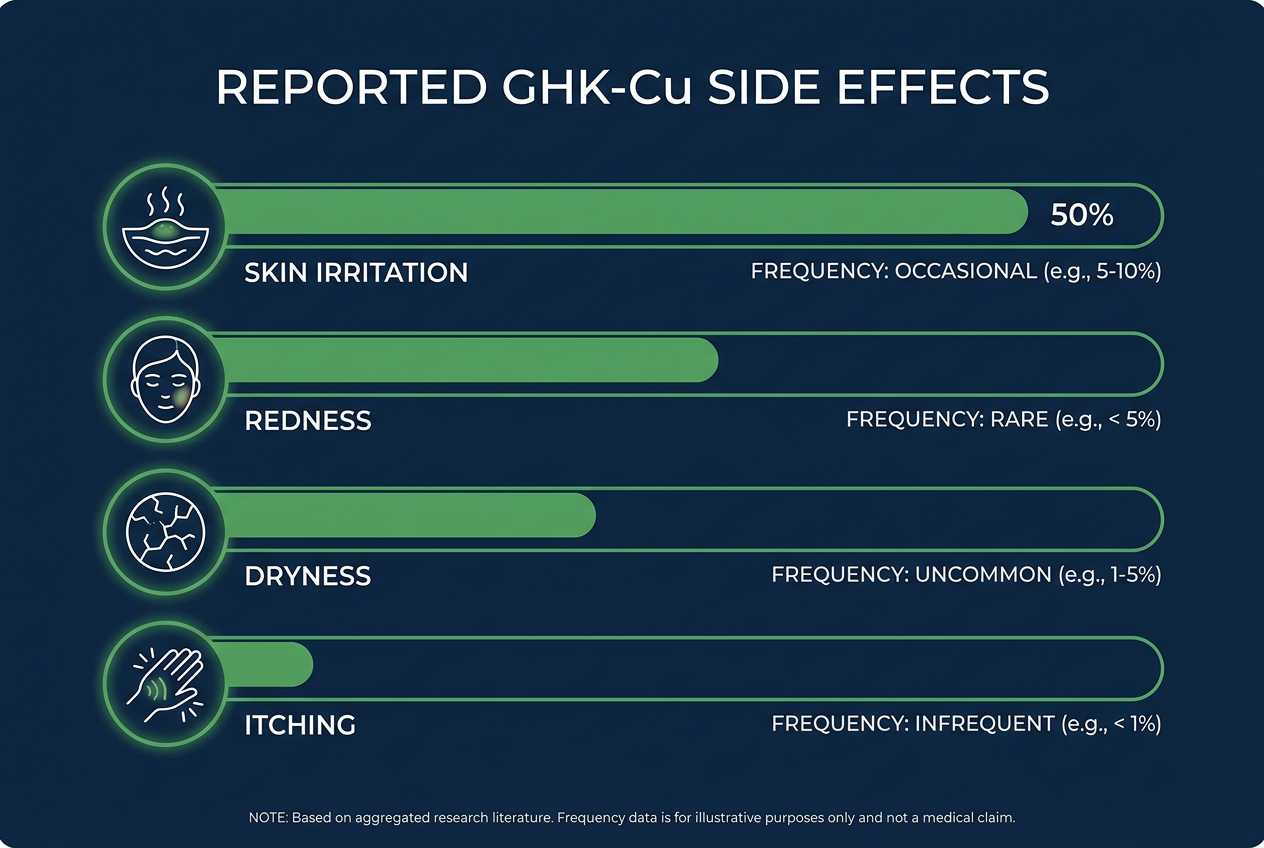
- Mild local irritation, not systemic toxicity, is the primary reported GHK-Cu side effect in topical use.
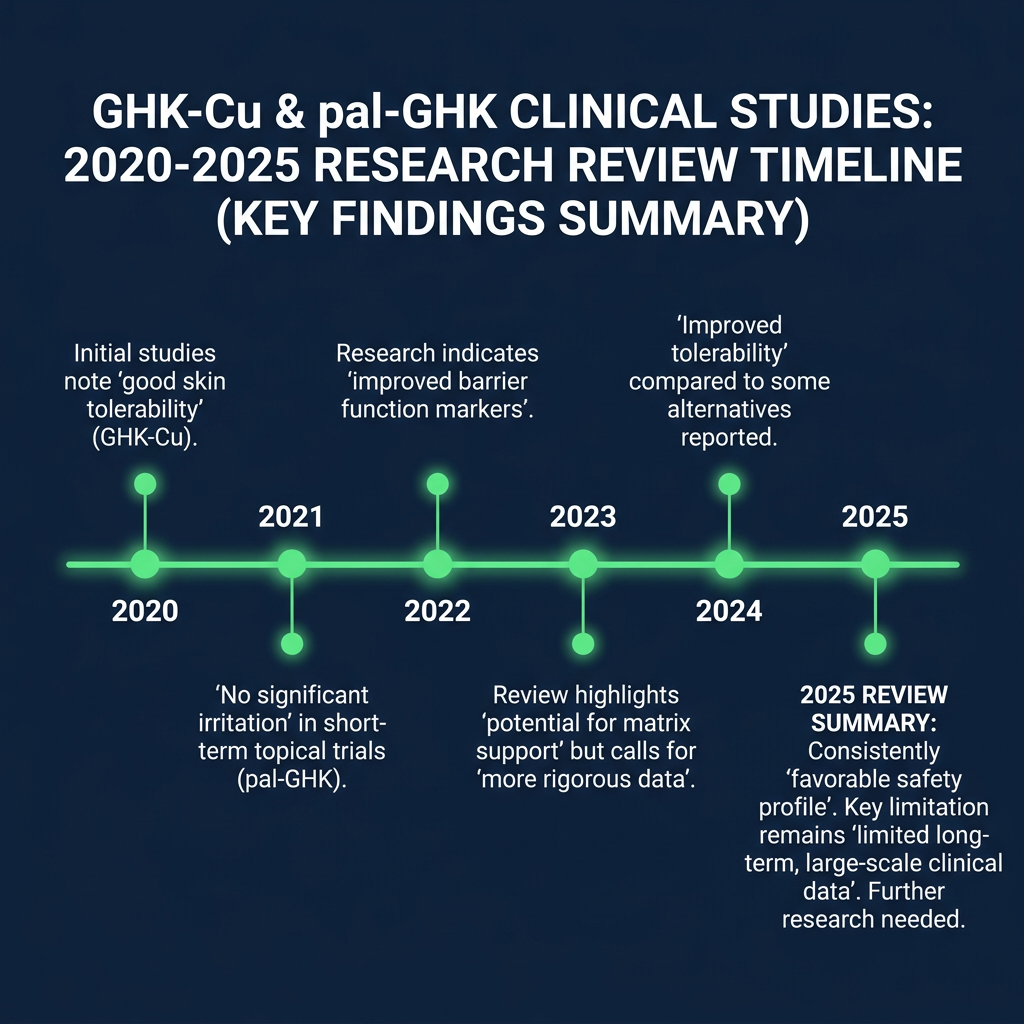
- The 2025 review notes a surprising absence of clinical studies on GHK-Cu and pal-GHK, including skin permeability and effectiveness data.
- The 2006 randomized trial in laser-resurfaced skin found no significant reduction in posttreatment erythema with GHK-Cu products.
- A 2016 study describes GHK-Cu as having low potential to induce skin irritation, and the Cosmetic Ingredient Review panel concluded safety in present practices of use.
- Peptides Library keeps this research guide focused on research-use-only interpretation, not medical advice.
!Research guide table comparing GHK-Cu side effects by source type and reported reaction
What side effects are actually reported for GHK-Cu in this research guide?
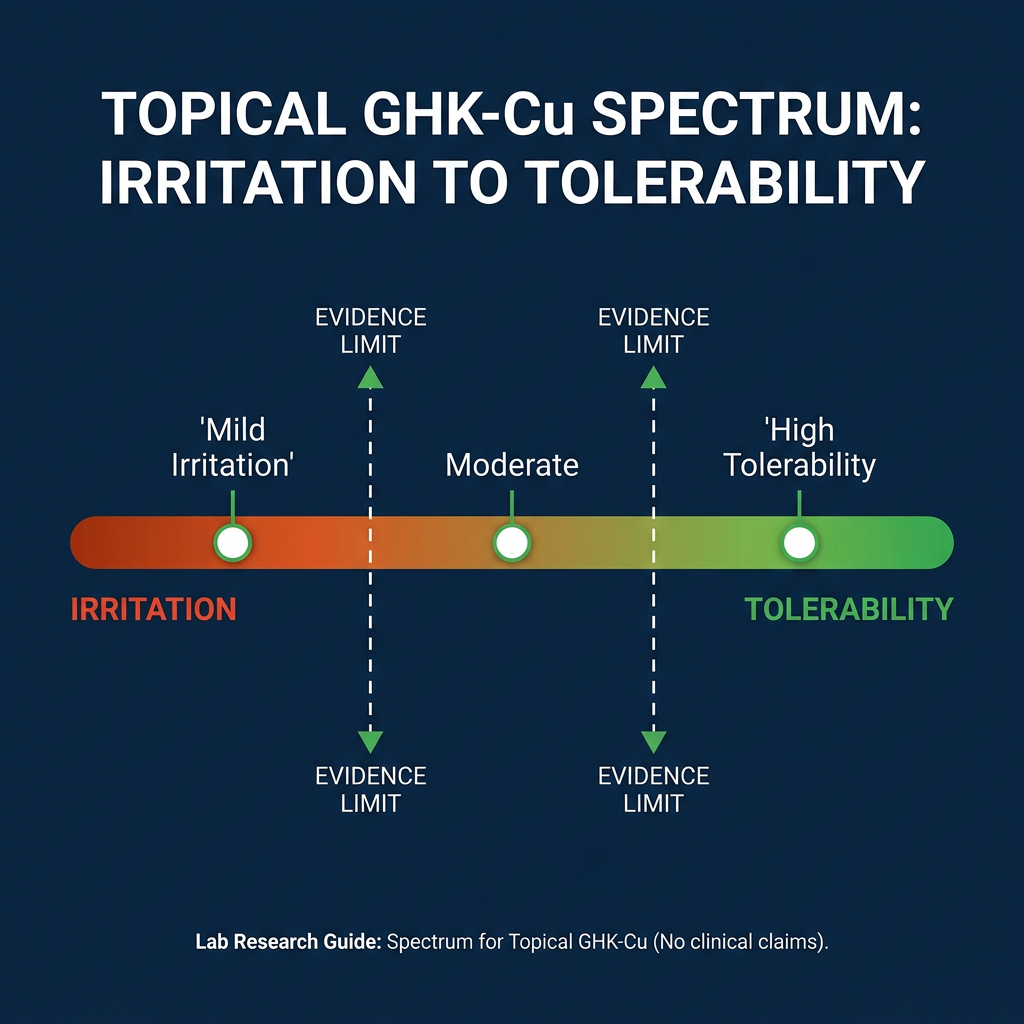
Across the sources Peptides Library reviews, the most consistent signal for GHK-Cu is mild local irritation rather than serious systemic harm. This research guide makes that point explicit, so you do not have to infer it from scattered abstracts, cosmetic summaries, or partial product descriptions. Reported local reactions include redness, itching, stinging, and occasional dryness at the application site. Allergic contact dermatitis appears rarely in the literature but is mentioned as a possibility in cosmetic safety assessments. This research guide distinguishes between a low potential to induce skin irritation—as described in a 2016 study—and the absence of strong human data on more serious outcomes. For researchers, that distinction is critical when comparing topical formulations or writing evidence summaries.
Peptides Library also makes the evidence gap visible. A peptide can be widely used in anti-wrinkle products and still have limited published human data on permeability, effectiveness, and real-world adverse effects. That distinction matters if you are comparing formulas, writing about peptide safety, advising patients, or deciding how much confidence to place in a cosmetic claim. This research guide keeps returning to the local side-effect profile because most safety language around GHK-Cu is tied to topical cosmetic use, not broad systemic exposure.
The 2016 study describing GHK-Cu as having low potential to induce skin irritation is one of the few direct tolerability assessments cited in this research guide. Peptides Library tracks that source carefully because it offers a measurable benchmark for irritation risk, even though it does not address long-term or systemic endpoints. Researchers should note that “low potential” is not the same as “no potential,” and individual reactions can still occur based on formulation pH, preservatives, or skin barrier status. This research guide encourages readers to check whether a claim cites the 2016 study, a cosmetic safety panel, or only a product description.
!Research guide visual summary of reported GHK-Cu local reactions including redness and itching
How does this research guide clarify topical GHK-Cu irritation, tolerability, and evidence limits?

Peptides Library brings the supported takeaway into focus: for cosmetic use, GHK-Cu is generally described as well tolerated, but the published human evidence is limited and mostly supports only mild local side effects. In practical terms, that means irritation, redness, or itching at the application site are more consistently reported than serious systemic problems. This research guide presents that conclusion without overstating either safety or risk. The balance matters because safety and effectiveness are often blurred together in peptide marketing. A product can appear to have a low irritation profile and still lack strong clinical proof for wrinkle improvement or other cosmetic outcomes.
This research guide shows both sides at once, including the 2006 randomized trial that did not show objective improvement in wrinkles or overall skin quality versus a comparison treatment, even though questionnaire responses were more favorable. That study is important because it tested GHK-Cu products in laser-resurfaced skin and found no significant reduction in posttreatment erythema. Peptides Library surfaces this result not to dismiss GHK-Cu but to show how tolerability and efficacy are separate questions. The same research guide also flags where the literature becomes less certain.
A 2025 review reported insufficient published information on skin permeability, effectiveness, and physicochemical properties for GHK-Cu and pal-GHK, while noting that metal complexation and hydrophobic modification can increase skin permeability. If you are trying to interpret newer delivery claims, that context helps you ask better questions about formulation, exposure, and relevance. This research guide keeps that 2025 review front and center because it represents the most current evidence gap statement for these copper peptides. Researchers evaluating topical delivery systems should treat permeability data as a missing variable rather than an assumed constant.
!Research guide diagram showing the evidence gap for GHK-Cu skin permeability and effectiveness
💡 Key Takeaway: How does this research guide clarify topical GHK-Cu irritation, tolerability, and evidence limits?
Which evidence types does this research guide sort for GHK-Cu safety?
Peptides Library does more than collect citations. This research guide sorts GHK-Cu safety information by what you actually need to decide: whether the source is a review, a randomized human trial, or a cosmetic safety panel; whether the reported issue is skin irritation, posttreatment erythema, or allergic contact dermatitis; and whether the claim applies to present cosmetic practices of use rather than to all possible formulations. That structure is what makes the research usable. Instead of giving equal weight to every mention of GHK-Cu, this research guide shows where the evidence is stronger, where it is older, and where it is mostly descriptive.
We also preserve source-specific language such as skin permeability, physicochemical properties, metal complexation, hydrophobic moiety, and present practices of use so you can trace how the safety argument is being made. For example, the Cosmetic Ingredient Review panel concluded the reviewed peptides were safe in the present practices of use and concentration described in the assessment. This research guide presents that conclusion alongside the later review noting limited or absent clinical data for anti-wrinkle use. You get a more realistic picture because Peptides Library does not need every peptide to look either fully proven or inherently risky.
To make comparisons easier, this research guide groups GHK-Cu sources into four categories: human randomized trials, cosmetic safety assessments, narrative or systematic reviews, and formulation studies. The 2006 randomized trial belongs to the first category and offers direct but negative efficacy data. The Cosmetic Ingredient Review assessment belongs to the second and provides a safety threshold for present practices. The 2025 review belongs to the third and highlights missing permeability and effectiveness data. The 2016 study belongs to the fourth and addresses irritation potential at a mechanistic level. Using these categories helps researchers avoid mixing tolerability claims with efficacy claims.
Why is Peptides Library different for GHK-Cu side effects research?
Peptides Library is designed for readers who care about evidence quality, not just quick reassurance. This research guide combines article-level citations, evidence reviews, practical interpretation, and broader peptide reference content so you can place one safety signal in context instead of reading it in isolation. That is especially helpful with GHK-Cu, where the conversation often swings between enthusiastic cosmetic claims and vague caution. This research guide improves that by narrowing the discussion to what is actually supported: generally good topical tolerability, mild local irritation as the most consistent reported issue, rare discussion of allergic contact dermatitis, and limited human clinical depth.
Because Peptides Library continuously updates coverage of emerging peptide research, you are not locked into a static summary. As new reviews, formulation studies, or safety discussions appear, our job is to keep the GHK-Cu picture clearer for people who need current, evidence-based interpretation. The independent editorial stance is part of the value. Peptides Library can tell you that the Cosmetic Ingredient Review panel concluded safety in present practices of use, while also telling you that a later review noted limited or absent clinical data for anti-wrinkle use. You get a more realistic picture because we do not need every peptide to look either fully proven or inherently risky.
Researchers comparing GHK-Cu to other copper-delivery approaches will find that this research guide avoids retailer bias. There are no product purchase prompts, no dosing suggestions, and no implied human consumption guidance. Instead, the content remains strictly research-use-only. For laboratory or academic use, always confirm certificate of analysis (COA) availability and recommended storage conditions from the supplier, as Peptides Library does not sell or specify these parameters. The Peptide Research Library: A Complete Reference Guide offers a broader framework for evaluating peptide evidence quality, and the Cell Penetrating Peptides for Research | Peptides Library page discusses permeability concepts that relate to the 2025 review findings.
When is this research guide the right fit for your GHK-Cu safety question?
This research guide is the right fit if you want to evaluate GHK-Cu side effects before choosing a cosmetic product, citing a peptide in your work, discussing tolerability with others, or comparing safety language across brands. Peptides Library helps when you need a grounded answer, not a sales pitch. We are also a good fit if you want the evidence limits stated plainly. With GHK-Cu, that means recognizing both the favorable tolerability profile described in cosmetic and review sources and the still-small human clinical evidence base. If you value that kind of balance, this research guide is built for you.
If you need personal diagnosis, treatment, or individualized medical advice, a clinician should guide that decision. But if your next step is to understand what the published GHK-Cu side effects literature actually supports, Peptides Library gives you a clear place to start. This research guide is especially useful for healthcare professionals preparing evidence summaries, students learning to assess cosmetic ingredient safety, and informed consumers who want to separate marketing language from published data. The Peptide Library: Research-Grade Peptides for Laboratories page can help if you are sourcing peptides for laboratory experiments and need to verify research-use-only documentation.
For those comparing GHK-Cu with other peptide side effect profiles, the Peptides Library Hexarelin Side Effects Research Hub provides a parallel structure for a different peptide. That comparison can highlight how evidence depth varies widely across peptide classes. Similarly, the AOD 9604 vs Retatrutide: 7 Research Differences Today article shows how Peptides Library handles head-to-head research questions without drifting into medical claims. These internal resources reinforce the same editorial standard applied throughout this research guide.
💡 Key Takeaway: When is this research guide the right fit for your GHK-Cu safety question?
What does the 2025 review say about GHK-Cu and pal-GHK clinical studies?
The 2025 review highlighted by Peptides Library notes a surprising absence of clinical studies on GHK-Cu and pal-GHK. This research guide emphasizes that finding because it directly affects how much confidence a researcher should place in cosmetic efficacy claims. The review reported insufficient published information on skin permeability, effectiveness, and physicochemical properties for both peptides. That means even basic parameters like how much GHK-Cu penetrates intact human skin are not well established in peer-reviewed literature. For a peptide widely used in anti-wrinkle products, this is a significant evidence gap. This research guide treats the 2025 review as a benchmark for current knowledge limits.
The same review noted that metal complexation and hydrophobic modification can increase skin permeability. This is a formulation-level insight, not a clinical outcome. Researchers should interpret it carefully: enhanced permeability might improve delivery or might increase local exposure, but without human permeability data, the net effect on side effects remains unclear. This research guide uses that finding to encourage better questions about formulation chemistry. If a product claims enhanced delivery, ask whether the supporting study measured actual permeability or only inferred it from chemical structure. Peptides Library keeps this distinction explicit throughout the GHK-Cu side effects coverage.
How can researchers use this research guide to compare GHK-Cu safety sources by type?
To compare GHK-Cu safety sources effectively, start with the source type, then the reported reaction, then the decision value. This research guide provides that three-step filter. First, identify whether the source is a randomized trial, a cosmetic safety panel, a review, or a formulation study. Each type answers a different question: trials test efficacy under specific conditions, panels assess safety thresholds, reviews summarize breadth but may lack new data, and formulation studies examine mechanisms. Second, note which side effect is reported: irritation, redness, itching, posttreatment erythema, or allergic contact dermatitis. Third, decide whether the claim applies to present cosmetic practices of use or to broader experimental conditions.
This research guide also preserves exact source language to prevent misinterpretation. Terms like “low potential to induce skin irritation,” “safe in the present practices of use and concentration,” and “no significant reduction in posttreatment erythema” carry specific evidentiary weight. A researcher comparing two cosmetic products should not treat all three statements as equivalent. The first describes a laboratory irritation assessment, the second is a panel conclusion with concentration limits, and the third is a negative clinical endpoint. Peptides Library keeps these distinctions visible because they change how much confidence you can place in a safety claim.
For laboratory or academic use, always confirm certificate of analysis (COA) availability and recommended storage conditions from the supplier, as Peptides Library does not sell or specify these parameters. This research guide does not provide purity percentages or storage temperatures because those are supplier-specific and outside the scope of an independent knowledge hub. Instead, it directs researchers to verify those details directly with a licensed vendor. External authoritative sources such as the National Institutes of Health and PubMed can be used to locate the primary studies cited in this research guide.
FAQ
What is the most common GHK-Cu side effect reported in published research?
Mild local irritation—including redness, itching, and stinging—is the most consistently reported GHK-Cu side effect in topical cosmetic use. Serious systemic side effects lack strong published support. This research guide separates local tolerability data from broader systemic claims.
Does GHK-Cu have strong clinical proof for reducing wrinkles?
No. The 2006 randomized trial in laser-resurfaced skin found no significant reduction in posttreatment erythema and no objective improvement in wrinkles or overall skin quality versus a comparison treatment. The 2025 review also noted limited or absent clinical data for anti-wrinkle use. This research guide highlights that efficacy remains unproven despite widespread cosmetic use.
What did the Cosmetic Ingredient Review panel conclude about GHK-Cu?
The Cosmetic Ingredient Review panel concluded the reviewed peptides were safe in the present practices of use and concentration described in the assessment. This research guide presents that conclusion alongside later evidence gaps, so researchers see both the safety threshold and the missing clinical depth.
Is GHK-Cu safe for human consumption or injection?
No. This research guide from Peptides Library is strictly research-use-only. It does not provide dosing, consumption, or injection guidance. GHK-Cu safety language in the reviewed literature applies to topical cosmetic use, not oral or parenteral exposure. For any personal medical use, consult a clinician.
How can I verify GHK-Cu purity and storage conditions for my laboratory?
Peptides Library does not sell peptides or specify purity percentages, COA availability, or storage temperatures. Researchers should request a certificate of analysis (COA) and storage documentation directly from a licensed supplier. This research guide directs you to verify those supplier-specific parameters before any experimental use.
Ready to Take the Next Step?
Every product includes lot-specific documentation and third-party purity testing.
Explore Our Research Products →Free shipping on qualifying orders · Batch COA on request