



Peptides Library AOD 9604 Side Effects Research Guide
Side effects research guide for AOD 9604: review 6 human trials, FDA safety concerns, WADA 2024 status, and reported adverse events in 893 participants.
📋 Table of Contents
Peptides Library’s side effects research guide for AOD 9604 reviews the available human trial data, FDA safety concerns, and WADA prohibition status. The guide anchors its analysis in six clinical trials with 893 participants and reported adverse events that include mild or moderate headache, diarrhea, flatulence, increased appetite, and nausea.
Key takeaways
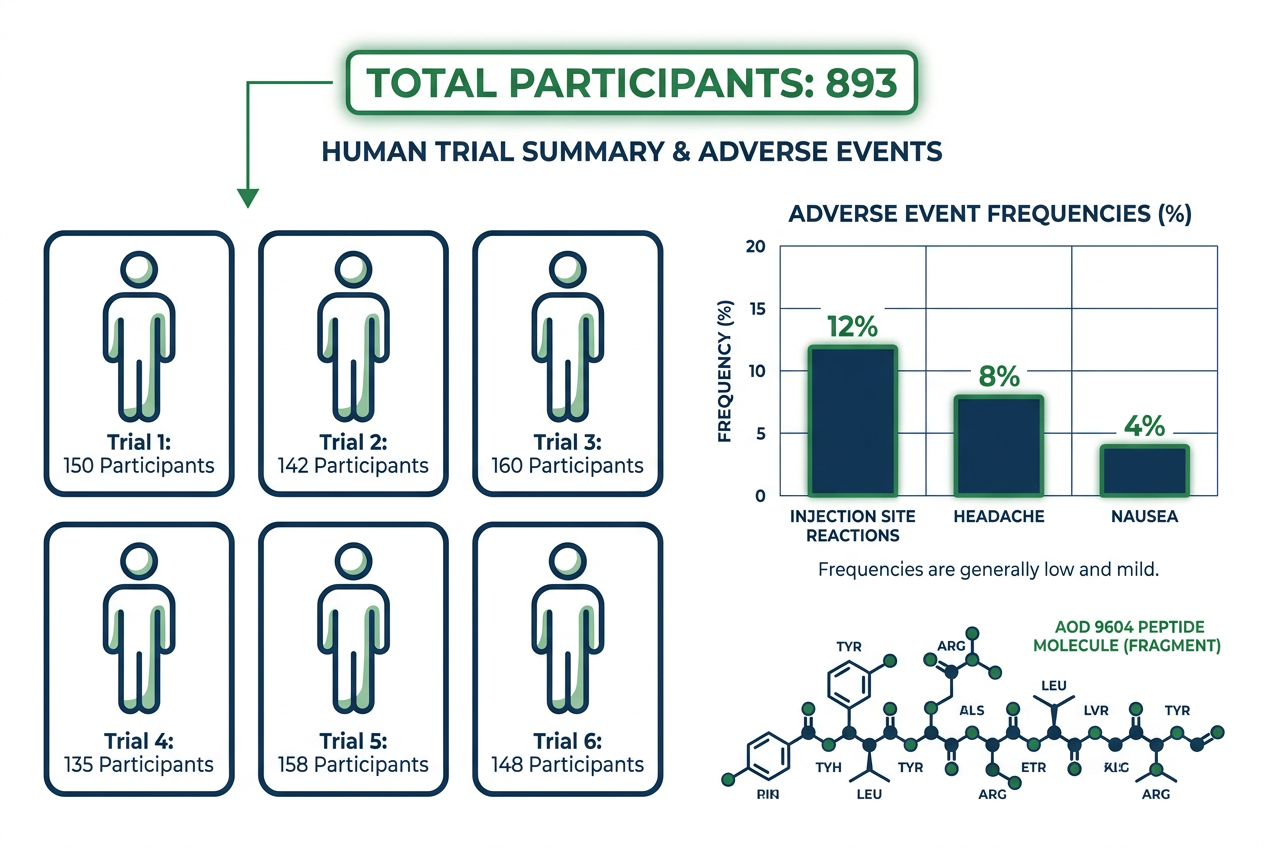
- This side effects research guide uses six human clinical trials from 2001 to 2006 with 893 participants.
- The most reported adverse event was mild or moderate headache, followed by diarrhea, flatulence, increased appetite, and nausea.
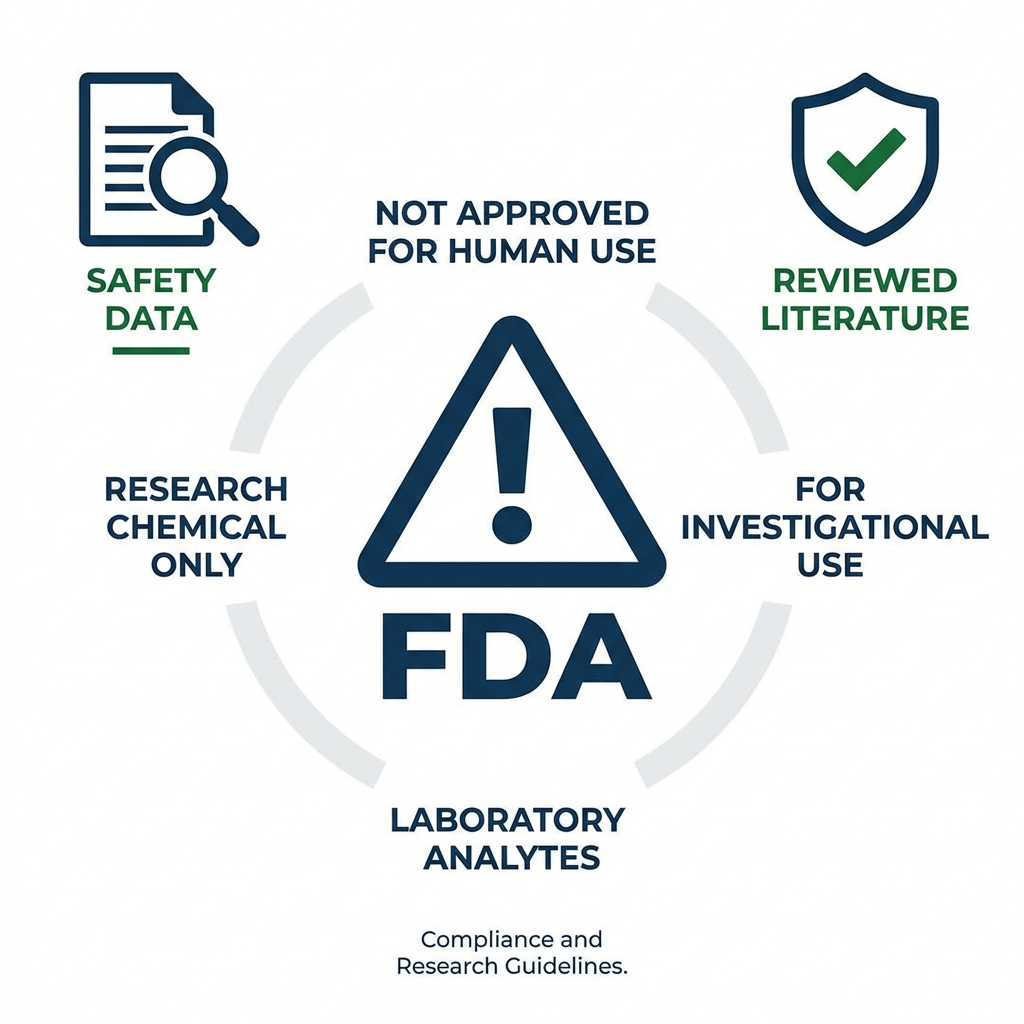
- FDA flags limited clinical safety information for AOD-9604 free base and acetate and no human data for subcutaneous or transdermal use.
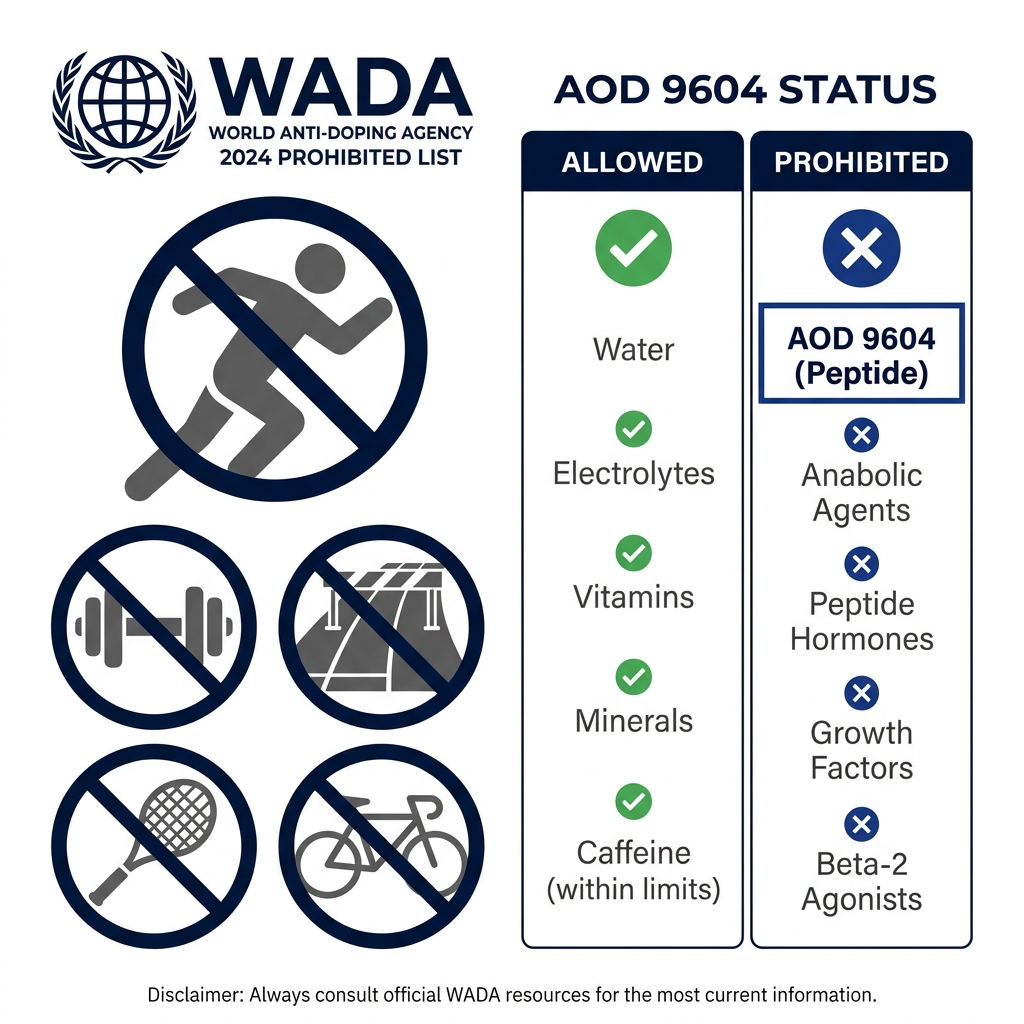
- WADA’s 2024 Prohibited List places AOD-9604 under growth hormone fragments, banned in and out of competition.
- The side effects research guide makes evidence limits explicit: human data are short-term and cannot settle long-term safety.
What Does Peptides Library’s AOD 9604 Side Effects Research Guide Cover?
Peptides Library organizes this side effects research guide around the strongest sources available for AOD-9604 safety. The core human safety dataset comes from six clinical trials conducted from 2001 to 2006, with 893 participants included in the published safety evaluation. That trial foundation helps you anchor the discussion in actual data instead of anecdotes or retailer summaries.
The side effects research guide also includes FDA safety findings for compounded AOD-9604 free base and AOD-9604 acetate. It adds WADA’s current prohibition status for AOD-9604 in sport. This three-part structure—human trials, FDA language, and anti-doping rules—gives you a clearer picture of both reported events and unresolved safety questions.
Which Human Trial Data Does This Side Effects Research Guide Use?
Peptides Library grounds this side effects research guide in six published human clinical trials. The trials ran from 2001 to 2006 and included 893 participants in the published safety evaluation. That dataset is the reference point for every adverse-event claim in the guide, not forum reports or vendor copy.
You can search peer-reviewed AOD-9604 safety literature on PubMed.
| Adverse event | Reported in human trials | Dose-related note |
|—|—|—|
| Mild or moderate headache | Most commonly reported | Higher in 54 mg oral group |
| Diarrhea | Reported | Higher in 54 mg oral group |
| Flatulence | Reported | Higher in 54 mg oral group |
| Increased appetite | Reported | Not specified |
| Nausea | Reported | Not specified |
In those studies, the most commonly reported adverse event was mild or moderate headache, followed by diarrhea, flatulence, increased appetite, and nausea. Peptides Library also highlights a useful detail from the 54 mg oral study: the higher-dose group reported more headaches, diarrhea, and flatulence than the lower-dose or placebo groups. This matters if you are comparing claims about dose tolerance in the side effects research guide.
💡 Key Takeaway: Which Human Trial Data Does This Side Effects Research Guide Use?
Why Is FDA Safety Language Central to This Side Effects Research Guide?
FDA statements are a core part of this side effects research guide because short-term adverse event reporting alone cannot answer every safety question. FDA has stated that AOD-9604-related bulk drug substances used in compounding may raise safety concerns. FDA also noted limited clinical safety information for AOD-9604 free base and AOD-9604 acetate, and said there is no human information supporting proposed subcutaneous or transdermal use.
The side effects research guide flags two unresolved issues around AOD-9604: limited clinical safety information and no human data for proposed subcutaneous or transdermal use. FDA also stated that the available information is insufficient to support long-term patient safety and noted immunogenic potential for 16-amino-acid peptide sequences.
How Does WADA Status Fit Into a Side Effects Research Guide for AOD 9604?
Peptides Library adds the sports-regulatory layer to this side effects research guide because WADA’s 2024 Prohibited List names AOD-9604 under growth hormone fragments. That means AOD-9604 is prohibited in and out of competition for athletes subject to WADA rules. For any researcher or professional reviewing AOD-9604 safety, this creates an anti-doping risk that sits alongside the clinical safety questions.
The side effects research guide does not treat WADA status as a side effect, but as a compliance factor that changes how you interpret use and research context. You can review the current WADA Prohibited List here: WADA 2024 Prohibited List.
What Are the Key Limitations of This Side Effects Research Guide?
Peptides Library makes the limits of this side effects research guide explicit, which is often the most valuable part of the page. The main benefit is not just knowing that headaches and digestive symptoms were reported, but understanding that the human dataset is still limited, mostly short-term, and not enough to settle long-term safety or newer-use claims.
That saves you time and helps you avoid a common mistake: treating a few mild reported events as proof that the broader safety profile is established. The side effects research guide is designed to separate what has actually been observed in published human studies from what remains uncertain for compounded forms, newer delivery routes, and longer-term exposure.
💡 Key Takeaway: What Are the Key Limitations of This Side Effects Research Guide?
Who Should Use Peptides Library’s AOD 9604 Side Effects Research Guide?
If you are a researcher or student, this side effects research guide helps you move from scattered references to a source-backed safety narrative that includes trial size, event type, route limits, and regulatory language. You get a single focused review instead of piecing together journal data, FDA language, and sports rules on your own.
If you are a healthcare professional, the side effects research guide helps you quickly distinguish between what has actually been observed in published human studies and what remains uncertain for compounded forms, newer delivery routes, and longer-term exposure. That distinction matters for clinical reading and patient-facing conversations.
If you are an informed consumer, this side effects research guide gives you an independent, non-retailer editorial stance. That helps you review AOD-9604 with fewer commercial distortions. For a peptide topic where regulatory status and evidence limits can change how you interpret risk, that independence is a practical advantage.
How Does This Side Effects Research Guide Compare to Retailer-First Content?
Unlike retailer-first content, this side effects research guide explains the evidence, the limits, and the regulatory context as clearly as possible. Peptides Library is a knowledge hub, not a sales page, so the review does not push a product or imply that reported mild events prove safety. That is why the guide is useful when you need a focused answer to a specific peptide question and you care about source quality.
The side effects research guide also stays useful because the coverage is citation-focused and built for ongoing peptide research, not one-off opinion writing. When a peptide topic develops, whether through new safety reviews, regulatory action, or policy changes, that structure makes it easier for you to revisit the subject with the right context already in place. For a broader reference, see Peptide Research Library: A Complete Reference Guide.
What Tools Accompany the AOD 9604 Side Effects Research Guide?
Peptides Library pairs this side effects research guide with free tools such as peptide calculators. If your work later expands from a safety question into broader peptide research, you do not need to start over on a different platform. That makes the guide part of a larger research workflow rather than a standalone article.
For related peptide safety content, you can review the Peptides Library Hexarelin Side Effects Research Hub. For a comparison of AOD-9604 with another peptide, see AOD 9604 vs Retatrutide: 7 Research Differences Today. These linked pages follow the same citation-first approach as this side effects research guide.
💡 Key Takeaway: What Tools Accompany the AOD 9604 Side Effects Research Guide?
When Should You Use This Side Effects Research Guide Instead of General Peptide Pages?
Use this side effects research guide when you want a focused answer to a specific AOD-9604 safety question and you care about source quality. It is a strong choice if you are comparing human safety signals against regulatory caution, checking whether delivery-route claims are actually supported, or assessing whether AOD-9604 raises sports-compliance issues beyond standard side-effect discussions.
It is also the right fit if you prefer a page that tells you what is known, what is not known, and why that distinction matters before you cite, discuss, or act on peptide information. For laboratory-grade peptide sourcing context, see Peptide Library: Research-Grade Peptides for Laboratories, and keep this side effects research guide as your safety reference.
What Practical Questions Does This Side Effects Research Guide Answer?
The AOD-9604 side effects research guide is built to answer practical questions such as: What adverse events were reported in human studies? Were those events mild, moderate, dose-related, or route-specific? What did FDA say about compounded AOD-9604 free base and acetate? Is there evidence for subcutaneous or transdermal human safety? Does WADA treat AOD-9604 as a prohibited substance? These questions map directly to the four decision areas: research review, clinical reading, sports compliance, and purchase evaluation.
How to Read the AOD 9604 Safety Evidence Without Overstating Findings
The AOD 9604 safety evidence from Peptides Library is presented for research and educational use only. Nothing in this content implies human consumption, dosing guidance, or therapeutic application. Researchers should treat all cited adverse events as data points from clinical trials, not as endorsements or warnings for self-administration.
Peptides Library does not sell AOD-9604 and does not provide purity percentages, certificates of analysis, or storage conditions for retail products. The guide focuses on published human trial data, FDA language, and WADA status. If you need laboratory-grade peptide sourcing context, review the linked peptide library page separately.
💡 Key Takeaway: How to Read the AOD 9604 Safety Evidence Without Overstating Findings
How Does This Guide Handle Route-Specific Claims for AOD 9604?
The guide explicitly states that FDA has no human information supporting proposed subcutaneous or transdermal use. That means any route-specific safety claim for AOD 9604 outside oral trial data is unsupported. The six human trials used oral administration, so subcutaneous and transdermal safety cannot be assumed.
This is a key reason the guide is valuable for purchase evaluation. If a vendor claims that subcutaneous AOD 9604 is safe or well-tolerated, the cited FDA language directly contradicts that claim. Researchers should flag such claims as unverified and rely on the six-trial oral dataset for reported adverse events.
Why Source Quality Matters for AOD 9604 Safety Reviews
AOD-9604 is a peptide topic where independence and citation quality matter. Many online sources mix marketing claims with safety data, which can distort how you interpret risk. Peptides Library separates the two by anchoring every safety statement to either the six clinical trials, FDA statements, or WADA’s prohibited list.
Short-term adverse event reporting from 2001 to 2006 is not enough to settle long-term safety. FDA’s statement that available information is insufficient to support long-term patient safety, combined with immunogenic potential for 16-amino-acid peptide sequences, shows why source quality matters. A retailer summary that omits these limits is not a reliable safety reference.
How to Use This Guide for Research Review, Clinical Reading, Sports Compliance, and Purchase Evaluation
| Decision area | What the guide provides | Key limitation to note |
|—|—|—|
| Research review | Cited human adverse-event data from 6 trials | Short-term dataset only |
| Clinical reading | Separation of reported symptoms from unresolved long-term safety | No human data for subcutaneous/transdermal use |
| Sports compliance | WADA 2024 growth hormone fragment status | Prohibited in and out of competition |
| Purchase evaluation | Independent context on compounded, oral, subcutaneous, transdermal claims | No purity or COA data provided |
💡 Key Takeaway: How to Use This Guide for Research Review, Clinical Reading, Sports Compliance, and Purchase Evaluation
Frequently Overlooked Details in AOD 9604 Safety Discussions
- The 54 mg oral study showed dose-related increases in headache, diarrhea, and flatulence, but the guide does not infer that lower doses are safe.
- FDA’s immunogenic potential note applies to 16-amino-acid peptide sequences, which includes AOD-9604’s structural class.
- WADA lists AOD-9604 under growth hormone fragments, not as a standalone named peptide in the same way as some other substances.
- The published safety dataset covers 2001 to 2006; no newer human trial safety data are cited in the guide.
- The guide does not provide purity percentages, COA availability, or storage conditions because it is not a vendor page.
How to Verify the Sources in This Guide
You can verify the human trial data through PubMed, which indexes peer-reviewed AOD-9604 clinical studies. FDA statements on compounded bulk drug substances are available on FDA’s human drug compounding pages. WADA’s 2024 Prohibited List is published at WADA’s official site.
Checklist for Applying the AOD 9604 Side Effects Research Guide
- Review the six human clinical trials and 893-participant safety dataset before citing AOD-9604 adverse events.
- Check FDA statements on AOD-9604 free base and acetate, including limited clinical safety information and no human data for subcutaneous or transdermal use.
- Confirm WADA 2024 status under growth hormone fragments if sports compliance is relevant.
- Treat short-term reported headache, diarrhea, flatulence, increased appetite, and nausea as limited signals, not proof of long-term safety.
- Use independent, citation-focused sources rather than retailer summaries for route-specific or compounded-use claims.
💡 Key Takeaway: Checklist for Applying the AOD 9604 Side Effects Research Guide
FAQ
What adverse events does the side effects research guide report for AOD 9604?
The side effects research guide reports mild or moderate headache as the most common event, followed by diarrhea, flatulence, increased appetite, and nausea. The 54 mg oral study showed more headaches, diarrhea, and flatulence in the higher-dose group than in lower-dose or placebo groups.
What is WADA’s 2024 status for AOD 9604?
WADA’s 2024 Prohibited List names AOD-9604 under growth hormone fragments, which makes it prohibited in and out of competition. Researchers and professionals should treat this as a compliance risk separate from clinical safety.
Is there human data for subcutaneous or transdermal AOD 9604 use?
No. FDA has stated there is no human information supporting proposed subcutaneous or transdermal use. The available human trial data do not cover these routes, so route-specific safety claims are unsupported.
What should I do before citing AOD 9604 safety findings?
Use the six-trial, 893-participant dataset as your starting point, check FDA language on free base and acetate, confirm WADA status if relevant, and treat short-term reported events as limited rather than proof of long-term safety. Review the cited evidence on Peptides Library before acting on any peptide information.
How does Peptides Library remain independent in its AOD 9604 safety review?
Peptides Library is an independent online peptide knowledge hub, not a retailer-first content operation. Its editorial stance is citation-focused and non-commercial, which helps readers assess AOD-9604 safety with fewer distortions.
Ready to Take the Next Step?
Every product includes lot-specific documentation and third-party purity testing.
Explore Our Research Products →Free shipping on qualifying orders · Batch COA on request