


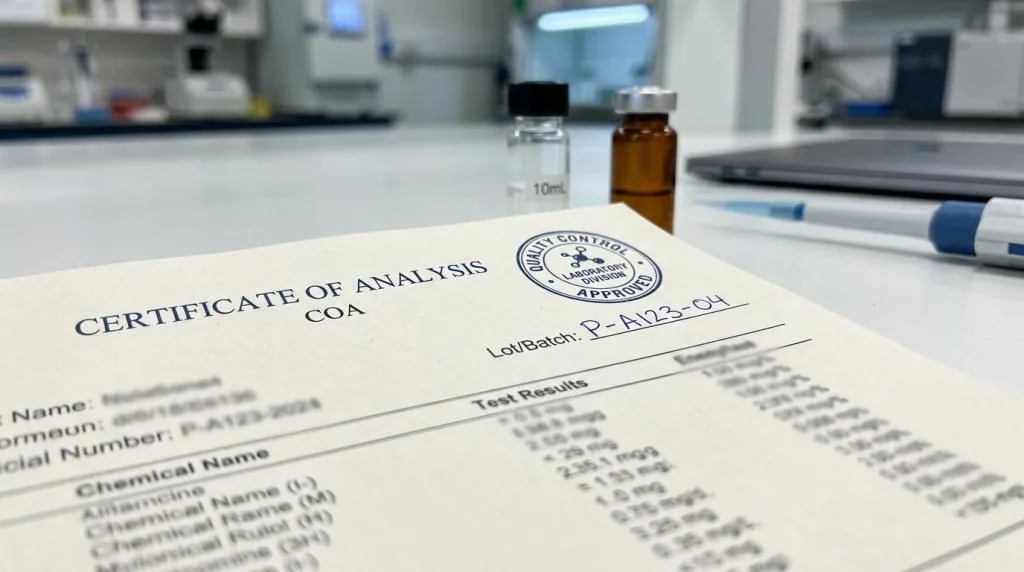
Peptide Research Controls: Why Good Data Starts Here
Peptide research controls define identity, purity, impurity, batch, and traceability checks for research peptides. Learn 7 proven QC steps here.
📋 Table of Contents
Peptide research controls are the analytical and documentation systems—identity, purity, impurity profiling, batch consistency, and traceability—that verify a research peptide sample is what it claims to be before any assay data is trusted. Without these controls, results can look clean while pointing in the wrong direction. Reliable data starts when the sample itself has earned confidence through peptide research controls.
Key takeaways
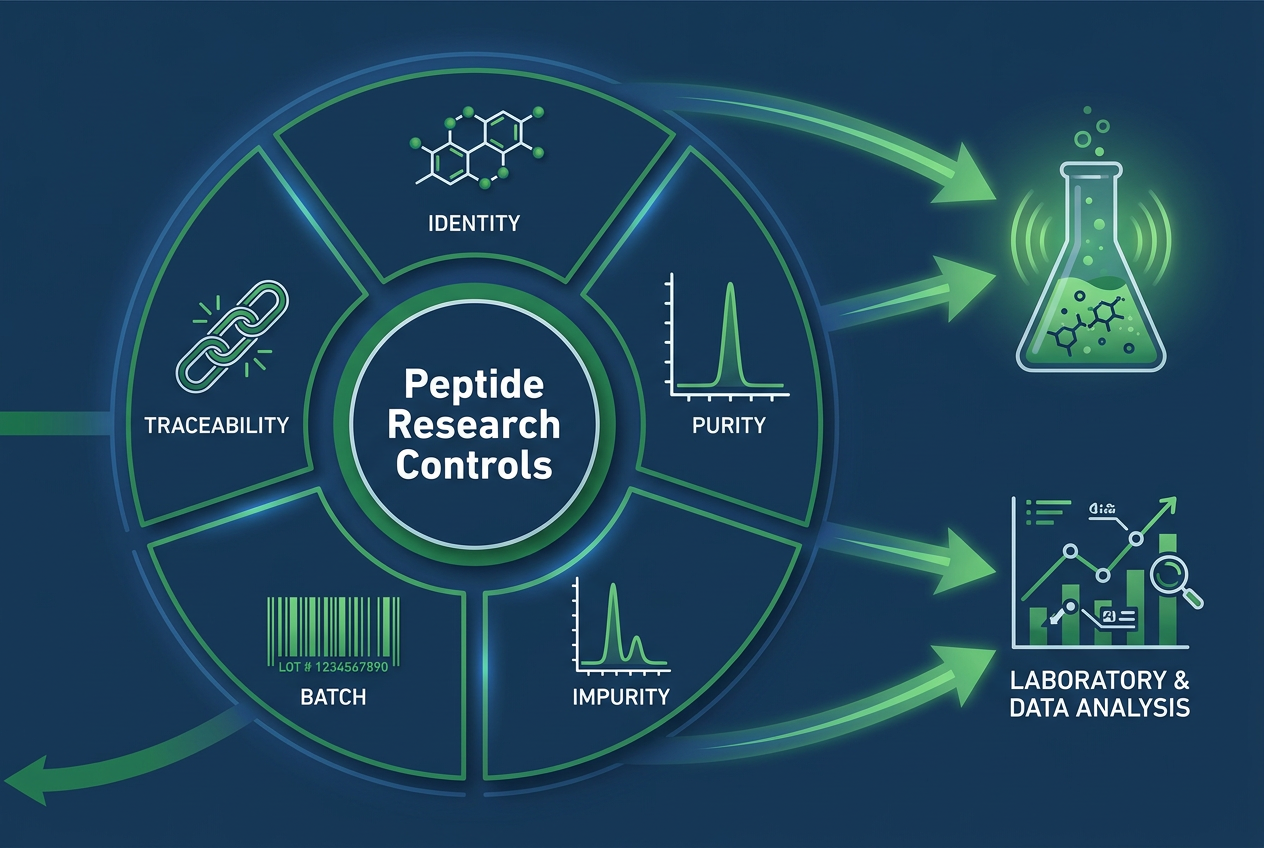
- peptide research controls verify identity, purity, impurity profile, batch consistency, and traceability—not just a single HPLC number.
- Orthogonal testing with RP-HPLC, LC-MS, and sequencing cross-verifies results because every method has blind spots.
- A certificate of analysis should show batch-specific data, methods, specifications, and storage details, not just a summary number.
- Reference standards and batch traceability anchor measurements over time and help separate biological drift from assay drift.
- Strong peptide research controls protect the interpretation of biological data, not just the sample. All uses described here are research-use-only.
What are peptide research controls and why do they matter before any assay begins?
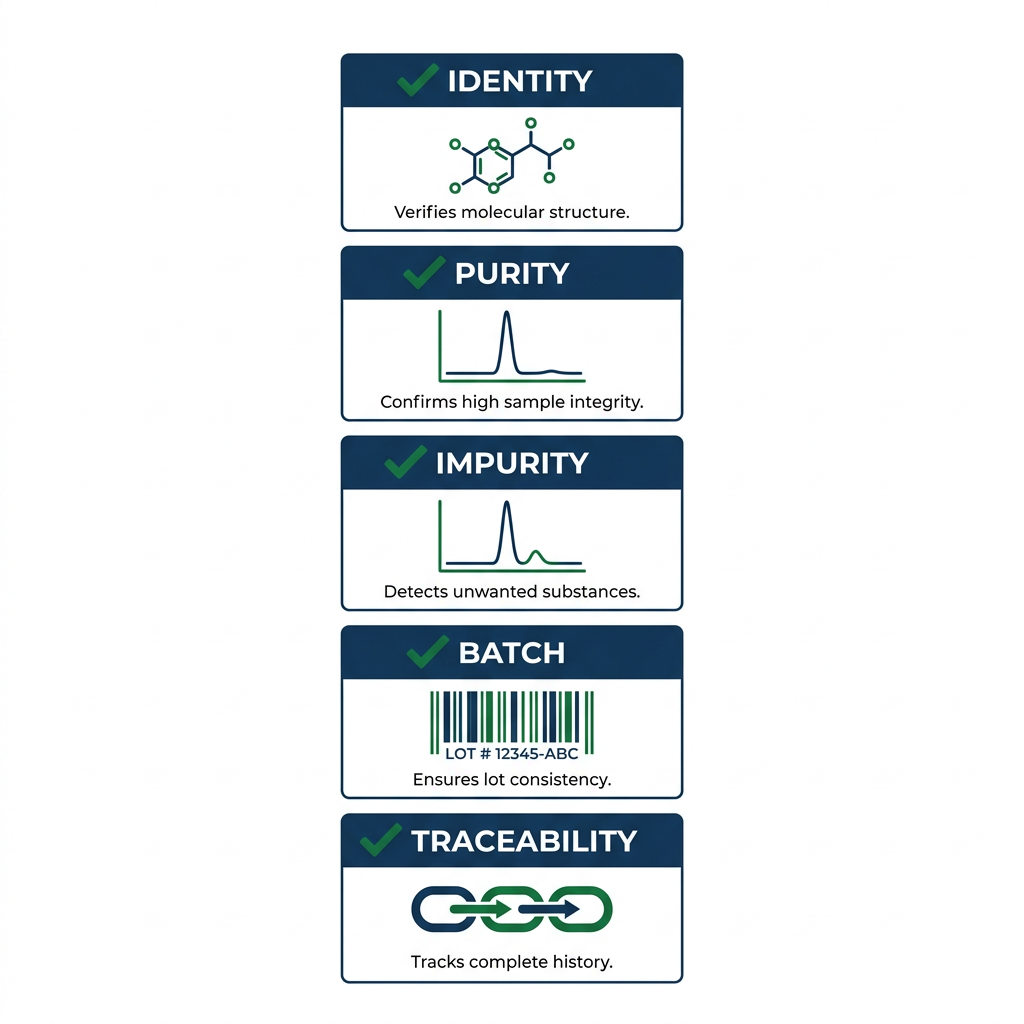
Peptide research controls are not a single test. They are a coordinated system of independent analytical checks and documentation practices that answer five non-negotiable questions: What is the peptide? How pure is it under the chosen method? What else is present? Does this batch match prior batches? Can every result be traced back to a specific batch, method, and reference point?
That sounds basic, yet it is where a surprising amount of research risk sits. A chromatogram may suggest high purity, yet that alone does not prove the amino acid sequence is correct. A mass signal may match the expected molecular weight, yet it may say little about low-level impurities that influence activity or stability. Good peptide research controls work as a system rather than a single metric, and when answers conflict, the data is already warning the lab before a biological readout is trusted.
For a broader view of how these controls fit into a full reference workflow, see our Peptide Research Library: A Complete Reference Guide.
What should peptide research controls verify?
A practical peptide research controls strategy has one aim: verify the sample from multiple angles so that key claims do not depend on a single test. Regulatory and standards bodies have long supported this logic. FDA guidance for active pharmaceutical ingredients emphasizes appropriate testing against specifications and control of impurity classes, including organic impurities, inorganic impurities, and residual solvents. That mindset applies directly to research quality as well.
When a peptide enters a study, the control framework should be able to answer a short list of non-negotiable questions.
- Identity: Confirms what the peptide is.
- Chromatographic purity: Estimates how much of the sample behaves as the main component under the chosen method.
- Impurity profile: Asks what else is present.
- Batch consistency: Checks whether repeated material stays comparable over time.
- Stability during storage: Verifies the sample remains fit for use under defined conditions.
- Traceable documentation: Ties every result back to a specific batch, method, and reference point.
Each item contributes something different. Identity confirms what the peptide is. Purity estimates how much of the sample behaves as the main component under the chosen method. Impurity profiling asks what else is present. Batch consistency checks whether repeated material stays comparable over time. Traceability ties every result back to a specific batch, method, and reference point. Without this layered approach, peptide research controls cannot distinguish a true change in material from a change in measurement.

💡 Key Takeaway: What should peptide research controls verify?
Why is HPLC purity alone not enough for peptide research quality?
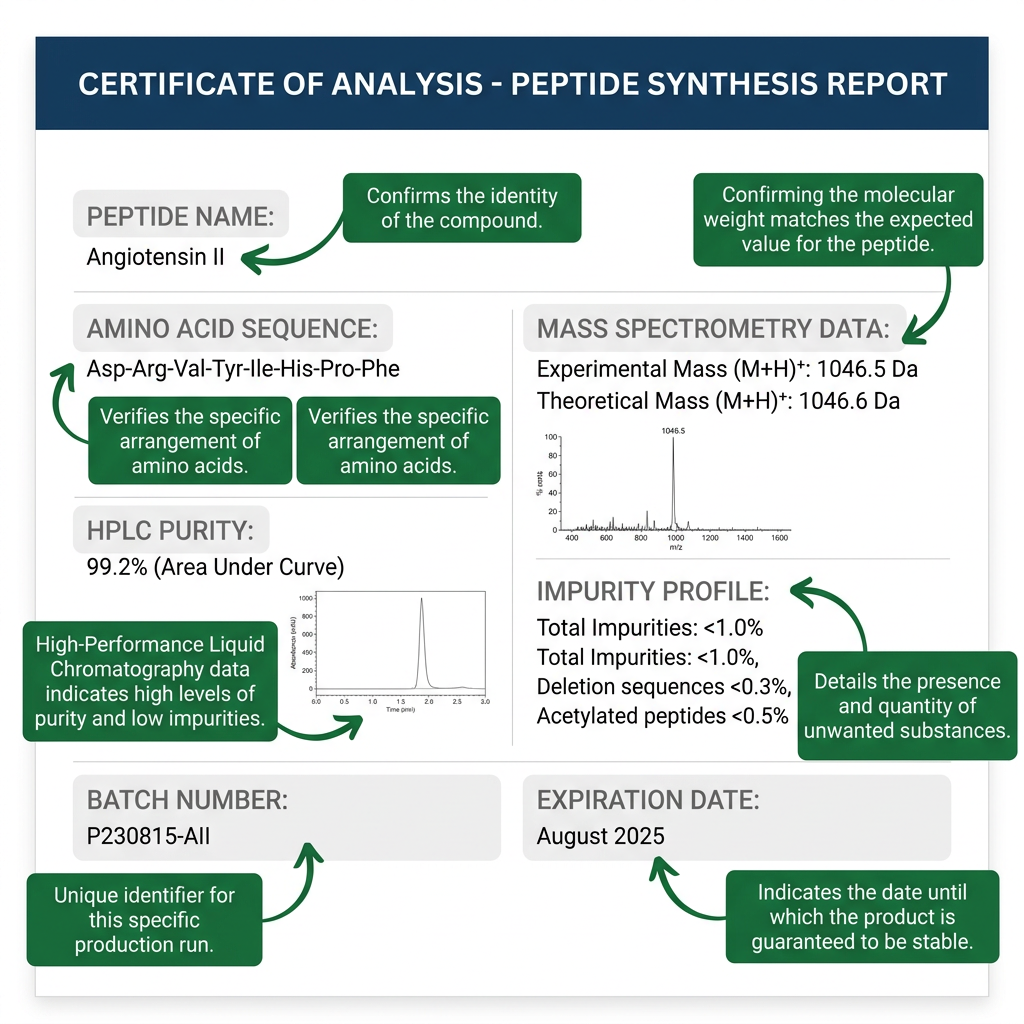
High-performance liquid chromatography is valuable, and often essential, for peptide work. It provides a practical view of chromatographic purity and can reveal obvious byproducts, degradation products, or process-related contaminants. A strong HPLC method is one of the first places researchers look.
Still, an HPLC purity percentage is only one layer of evidence.
The limitation is straightforward. HPLC measures separation under a specific chromatographic setup. It does not, by itself, confirm full molecular identity, prove the amino acid sequence, or guarantee that all relevant impurities are separated into distinct visible peaks. Two compounds can co-elute. A mass-confirming impurity may sit below an easy visual threshold. A sequence-related variant may require a different method to show up clearly.
That is why a headline purity number should never be treated as the whole quality story. It is a useful result, not a complete verdict. In robust peptide research controls, HPLC is one strong instrument in a coordinated set of controls. A typical research-grade peptide may report HPLC purity at or above 95%, but that value depends on column chemistry, mobile phase, gradient, detection wavelength, and integration parameters. If any of those change, the number can shift without a real change in the sample.
Analytical tool | Main question answered | What it does well | What it may miss if used alone
—|—|—|—
RP-HPLC | How much of the sample appears as the main chromatographic peak? | Estimates chromatographic purity and detects many visible impurities | Co-eluting impurities, sequence confirmation, exact molecular identity
LC-MS | Does the sample have the expected molecular weight? | Confirms molecular identity and detects mass-related variants | Some same-mass or near-isobaric issues, limited sequence-level proof
Peptide sequencing | Is the amino acid order correct? | Verifies sequence directly | May not quantify low-level impurities well
Reference standard comparison | Does the sample agree with a known material? | Supports calibration, harmonization, and method validation | Depends on the quality of the reference standard
Batch trend review | Is the batch consistent with prior material? | Detects drift across time and production history | Requires documented historical data
A mature peptide QC program treats HPLC as one strong instrument in a coordinated set of controls, not as a standalone verdict.

How does orthogonal analytical testing improve peptide research controls?
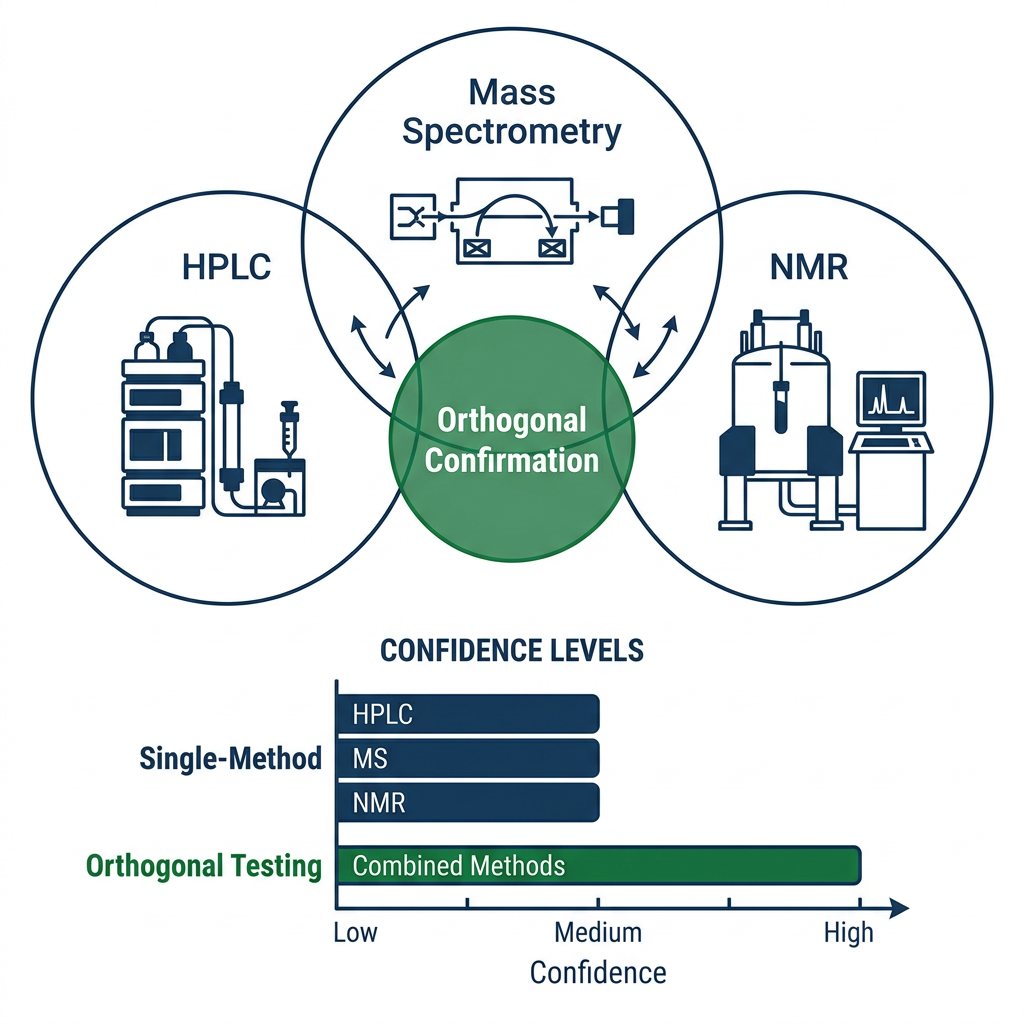
Orthogonal analytical testing means using different methods that rely on different scientific principles to examine the same sample. This matters because each technique has blind spots. When independent methods point to the same answer, confidence rises sharply.
In peptide work, a common trio is RP-HPLC, LC-MS, and sequencing. RP-HPLC addresses chromatographic purity. LC-MS checks molecular identity and expected mass. Sequencing confirms amino acid order. Together, they provide a much richer picture than any one of them can provide alone.
The strength of this approach is not simply redundancy. It is cross-verification. A sample that passes RP-HPLC but fails LC-MS presents a very different risk profile than a sample that passes both. A sample with correct mass but sequence ambiguity raises yet another set of concerns. Orthogonal testing turns those hidden uncertainties into visible analytical questions, which is exactly what peptide research controls are designed to do.
A useful way to think about it is this:
- RP-HPLC: Estimates chromatographic purity under defined separation conditions
- LC-MS: Confirms expected molecular weight and supports molecular identity
- Sequencing: Verifies the peptide sequence directly
- Additional methods: NMR, amino acid analysis, or specialized impurity assays can add depth when the application demands it
USP materials on synthetic peptide therapeutics reflect this same multi-method mindset. Peptide quality is assessed through a series of analytical tests, supported by well-characterized reference standards, and often informed by results from multiple laboratories when a standard is assigned a value. A mass accuracy of ±0.5 Da or better is common for peptide LC-MS, but that alone does not resolve all sequence ambiguities.
Why do reference standards and batch traceability strengthen peptide research controls?
Good measurements need anchors. That is the role of a reference standard.
Reference standards help labs calibrate methods, compare results between runs, and judge whether a new batch behaves like a known material. NIST describes reference materials as tools for unbiased calibration and validation, as well as for between-method harmonization and process stability assessment. In plain terms, they help turn isolated measurements into measurements that can be trusted over time.
This is especially valuable in peptide research, where minor shifts in synthesis, purification, handling, or storage can alter impurity patterns or apparent assay performance. Without a reliable reference point, a lab may notice a changed signal but struggle to tell whether the biology shifted, the assay drifted, or the peptide itself changed. Strong peptide research controls use reference standards to answer that question before it contaminates a dataset.
Batch traceability supports the same goal from a documentation angle. Every sample should connect clearly to a batch identifier, test methods, test dates, storage conditions, and a certificate of analysis. When a result needs review, traceability makes it possible to reconstruct what happened instead of guessing after the fact.

💡 Key Takeaway: Why do reference standards and batch traceability strengthen peptide research controls?
What should you review in a peptide certificate of analysis?
A certificate of analysis is often the first document a researcher sees, and it should be treated as more than a formality. A useful COA consolidates batch-specific analytical findings and shows how quality claims were generated. That allows the researcher to evaluate the evidence, not just accept a purity number at face value.
A strong COA should make the batch legible, especially within peptide research controls.
When reviewing a peptide COA, look for the following elements:
- Batch identification: A unique lot or batch number tied to the exact material in hand
- Analytical methods: Clear naming of methods used, such as RP-HPLC, LC-MS, or sequencing
- Results and specifications: Reported values paired with acceptance criteria where available
- Chromatographic data: Purity result plus supporting chromatogram or method details
- Molecular identity: Mass confirmation and expected molecular weight comparison
- Dates and handling details: Testing date, storage guidance, and relevant stability notes
If a COA is vague about methods, lacks batch specificity, or presents a single summary number with no analytical context, it should prompt caution. Good documentation does not guarantee a good peptide, but weak documentation is often the first sign that peptide research controls were not fully applied.
This is one reason our Peptide Library: Research-Grade Peptides for Laboratories emphasizes batch-level transparency.
Which storage and handling conditions support reliable peptide research controls?
Storage and handling are part of the control system, not an afterthought. Even a well-characterized peptide can degrade if stored improperly, and that degradation can create new impurities that no original COA would have seen.
For lyophilized research peptides, typical storage guidance includes:
- Store at -20°C or below, desiccated and protected from light
- Avoid repeated freeze-thaw cycles by aliquoting on first reconstitution
- Use appropriate solvents and buffers for reconstitution, and record the exact composition
- Keep a log of storage temperature, reconstitution date, and any observed changes
- Re-verify critical parameters if a sample has been stored beyond the documented stability window
These practices keep the analytical profile stable enough that peptide research controls remain meaningful over time. If storage conditions drift, apparent assay differences may reflect sample degradation rather than biological effect.
For peptides with known sensitivity, such as certain cell penetrating peptides, handling controls become even more important. See our Cell Penetrating Peptides for Research page for peptide-class-specific considerations.

How do you build a batch-to-batch consistency plan for peptide research controls?
Batch consistency is not about proving every batch is identical. It is about detecting drift before it becomes a data problem. A consistency plan compares each new batch against documented historical results and a reference standard, using the same methods and acceptance criteria.
A simple batch-to-batch review for peptide research controls includes:
- Trend the main HPLC purity result against prior batches and specification limits
- Overlay chromatograms or compare retention times for signature peaks
- Confirm expected molecular weight by LC-MS and compare mass accuracy to prior runs
- Review any new or enlarged impurity peaks, even if total purity remains high
- Document any change in synthesis route, purification method, or storage conditions
This approach is similar to how researchers compare peptide variants in a structured library context. For example, when comparing AOD 9604 vs Retatrutide, batch-level controls help separate true molecular differences from analytical noise.
When a batch trend moves outside historical ranges, the correct response is not to discard the data automatically. It is to investigate the peptide research controls themselves—method performance, reference standard stability, sample handling—before attributing the shift to the peptide.
💡 Key Takeaway: How do you build a batch-to-batch consistency plan for peptide research controls?
What documentation turns peptide research controls into a defensible data trail?
Documentation is what makes peptide research controls repeatable and auditable. Without it, even excellent analytical work becomes anecdotal. The documentation trail should allow a reviewer to reconstruct exactly which batch was tested, how it was tested, when it was tested, and what the results meant relative to specifications.
Minimum documentation elements include:
- Unique batch or lot number
- Test methods with instrument parameters and column details
- Raw data files or chromatograms, not just summary values
- Acceptance criteria and whether each result met them
- Reference standard lot and traceability
- Storage and reconstitution logs
- Date of testing and analyst or laboratory identifier
These records are especially important when research is repeated months later or transferred to another laboratory. Good peptide research controls do not rely on memory. They rely on a written trail that connects the sample in the vial to the data in the notebook.
Where do peptide research controls fit in the broader peptide research library?
Peptide research controls are not isolated from the rest of your peptide workflow. They interact with method development, reference standard selection, stability studies, and the broader organization of a peptide research library. A well-organized library should include batch-level control data alongside structural and functional information, so that every entry can be evaluated for quality before use.
This matters because different research questions require different levels of confidence. A screening library may tolerate a lower purity threshold than a mechanistic study using a single lead peptide. But even in screening, identity and traceability remain essential. Peptide research controls scale with the question being asked.
A useful way to integrate these controls is to treat each library entry as a mini-dossier: structure, sequence, purity, impurity profile, reference standard comparison, storage history, and COA. Then, when a peptide shows an interesting result, the first question is not “what does this mean biologically?” but “do the peptide research controls support this result?”
For a complete reference on organizing research peptides, see the Peptide Research Library: A Complete Reference Guide again if needed.
Which common mistakes weaken peptide research controls?
Even well-intentioned labs can undermine peptide research controls by relying on a single metric, accepting a COA without reading it, or treating storage as trivial. Common mistakes include:
- Treating HPLC purity as proof of identity
- Assuming a mass match confirms the full sequence
- Ignoring low-level impurity peaks that do not lower total purity below a threshold
- Using a reference standard of unknown quality or expired lot
- Failing to record storage conditions or reconstitution details
- Comparing batches using different methods or acceptance criteria
Each mistake weakens the cross-verification that peptide research controls are supposed to provide. The result is not always an obvious failure. More often, it is a quiet drift in data quality that becomes visible only after many experiments.
To avoid this, treat peptide research controls as a living system: review COAs, trend batch data, re-validate methods when instruments change, and document every deviation. That is how good data starts—not with a single clean number, but with a sample that has earned confidence through layered evidence.
💡 Key Takeaway: Which common mistakes weaken peptide research controls?
FAQ
What are peptide research controls?
Peptide research controls are the analytical and documentation checks—identity, purity, impurity profiling, batch consistency, and traceability—that verify a research peptide sample before assay data is interpreted.
How many analytical methods should peptide research controls include?
No fixed number fits every project, but orthogonal testing with at least RP-HPLC, LC-MS, and sequencing is a practical baseline. Additional methods such as NMR or amino acid analysis can add depth when the application demands it.
Why is a certificate of analysis not enough by itself?
A COA is only as good as the methods and batch specificity behind it. If it lacks supporting chromatograms, acceptance criteria, or storage details, it cannot confirm that peptide research controls were fully applied.
What storage conditions protect research peptide integrity?
Lyophilized peptides should typically be stored at -20°C or below, desiccated, protected from light, and aliquoted to avoid repeated freeze-thaw cycles.
Are peptide research controls relevant for every peptide study?
Yes. Even screening libraries require identity and traceability, while mechanistic studies demand deeper impurity profiling and batch trend review. Peptide research controls scale with the question being asked.
Ready to Take the Next Step?
Every product includes lot-specific documentation and third-party purity testing.
Explore Our Research Products →Free shipping on qualifying orders · Batch COA on request