


Sermorelin vs CJC 1295: 7 Research Differences Today
Sermorelin vs CJC 1295: 7 Research Differences Today explained with FDA history, half-life data, and study endpoints. Research-use-only comparison.
📋 Table of Contents
Sermorelin vs CJC 1295: 7 Research Differences Today is not a simple substitution question. Sermorelin is the older GHRH(1-29) analog with FDA approval history in pediatric growth hormone deficiency, while CJC-1295 is a longer-acting investigational analog with published multi-day GH and IGF-I elevation in healthy adults. Researchers should treat them as separate tools, not interchangeable substitutes, because endpoints, half-life, and regulatory context differ sharply.
Key takeaways
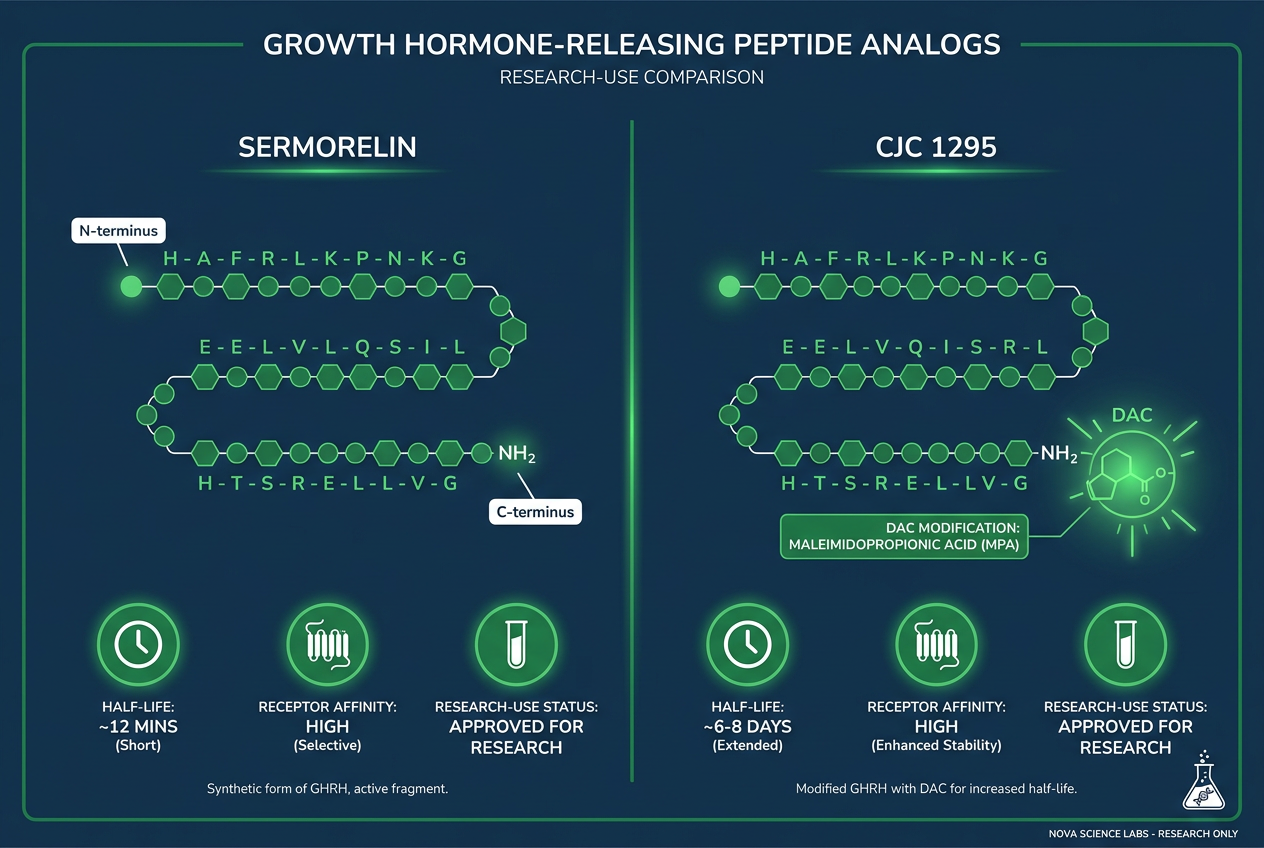
- Sermorelin vs CJC 1295: 7 Research Differences Today highlights sermorelin as a synthetic 29-amino-acid GHRH analog with documented pediatric FDA approval history, while CJC-1295 lacks FDA approval evidence in reviewed sources.
- CJC-1295 has a published human half-life estimate of 5.8 to 8.1 days, unlike sermorelin studies built around short-interval repeated dosing.
- In the most cited human CJC-1295 trial, a single subcutaneous dose increased GH 2- to 10-fold for 6 days or more and IGF-I 1.5- to 3-fold for 9 to 11 days.
- Sermorelin literature centers on children with short stature or pediatric growth hormone deficiency, while CJC-1295 human data often center on healthy adults after limited dosing.
- All comparisons remain research-use-only; no human consumption guidance or dosing recommendations are provided.
What is the main difference between Sermorelin vs CJC 1295: 7 Research Differences Today?
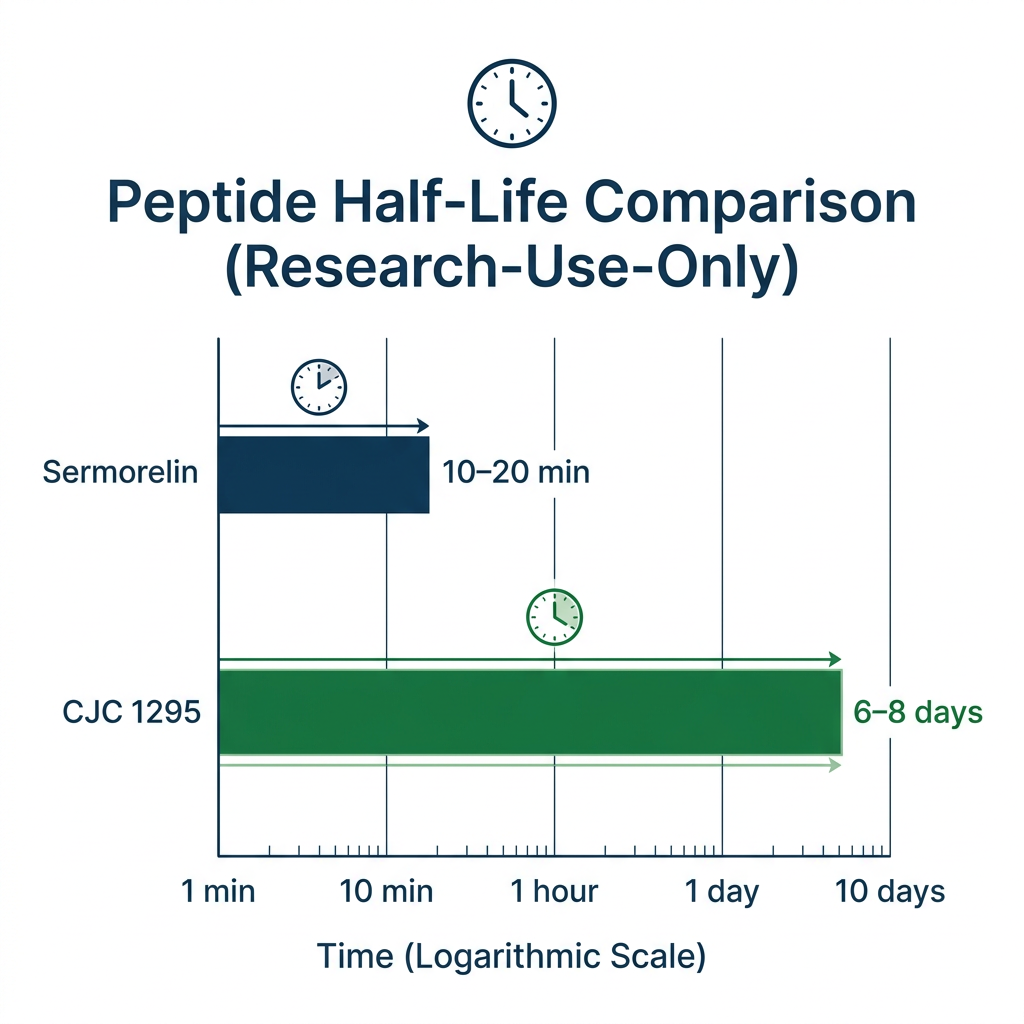
The core divide in Sermorelin vs CJC 1295: 7 Research Differences Today is regulatory and pharmacokinetic. Sermorelin is a short GHRH(1-29) analog with FDA approval history in pediatric growth hormone deficiency, while CJC-1295 is a longer-acting investigational analog studied for sustained GH and IGF-I elevation.
Sermorelin comes from the older GHRH fragment literature and is best understood as a pituitary stimulant with a documented pediatric regulatory history. CJC-1295 sits in a different lane: it is primarily discussed as a modified GHRH analog designed to extend activity, especially in the Drug Affinity Complex, or DAC, form.
A common misconception is that both peptides are basically natural GH boosters and can be read the same way. They cannot. Sermorelin research often asks whether repeated stimulation can support growth-related outcomes over months in children. CJC-1295 research often asks whether a single or limited exposure can sustain hormone elevation over days in adults.
Peptides Library describes sermorelin as a synthetic 29-amino-acid analog of GHRH, which is a useful reminder that its mechanism depends on pituitary stimulation rather than direct GH replacement. For a broader reference on peptide categories, see the Peptide Research Library: A Complete Reference Guide.
Which peptide lasts longer in the body?
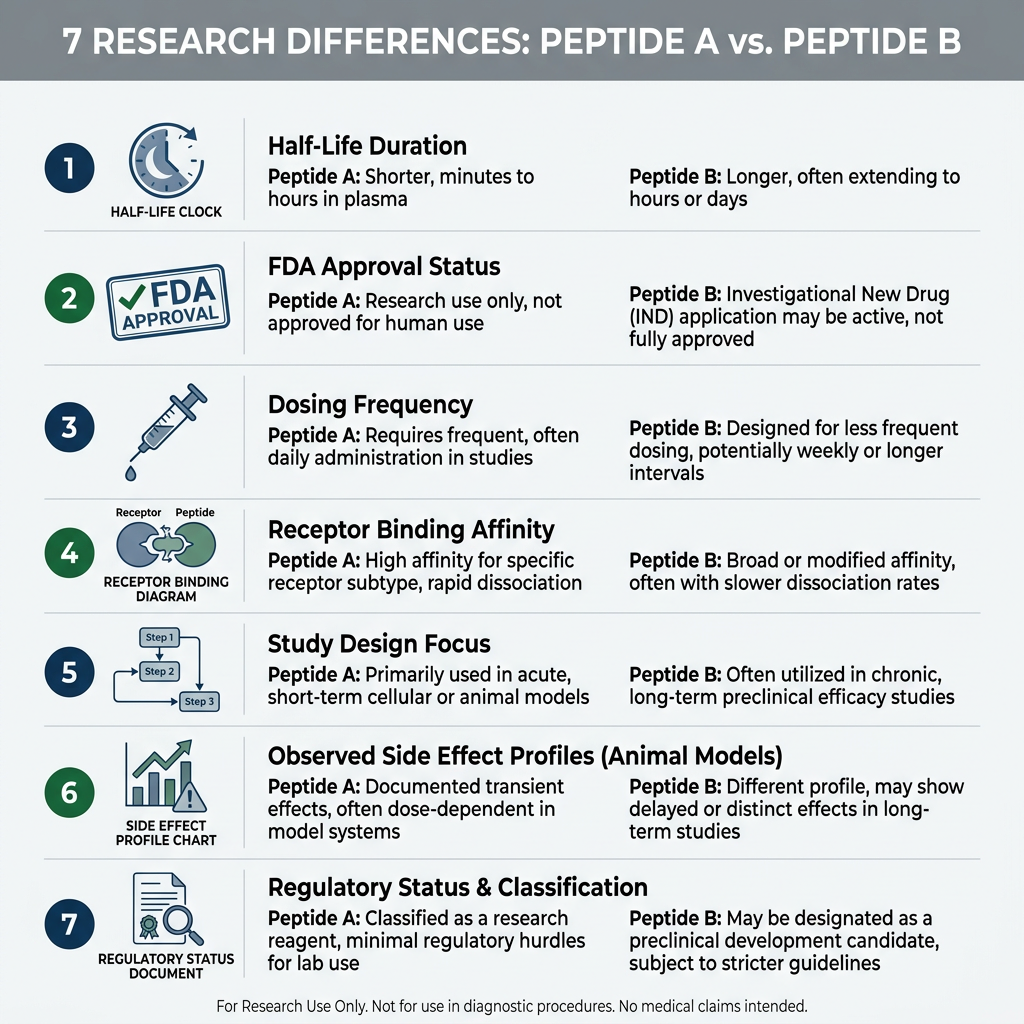
CJC-1295 lasts far longer in published human data. A PubMed trial reported an estimated half-life of 5.8 to 8.1 days, unlike sermorelin studies built around short-interval repeated dosing.
In the 2006 PubMed report, healthy adults receiving subcutaneous CJC-1295 showed dose-dependent GH increases for 6 days or more and IGF-I increases for 9 to 11 days. That duration is unusual for a GHRH-related peptide and is central to why CJC-1295 attracts attention in peptide research discussions.
Sermorelin studies do not present that same multi-day pharmacokinetic profile. Instead, the older pediatric literature describes once-daily or twice-daily subcutaneous injections over months. If a study needs a prolonged endocrine signal after a limited dose, CJC-1295 fits better. If a study needs repeated short-interval stimulation, sermorelin is the closer match.
Longer-acting does not automatically mean better. It means the exposure pattern is different, which changes both the question you can ask and the confounders you must manage. This distinction is one reason Sermorelin vs CJC 1295: 7 Research Differences Today matters for study design.
💡 Key Takeaway: Which peptide lasts longer in the body?
What are the 7 research differences between Sermorelin vs CJC 1295: 7 Research Differences Today?
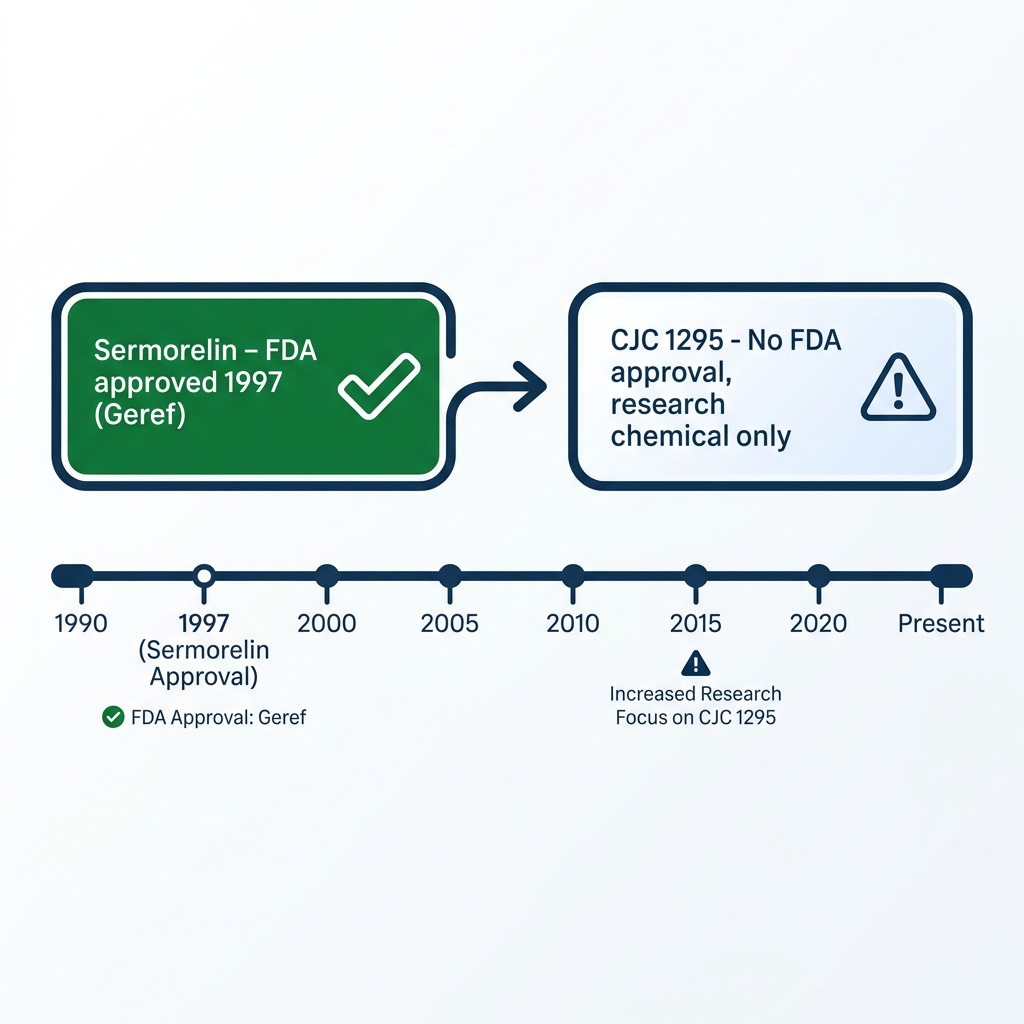
The seven biggest differences in Sermorelin vs CJC 1295: 7 Research Differences Today are regulatory status, half-life, exposure window, study populations, dosing pattern, endpoint type, and interpretation risk. Seen together, these differences explain why the peptides often get grouped together in online discussion yet separate quickly under closer review.
1. Regulatory history: Sermorelin has documented FDA approval history in pediatric growth hormone deficiency; CJC-1295 does not have FDA approval evidence in the sources reviewed.
2. Molecular behavior: Sermorelin is a short GHRH fragment analog; CJC-1295 is typically discussed as a longer-acting modified analog, especially in DAC form.
3. Estimated half-life: CJC-1295 has published human half-life estimates of 5.8 to 8.1 days; sermorelin literature highlighted here is better characterized by repeated dosing schedules than by multi-day persistence.
4. Hormone elevation window: CJC-1295 showed GH elevation for 6 days or more and IGF-I elevation for 9 to 11 days after a single dose in healthy adults.
5. Population studied: Sermorelin evidence here centers on children with short stature or pediatric growth hormone deficiency contexts; CJC-1295 human data highlighted here center on healthy adults.
6. Endpoint style: Sermorelin studies often track growth velocity over months; CJC-1295 studies often track pharmacodynamic markers like GH and IGF-I over days.
7. Interpretation risk: Directly comparing growth outcomes in children with hormone curves in adults can produce false equivalence.
These seven points are the backbone of Sermorelin vs CJC 1295: 7 Research Differences Today. Researchers who ignore any one of them risk designing a study that answers the wrong question.
How do you compare FDA approval and regulatory status step by step?
Start with FDA status. Peptides Library separates sermorelin from CJC-1295 here because sermorelin has documented FDA approval history for pediatric GHD, while CJC-1295 lacks FDA approval evidence in the sources reviewed.
Step 1 is to identify the approved indication, not just the peptide name. FDA records show sermorelin acetate, marketed as Geref, with a 1997 approval date in the orphan-drug database for idiopathic or organic growth hormone deficiency in children with growth failure. That is a very specific historical regulatory fact.
Step 2 is to separate pediatric and adult use. FDA also states that there are no growth hormone secretagogues approved for treatment of adult-onset or childhood-onset growth hormone deficiency in adults. That point is easy to miss, and it changes how claims should be framed.
Step 3 is to avoid a second misconception: lack of approval for these peptides is not the same as lack of approved treatment options in general. FDA states that multiple approved drug products exist for adults with growth hormone deficiency and for children with growth failure due to inadequate endogenous GH secretion. The regulatory landscape is broader than any single peptide. You can review general regulatory information at the FDA website.
Peptides Library keeps CJC-1295 in the investigational category because the commonly cited human evidence centers on prolonged hormone elevation, not an FDA-approved indication. This regulatory asymmetry is central to Sermorelin vs CJC 1295: 7 Research Differences Today.
How should you read the human study data step by step?
Read these studies by first checking the population, then the endpoint, then the time horizon. Healthy adults, prepubertal children, GH levels, IGF-I, and growth velocity are not interchangeable data points. This stepwise reading prevents the false equivalence that often plagues Sermorelin vs CJC 1295: 7 Research Differences Today discussions.
Step 1 is population. The best-known CJC-1295 human trials were randomized, placebo-controlled, double-blind, ascending-dose studies in healthy adults. The sermorelin-related studies highlighted here involved children with short stature or pediatric deficiency contexts.
Step 2 is endpoint selection. In CJC-1295 studies, the endpoints were hormone changes after dosing. In sermorelin studies, one key outcome was growth velocity over 9 to 12 months. Those are different layers of evidence. A stronger acute GH signal does not automatically predict a superior longitudinal growth outcome.
Step 3 is time horizon. A multi-day IGF-I rise tells you something about persistence. A year of repeated injections tells you something about sustained treatment exposure and adaptation. If you collapse those into one effectiveness bucket, the comparison loses scientific value.
For laboratories evaluating peptide research tools, the Peptide Library: Research-Grade Peptides for Laboratories page offers context on how research-grade materials are categorized.
💡 Key Takeaway: How should you read the human study data step by step?
How do dosing schedules differ in the published literature?
Published sermorelin-related studies use repeated subcutaneous dosing, while CJC-1295 human data highlighted here show prolonged effects after a single subcutaneous dose. This dosing contrast is one of the most practical points in Sermorelin vs CJC 1295: 7 Research Differences Today.
In a 12-month study of 18 prepubertal children with idiopathic short stature, GHRH(1-29)NH2 was given at 20 micrograms/kg by twice-daily subcutaneous injection. In an earlier nine-month study in boys with short stature, GRF(1-29)NH2 was used at 3 to 4 micrograms/kg subcutaneously once daily or twice daily, followed later by a higher-dose once-daily period.
CJC-1295 stands apart because the cited adult trials focused on ascending single-dose exposure and then tracked endocrine effects over several days. That tells you the peptide is suited to a different kind of pharmacology question.
A practical tip: dosing frequency is not just a convenience issue. It shapes receptor exposure, peak-trough behavior, and how easy it is to separate signal from noise in a study design.
Why does the research-use-only distinction matter for Sermorelin vs CJC 1295: 7 Research Differences Today?
Sermorelin vs CJC 1295: 7 Research Differences Today exists only in a research-use context. Neither peptide should be discussed as a human consumption product, and no dosing guidance is appropriate outside approved clinical protocols or laboratory studies.
Peptides Library maintains a research-use-only framing because the published human data come from controlled trials with specific inclusion criteria, not from general consumer use. The CJC-1295 2006 trial, for example, enrolled healthy adults under double-blind, placebo-controlled conditions, which limits how broadly the findings can be generalized.
Sermorelin’s pediatric approval history also does not translate into general adult research recommendations. FDA explicitly notes no approved growth hormone secretagogue for adult GHD, so any adult-related claim must be read as investigational only.
This distinction protects the integrity of Sermorelin vs CJC 1295: 7 Research Differences Today. When researchers ignore research-use-only framing, they risk conflating historical approval with current safety or efficacy claims.
Which study design fits which peptide?
If your study needs a short, repeatable pituitary stimulus with pediatric growth endpoints, sermorelin-related designs fit better. The published sermorelin literature uses twice-daily or once-daily subcutaneous dosing over months and tracks growth velocity as a primary outcome.
If your study needs a prolonged endocrine signal after limited exposure in adults, CJC-1295 designs fit better. The published CJC-1295 data show sustained GH and IGF-I elevation after a single subcutaneous dose, with an estimated half-life of 5.8 to 8.1 days.
Choosing between them is not a value judgment. It is a question of matching the exposure pattern to the research question. Sermorelin vs CJC 1295: 7 Research Differences Today is fundamentally about that matching process.
For researchers comparing other peptide pairs with similar logic, the AOD 9604 vs Retatrutide: 7 Research Differences Today article applies a parallel stepwise method.
💡 Key Takeaway: Which study design fits which peptide?
What should laboratories check before using either peptide?
Before using either peptide in a laboratory setting, verify the peptide sequence, purity documentation, and solubility requirements. For CJC-1295, confirm whether the material is the DAC or non-DAC form, because the half-life profile differs substantially.
For sermorelin, confirm the exact fragment and salt form. Sermorelin acetate, as referenced in the 1997 FDA orphan-drug approval, is a specific molecular entity. Different salts or fragments are not automatically equivalent.
Storage conditions also differ. Long-acting peptides like CJC-1295 may require specific lyophilized storage and reconstitution buffers to maintain stability, while sermorelin studies often use fresh preparation before injection. Always follow the supplier’s certificate of analysis and peer-reviewed methods.
The Peptide Research Library: A Complete Reference Guide includes practical notes on verifying research-grade peptide materials. This verification step is essential for reproducible Sermorelin vs CJC 1295: 7 Research Differences Today experiments.
What are the most common interpretation errors in Sermorelin vs CJC 1295: 7 Research Differences Today?
The first error is assuming that a longer half-life automatically means better efficacy. CJC-1295’s 5.8 to 8.1 day half-life is a pharmacokinetic property, not a clinical outcome. Sermorelin’s shorter activity window is paired with repeated dosing designs that measure growth velocity over months.
The second error is comparing pediatric growth outcomes with adult hormone curves. Sermorelin studies often involve prepubertal children with idiopathic short stature, while CJC-1295 studies involve healthy adults. These populations have different endocrine baselines, regulatory contexts, and safety profiles.
The third error is ignoring regulatory status. Sermorelin has a documented FDA approval history in pediatric GHD, but that approval does not extend to adult use. CJC-1295 has no FDA approval evidence in the sources reviewed, which means all claims must remain investigational.
The fourth error is treating both peptides as direct substitutes in a protocol. Sermorelin vs CJC 1295: 7 Research Differences Today shows that half-life, dosing frequency, and endpoint type all differ enough to make direct substitution scientifically invalid.
How do the molecular structures differ?
Sermorelin is a synthetic 29-amino-acid analog of the naturally occurring growth hormone-releasing hormone, specifically representing the GHRH(1-29) fragment. This shorter sequence retains pituitary-stimulating activity but has a shorter biological half-life than the full-length hormone.
CJC-1295 is a modified GHRH analog, often discussed in the Drug Affinity Complex form. The DAC modification binds to serum albumin after subcutaneous injection, which extends the peptide’s presence in circulation and produces the multi-day half-life observed in published human data.
These structural differences explain the divergent dosing schedules. Sermorelin requires frequent administration to maintain a pulsatile signal, while CJC-1295 produces a prolonged exposure after a single dose.
Understanding structure is a prerequisite for interpreting Sermorelin vs CJC 1295: 7 Research Differences Today. Without it, researchers may confuse extended half-life with a different mechanism of action.
💡 Key Takeaway: How do the molecular structures differ?
What does the 2006 CJC-1295 human trial actually show?
The 2006 PubMed trial, available at PubMed, enrolled healthy adults in a randomized, placebo-controlled, double-blind, ascending-dose design. After a single subcutaneous dose of CJC-1295, researchers observed dose-dependent GH increases for 6 days or more and IGF-I increases for 9 to 11 days.
The estimated half-life range was 5.8 to 8.1 days, which is substantially longer than unmodified GHRH-related peptides. These findings established the prolonged endocrine exposure profile that defines CJC-1295 in research discussions.
However, this trial measured pharmacodynamic markers, not long-term growth outcomes. The absence of pediatric growth velocity data is a key limitation when comparing CJC-1295 with sermorelin.
Sermorelin vs CJC 1295: 7 Research Differences Today uses this trial as the central human CJC-1295 evidence because it is the most cited source for multi-day GH and IGF-I elevation.
What does the sermorelin pediatric literature show?
The sermorelin-related pediatric literature centers on children with short stature or pediatric growth hormone deficiency. One 12-month study of 18 prepubertal children with idiopathic short stature used GHRH(1-29)NH2 at 20 micrograms/kg by twice-daily subcutaneous injection and tracked growth velocity as a key outcome.
An earlier nine-month study in boys with short stature used GRF(1-29)NH2 at 3 to 4 micrograms/kg subcutaneously once daily or twice daily, followed later by a higher-dose once-daily period. These studies reflect a repeated-stimulation model rather than a prolonged single-exposure model.
The regulatory milestone for sermorelin is the 1997 FDA orphan-drug approval of sermorelin acetate as Geref for idiopathic or organic growth hormone deficiency in children with growth failure. This approval history gives sermorelin a distinct evidentiary base.
These pediatric data are not directly comparable to adult CJC-1295 pharmacodynamic studies, which is why Sermorelin vs CJC 1295: 7 Research Differences Today emphasizes population separation.
How can researchers avoid false equivalence?
False equivalence happens when researchers compare a pediatric growth outcome with an adult hormone curve and call it the same endpoint. To avoid this, always state the population, endpoint, and time horizon before making any comparison.
Use a comparison table or checklist. For example, list regulatory status, half-life, dosing frequency, study population, and primary endpoint for each peptide. If any row does not match, the comparison is not one-to-one.
Another safeguard is to cite primary sources rather than secondary summaries. The 2006 CJC-1295 trial and the FDA orphan-drug database for sermorelin are specific, verifiable references that reduce interpretive drift.
Sermorelin vs CJC 1295: 7 Research Differences Today is not about ranking one peptide above the other. It is about preventing the kind of collapsed comparison that erases important scientific distinctions.
💡 Key Takeaway: How can researchers avoid false equivalence?
What role does the Drug Affinity Complex play?
The Drug Affinity Complex, or DAC, is the modification most often associated with CJC-1295. It allows the peptide to bind reversibly to serum albumin, which slows clearance and produces the multi-day half-life reported in human data.
Sermorelin does not have this DAC modification. Its shorter half-life means the peptide is cleared more quickly, which is why published studies use repeated daily or twice-daily dosing.
The DAC distinction is important for laboratory sourcing. CJC-1295 with DAC and CJC-1295 without DAC are not identical research materials, and their pharmacokinetic profiles differ. Always verify which form is referenced in the study you are replicating.
This molecular detail is often overlooked in Sermorelin vs CJC 1295: 7 Research Differences Today discussions, yet it directly affects exposure duration and study design.
Are there any approved adult indications for these peptides?
No. FDA states that there are no growth hormone secretagogues approved for treatment of adult-onset or childhood-onset growth hormone deficiency in adults. This statement applies to both sermorelin and CJC-1295 in the adult context.
Sermorelin’s FDA approval history is specifically pediatric, for idiopathic or organic growth hormone deficiency in children with growth failure. That approval does not transfer to adult indications.
CJC-1295 has no FDA approval evidence in the sources reviewed. Its human data come from investigational pharmacodynamic trials in healthy adults, not from approved therapeutic use.
This regulatory boundary is a core part of Sermorelin vs CJC 1295: 7 Research Differences Today. Any adult-use claim must remain research-only and investigational.
What should a researcher document before starting a comparative study?
Before starting a comparative study, document the peptide source, batch number, purity certificate, storage conditions, and reconstitution method. For sermorelin, record the exact salt form and fragment. For CJC-1295, record whether DAC is present.
Define the primary endpoint before data collection begins. If the endpoint is growth velocity over months, sermorelin-related designs are more aligned with published literature. If the endpoint is multi-day GH or IGF-I elevation after a single dose, CJC-1295 designs are more appropriate.
State the population clearly. Healthy adults and prepubertal children have different endocrine physiology and regulatory considerations. Mixing them in a single comparison invalidates the conclusion.
Finally, cite the primary human data. The 2006 CJC-1295 trial and the FDA orphan-drug record for sermorelin are foundational references for Sermorelin vs CJC 1295: 7 Research Differences Today.
💡 Key Takeaway: What should a researcher document before starting a comparative study?
How do storage and handling differ in practice?
Sermorelin studies often involve fresh preparation before subcutaneous injection, with storage conditions aligned to short-term use. Because the peptide is used repeatedly, researchers typically prepare doses frequently and follow stability guidelines specific to the acetate salt.
CJC-1295, especially the DAC form, may require lyophilized storage at controlled temperatures and careful reconstitution to preserve the albumin-binding modification. Improper handling can degrade the peptide and alter the half-life profile.
Always consult the supplier’s certificate of analysis and peer-reviewed methods before designing storage protocols. The Cell Penetrating Peptides for Research | Peptides Library page provides additional context on peptide handling in laboratory settings.
Storage is not a minor detail. In Sermorelin vs CJC 1295: 7 Research Differences Today, handling errors can introduce variability that mimics or masks real pharmacokinetic differences.
What are the limits of the existing human data?
The existing human data for CJC-1295 come primarily from a small number of healthy adult volunteers in ascending-dose trials. These studies measured hormone levels over days, not long-term growth or safety outcomes over years.
The sermorelin pediatric data include growth velocity outcomes over 9 to 12 months, but they are limited to specific pediatric populations with short stature. These studies do not address adult pharmacodynamics or prolonged single-dose exposure.
Neither dataset provides a complete picture for all research questions. CJC-1295 lacks long-term pediatric growth data, while sermorelin lacks multi-day single-dose adult exposure data.
Recognizing these limits is essential for honest interpretation of Sermorelin vs CJC 1295: 7 Research Differences Today. No single study can answer every comparative question.
How should researchers cite the key sources?
Cite the 2006 CJC-1295 trial using its PubMed identifier, 17018654, when discussing multi-day GH and IGF-I elevation and the 5.8 to 8.1 day half-life. This is the primary source for the prolonged exposure profile.
Cite the FDA orphan-drug database record for sermorelin acetate, marketed as Geref, with the 1997 approval date for pediatric growth hormone deficiency. This is the primary regulatory source for sermorelin’s approval history.
For the pediatric sermorelin dosing studies, reference the 12-month study of 18 prepubertal children with idiopathic short stature using 20 micrograms/kg twice-daily subcutaneous GHRH(1-29)NH2, and the nine-month study using 3 to 4 micrograms/kg once or twice daily.
Proper citation is part of the research-use-only discipline in Sermorelin vs CJC 1295: 7 Research Differences Today. It keeps claims verifiable and prevents drift into unsupported generalizations.
💡 Key Takeaway: How should researchers cite the key sources?
FAQ
What is the half-life difference between sermorelin and CJC-1295?
CJC-1295 has a published human half-life estimate of 5.8 to 8.1 days based on the 2006 PubMed trial. Sermorelin literature does not present a comparable multi-day half-life; instead, studies use repeated daily or twice-daily dosing to maintain stimulation.
Is CJC-1295 FDA approved?
No. CJC-1295 has no FDA approval evidence in the sources reviewed. It remains an investigational analog. Sermorelin, by contrast, has a 1997 FDA orphan-drug approval history for pediatric growth hormone deficiency under the brand name Geref.
Why does Sermorelin vs CJC 1295: 7 Research Differences Today matter for study design?
Because the two peptides differ in half-life, dosing frequency, study population, endpoint type, and regulatory status. Choosing one over the other changes the research question you can answer and the confounders you must manage.
Can sermorelin and CJC-1295 be used interchangeably in research?
No. Sermorelin is a short GHRH(1-29) analog suited to repeated-stimulation pediatric designs, while CJC-1295 is a longer-acting modified analog suited to prolonged single-exposure adult designs. They are not direct substitutes.
What did the 2006 CJC-1295 human trial show?
A single subcutaneous dose in healthy adults increased GH 2- to 10-fold for 6 days or more and IGF-I 1.5- to 3-fold for 9 to 11 days, with an estimated half-life of 5.8 to 8.1 days. The trial was randomized, placebo-controlled, and double-blind.
Ready to Take the Next Step?
Every product includes lot-specific documentation and third-party purity testing.
Explore Our Research Products →Free shipping on qualifying orders · Batch COA on request