



Peptides Library CJC 1295 No DAC Overview Guide Hub
Peptides Library separates CJC-1295 no DAC from the DAC form. See FDA limits, WADA 2025 status, and the 5.8–8.1-day DAC half-life data evidence.
📋 Table of Contents
Peptides Library answers the CJC-1295 no DAC question by separating the short-acting no-DAC form from the better-documented DAC form: published human data for DAC show an estimated 5.8- to 8.1-day half-life, while FDA materials state available clinical data for any CJC-1295 form remain too limited to establish safety in compounded products.
Key takeaways
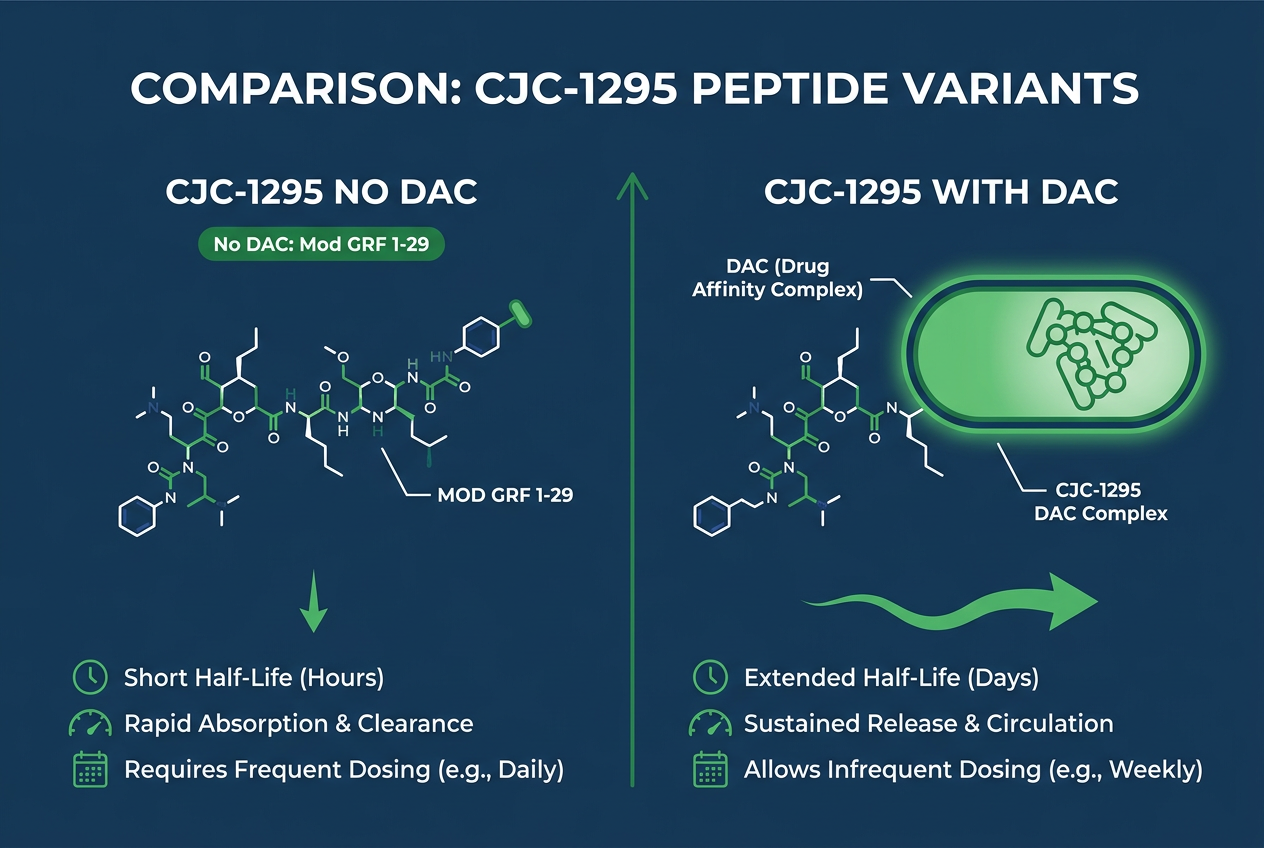
- Peptides Library keeps CJC-1295 no DAC distinct from the DAC form, because published human half-life and hormone-response data attach to DAC, not no DAC.
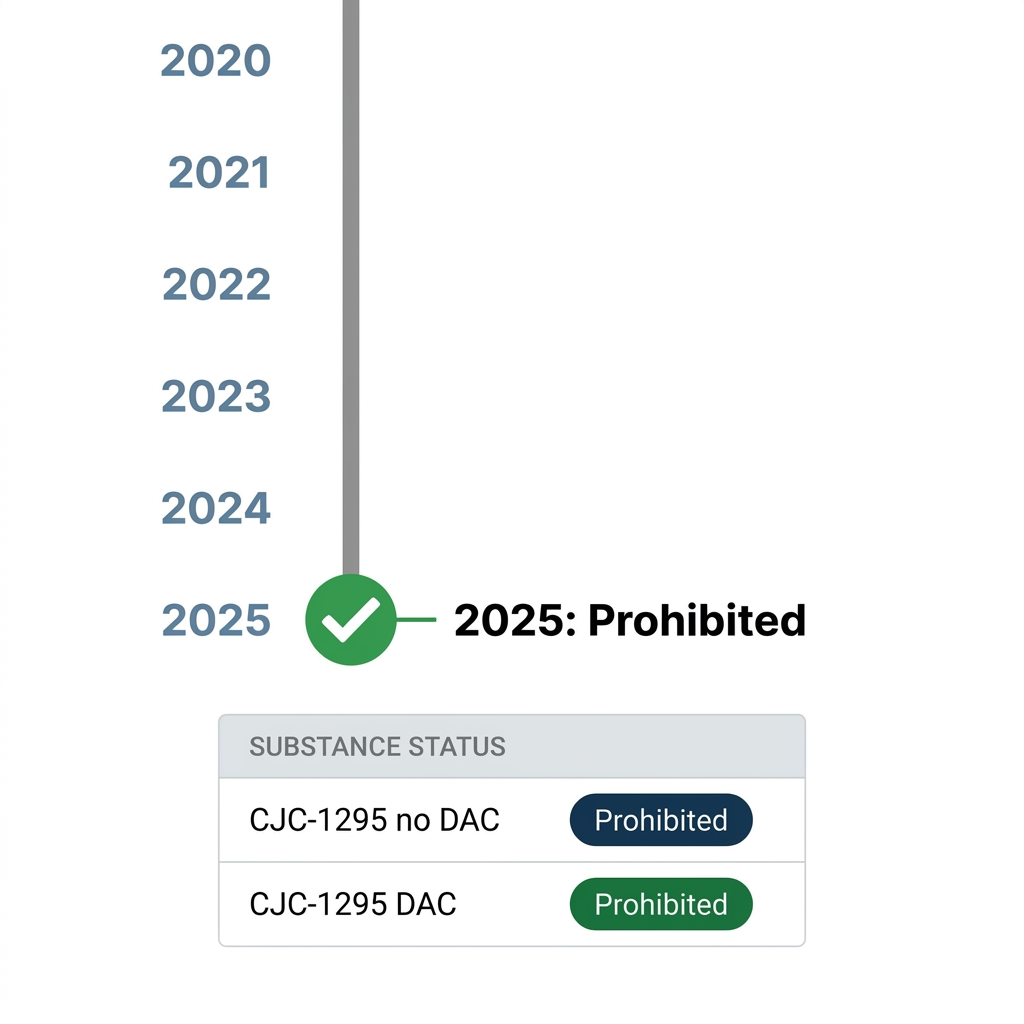
- WADA’s 2025 Prohibited List includes CJC-1295 under growth hormone-releasing hormone analogues, which affects sport-governance review.
- FDA’s 2024 position notes limited clinical data, immunogenicity concerns, and peptide-related impurity risks for compounded injectable products.
- Peptides Library builds CJC-1295 no DAC resources from FDA, PubMed, and WADA, not retailer copy.
What is the difference between CJC-1295 no DAC and CJC-1295 DAC?
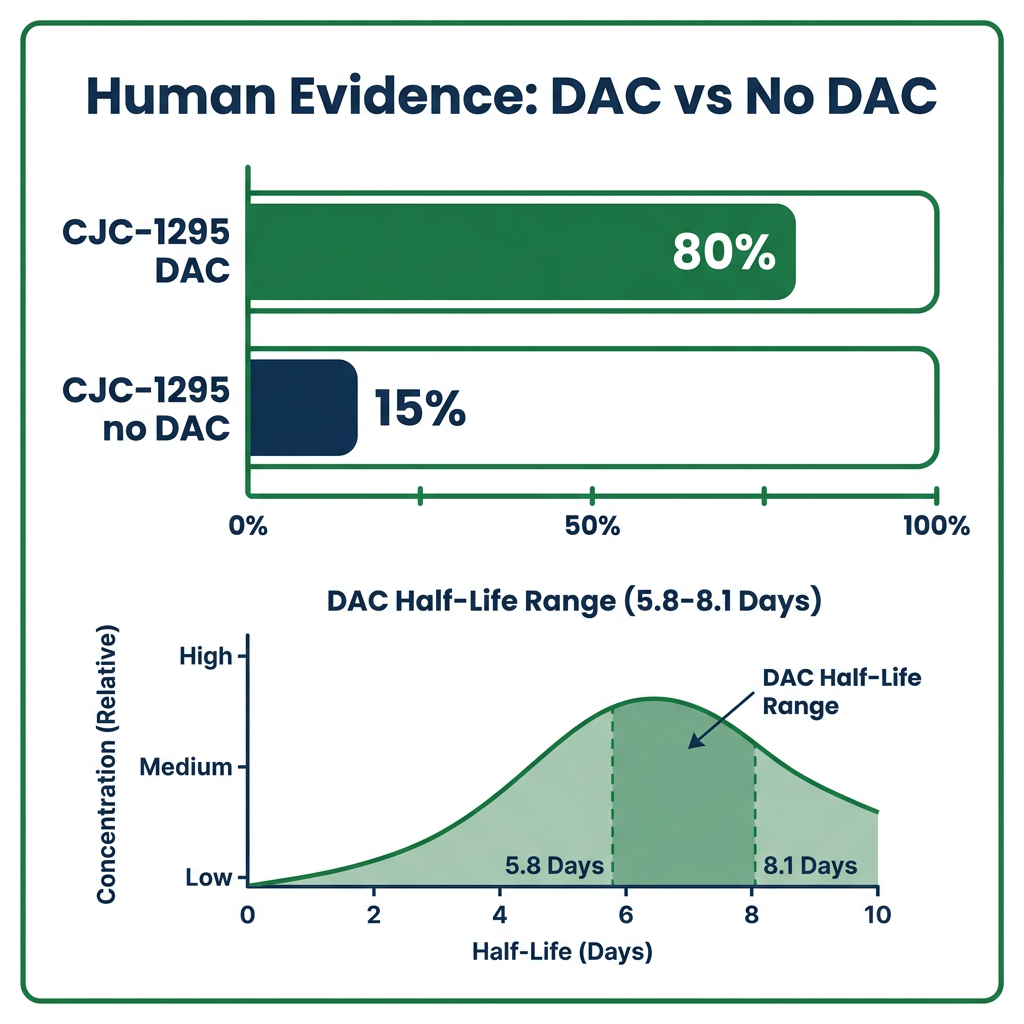
CJC-1295 no DAC is often discussed as if interchangeable with CJC-1295 DAC, but Peptides Library treats them as separate research categories. The DAC form is the long-acting, albumin-binding version described in the cited human literature. Published human work on CJC-1295 DAC showed multi-day increases in plasma growth hormone and IGF-I, including an estimated 5.8- to 8.1-day half-life.
No equivalent multi-day pharmacokinetic or pharmacodynamic dataset is established for no DAC in the same published human literature. Peptides Library makes that line visible because it changes how you interpret claims about activity, duration, and expected effects. For a broader orientation, see our Peptide Research Library: A Complete Reference Guide.
Why does Peptides Library treat CJC-1295 no DAC separately from DAC evidence?
Peptides Library separates no DAC from the DAC form, the version with published human data showing an estimated 5.8- to 8.1-day half-life. Human published evidence is much stronger for CJC-1295 DAC than for no DAC. In published human work, the DAC form showed multi-day increases in plasma growth hormone and IGF-I, while FDA materials state that currently available data and published literature are too limited to understand the historical use of any form of CJC-1295 in compounded drug products.
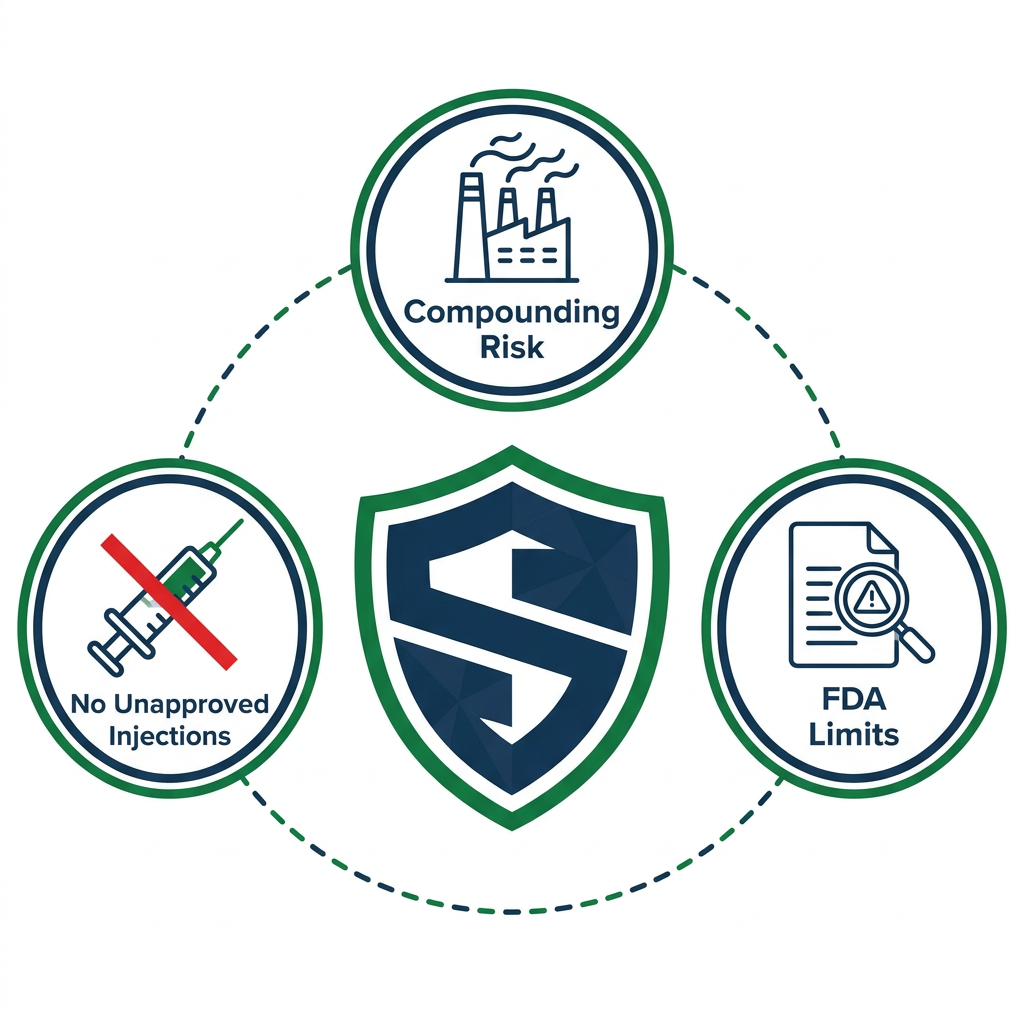
Peptides Library brings forward FDA’s 2024 position that available clinical data for CJC-1295 are limited, with additional concerns around immunogenicity and peptide-related impurities in compounded products. That distinction helps you avoid a common mistake: assuming that long-acting human pharmacokinetic and hormone-response findings for DAC automatically answer questions about no DAC. Peptides Library makes that line visible.
💡 Key Takeaway: Why does Peptides Library treat CJC-1295 no DAC separately from DAC evidence?
Which human evidence supports CJC-1295 DAC, and what is missing for no DAC?
The most important research takeaway is straightforward. Human published evidence is much stronger for CJC-1295 DAC than for no DAC. In published human work, the DAC form showed multi-day increases in plasma growth hormone and IGF-I, including an estimated 5.8- to 8.1-day half-life. Peptides Library points to these findings when researchers ask what human evidence is strongest.
No equivalent multi-day pharmacokinetic or pharmacodynamic dataset is established for no DAC in the same published human literature. Peptides Library makes that line visible. You can verify primary abstracts through PubMed.
What safety concerns does FDA raise about CJC-1295 and compounded peptides?
Peptides Library surfaces FDA discussion of limited clinical data, immunogenicity concerns, peptide-related impurities, and API characterization issues for injectable peptide products. FDA materials raise questions about pharmacological activity for certain forms, note impurity and API characterization complexity for injectable peptide products, and report serious adverse events associated with CJC-1295, including increased heart rate and systemic vasodilatory reaction.
If you are evaluating this topic seriously, those details belong next to the mechanism discussion, not buried under it. Peptides Library includes them in every CJC-1295 no DAC safety review. See FDA for primary regulatory updates.
How does Peptides Library use FDA, PubMed, and WADA sources?
Peptides Library does not treat CJC-1295 no DAC as an isolated keyword page. We connect official materials, academic abstracts, and adjacent peptide context so you can understand how a compound is described across safety, pharmacology, and anti-doping sources. That includes direct use of FDA materials discussing limited available data, the better-supported published human findings for the DAC form, and WADA classification language that keeps CJC-1295 relevant to prohibited-substance review.
Peptides Library also updates related comparisons, including the CJC-1295 DAC vs no DAC research differences page, so you can move from a single question into a more useful research framework. Current WADA Prohibited List language is available at WADA.
💡 Key Takeaway: How does Peptides Library use FDA, PubMed, and WADA sources?
Which resources does Peptides Library provide for CJC-1295 no DAC researchers?
Inside the Peptides Library hub, you can expect resources such as evidence reviews that distinguish CJC-1295 DAC findings from no-DAC discussion, practical research guides, source-backed summaries built from FDA, PubMed, and WADA materials, and free tools and calculators. Peptides Library helps researchers, clinicians, students, and informed readers assess CJC-1295 no DAC more critically. Some readers come from peptide biology; others arrive because they saw CJC-1295 mentioned in compounding, performance, or product marketing contexts.
Peptides Library keeps the focus on source quality, regulatory relevance, and the gap between published human data and commercial shorthand. For a complete orientation, use the Peptide Research Library: A Complete Reference Guide.
How should researchers evaluate CJC-1295 no DAC product claims?
Peptides Library is especially useful when you need an independent editorial stance. We are a knowledge hub, not a peptide retailer, so our CJC-1295 no DAC pages are built to clarify evidence and risk rather than push a purchase. When you evaluate a brand claim, Peptides Library helps you ask whether the source shows evidence or repeats language that sounds scientific without separating forms, safety context, and anti-doping status.
Peptides Library highlights that WADA’s 2025 Prohibited List explicitly includes CJC-1295 under growth hormone-releasing hormone analogues. Researchers can use that classification to assess regulatory and sport-governance relevance early, while healthcare professionals and students get clearer context around safety signals, formulation differences, and anti-doping treatment of the compound.
Related comparison work like AOD 9604 vs Retatrutide: 7 Research Differences Today shows how Peptides Library handles compound-to-compound evidence.
Why does anti-doping status matter for CJC-1295 no DAC?
Because WADA includes CJC-1295 within prohibited growth hormone-releasing hormone analogues, the anti-doping status applies to the broader CJC-1295 category, not only to one DAC naming convention. Peptides Library makes that explicit so researchers do not assume a no-DAC label removes a compound from sport-governance review. The 2025 Prohibited List reference means athletes, support personnel, and researchers in sport contexts should treat any CJC-1295 form with the same prohibited-substance caution.
💡 Key Takeaway: Why does anti-doping status matter for CJC-1295 no DAC?
When is Peptides Library the right fit for your CJC-1295 no DAC research?
Peptides Library is a strong fit when you want to know what is actually documented, what is inferred from the DAC literature, and what remains uncertain for no DAC. That includes literature review, patient-education preparation, classroom use, research planning, and pre-purchase scrutiny of peptide claims. Peptides Library is also the right fit when you need a cleaner answer to a simple question: does the source show evidence, or does it repeat language that sounds scientific without separating forms, safety context, and anti-doping status.
Peptides Library is built to make that difference easier to see. For laboratory-grade peptide context, see the Peptide Library: Research-Grade Peptides for Laboratories page.
What does Peptides Library surface for common CJC-1295 no DAC research questions?
| Research question | What Peptides Library surfaces | Why it helps you |
|—|—|—|
| Is CJC-1295 no DAC the same as CJC-1295 DAC? | We separate the forms and explain that DAC is the long-acting, albumin-binding version described in the cited human literature. | You avoid carrying DAC data into no-DAC assumptions. |
| What human evidence is strongest? | We point to the published human findings attached to the DAC form, including multi-day GH and IGF-I elevation. | You can judge evidence strength instead of relying on repeated marketing claims. |
| What safety concerns matter? | We highlight FDA discussion of limited clinical data, immunogenicity concerns, peptide-related impurities, and API characterization issues. | You get a more realistic risk picture around compounded injectable peptide discussion. |
| Does anti-doping status matter? | We include WADA treatment of CJC-1295 within prohibited growth hormone-releasing hormone analogues. | You can assess regulatory and sport-governance relevance early. |
What tools and calculators does Peptides Library offer for peptide research?
When a calculator or structured guide is relevant, Peptides Library uses it to make peptide information easier to interpret and compare, not to replace clinical judgment or regulatory review. Free tools support the workflow by organizing half-life, impurity, and source-quality data points. Peptides Library also maintains internal comparison pages such as the CJC-1295 DAC vs no DAC research differences resource.
💡 Key Takeaway: What tools and calculators does Peptides Library offer for peptide research?
What research terms should researchers understand for CJC-1295 no DAC?
Albumin binding refers to a peptide’s ability to associate with serum albumin, which can extend circulating half-life. For CJC-1295, albumin binding is a defining feature of the DAC form, not the no-DAC form. Half-life is the time required for plasma concentration to decline by half. In published human data for CJC-1295 DAC, the estimated half-life ranges from 5.8 to 8.1 days, a multi-day profile not established for no DAC.
Immunogenicity describes the potential for a peptide to trigger an immune response. FDA materials raise immunogenicity as a concern when discussing limited clinical data and compounded peptide products. Peptide-related impurities include residual solvents, byproducts, or degradation products that may arise during synthesis or storage. API characterization complexity refers to the challenge of confirming the active pharmaceutical ingredient’s identity and purity in injectable peptide formulations.
Understanding these terms helps researchers avoid conflating DAC pharmacology with no-DAC claims, and supports clearer evaluation of product descriptions and study abstracts.
How does the DAC vs no DAC comparison affect literature review?
A literature review that does not separate CJC-1295 DAC from no DAC can misattribute multi-day growth hormone and IGF-I findings. The published human data showing those effects belong to the DAC form, which includes the albumin-binding moiety. No-DAC references often appear in secondary discussions, product listings, or anecdotal reports, but they lack the same human pharmacokinetic dataset. Researchers should flag any no-DAC claim that cites DAC human data as indirect or extrapolated.
The comparison also matters for safety review. FDA materials discuss limited available clinical data for any CJC-1295 form, so a no-DAC safety profile cannot be assumed safer or better characterized simply because it lacks the DAC linker. When building a citation list, separate primary human studies on DAC from reviews, regulatory documents, and anti-doping classifications. This keeps the evidence hierarchy transparent and reduces carryover bias.
What practical checklist should researchers follow for CJC-1295 no DAC evidence?
1. Identify the exact form: CJC-1295 DAC or CJC-1295 no DAC. If a source does not specify, treat it as ambiguous.
2. Check whether human half-life or hormone-response data are cited. If yes, verify whether those data come from DAC studies.
3. Look for FDA regulatory language about limited clinical data, immunogenicity, and peptide-related impurities.
4. Confirm WADA status using the current Prohibited List, which includes CJC-1295 under growth hormone-releasing hormone analogues.
5. Evaluate product claims against primary sources, not retailer descriptions or forum summaries.
6. Document uncertainty: where no-DAC-specific human data are missing, note that gap explicitly.
Following this checklist reduces the risk of treating CJC-1295 no DAC as interchangeable with the long-acting DAC form and keeps research-use-only framing intact.
💡 Key Takeaway: What practical checklist should researchers follow for CJC-1295 no DAC evidence?
How does the 2025 WADA classification change the CJC-1295 no DAC research picture?
The WADA 2025 Prohibited List explicitly includes CJC-1295 under growth hormone-releasing hormone analogues. That classification does not distinguish between DAC and no DAC, so the anti-doping status applies to the entire CJC-1295 category. For researchers in sport science, this means any CJC-1295 no DAC reference must be reviewed with prohibited-substance caution. For healthcare professionals, it adds a regulatory layer beyond FDA safety discussion.
The classification also affects how product descriptions are evaluated. A no-DAC label does not remove the compound from prohibited status, so claims implying otherwise are not supported by WADA language.
What does brand-independent peptide research mean for CJC-1295 no DAC?
Brand-independent research means the editorial process does not depend on selling peptides. This hub is a knowledge resource, not a retailer, so CJC-1295 no DAC pages prioritize evidence, risk, and regulatory context over purchase incentives. That independence allows the hub to highlight uncomfortable details, such as FDA’s limited clinical data position and serious adverse event reports, without softening them for commercial appeal.
For researchers and clinicians, brand-independent coverage makes it easier to separate documented findings from marketing shorthand, especially when DAC and no-DAC forms are blurred in product descriptions.
How does this knowledge hub handle CJC-1295 no DAC updates?
The hub updates related comparisons and evidence reviews when new FDA, PubMed, or WADA materials become available. That includes the CJC-1295 DAC vs no DAC research differences page and adjacent peptide comparison work. Updates follow source quality rather than trending keywords. If a new human study or regulatory statement appears, the hub reviews it against existing CJC-1295 no DAC boundaries before adding it to the resource base.
This approach keeps the CJC-1295 no DAC topic aligned with current official materials, not outdated assumptions about interchangeability between DAC and no-DAC forms.
💡 Key Takeaway: How does this knowledge hub handle CJC-1295 no DAC updates?
FAQ
Does Peptides Library sell CJC-1295 no DAC?
No. Peptides Library is an independent knowledge hub, not a retailer, so all CJC-1295 no DAC pages are research-use-only and evidence-focused.
Which form has published human half-life data?
The DAC form. Published human findings show an estimated 5.8- to 8.1-day half-life for CJC-1295 DAC, not no DAC. Peptides Library points to that distinction.
Is CJC-1295 no DAC allowed in sport?
No. WADA’s 2025 Prohibited List includes CJC-1295 under growth hormone-releasing hormone analogues, regardless of DAC naming.
What sources does Peptides Library use for CJC-1295 no DAC?
We build coverage from FDA, PubMed, and WADA materials, plus peer-reviewed abstracts, without retailer copy.
Ready to Take the Next Step?
Every product includes lot-specific documentation and third-party purity testing.
Explore Our Research Products →Free shipping on qualifying orders · Batch COA on request