


Peptides Library Ipamorelin Benefits Research Guide
Research guide to ipamorelin benefits: examine human trial data, FDA findings, bone and GI preclinical evidence, and how Peptides Library structures evidence.
📋 Table of Contents
This research guide answers the core question directly: ipamorelin demonstrates measurable growth-hormone release in healthy human volunteers, but published evidence does not establish it as a proven therapy for body composition, bone, or gastrointestinal outcomes. Peptides Library organizes that evidence without blurring investigational pharmacology into clinical benefit.
Key takeaways
- Ipamorelin is an investigational growth hormone secretagogue, not an FDA-approved therapy for any human indication.
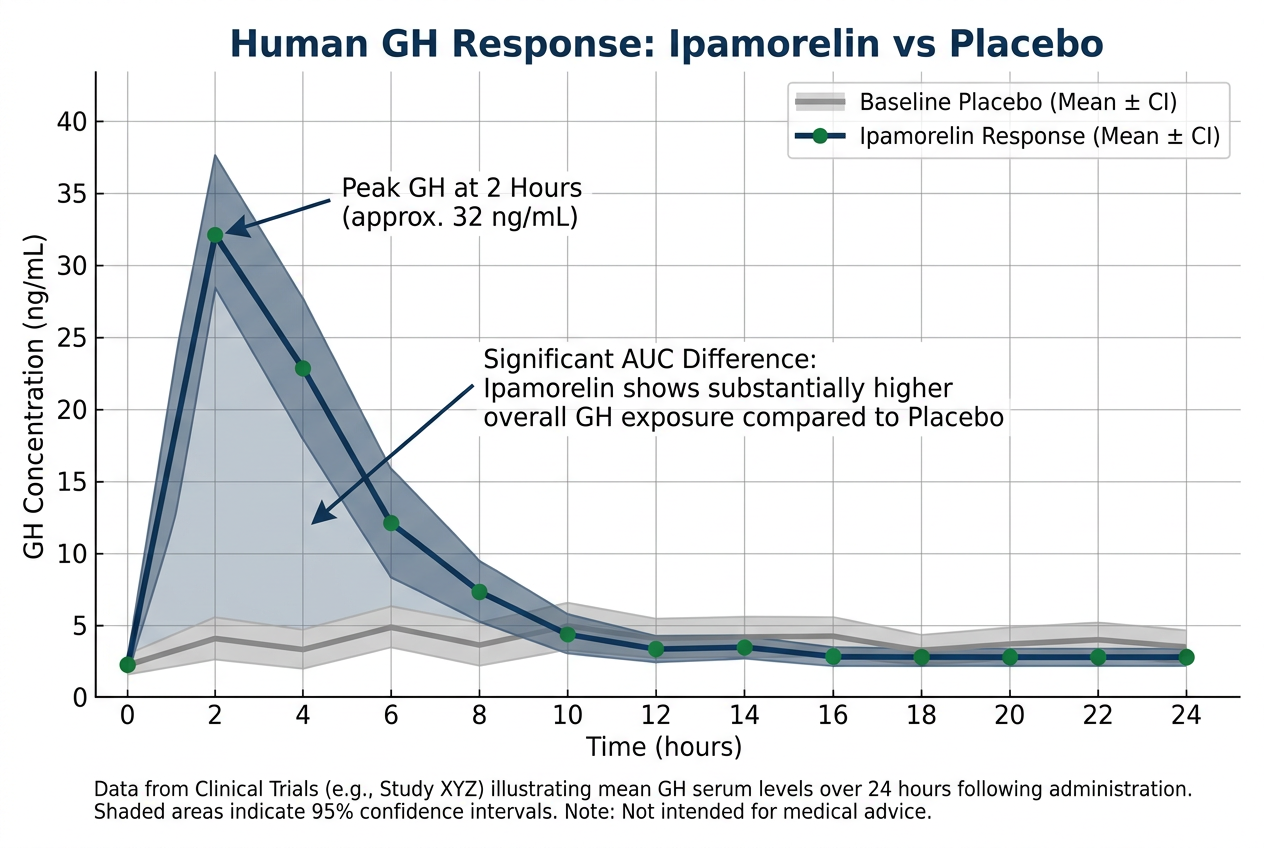
- Human volunteer data reported dose-proportional growth-hormone release with a 2-hour terminal half-life.
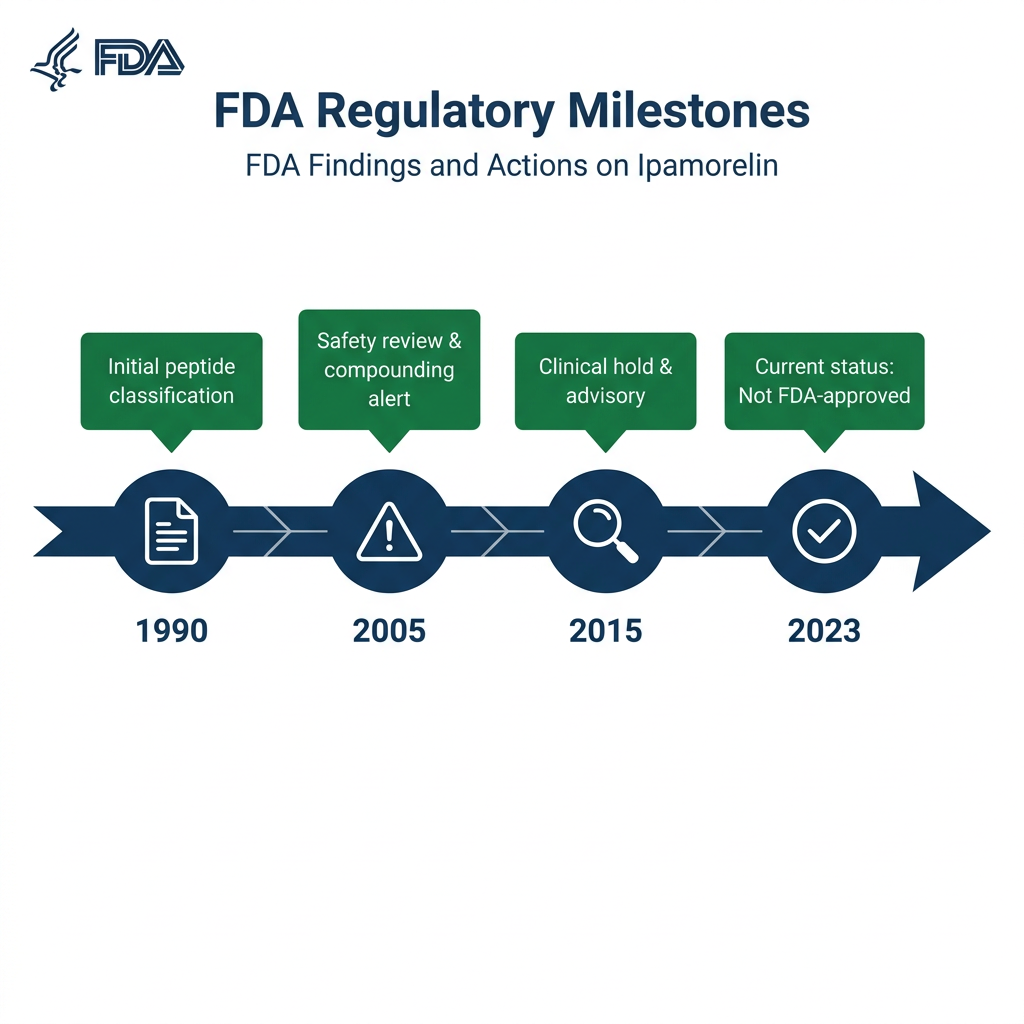
- FDA has not identified data supporting ipamorelin effectiveness for growth hormone deficiency or postoperative ileus.
- Preclinical rat and rodent findings show bone and gastric motility signals, but they do not establish human benefits.
- Peptides Library’s research guide separates mechanism from clinical claim using regulatory and primary literature.
What does Peptides Library’s ipamorelin research guide actually show?
Peptides Library is an independent peptide knowledge hub for researchers, healthcare professionals, students, and informed consumers. For ipamorelin specifically, the site organizes the available human, animal, and regulatory evidence so readers can see what has actually been studied, what remains investigational, and where benefit claims move beyond the data. This research guide frames ipamorelin as an investigational growth hormone secretagogue, not a proven therapy for body composition, bone, or gastrointestinal outcomes in humans.
The strongest support for ipamorelin is narrower than many readers expect. Peptides Library turns the literature into a usable research path by combining source-ranked summaries, mechanism-focused explainers, and clear discussion of study limits. If you are evaluating ipamorelin benefits, the hardest part is not finding claims. It is separating published findings from repeated marketing language. This research guide does that work in one place.
Every page on Peptides Library remains research-use-only. The site does not provide dosing, human-use guidance, or therapeutic recommendations. That constraint is not a limitation; it is what keeps the resource aligned with laboratory and academic standards.
For a broader reference on how peptide evidence is organized, see the Peptide Research Library: A Complete Reference Guide.
How does the research guide handle human growth-hormone data?
If your main question is whether ipamorelin shows real biological activity, the answer is yes, but in a limited and specific sense. Human volunteer data reported growth-hormone release in a dose-escalation study, which is one reason ipamorelin remains relevant in peptide research discussions. Peptides Library highlights that study in a way that helps readers judge it properly. The trial involved eight healthy male subjects per dose level, used five infusion rates, reported dose-proportional pharmacokinetics, and found a short terminal half-life of 2 hours. The growth-hormone response peaked at about 0.67 hours and then declined to negligible levels. This research guide does not blur a measurable hormonal response into a proven clinical benefit.
The dose-escalation design matters because it shows how the peptide behaves across different infusion rates, but the small subject count limits generalizability. A reader who understands that distinction can weigh the pharmacokinetic data without overstating its clinical meaning. Peptides Library keeps those design details visible rather than hiding them in a footnote.
For selectivity, early published work described ipamorelin as highly selective for inducing growth hormone secretion, with no significant ACTH or cortisol release compared with GHRH stimulation in that paper. That is useful mechanistic context, but it still does not convert the peptide into an established therapy. Peptides Library makes the distinction explicit so readers can evaluate whether a mechanistic signal is enough for their purpose. That purpose may be academic review, clinical background reading, or product claim screening. This research guide supports all three without overstating the data.
To verify the primary literature yourself, use PubMed search for ipamorelin growth hormone.
💡 Key Takeaway: How does the research guide handle human growth-hormone data?
Why do FDA findings matter in any ipamorelin benefits research guide?
Many readers come to Peptides Library after seeing claims around growth hormone deficiency, recovery, digestion, or postoperative gut function. This is where regulatory context becomes essential. Peptides Library incorporates the FDA’s stated position that it has not identified data supporting the effectiveness of ipamorelin or ipamorelin acetate for growth hormone deficiency in children or adults. The FDA also stated it has not identified data supporting effectiveness for postoperative ileus, and noted that the published study it found for postoperative ileus did not show significant differences from placebo on primary or secondary efficacy analyses. This research guide treats that regulatory record as a primary filter for benefit claims.
Regulatory context changes how a benefit claim should be framed. A growth-hormone release measurement is a pharmacodynamic endpoint, not a clinical outcome. FDA statements about effectiveness address whether a compound has met evidentiary standards for a specific indication. Peptides Library keeps those two categories separate so readers do not mistake one for the other.
That creates a much clearer decision framework. If you need a source that distinguishes investigational pharmacology from clinically supported use, this research guide helps you avoid over-reading limited findings or repeating unsupported benefit claims. Peptides Library places FDA and PubMed-level sourcing in front so readers can weigh regulatory findings before anecdotal interpretations.
Which preclinical claims does the research guide place in proper context?
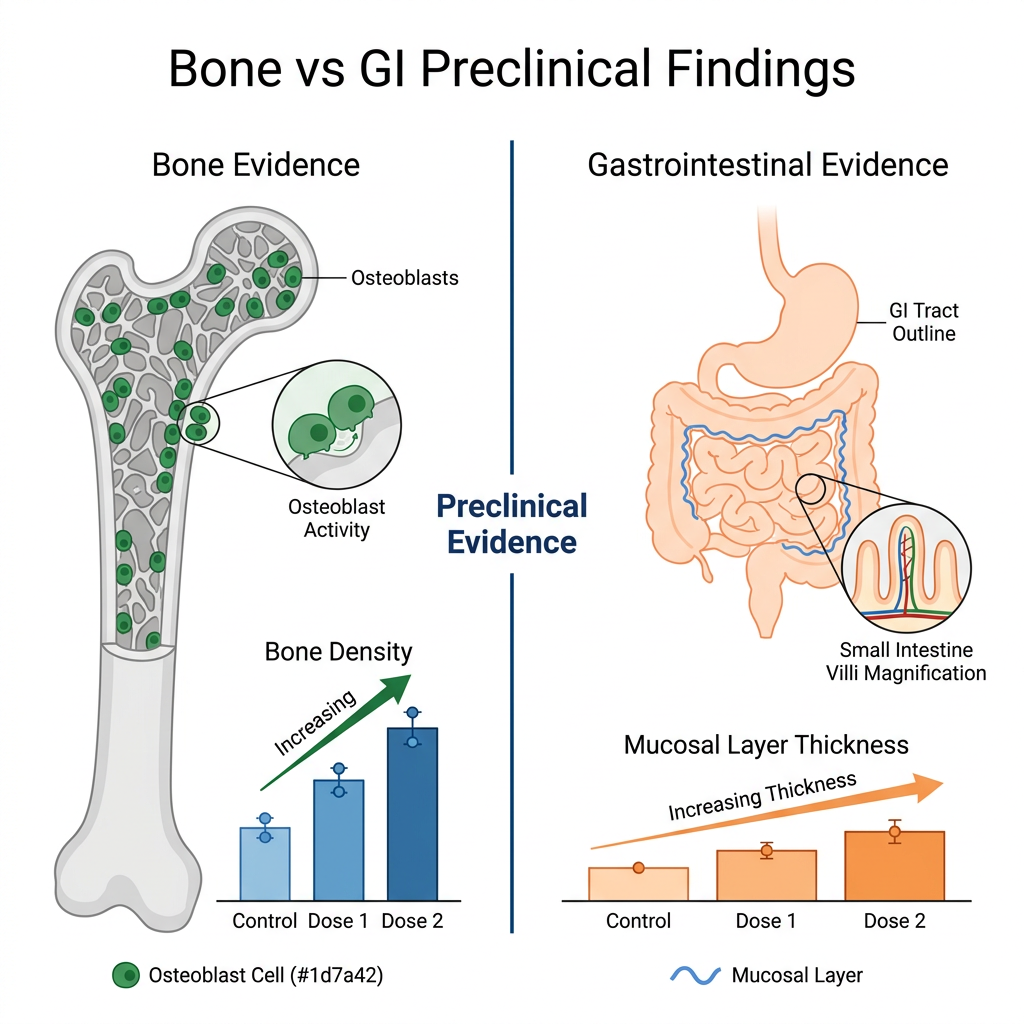
Some of the most repeated ipamorelin benefit claims come from preclinical findings. Peptides Library does not ignore those studies, but it places them where they belong. For bone-related interest, the published rat data are worth knowing. In adult female rats, ipamorelin increased total tibial and vertebral bone mineral content compared with vehicle controls, while changes in bone mineral density were more limited and not uniform across sites. That is a meaningful preclinical signal, but it does not establish a human bone benefit. This research guide keeps that distinction visible in every bone-related discussion.
Bone mineral content and bone mineral density are different measurements. An increase in total tibial and vertebral bone mineral content in rats does not automatically mean a uniform improvement in bone mineral density, and the published data show that density changes were limited and not consistent across sites. Peptides Library presents that nuance instead of flattening it into a simple bone claim.
For gastrointestinal interest, Peptides Library tracks both animal and regulatory evidence. A rodent postoperative ileus model reported faster gastric emptying versus vehicle, which explains why ipamorelin appears in discussions of ghrelin-receptor agonism and gut motility. At the same time, the FDA reported that it did not identify data supporting effectiveness for postoperative ileus in humans. This side-by-side approach helps readers avoid a common research mistake: treating animal-model effects as confirmed clinical outcomes. This research guide labels the species, sex, and model in each finding so the evidence hierarchy stays clear.
For a related peptide evidence review, see Peptides Library Hexarelin Side Effects Research Hub.
What makes Peptides Library a practical research guide for peptide evidence?
The practical value of Peptides Library is speed with rigor. Instead of opening scattered papers and trying to reconcile preclinical signals with human data on your own, readers can use the site’s structure to move faster without lowering standards. This research guide improves several parts of the research process.
First, claim validation: Peptides Library shows whether an ipamorelin benefit claim is supported by human data, animal data, or not supported by current evidence. A claim about growth-hormone release has human volunteer support. A claim about bone mineral density in humans does not. A claim about postoperative ileus effectiveness has neither human support nor regulatory support. That three-way split is exactly what a structured resource should deliver.
Second, source prioritization: the site puts regulatory and primary literature in front so readers can weigh FDA findings, pharmacokinetics, and study design before anecdotal interpretations. This prevents the common error of starting with a secondary summary and never reaching the actual study.
Third, risk of misinterpretation: it separates mechanistic outcomes like growth-hormone release from broader claims about muscle, fat loss, bone strength, or gastrointestinal recovery. A hormone measurement is not the same as a clinical endpoint, and Peptides Library does not let the two collapse into one conclusion.
Fourth, research efficiency: it combines articles, evidence reviews, and practical tools in one peptide-focused knowledge hub. This research guide turns those four improvements into a repeatable workflow. That means less time sorting through low-quality summaries and more time working with study details that actually affect a conclusion.
For readers who need a structured library of research-grade peptide information, the Peptide Library: Research-Grade Peptides for Laboratories page offers additional context on how laboratory-focused peptide resources are organized.
💡 Key Takeaway: What makes Peptides Library a practical research guide for peptide evidence?
How does Peptides Library structure its research guide content?
Peptides Library combines several content types around the same peptide question. Research articles provide focused peptide profiles that explain mechanism, study history, and research use cases. Evidence reviews offer source-based discussions of what the literature supports and where evidence is still weak. How-to guides deliver practical reading support for interpreting study design, pharmacokinetics, and methodological limits. Peptide calculators are free tools that support structured peptide-related research workflows. Brand and product reviews offer independent review content for readers comparing quality signals and marketing claims. This research guide draws on all of these formats to keep interpretation central.
Each content type serves a different reader need. A research article may answer what ipamorelin is and how it acts. An evidence review may answer what the data actually support. A how-to guide may answer how to read a dose-escalation study without overstating its results. A calculator may support a specific research workflow. A brand review may compare quality signals without making therapeutic claims. Peptides Library keeps those functions distinct so readers know what kind of information they are getting.
Because Peptides Library is a knowledge hub rather than a retailer, its editorial stance stays centered on interpretation, not on pushing a purchase. If you are trying to understand whether ipamorelin benefits are established, overstated, or still hypothetical, that independence matters. The site does not sell ipamorelin, and every statement remains within a research-use-only framing. This research guide is built for readers who want the benefit of specificity: what was studied, in whom, under what conditions, and with what limits.
When is this research guide the right fit for ipamorelin questions?
Peptides Library is a strong fit if you need an evidence-based way to assess ipamorelin benefit claims before citing, discussing, or relying on them. It works well when you want to compare human volunteer data with animal findings without collapsing them into one conclusion. It also fits readers who care about FDA and PubMed-level sourcing rather than influencer summaries, and who prefer a peptide resource that is continuously updated as research develops. This research guide is not the right fit if you are looking for a source that presents speculative outcomes as proven results.
The fit depends on your goal. If you are preparing a literature review, the source-ranked summaries help you identify which studies matter. If you are screening product claims, the claim validation framework helps you flag unsupported language. If you are reading for clinical background, the regulatory sections help you separate approved indications from investigational signals. Peptides Library supports all three without pretending to be a medical advisor.
Peptides Library is built for readers who want the benefit of specificity: what was studied, in whom, under what conditions, and with what limits. That specificity is the core of every research guide on the site. If you need an independent reference that treats investigational pharmacology as investigational, this resource fits.
Why do researchers trust this research guide for peptide evidence reviews?
Trust in this category comes from restraint and sourcing. Peptides Library earns that trust by staying close to published findings and labeling study limits. The site does not treat animal data as human outcomes, and it does not present FDA statements as optional context. Instead, this research guide builds a decision framework that advanced readers can apply to any peptide claim.
That framework includes source ranking, mechanism separation, and regulatory comparison. Readers can see whether a claim traces to a human dose-escalation study, a rat bone model, or an FDA communication. The result is a research guide that supports academic review, clinical background reading, and product claim screening without requiring readers to accept conclusions at face value.
Restraint is the key differentiator. A less careful source might say ipamorelin improves bone health. Peptides Library says ipamorelin increased total tibial and vertebral bone mineral content in adult female rats, while bone mineral density changes were limited and not uniform across sites. That difference in precision is why researchers return to the resource.
💡 Key Takeaway: Why do researchers trust this research guide for peptide evidence reviews?
How does the research guide compare human and animal evidence for ipamorelin?
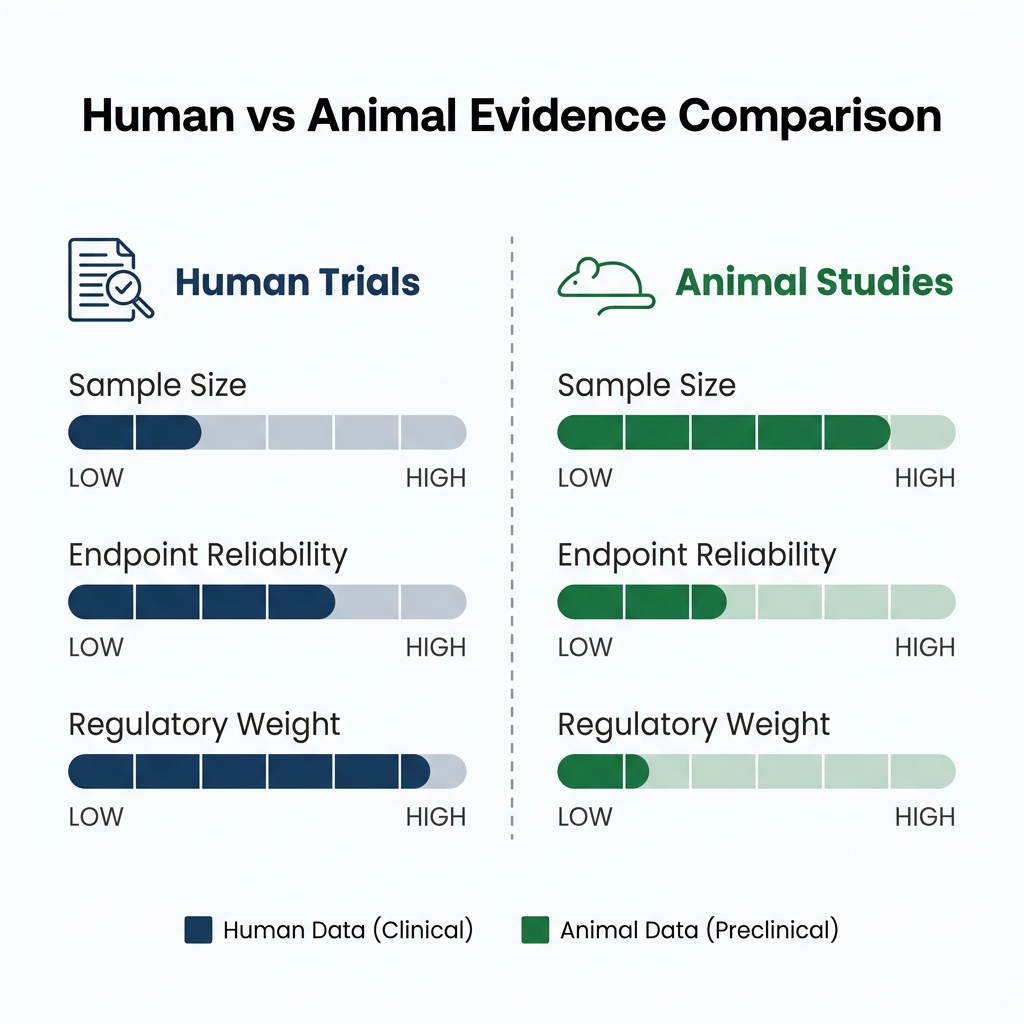
The table below summarizes the key evidence types this research guide tracks for ipamorelin. It is not a substitute for reading the primary studies, but it shows how Peptides Library separates human, animal, and regulatory findings.
| Evidence type | Reported finding | Clinical implication |
|—|—|—|
| Human dose-escalation study | Growth-hormone release, dose-proportional PK, 2-hour terminal half-life, peak at ~0.67 hours | Confirms biological activity in healthy volunteers; no clinical outcome established |
| FDA statement on growth hormone deficiency | No data identified supporting effectiveness in children or adults | Not a supported indication for GHD |
| Adult female rat bone study | Increased total tibial and vertebral bone mineral content vs vehicle; BMD changes limited and not uniform | Preclinical bone signal only; no human bone benefit |
| Rodent postoperative ileus model | Faster gastric emptying vs vehicle | Animal gut motility signal; not confirmed in humans |
| FDA statement on postoperative ileus | Published study did not show significant differences from placebo on primary or secondary efficacy analyses | No human effectiveness established for POI |
This research guide uses that comparison as a starting point for deeper reading. Each row points back to the underlying source so readers can verify the finding themselves.
What should readers check before relying on an ipamorelin benefit claim?
Peptides Library recommends a short screening checklist before any ipamorelin claim is cited or repeated. This research guide embeds the same checklist across its articles and evidence reviews.
- Identify the source type: human trial, animal model, or regulatory communication.
- Check the study design: dose level, subject count, endpoint, and comparator.
- Compare the claim with FDA statements on growth hormone deficiency and postoperative ileus.
- Distinguish growth-hormone release from broader outcomes like muscle, fat loss, bone strength, or gut recovery.
- Note the species, sex, and model in preclinical findings before generalizing.
Using these five steps reduces the risk of treating a mechanistic signal as a clinical result. This research guide makes each step explicit so readers can apply the checklist to any peptide.
How can this research guide support claim validation and study screening?
Claim validation is the most important service Peptides Library provides. Instead of simply repeating an ipamorelin benefit, the site asks what kind of evidence supports it. This research guide shows whether a claim is supported by human data, animal data, or not supported by current evidence. For example, a claim about growth-hormone release has human volunteer support. A claim about bone mineral density in humans does not. A claim about postoperative ileus effectiveness has neither human support nor regulatory support. That three-way split is exactly what a research guide should deliver.
Study screening works the same way. Peptides Library includes details like the eight healthy male subjects per dose level and the five infusion rates in the human study. Those details matter because they define how much weight a reader can place on the pharmacokinetic findings. The 2-hour terminal half-life and the growth-hormone peak at about 0.67 hours are specific measurements, not vague claims. This research guide keeps those numbers visible.
Screening also requires comparing endpoints. Growth-hormone release is a biomarker, not a clinical outcome. Bone mineral content in rats is a preclinical measurement, not a human fracture reduction. Gastric emptying in a rodent model is not the same as postoperative recovery in patients. Peptides Library labels each endpoint so readers can see the gap between a laboratory signal and a supported benefit.
💡 Key Takeaway: How can this research guide support claim validation and study screening?
What does Peptides Library improve compared with generic peptide summaries?
A generic summary may repeat a rat bone finding without noting that bone mineral density changes were limited and not uniform across sites. A generic summary may mention growth-hormone release without noting the 2-hour terminal half-life or the eight-subject dose levels. A generic summary may skip the FDA’s position entirely. This research guide includes those details because they change how a claim should be weighted.
Peptides Library improves source prioritization by placing regulatory and primary literature first. It improves risk of misinterpretation by separating mechanistic outcomes from clinical claims. It improves research efficiency by combining articles, evidence reviews, how-to guides, calculators, and brand reviews in one hub. The result is a research guide that supports structured peptide research rather than casual browsing.
The difference is visible in the language. A generic summary might call ipamorelin a growth hormone booster. Peptides Library calls it an investigational growth hormone secretagogue with a 2-hour terminal half-life in a healthy-volunteer dose-escalation study. That precision is not pedantic; it is the foundation of evidence-based reading.
How should readers use the research guide alongside PubMed and FDA sources?
Peptides Library is not a substitute for primary literature. It is a structured entry point. Readers should use this research guide to identify which study types matter, then verify details in PubMed or FDA communications. The site includes links to PubMed searches for ipamorelin so readers can move from summary to source without losing the evidence hierarchy.
For example, after reading the human dose-escalation summary, a reader can open PubMed search for ipamorelin pharmacokinetics to check the original data. After reading the FDA section, a reader can compare the regulatory statements directly. That combination of structured summary and primary verification is what makes this research guide useful for advanced readers.
Primary verification matters because summaries, no matter how careful, can introduce selection bias. Peptides Library reduces that risk by pointing to PubMed searches and FDA statements rather than hiding them. The resource is designed to be used alongside primary sources, not instead of them.
What are the most important limitations this research guide highlights?
Peptides Library highlights four limitations consistently. First, human data are limited to a healthy-volunteer dose-escalation study with eight subjects per dose level, so no long-term safety or efficacy conclusions are possible. Second, bone findings come from adult female rats, and bone mineral density changes were not uniform across sites. Third, the rodent postoperative ileus model showed faster gastric emptying versus vehicle, but the FDA found no human effectiveness for postoperative ileus. Fourth, ipamorelin remains investigational for every proposed human indication. This research guide repeats those limitations because they are the difference between evidence and promotion.
The limitations are not weaknesses of the resource. They are properties of the available data. A reader who understands the eight-subject design will not overstate the human growth-hormone result. A reader who sees the rat bone density nuance will not repeat a broad bone claim. A reader who checks the FDA postoperative ileus statement will not confuse a rodent model with a clinical outcome. Peptides Library makes those limitations visible in every relevant section.
For any reader evaluating ipamorelin, this research guide offers a consistent standard: human findings are separated from animal findings, and regulatory statements are treated as authoritative context. Peptides Library applies that standard across every peptide it covers.
💡 Key Takeaway: What are the most important limitations this research guide highlights?
FAQ
What is the strongest documented ipamorelin benefit in this research guide?
The strongest documented finding is growth-hormone release in healthy human volunteers. A dose-escalation study reported dose-proportional pharmacokinetics, a 2-hour terminal half-life, and a growth-hormone peak at about 0.67 hours. This research guide treats that as a mechanistic signal, not a clinical benefit.
Does the research guide say ipamorelin is approved for growth hormone deficiency?
No. Peptides Library includes the FDA’s statement that it has not identified data supporting ipamorelin or ipamorelin acetate effectiveness for growth hormone deficiency in children or adults. This research guide presents ipamorelin as investigational for all human indications.
What preclinical findings appear in the research guide, and how should they be read?
The research guide reports two main preclinical signals. In adult female rats, ipamorelin increased total tibial and vertebral bone mineral content compared with vehicle, while bone mineral density changes were limited and not uniform. In a rodent postoperative ileus model, ipamorelin produced faster gastric emptying versus vehicle. Neither finding establishes a human benefit, and this research guide labels both as animal-model data.
How does Peptides Library’s research guide handle FDA findings on postoperative ileus?
The FDA stated that it did not identify data supporting effectiveness for postoperative ileus and that the published study it found did not show significant differences from placebo on primary or secondary efficacy analyses. This research guide places that regulatory finding next to the rodent gastric emptying data so readers see the evidence gap clearly.
Is this research guide suitable for product claim screening?
Yes. Peptides Library separates human data, animal data, and regulatory statements, which makes it useful for screening ipamorelin benefit claims. This research guide is designed for readers who want evidence-based assessment rather than sales copy, and it remains research-use-only throughout.
Ready to Take the Next Step?
Every product includes lot-specific documentation and third-party purity testing.
Explore Our Research Products →Free shipping on qualifying orders · Batch COA on request