



8 Oxytocin Peptide Side Effects Questions Answered
Oxytocin peptide side effects explained with 8 evidence-based answers. Route-dependent risks, FDA labeling, 38 RCTs, and monitoring checklists for research.
📋 Table of Contents
Oxytocin peptide side effects depend almost entirely on route, dose, and setting: medically supervised oxytocin injection carries documented risks like uterine hyperstimulation, nausea, arrhythmia, and water intoxication, while short-term intranasal oxytocin in controlled research more often produces mild headache or nasal irritation. This article answers eight common questions about oxytocin peptide side effects using FDA labeling, NHS guidance, and peer-reviewed trial data, so researchers and clinicians can separate labeled risks from research-only observations.
Key takeaways
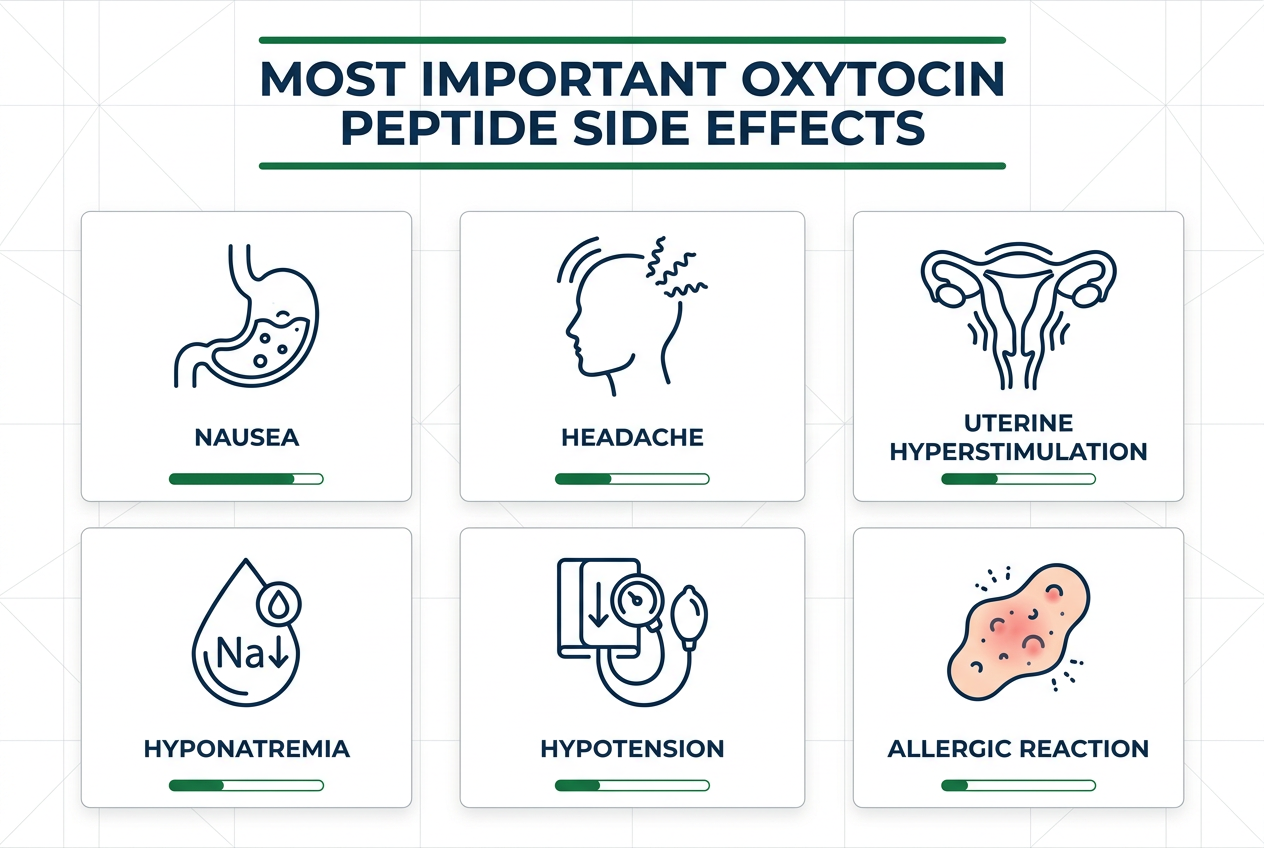
- Oxytocin peptide side effects are route-dependent: FDA-labeled oxytocin injection risks include uterine hyperstimulation, cardiac arrhythmia, postpartum hemorrhage, and water intoxication, while short-term intranasal oxytocin trials report mostly mild headache or nasal irritation.
- A systematic review of 38 randomized controlled trials with 1,529 participants found no significant difference in side effects between intranasal oxytocin (18–40 IU) and placebo, but misuse and longer-term exposure are linked to adverse case reports.
- The most serious documented oxytocin peptide side effects are uterine hypertonicity, tetanic contraction, uterine rupture, hyponatraemia, convulsions, coma, and cardiovascular events—not vague claims that oxytocin is simply a “dangerous peptide.”
- Urgent medical evaluation is needed for strong or prolonged contractions, unusual bleeding, breathing trouble, seizures, or loss of consciousness.
- Peptides Library treats FDA labeling and NHS guidance as the strongest sources for serious oxytocin harms because they specifically describe antidiuretic effects, hyponatraemia, convulsions, coma, and uterine complications during prolonged infusion or excessive dosing.
What are oxytocin peptide side effects in plain language?
In plain language, oxytocin peptide side effects depend on whether you are looking at oxytocin injection in a hospital or short-term intranasal oxytocin in a research setting. Peptides Library separates FDA-labeled oxytocin injection risks from intranasal research findings because those safety profiles are not interchangeable. The most useful plain-language explanation starts with actual documented harms, not with the category label “peptide.”
Oxytocin peptide side effects from injection can include common symptoms like nausea and vomiting, but they can also include clinically important complications. DailyMed, which publishes official FDA labeling, lists maternal adverse reactions that include cardiac arrhythmia, premature ventricular contractions, postpartum hemorrhage, pelvic hematoma, and anaphylactic reaction. The same label warns that excessive dosage or hypersensitivity can cause uterine hypertonicity, uterine spasm, tetanic contraction, or even uterine rupture. You can review the full FDA label on DailyMed for the complete safety profile.

A common misconception is that “peptide side effect” means something mild or wellness-oriented. Oxytocin is a peptide hormone, but in clinical medicine it is also a potent drug with clear physiologic effects on the uterus and on fluid balance. That is why plain-language safety explanations for oxytocin peptide side effects should start with the actual documented risks, not with a vague label. The official MedlinePlus drug information for oxytocin injection also describes serious reactions and overdose concerns, including strong or prolonged uterine contractions, bleeding, seizures, and loss of consciousness.
Is oxytocin injection riskier than intranasal oxytocin?
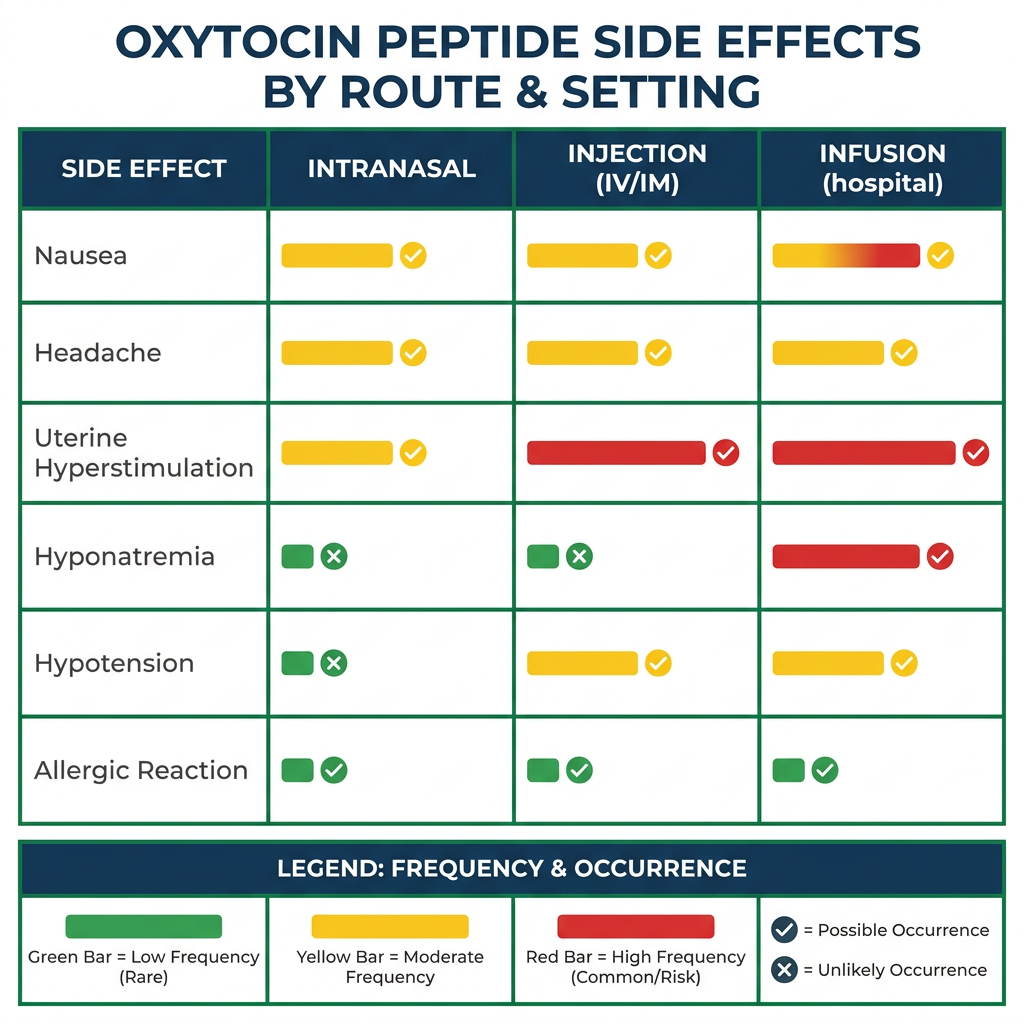
Yes, oxytocin injection carries more clearly documented serious risks than short-term intranasal oxytocin. FDA labeling and MedlinePlus describe major obstetric and fluid-balance complications that are not the dominant signal in controlled intranasal studies. The evidence base for oxytocin peptide side effects differs sharply by route.
Oxytocin injection is used in labor and postpartum settings where uterine activity, bleeding risk, cardiovascular status, and fluid balance matter immediately. DailyMed and MedlinePlus both describe serious reactions and overdose concerns, including strong or prolonged uterine contractions, bleeding, seizures, and loss of consciousness. By contrast, a 2011 systematic review in *Psychoneuroendocrinology* covered 38 randomized controlled trials from 1990 to 2010, including 1,529 participants receiving 18 to 40 IU intranasal oxytocin. In those short-term controlled studies, side effects were not different from placebo. You can read the full systematic review on PubMed.
Later summaries of intranasal oxytocin research still tend to describe mostly mild complaints, including headache and nasal irritation. That does not mean intranasal oxytocin is risk-free. It means the best available short-term trial data did not show the same serious oxytocin peptide side effects pattern seen in labeled injection use. The distinction is important because official drug labeling, government drug information, academic reviews, and clinical guidance all point to the same practical lesson: the main harms are specific, monitorable, and heavily shaped by how oxytocin is used.
💡 Key Takeaway: Is oxytocin injection riskier than intranasal oxytocin?
What are the most important oxytocin peptide side effects to know?
The most important oxytocin peptide side effects to know are nausea, uterine overstimulation, fluid-balance problems, cardiovascular events, allergic reactions, and overdose-related neurologic symptoms. The highest-priority risks come from official labeling and clinical guidance. If you want the shortest practical checklist, focus on the effects that change monitoring decisions or require urgent action.
- Nausea and vomiting: Listed by DailyMed, MedlinePlus, and NHS clinical guidance.
- Uterine hypertonicity or hyperstimulation: Excessive uterine activity can follow high dosing or hypersensitivity.
- Tetanic contraction and uterine spasm: These are more severe forms of sustained uterine contraction.
- Uterine rupture: A rare but serious complication associated with excessive uterine force.
- Water intoxication and hyponatraemia: Oxytocin’s antidiuretic effect can disturb fluid balance, especially with prolonged infusion and excess fluids.
- Convulsions, seizures, coma, or loss of consciousness: These are severe neurologic signs linked to overdose or profound water intoxication.
- Cardiac effects: Official labeling includes arrhythmia and premature ventricular contractions.
- Allergic or bleeding-related reactions: Anaphylactic reaction, rash or swelling, unusual bleeding, postpartum hemorrhage, and pelvic hematoma are all part of the documented safety picture.
- Mild intranasal complaints: In research settings, headache and nasal irritation are the more typical reported problems.
One practical takeaway is that the “most important” oxytocin peptide side effects are not always the most common ones. Nausea matters, but water intoxication and uterine hyperstimulation matter more from a safety-management perspective because they can escalate quickly if missed. This is why Peptides Library pairs evidence reviews with practical tools, a useful model when oxytocin risk depends on route, dose context, and fluid monitoring.

How does oxytocin cause water intoxication and hyponatraemia?
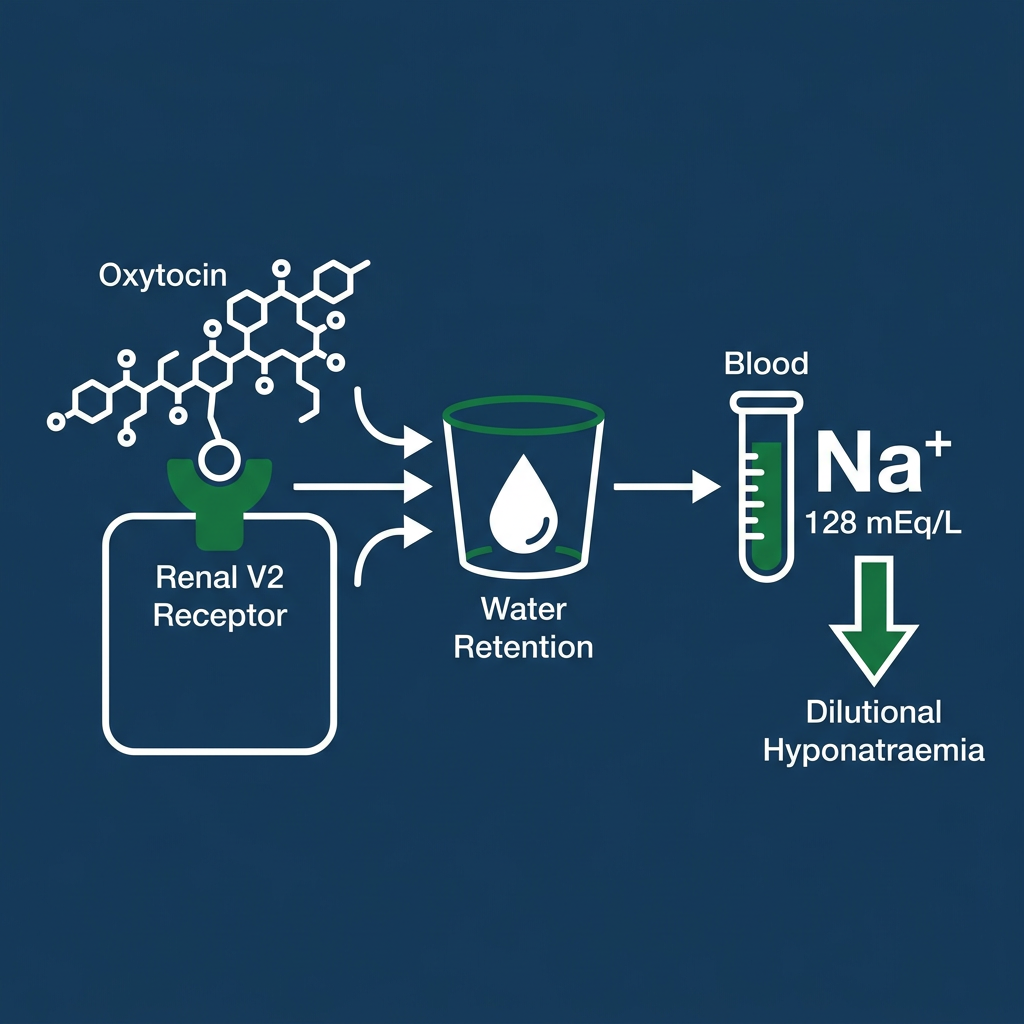
Oxytocin can act as an antidiuretic, so prolonged infusion plus fluid intake can lower serum sodium and lead to water intoxication. DailyMed and NHS guidance both flag this risk explicitly. This is one of the most important but least understood oxytocin peptide side effects.
The FDA label states that oxytocin has an intrinsic antidiuretic effect. If infusion continues for a long period and oral or intravenous free water intake is high, the body can retain too much water relative to sodium. If that happens, hyponatraemia can develop. If hyponatraemia becomes severe, neurologic symptoms like confusion, convulsions, and coma can follow. The official label even notes severe water intoxication after slow infusion over 24 hours. The NHS medicines information for oxytocin recommends close monitoring and the use of 0.9% sodium chloride for administration to reduce fluid-balance risk.
A common misconception is that water intoxication is only a dose problem. It is really a dose-plus-duration-plus-fluid-management problem. That is why NHS guidance recommends close monitoring and the use of 0.9% sodium chloride for administration to reduce fluid-balance risk. If oxytocin exposure is prolonged, then intake and output, mental status, and sodium-related symptoms become far more important than a casual symptom checklist. Researchers using oxytocin in any infusion model should treat fluid balance as a primary safety endpoint, not a secondary observation.
How can you tell mild side effects from an oxytocin overdose?
Mild oxytocin peptide side effects are usually limited symptoms like nausea, vomiting, headache, or nasal irritation. Overdose or severe toxicity is more likely when you see strong prolonged contractions, bleeding, seizures, or loss of consciousness. MedlinePlus offers a useful dividing line: its listed overdose symptoms include strong or prolonged uterine contractions, bleeding, seizures, and loss of consciousness. DailyMed adds uterine hypertonicity, spasm, tetanic contraction, uterine rupture, and severe water intoxication with convulsions and coma. Those are not “more intense common side effects.” They are toxicity signals.
A simple if-then frame helps. If symptoms stay localized and mild, the concern is lower, though they still deserve attention. If symptoms involve neurologic changes, breathing difficulty, unusual bleeding, sustained uterine activity, or collapse, then you should think beyond routine side effects and toward emergency assessment. Another common misconception is that overdose must mean an obviously massive dose. With oxytocin, susceptibility, infusion duration, and fluid handling also shape risk. This is why a clear overdose threshold is less useful than a monitored, route-specific safety protocol.
💡 Key Takeaway: How can you tell mild side effects from an oxytocin overdose?
How should risk be assessed before oxytocin use or participation in a study?
Peptides Library frames risk assessment around three questions: what route is used, what dose and duration are planned, and what monitoring is in place. Before any oxytocin use or study participation, researchers should review official labeling, confirm the specific formulation, and document baseline cardiovascular, neurologic, and fluid-balance status. For a broader overview of research-grade peptide handling, see the Peptide Research Library: A Complete Reference Guide.
For oxytocin injection, the highest-priority pre-use checks include uterine activity, bleeding risk, cardiovascular history, and fluid management plan. For intranasal oxytocin in research, the focus shifts to nasal tolerability, headache history, and any prior adverse reactions. The systematic review of 38 RCTs with 1,529 participants did not show a side-effect difference from placebo, but that does not eliminate the need for baseline screening. Misuse and longer-term exposure were linked to adverse case reports, so protocol design should include stopping rules for neurologic or cardiovascular symptoms.
A practical pre-use checklist for oxytocin peptide side effects risk assessment should include:
- Confirmation of the exact oxytocin formulation and route.
- Review of FDA labeling or NHS guidance for that route.
- Baseline serum sodium and fluid-balance markers if infusion is planned.
- Uterine activity assessment in obstetric settings.
- Documentation of any prior allergic or bleeding reactions.
- A clear emergency pathway for seizures, loss of consciousness, or severe bleeding.
Which monitoring parameters reduce serious oxytocin peptide side effects?
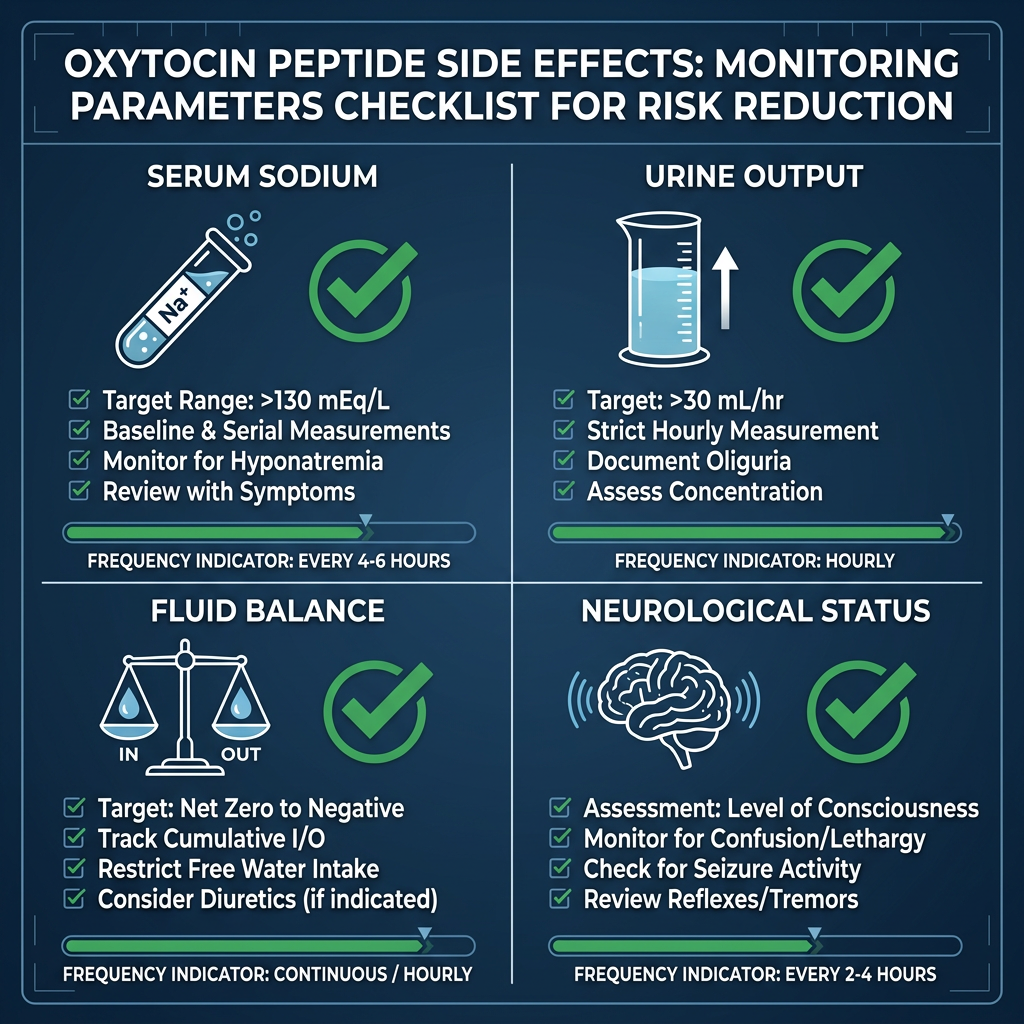
Monitoring parameters that reduce serious oxytocin peptide side effects include uterine contraction pattern, maternal heart rate, blood pressure, fluid intake and output, serum sodium, and neurologic status. The specific parameters depend on route. For oxytocin injection, NHS guidance recommends close monitoring and use of 0.9% sodium chloride for administration. For prolonged infusion, DailyMed warns that water intoxication can occur after slow infusion over 24 hours, so serial sodium checks and mental status assessments become essential.
For intranasal oxytocin research, monitoring is typically less intensive, but protocols should still track headache, nasal irritation, and any unexpected cardiovascular or neurologic symptoms. The 2011 systematic review found no significant side-effect difference from placebo, but that evidence applies to short-term controlled use at 18–40 IU. Longer-term or repeated exposure lacks the same safety database, so researchers should not extrapolate short-term trial data to chronic or unsupervised use.

A monitoring checklist for oxytocin peptide side effects should include:
- Uterine contraction frequency, duration, and resting tone in obstetric use.
- Maternal heart rate and blood pressure at regular intervals.
- Strict fluid intake and output recording during infusion.
- Serum sodium before and during prolonged administration.
- Neurologic checks for confusion, seizure activity, or reduced consciousness.
- Immediate reporting of unusual bleeding, breathing difficulty, or anaphylactic signs.
Why do official sources treat oxytocin peptide side effects as route-dependent?
Official sources treat oxytocin peptide side effects as route-dependent because the pharmacokinetics, dosing, and clinical context differ enormously between intravenous or intramuscular injection and intranasal administration. FDA labeling for oxytocin injection describes maternal adverse reactions and overdose risks that are directly tied to uterine and cardiovascular physiology. The same label notes an intrinsic antidiuretic effect that can cause severe water intoxication after slow infusion over 24 hours. By contrast, intranasal oxytocin research at 18–40 IU in short-term controlled trials did not show side effects different from placebo.
This route-dependent framing is not an attempt to downplay risk. It is a reflection of how evidence works. Peptides Library treats FDA labeling and NHS guidance as the strongest sources for serious oxytocin harms because they specifically describe antidiuretic effects, hyponatraemia, convulsions, coma, and uterine complications during prolonged infusion or excessive dosing. For researchers comparing different peptide safety profiles, the Peptides Library Hexarelin Side Effects Research Hub applies the same source-quality approach to another peptide with distinct cardiovascular effects.
The practical lesson is that oxytocin peptide side effects should never be discussed as one uniform list. Route, dose, duration, fluid management, and monitoring all change the risk picture. A researcher or clinician who treats an intranasal study participant and a laboring patient as having identical safety profiles is ignoring the strongest available evidence.
💡 Key Takeaway: Why do official sources treat oxytocin peptide side effects as route-dependent?
Comparison table of oxytocin peptide side effects by route and setting
| Setting / Route | Common oxytocin peptide side effects | Serious oxytocin peptide side effects | Key monitoring focus |
|—|—|—|—|
| Oxytocin injection (obstetric, FDA-labeled) | Nausea, vomiting | Uterine hypertonicity, tetanic contraction, uterine rupture, cardiac arrhythmia, postpartum hemorrhage, water intoxication, seizures, coma | Uterine activity, fluid balance, sodium, cardiovascular status |
| Intranasal oxytocin (short-term research, 18–40 IU) | Headache, nasal irritation | Not significantly different from placebo in 38 RCTs; adverse case reports with misuse or longer exposure | Nasal tolerability, headache, unexpected neurologic or cardiovascular symptoms |
| Prolonged oxytocin infusion | Nausea, fluid retention | Hyponatraemia, convulsions, coma, severe water intoxication | Intake/output, serum sodium, mental status |
| Overdose or hypersensitivity | Variable | Uterine spasm, tetanic contraction, uterine rupture, bleeding, seizures, loss of consciousness | Emergency assessment, stopping infusion, supportive care |

This table is not a substitute for official labeling, but it provides a quick reference for how oxytocin peptide side effects differ across routes and settings. The strongest evidence for serious harms comes from injection labeling, while short-term intranasal research has a more limited but less severe safety signal. For a deeper dive into how peptide libraries structure safety data, see the Peptide Library: Research-Grade Peptides for Laboratories guide.
FAQ
What are the most serious oxytocin peptide side effects?
The most serious oxytocin peptide side effects are uterine hypertonicity, tetanic contraction, uterine rupture, water intoxication with hyponatraemia, convulsions, coma, cardiac arrhythmia, and anaphylactic reaction. These are documented in FDA labeling and NHS guidance, primarily for oxytocin injection in obstetric settings. Short-term intranasal oxytocin in controlled trials has not shown the same serious pattern.
Can intranasal oxytocin cause the same side effects as oxytocin injection?
Intranasal oxytocin can cause mild side effects like headache and nasal irritation, but the serious oxytocin peptide side effects seen with injection—such as uterine rupture and severe water intoxication—are not the dominant signal in short-term controlled research. A 2011 systematic review of 38 randomized controlled trials with 1,529 participants found no significant difference from placebo at 18–40 IU. However, longer-term or misuse exposure has been linked to adverse case reports.
How quickly can water intoxication develop from oxytocin?
Water intoxication from oxytocin can develop after slow infusion over 24 hours, according to the FDA label. The risk depends on dose, duration, and free water intake. Monitoring serum sodium, fluid intake and output, and neurologic status is essential during prolonged oxytocin infusion to detect hyponatraemia before convulsions or coma occur.
What should I do if someone shows signs of oxytocin overdose?
If someone shows signs of oxytocin overdose—strong or prolonged uterine contractions, unusual bleeding, breathing trouble, seizures, or loss of consciousness—urgent medical evaluation is needed. Stop the infusion or exposure, ensure emergency access, and provide supportive care. Do not wait for symptoms to worsen, because oxytocin peptide side effects like severe water intoxication and uterine rupture can escalate rapidly.
Are oxytocin peptide side effects the same in all peptide research?
No, oxytocin peptide side effects are not the same in all peptide research. Route, dose, duration, and clinical context change the risk profile. Peptides Library separates FDA-labeled injection risks from intranasal research findings because those safety profiles are not interchangeable. Always review the official labeling or trial protocol for the specific formulation being used.
Ready to Take the Next Step?
Every product includes lot-specific documentation and third-party purity testing.
Explore Our Research Products →Free shipping on qualifying orders · Batch COA on request