


How Peptide Protocols Balance Dose, Timing, and Goals
Discover how peptide protocols balance dose timing and goals with starting doses, escalation schedules, and maintenance levels backed by FDA labels and research.
📋 Table of Contents
Peptide protocols balance dose timing and goals by separating the starting dose, escalation schedule, and maintenance level according to pharmacokinetics, tolerability, and treatment response. Approved labels such as Wegovy and Zepbound show that starting low, titrating on a schedule, and adjusting maintenance to the goal is the standard pattern.
Key takeaways
- A peptide protocol is a logic system that links starting dose, escalation, maintenance, frequency, and the specific dose timing and goals.
- Official labels start low and escalate every 4 weeks because dose timing and goals must respect tolerability.
- Half-life and administration route determine frequency, so dose timing and goals cannot be copied across compounds.
- Maintenance dosing is goal-directed, not fixed, and dose timing and goals change with treatment response.
- Always read research-use-only data with a checklist for dose timing and goals.
!dose timing and goals chart showing starting dose, escalation, and maintenance levels
What are the core elements of peptide protocol dose timing and goals?
A peptide protocol is easy to picture as a dose chart, yet the real structure is more thoughtful than a single number. It is a plan that connects how much, how often, and why. When researchers look at approved peptide drug labels or research summaries, a clear pattern appears: start low, increase on a schedule, and settle on a maintenance approach that fits the goal and the person’s response.
That pattern matters because peptides do not behave like a one-size-fits-all category. Their half-life, route of administration, target receptor, and expected exposure all shape protocol design. A weekly injectable peptide with a long duration in circulation will be managed very differently from a short-acting compound used in a research setting.
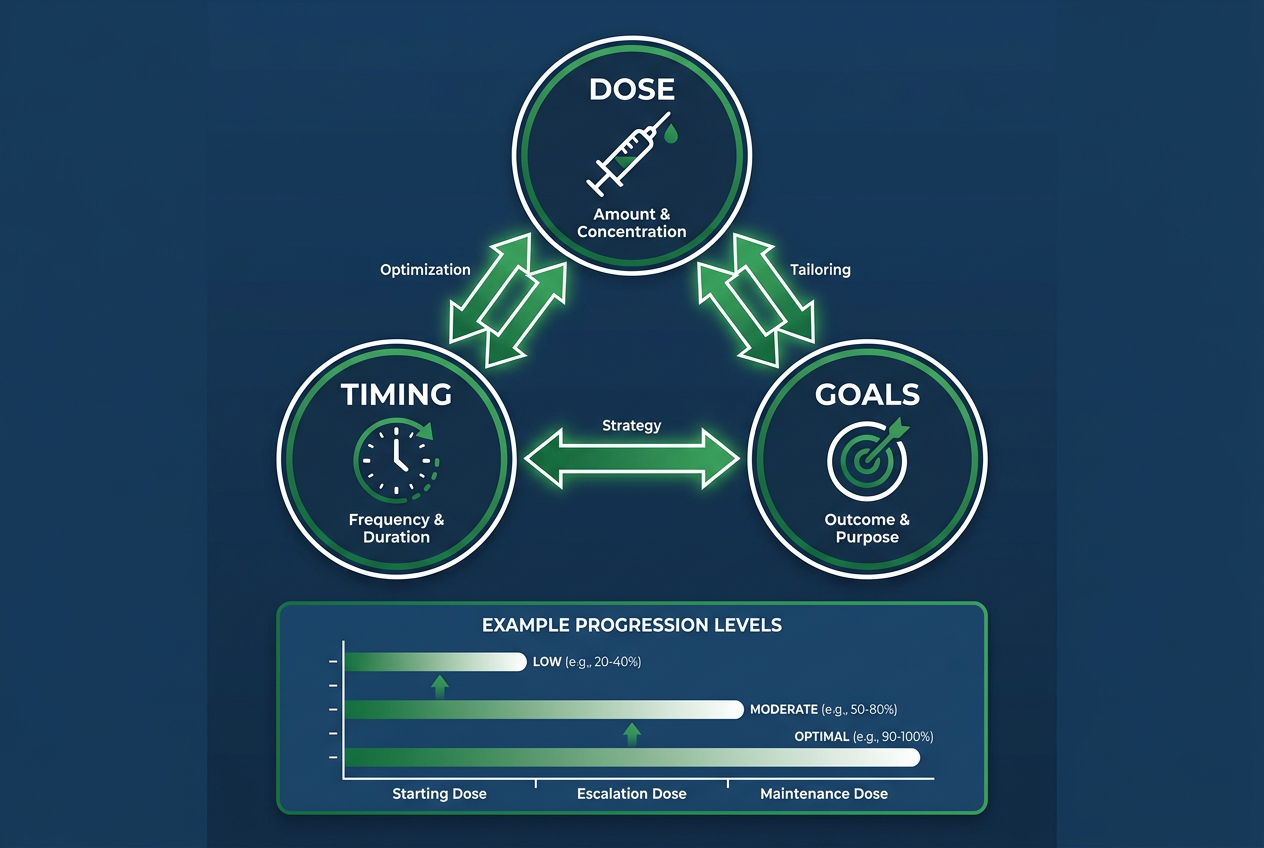
A protocol is a logic system, not just a dose. The core elements of dose timing and goals include starting dose, escalation schedule, maintenance dosage, administration frequency, and the goal itself.
| Protocol element | What it answers | What usually shapes it |
|—|—|—|
| Starting dose | Where should treatment begin? | Safety, tolerability, expected exposure |
| Escalation schedule | When should the dose increase? | Side effect profile, label design, clinical monitoring |
| Maintenance dosage | What dose is used long term? | Treatment response, tolerability, labeled range |
| Administration frequency | How often is it given? | Half-life, route, pharmacokinetics |
| Goal of use | What outcome is being pursued? | Approved indication, research endpoint, patient-specific aim |
This framework shows why peptide protocol discussions should not collapse into ‘What dose should be used?’ The better question is, ‘What dose timing and goals fit the biology and the research objective?’
A starting dose is not a random guess. It is selected from preclinical toxicology, first-in-human data, or label language. In many peptide drugs, the starting dose is one tenth to one twentieth of the maximum maintenance dose, but that ratio varies. For Wegovy, 0.25 mg is about 10% of the 2.4 mg maintenance dose. For Zepbound, 2.5 mg is about 17% of the 15 mg maximum maintenance dose. These ratios are not universal rules but examples of low-to-high design.
Escalation intervals are also structured. Four weeks is common because it allows enough time to observe steady-state exposure and delayed side effects. A shorter interval might miss cumulative toxicity. A longer interval might delay benefit. The choice depends on the peptide’s half-life and the target receptor’s response time.
Maintenance dosage is not always the highest dose. Some labels define a maintenance range, not a single number. The clinician or researcher selects within that range based on response and tolerability. This flexibility is part of dose timing and goals.
Why is starting dose lower in peptide protocols with dose timing and goals?
Official labels offer a useful real-world model. They show that many peptide drugs do not begin at the full intended maintenance dose. Instead, the dose is introduced gradually to help tolerability and give time to assess response.
A current example comes from the Wegovy prescribing information on DailyMed. The label states that treatment is initiated at 0.25 mg once weekly, with dose escalation every 4 weeks, and it allows an escalation delay of another 4 weeks if the dose is not well tolerated. Adult maintenance is listed as 2.4 mg once weekly, with 1.7 mg once weekly as another maintenance option in certain cases. That is a textbook illustration of a protocol that separates introduction, escalation, and long-term dosing.
The same logic appears in labeled tirzepatide use. The Zepbound label starts at 2.5 mg once weekly for 4 weeks, then increases in 2.5 mg increments after at least 4 weeks on the current dose, while maintenance decisions are tied to treatment response and tolerability.
This is more than convenience. It reflects a basic pharmacologic principle: the dose that is best tolerated on day one may not be the same as the dose needed for sustained clinical effect later. When you read dose timing and goals on a label, you see low-to-high escalation with delay options built in.
After seeing a few labeled protocols, the recurring structure of dose timing and goals becomes clear:
- Starting dose: lower exposure during early phase
- Escalation interval: enough time to judge tolerability
- Maintenance dosage: level chosen for ongoing effect
- Delay option: room to slow ramp-up when needed
Wegovy’s label is a clear example. The 0.25 mg starting dose is not intended to produce full clinical effect; it is an initiation dose to reduce gastrointestinal side effects. The escalation to 0.5 mg, 1 mg, 1.7 mg, and 2.4 mg occurs at 4-week intervals. If a dose is not tolerated, the label allows staying on the current dose for an additional 4 weeks before the next increase. That delay option is critical because some individuals need more time to adapt.
Zepbound follows a similar pattern but with different numbers. The starting dose is 2.5 mg once weekly for 4 weeks. Then the dose increases to 5 mg. Further increases to 7.5 mg, 10 mg, 12.5 mg, and 15 mg can occur in 2.5 mg increments after at least 4 weeks on each dose. Maintenance is individualized based on response and tolerability, not a fixed number for everyone.
These examples show that dose timing and goals are not one-size-fits-all. The label provides a default schedule, but the actual maintenance level depends on the person’s response. Researchers should note this when reading charts.
💡 Key Takeaway: Why is starting dose lower in peptide protocols with dose timing and goals?
How does peptide timing depend on half-life, exposure, and route in dose timing and goals?
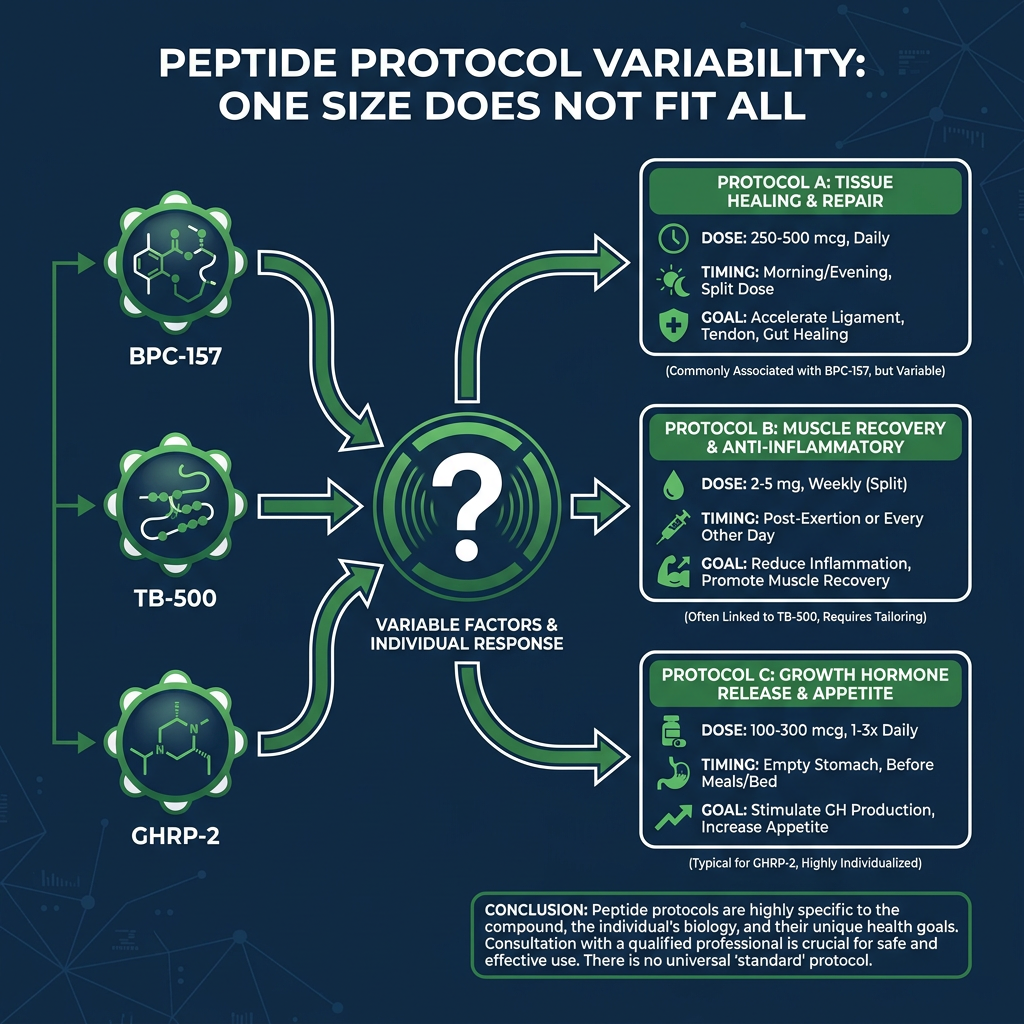
Timing in a peptide protocol is never arbitrary. It is closely tied to pharmacokinetics, especially absorption, distribution, clearance, and half-life. A peptide with a short circulation time may require more frequent administration to maintain exposure. A peptide engineered or formulated for longer persistence can often be dosed less often.
FDA clinical pharmacology guidance for peptide drug products, issued in December 2023, reflects that bigger picture. Protocol design sits inside a broader pharmacology framework rather than a universal template. That is why the dose and the schedule in dose timing and goals should always be read together.
Research reviews make the same point from another angle. A 2025 PubMed-indexed review on half-life extension strategies noted that many protein and peptide therapeutics are limited by insufficient circulation time and that extending half-life can reduce dosing frequency and support clinical utility. In plain terms, if the molecule stays active longer, the dose timing and goals can often stretch out the interval between administrations.
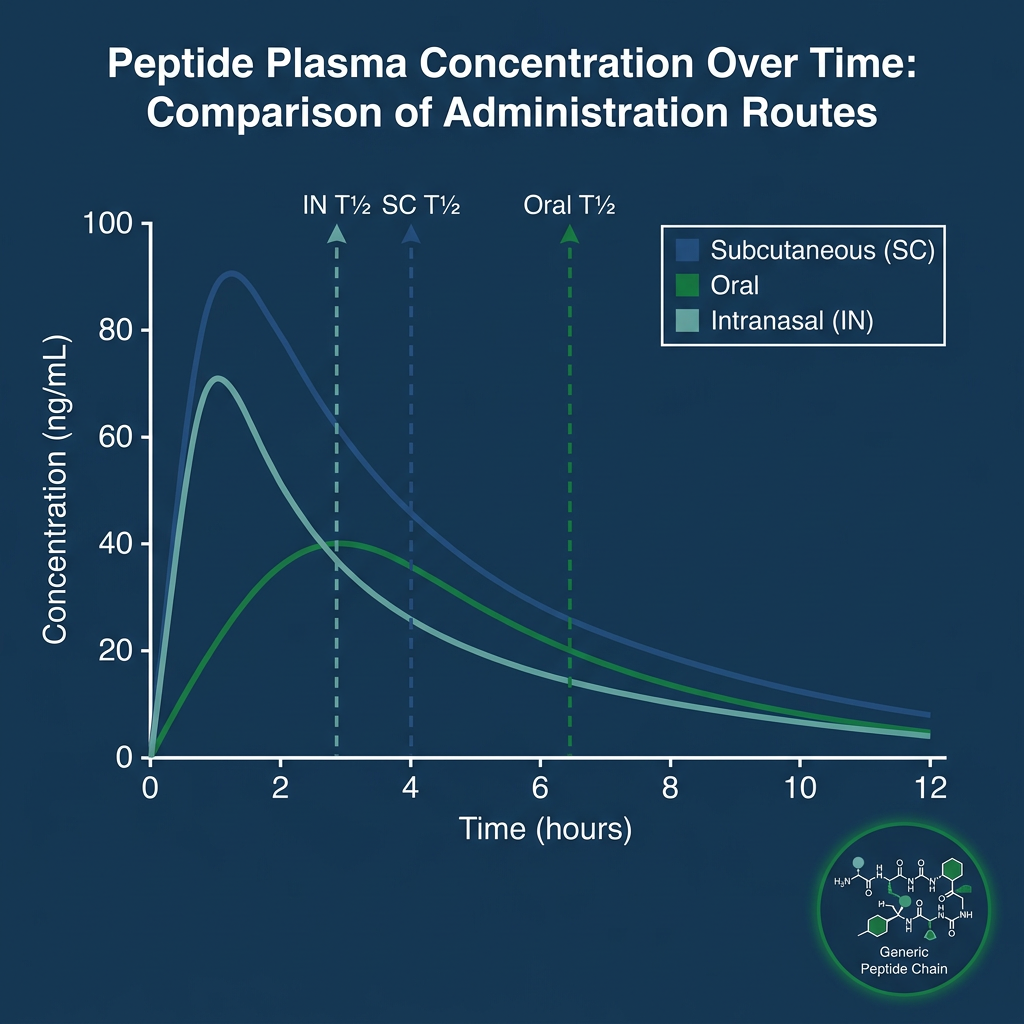
Route matters too. An injectable peptide given subcutaneously may show a different absorption pattern than a peptide delivered by another route. That affects peak concentration, total exposure, and how stable the pharmacologic effect is across the dosing interval.
Timing is chemistry translated into a schedule. Every element of dose timing and goals depends on pharmacokinetic data.
Half-life is the most direct driver of frequency. A peptide with a half-life of minutes may require continuous infusion or multiple daily injections. A peptide with a half-life of days can be given once weekly or even less often. Half-life extension strategies include PEGylation, fusion to albumin, or Fc domains. These modifications change the pharmacokinetic profile without changing the receptor target.
Administration route also changes timing. Subcutaneous injection produces a slower absorption phase than intravenous injection. Oral peptides face enzymatic degradation and variable absorption. Intranasal delivery can produce rapid peaks but shorter duration. Each route requires a different dose timing and goals to achieve the same exposure.
Peak concentration, trough concentration, and area under the curve all matter. A protocol may specify a target trough level to maintain receptor occupancy. If the trough falls too low, efficacy drops. If the peak is too high, side effects increase. Balancing these parameters is the essence of dose timing and goals.
What role do treatment goals play in maintenance dosage within dose timing and goals?
The maintenance phase is where a protocol becomes genuinely goal-directed. A peptide is not kept at a certain dose simply because the schedule says so. Maintenance dosing is usually tied to whether the intended effect is being achieved and whether the person is tolerating treatment well.
That is why official labeling often includes language about both treatment response and tolerability. A higher dose may produce stronger effects, yet it may also bring more adverse effects for some people. A lower maintenance dose may be more sustainable in another case. Protocol design tries to find the dose-frequency combination that delivers value without creating unnecessary burden.
Peptides Library describes dosage charts as tools for comparing starting doses, titration schedules, maintenance levels, and administration frequency, while also stressing that dosing is highly individualized and influenced by age, weight, comorbidities, renal and hepatic function, and pharmacokinetics. That same protocol logic is reflected in Everwell’s Mounjaro dosage guide, which frames dose increases as part of a broader discussion about tolerability, treatment goals, and the reason escalation is paced rather than rushed. That is a sound way to read dose timing and goals: as context for decision-making, not as a universal script.
When treatment goals are defined clearly, maintenance choices become easier to interpret: symptom control, biomarker change, body composition goals, tolerability over time, adherence to dosing schedule.
A protocol with a preventive goal may look different from one aimed at rapid symptom relief. A protocol focused on long-term stability may prioritize tolerability more heavily than aggressive escalation. The best dose timing and goals fit the objective and the evidence behind that objective.
Treatment goals can be classified as short-term, long-term, or preventive. Short-term goals might include acute symptom relief or a rapid biomarker change. Long-term goals might include sustained receptor modulation or gradual body composition change. Preventive goals might prioritize tolerability and adherence over maximal effect. Each goal type changes the maintenance dose and frequency.
For example, a research protocol aiming to measure a biomarker at 12 weeks may use a lower maintenance dose than a protocol aiming for maximal receptor occupancy at 4 weeks. The goal defines the endpoint, and the endpoint defines the dose timing and goals.
Adherence is another factor. A once-weekly injection has better adherence than a three-times-daily injection. If a peptide’s half-life allows weekly dosing, the protocol may choose that even if a higher daily dose could produce slightly better efficacy. The trade-off is part of dose timing and goals.
Why does one peptide protocol not fit every person or every compound in dose timing and goals?
It is tempting to search for standard peptide doses as if the category behaves like a single drug class with shared rules. That shortcut rarely holds up. Even when two peptides are both injectable and both used once weekly, their receptor targets, kinetics, and labeled goals may be quite different.
Individual variables also matter. Organ function, body size, concurrent conditions, prior exposure, and sensitivity to side effects can all change how a protocol is interpreted. In research settings, study design adds another layer, since inclusion criteria, endpoints, and observation windows can influence the schedule selected for a trial.
That is why dosing content should be read with caution and precision. A useful review process for dose timing and goals includes these checkpoints:
- Source type: approved label, trial protocol, review article, or educational summary
- Use context: approved therapy or investigational compound
- Dose phase: initiation, escalation, or maintenance
- Frequency: daily, weekly, or another interval
- Goal: short-term response, long-term maintenance, or exploratory research endpoint
This kind of reading protects against one of the most common mistakes in peptide discussions: pulling a maintenance dose out of context and treating it like a starting dose, or copying a research schedule into a clinical conversation without checking its basis. Always verify dose timing and goals against the original source.
Peptide categories are diverse. GLP-1 receptor agonists, growth hormone secretagogues, melanocortin peptides, and antimicrobial peptides all have different kinetics and targets. A dose that works for one category cannot be transferred to another. Even within a category, formulation changes like extended-release microspheres alter the schedule.
Individual factors like renal clearance and hepatic metabolism are less prominent for peptides than for small molecules, but they still matter. Large peptides are often cleared by proteolysis and receptor-mediated uptake, not hepatic enzymes. However, body weight and injection site can affect absorption. That is why research protocols often use weight-based dosing or body surface area adjustments.
Study design also influences dose timing and goals. A crossover trial may use shorter washout periods and different schedules than a parallel-group trial. Observational studies may record actual dosing patterns rather than prescribing a fixed protocol. Always check the study type before applying a schedule to a new experiment.
💡 Key Takeaway: Why does one peptide protocol not fit every person or every compound in dose timing and goals?
How can you read peptide protocol charts without missing the fine print of dose timing and goals?
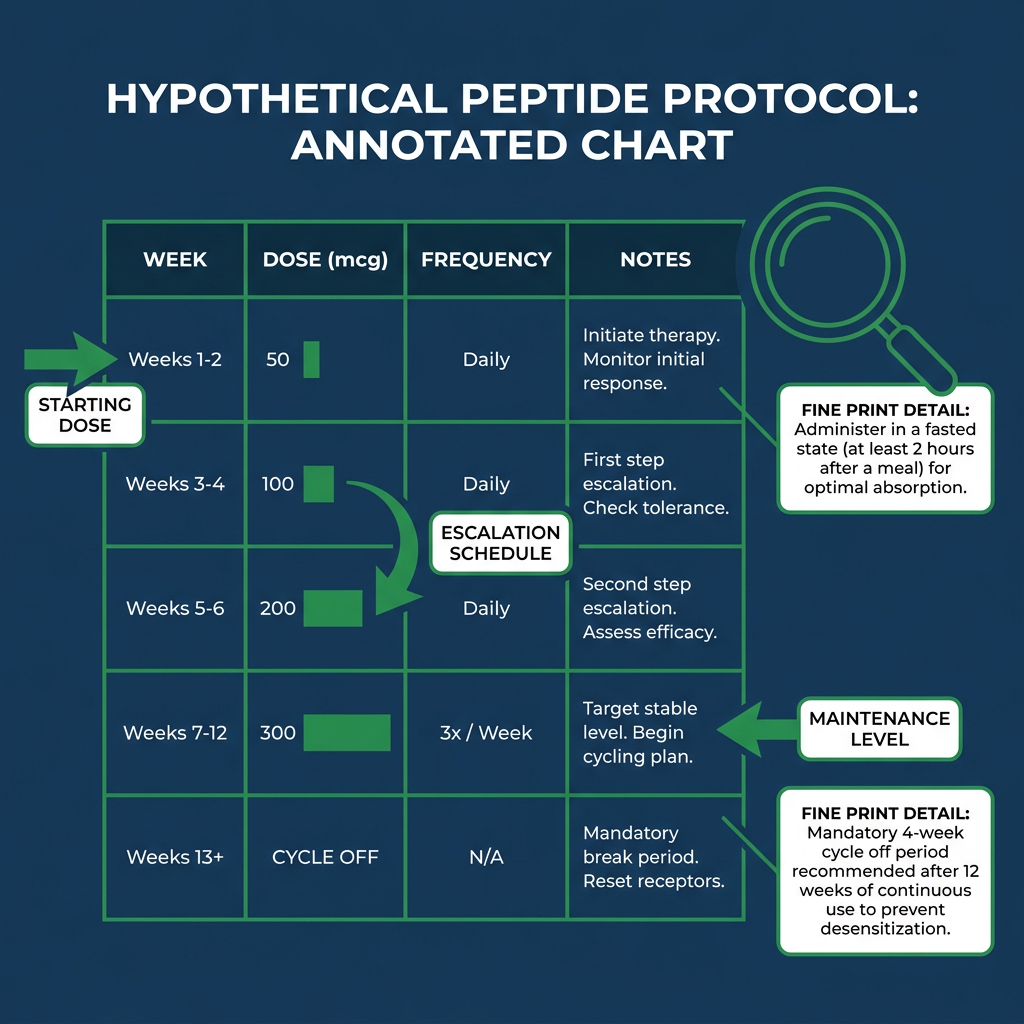
Protocol charts are helpful because they condense a lot of moving parts into one place. They can show a reader where a dose starts, how it escalates, and what maintenance level is expected. But a chart without context can mislead. The fine print of dose timing and goals includes the escalation interval, the delay option, and the stated endpoint.
For example, a chart might list 2.4 mg weekly for Wegovy maintenance, but that number only makes sense after 16 to 20 weeks of escalation from 0.25 mg. If a reader skips the ramp-up, they misinterpret the protocol. The same is true for Zepbound, where 2.5 mg increments require at least 4 weeks at each step.
Research-use-only peptide charts should always be paired with a source table and a clear statement of the goal. The internal Peptide Research Library: A Complete Reference Guide explains how to organize such data without losing the protocol logic. For laboratory comparisons, the AOD 9604 vs Retatrutide: 7 Research Differences Today article shows why two research peptides can have different dose timing and goals even when both are injectable.
When reading charts, ask these questions: What is the starting dose? What is the escalation interval? What is the maintenance range? What is the administration route? What is the measured endpoint? The answers define dose timing and goals more accurately than any single number.
Charts often omit the titration steps. A chart that lists only maintenance doses can mislead a reader into thinking that is the starting dose. Always look for a footnote or a separate column showing the ramp-up. The fine print includes delay options, maximum tolerated dose, and discontinuation rules.
Another common omission is the administration route. A chart might list 2.4 mg weekly without stating subcutaneous injection. That matters because the same peptide given intravenously would produce very different exposure. Always verify the route before comparing doses.
Finally, check the goal column. A chart for weight management may list different maintenance levels than a chart for glycemic control, even for the same peptide. The dose timing and goals are inseparable from the endpoint.
What research-use-only boundaries apply to peptide dose timing and goals?
All peptide protocol information in this article is for research use only. It does not constitute medical advice, and no dose should be considered a recommendation for human consumption. The dose timing and goals described here come from approved drug labels and published research summaries, not from personal use protocols.
Research peptides are often sold as laboratory reagents. They are not approved for human use unless specifically labeled otherwise. When researchers design experiments, they must follow institutional guidelines and safety data. The Cell Penetrating Peptides for Research | Peptides Library article provides an example of how peptide properties affect study design without implying any human application.
A proper research protocol documents the source, purity, storage conditions, and intended endpoint. It also separates dose timing and goals from anecdotal reports. Reliable data come from controlled studies, not forum posts.
The phrase dose timing and goals should always appear in a research protocol’s methods section, because reviewers need to see the schedule and the purpose. Without that clarity, results cannot be replicated.
FAQ
What is the standard starting dose pattern for peptide protocols?
Most peptide protocols start at a dose lower than the eventual maintenance level. For example, Wegovy starts at 0.25 mg once weekly and escalates to 2.4 mg, while Zepbound starts at 2.5 mg and can increase to 15 mg. The starting dose is chosen for tolerability, not full effect.
How often should a peptide dose be escalated?
Escalation intervals are usually 4 weeks in approved labels, but the exact timing depends on the peptide’s half-life, side effect profile, and treatment response. The label may allow a delay of another 4 weeks if the current dose is not well tolerated.
Can two different peptides use the same dose timing and goals?
No. Even if two peptides are both injectable and given once weekly, their receptor targets, pharmacokinetics, and labeled goals may differ significantly. Always check the specific compound’s label or research summary before applying a schedule.
Why do maintenance doses vary between individuals?
Maintenance dosing is goal-directed and individualized. Factors such as treatment response, tolerability, body weight, organ function, and the specific endpoint all influence the final maintenance level. Labels often define a range rather than a single fixed dose.
What should I check when reading a peptide protocol chart?
Always verify the starting dose, escalation interval, maintenance range, administration route, and stated goal. Charts that omit titration steps or route can mislead. Cross-reference the original source, such as an approved label or peer-reviewed study.
Ready to Take the Next Step?
Every product includes lot-specific documentation and third-party purity testing.
Explore Our Research Products →Free shipping on qualifying orders · Batch COA on request