


TB 500 vs Thymosin Beta 4: 7 Research Differences Today
TB 500 vs Thymosin Beta 4: 7 Research Differences Today—critical sequence, FDA, mechanism, and clinical evidence gaps for research use. Read the full guide.
📋 Table of Contents
TB 500 vs Thymosin Beta 4: 7 Research Differences Today is not a branding comparison but a molecular identity question. TB-500 refers to the thymosin beta-4 fragment LKKTETQ, while thymosin beta-4 is the full 43-amino-acid peptide. This article clarifies the seven evidence-based differences that separate the fragment from the parent peptide for research use only.
Key takeaways
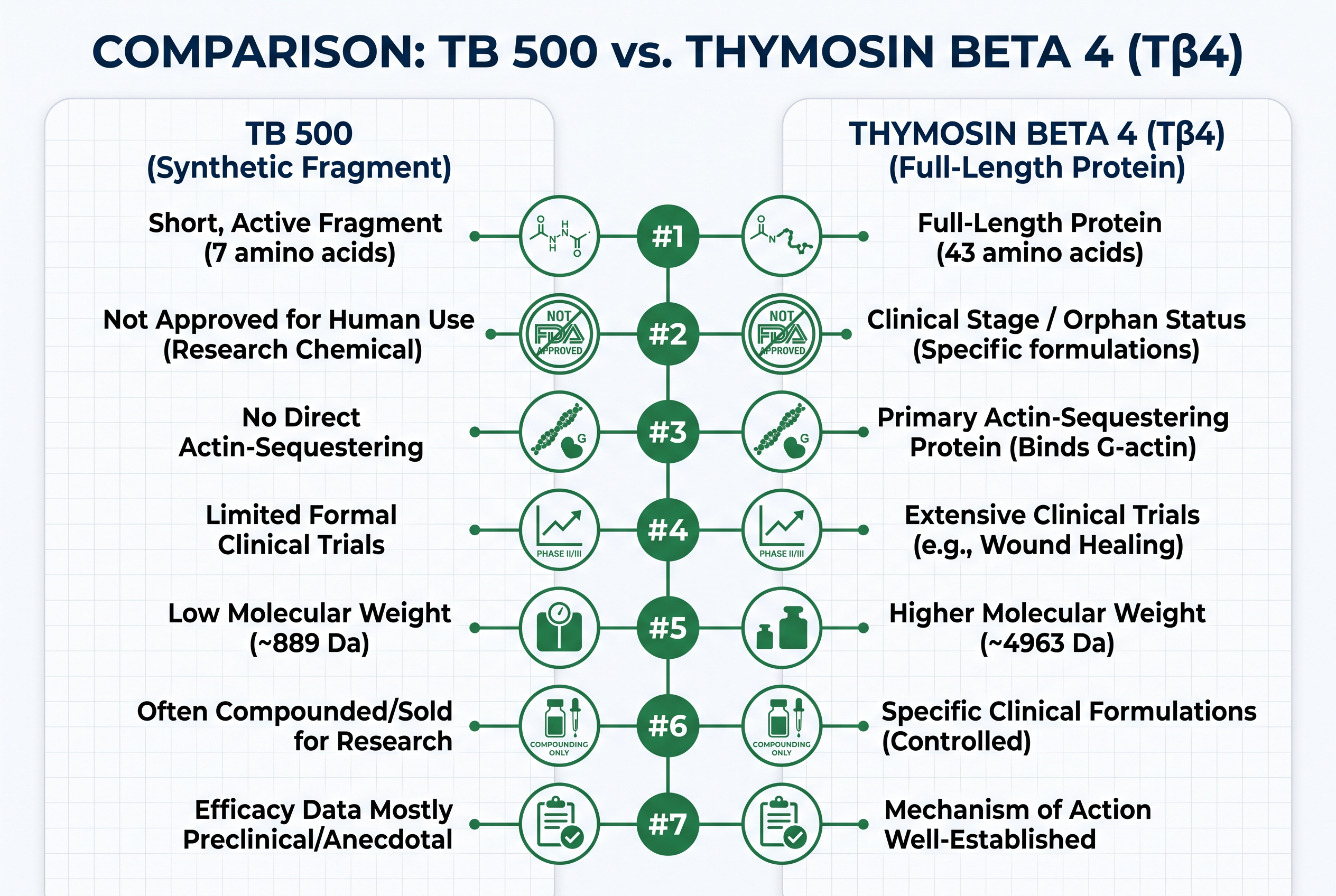
- TB-500 is the thymosin beta-4 fragment LKKTETQ; full-length thymosin beta-4 has 43 amino acids.
- FDA has not identified human exposure data for TB-500 drug products and flags immunogenicity risk from aggregation and peptide-related impurities.
- Full-length thymosin beta-4 has a human clinical trial history; TB-500 does not have the same published human exposure footing.
- The shared LKKTETQ actin-binding motif does not make the fragment biologically identical to the 43-amino-acid parent peptide.
- Verify sequence, fragment numbering, and analytical methods before citing any study.
What Are the 7 Research Differences in TB 500 vs Thymosin Beta 4: 7 Research Differences Today?
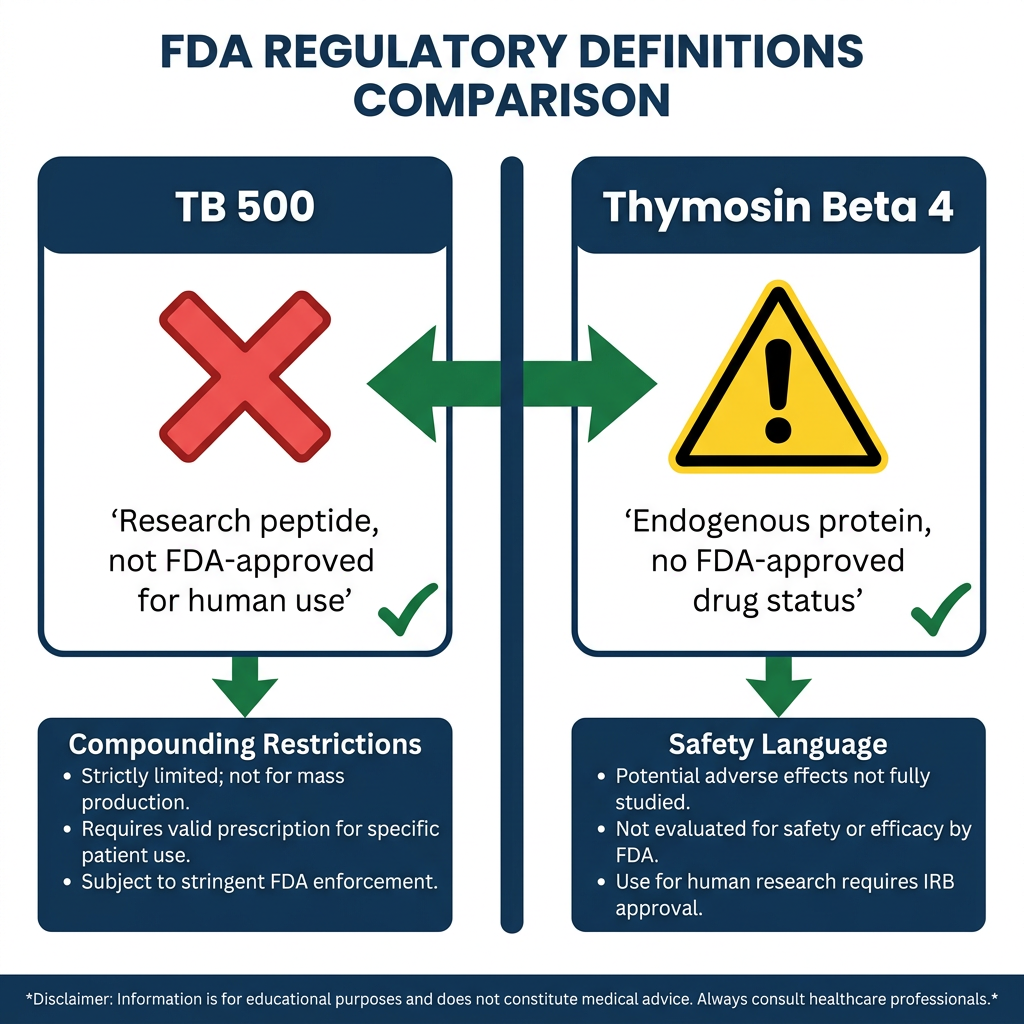
The seven research differences between TB 500 vs Thymosin Beta 4: 7 Research Differences Today cover chemical identity, sequence length, naming precision, mechanism depth, clinical history, analytical characterization, and current FDA compounding context. Each difference changes which data can reasonably be cited.
!TB 500 vs Thymosin Beta 4: 7 Research Differences Today – Sequence Comparison

Chemical identity in TB 500 vs Thymosin Beta 4: 7 Research Differences Today
FDA lists TB-500 as thymosin beta-4 fragment LKKTETQ. Thymosin beta-4 is the full peptide. This is the core distinction. In published biology, thymosin beta-4 is a naturally occurring peptide associated with actin regulation, cytoskeleton organization, cell migration, and wound-related processes. TB-500, by contrast, is commonly described as a shorter fragment tied to the LKKTETQ motif.
A common mistake is to treat “contains the active site” as equivalent to “is the same molecule.” It is not. A fragment can preserve part of a parent peptide’s activity, yet still differ in distribution, stability, binding behavior, and research support. For any literature review on TB 500 vs Thymosin Beta 4: 7 Research Differences Today, this chemical identity point is the foundation.
Sequence length in TB 500 vs Thymosin Beta 4: 7 Research Differences Today
Thymosin beta-4 has 43 amino acids. TB-500 is discussed as a much shorter fragment, including Ac-LKKTETQ in analytical literature. The fragment includes a functionally important site, but that does not make it the same molecule. A reference to residues 17-23 points away from full-length thymosin beta-4.
Naming precision in TB 500 vs Thymosin Beta 4: 7 Research Differences Today
“TB-500” is a common shorthand, while “thymosin beta-4” is a defined biological peptide entity. Shorthand names create room for confusion. If a paper only says “TB4” without a sequence, treat the evidence as ambiguous until the methods clarify it. That one habit will prevent many citation errors when comparing TB 500 vs Thymosin Beta 4: 7 Research Differences Today.
Mechanism depth in TB 500 vs Thymosin Beta 4: 7 Research Differences Today
Thymosin beta-4 has stronger support for actin sequestration and cytoskeletal effects. TB-500 claims often rely on extrapolation from the shared motif. NCBI MeSH describes thymosin beta-4 as a peptide that regulates cytoskeleton organization by binding and sequestering actin monomers, which inhibits polymerization. That is a clear mechanism tied to a defined peptide entity.
The 2010 PubMed literature identifies LKKTETQ as the central actin-binding domain of thymosin beta-4 and connects that region to angiogenesis, wound healing, and cell migration. That supports why TB-500 is discussed at all. Still, an important misconception needs correcting: a central binding domain is not the same as the whole peptide’s complete biological profile. If a response depends on full-peptide context, tissue distribution, or additional interactions, then fragment-to-parent extrapolation becomes weaker. This is a key point in TB 500 vs Thymosin Beta 4: 7 Research Differences Today.
Clinical history in TB 500 vs Thymosin Beta 4: 7 Research Differences Today
Full-length thymosin beta-4 has a documented human trial history; TB-500 does not have the same published human exposure footing in the FDA record. ClinicalTrials.gov includes a randomized, double-blind, placebo-controlled study of topical thymosin beta-4 in patients with pressure ulcers. The registry describes 0.01%, 0.02%, and 0.1% w/w doses applied once daily for up to 84 days, with wound-healing incidence by day 84 as the primary outcome.
Even without discussing efficacy results, that registry matters because it shows actual human clinical development for full-length thymosin beta-4. By contrast, FDA says it has not identified human exposure data for drug products containing thymosin beta-4 fragment LKKTETQ. The trade-off is straightforward. If you want mechanistic plausibility, both parent-peptide biology and fragment literature may offer clues. If you want human exposure and trial context, full-length thymosin beta-4 is the better-supported evidence base. This asymmetry is central to TB 500 vs Thymosin Beta 4: 7 Research Differences Today.
Analytical characterization in TB 500 vs Thymosin Beta 4: 7 Research Differences Today
A 2012 PubMed-indexed paper identified TB-500 as the N-terminal acetylated 17-23 fragment of human thymosin beta-4 using high-performance liquid chromatography and high-resolution mass spectrometry. That analytical work matters because it provides a precise chemical fingerprint for the fragment. It is not enough to rely on vendor shorthand. When you evaluate TB 500 vs Thymosin Beta 4: 7 Research Differences Today, look for HPLC and HRMS data that confirm the exact sequence.
Current FDA compounding context in TB 500 vs Thymosin Beta 4: 7 Research Differences Today
FDA specifically flags the fragment for possible compounding-related safety risks, including immunogenicity concerns from aggregation and impurities. FDA also states that compounded drugs containing thymosin beta-4 fragment may present significant safety risks. The concerns it names include possible immunogenicity risk related to aggregation and peptide-related impurities.
Just as important, FDA says it has not identified human exposure data for drug products containing this fragment and does not have enough information to know whether it would cause harm in humans. None of that should be collapsed into a single vague claim like “same as thymosin beta-4.” This is a regulatory reality of TB 500 vs Thymosin Beta 4: 7 Research Differences Today.
!TB 500 vs Thymosin Beta 4: 7 Research Differences Today – FDA Safety Context

How Does FDA Define TB 500 vs Thymosin Beta 4: 7 Research Differences Today?
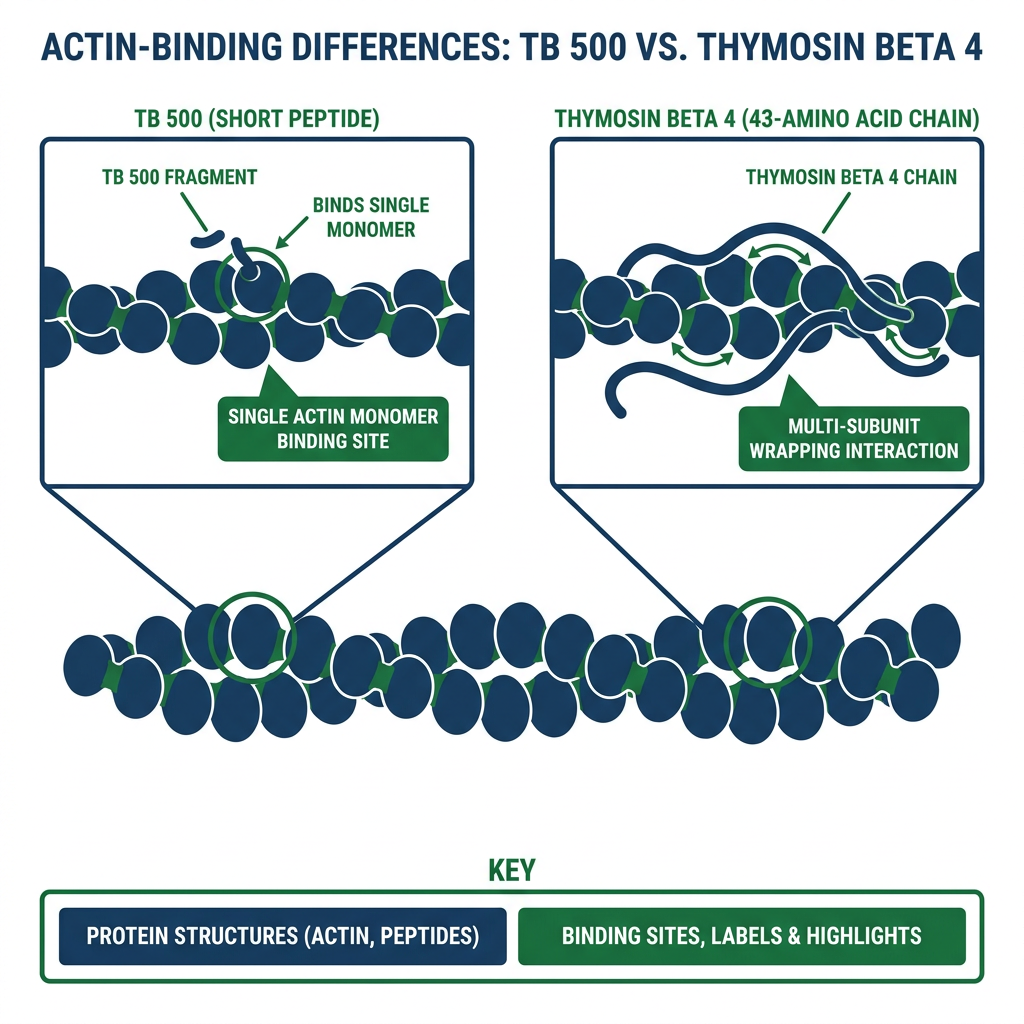
FDA currently treats TB-500 as thymosin beta-4 fragment (LKKTETQ), not as full-length thymosin beta-4. That wording is highly informative. It tells you that, for current compounding and safety discussions, FDA is not using TB-500 as a synonym for the full 43-amino-acid peptide. It is identifying a fragment.
The practical reading is simple: fragment identity, evidence gap, and safety uncertainty are all part of the current FDA picture. For any researcher working with TB 500 vs Thymosin Beta 4: 7 Research Differences Today, the FDA definition is the first checkpoint.
💡 Key Takeaway: How Does FDA Define TB 500 vs Thymosin Beta 4: 7 Research Differences Today?
Why Does Molecular Identity Matter for TB 500 vs Thymosin Beta 4: 7 Research Differences Today?
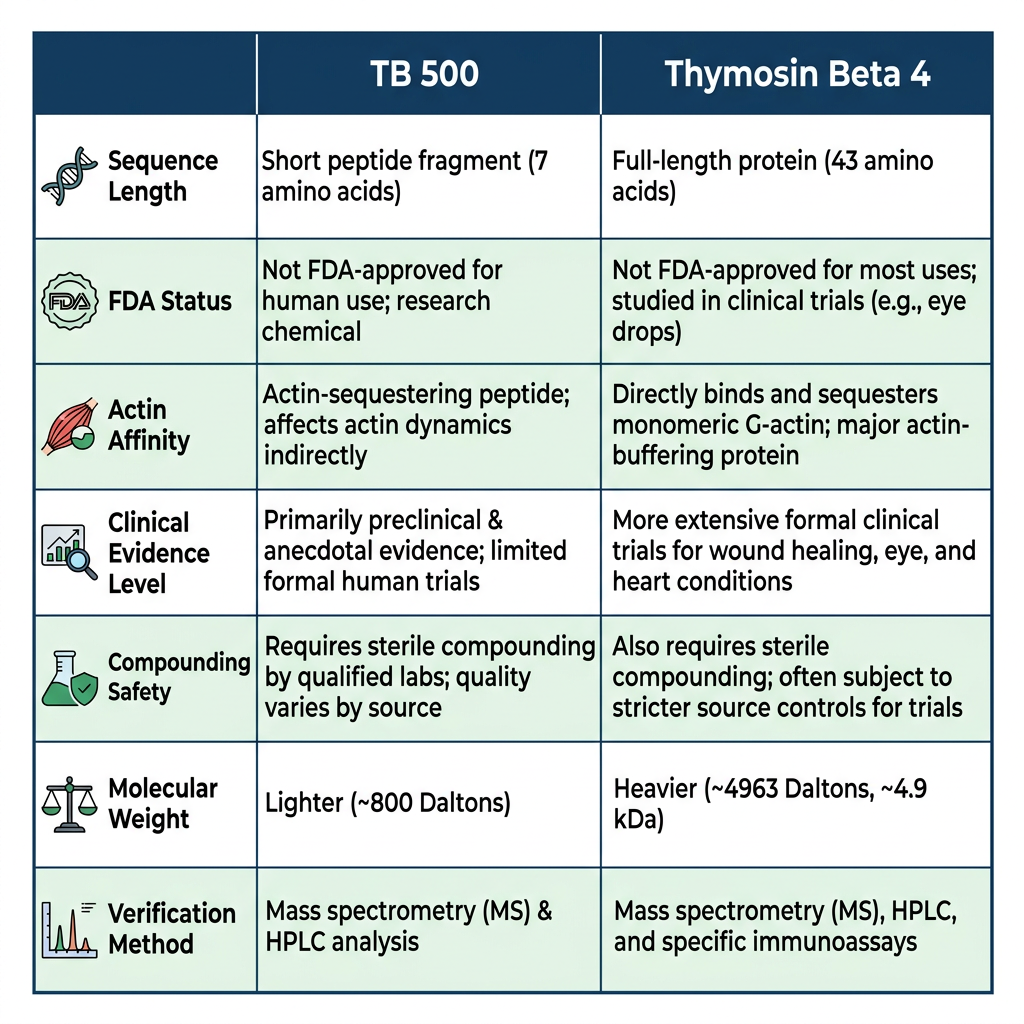
Molecular identity matters because a fragment and a parent peptide are not interchangeable evidence units. If a paper, label, or discussion does not state the sequence, do not assume the evidence for full-length thymosin beta-4 automatically applies to TB-500. That makes the comparison less about branding and more about molecular identity.
At Peptides Library, the practical takeaway is to treat TB-500 as a fragment-specific term, because full-length thymosin beta-4 has broader published biology and a human clinical study history. This is why TB 500 vs Thymosin Beta 4: 7 Research Differences Today should be separated from the start. For more background on peptide research terminology, see Peptide Research Library: A Complete Reference Guide.
How Can You Verify a Study Used TB 500 vs Thymosin Beta 4: 7 Research Differences Today?
Start with the sequence. Peptides Library recommends checking whether a paper names LKKTETQ or a 43-amino-acid thymosin beta-4 construct before reading any claimed effect. Many readers begin with the abstract, but the methods section is usually more decisive than the headline result.
Look for the exact sequence. If you see LKKTETQ or Ac-LKKTETQ, you are likely reading fragment-specific work. Check the peptide length or fragment numbering. A reference to residues 17-23 points away from full-length thymosin beta-4. Separate assay type from molecule identity. A wound-healing or migration model does not tell you which peptide was tested. Verify the formulation and route. Topical, compounded, endogenous, and synthetic contexts should not be merged casually.
Pro tip: if a paper only says “TB4” without a sequence, treat the evidence as ambiguous until the methods clarify it. That one habit will prevent many citation errors in TB 500 vs Thymosin Beta 4: 7 Research Differences Today. For a broader guide on peptide libraries and research-grade sourcing, see Peptide Library: Research-Grade Peptides for Laboratories.
What Are the Actin-Binding Mechanism Differences in TB 500 vs Thymosin Beta 4: 7 Research Differences Today?
Thymosin beta-4 has stronger support as an actin-sequestering peptide that regulates cytoskeleton organization and cell migration. TB-500 evidence is narrower because it centers on the shared LKKTETQ motif rather than the full peptide context. This is where the biology gets interesting.
NCBI MeSH describes thymosin beta-4 as a peptide that regulates cytoskeleton organization by binding and sequestering actin monomers, which inhibits polymerization. That is a clear mechanism tied to a defined peptide entity. The 2010 PubMed literature identifies LKKTETQ as the central actin-binding domain of thymosin beta-4 and connects that region to angiogenesis, wound healing, and cell migration. That supports why TB-500 is discussed at all.
Still, an important misconception needs correcting: a central binding domain is not the same as the whole peptide’s complete biological profile. If a response depends on full-peptide context, tissue distribution, or additional interactions, then fragment-to-parent extrapolation becomes weaker. Peptides Library frames TB 500 vs Thymosin Beta 4: 7 Research Differences Today as a mechanism question first: the shared LKKTETQ site does not make the fragment biologically identical to the 43-amino-acid parent peptide.
If a claim says both peptides “work the same,” ask what exact function was tested. Actin interaction, cell migration, angiogenesis signaling, and clinical wound outcomes are related concepts, not identical endpoints. For more on peptide delivery and cellular uptake, see Cell Penetrating Peptides for Research | Peptides Library.
!TB 500 vs Thymosin Beta 4: 7 Research Differences Today – Actin Binding Mechanism

💡 Key Takeaway: What Are the Actin-Binding Mechanism Differences in TB 500 vs Thymosin Beta 4: 7 Research Differences Today?
How Does Human Clinical Evidence Compare for TB 500 vs Thymosin Beta 4: 7 Research Differences Today?
Full-length thymosin beta-4 has a documented human trial history; TB-500 does not have the same published human exposure footing in the FDA record. That difference is one of the cleanest ways to compare the two. ClinicalTrials.gov includes a randomized, double-blind, placebo-controlled study of topical thymosin beta-4 in patients with pressure ulcers. The registry describes 0.01%, 0.02%, and 0.1% w/w doses applied once daily for up to 84 days, with wound-healing incidence by day 84 as the primary outcome.
Even without discussing efficacy results, that registry matters because it shows actual human clinical development for full-length thymosin beta-4. By contrast, FDA says it has not identified human exposure data for drug products containing thymosin beta-4 fragment LKKTETQ. The trade-off is straightforward. If you want mechanistic plausibility, both parent-peptide biology and fragment literature may offer clues. If you want human exposure and trial context, full-length thymosin beta-4 is the better-supported evidence base. This asymmetry is critical for anyone evaluating TB 500 vs Thymosin Beta 4: 7 Research Differences Today.
What Should You Know About FDA Compounding and Safety Language in TB 500 vs Thymosin Beta 4: 7 Research Differences Today?
Read FDA wording literally. Peptides Library treats “may present significant safety risks” as a research-use-only caution, not a clinical claim. FDA specifically flags the fragment for possible compounding-related safety risks, including immunogenicity concerns from aggregation and impurities. FDA also states that compounded drugs containing thymosin beta-4 fragment may present significant safety risks.
The concerns it names include possible immunogenicity risk related to aggregation and peptide-related impurities. Just as important, FDA says it has not identified human exposure data for drug products containing this fragment and does not have enough information to know whether it would cause harm in humans. For laboratory researchers, this means TB 500 vs Thymosin Beta 4: 7 Research Differences Today includes a regulatory dimension: fragment identity, evidence gap, and safety uncertainty are all part of the current FDA picture. Do not collapse that into a vague “same as thymosin beta-4” claim.
A Side-by-Side Table: TB 500 vs Thymosin Beta 4: 7 Research Differences Today
| Attribute | TB-500 | Thymosin Beta-4 |
|—|—|—|
| FDA identity | Thymosin beta-4 fragment LKKTETQ | Full 43-amino-acid peptide |
| Sequence length | Fragment, often Ac-LKKTETQ (residues 17-23) | 43 amino acids |
| Naming precision | Common shorthand | Defined biological peptide entity |
| Mechanism support | Narrower, tied to LKKTETQ motif | Stronger actin sequestration, cytoskeleton organization, cell migration |
| Human clinical history | No identified human exposure data in FDA record | Randomized placebo-controlled pressure ulcer trial on ClinicalTrials.gov |
| Analytical characterization | 2012 PubMed paper: HPLC and HRMS identified N-terminal acetylated 17-23 fragment | Full peptide sequence characterized in literature |
| FDA compounding context | Flagged for immunogenicity risk from aggregation and impurities | Not currently flagged in same fragment-specific compounding language |
💡 Key Takeaway: A Side-by-Side Table: TB 500 vs Thymosin Beta 4: 7 Research Differences Today
Checklist for Researchers: TB 500 vs Thymosin Beta 4: 7 Research Differences Today
- Confirm the exact sequence: LKKTETQ for TB-500, 43-amino-acid for thymosin beta-4.
- Check fragment numbering: residues 17-23 indicate fragment, not full-length.
- Verify analytical methods: HPLC and HRMS data from the 2012 PubMed paper.
- Separate mechanism extrapolation from direct evidence.
- Review human trial registry data only for full-length thymosin beta-4.
- Read FDA compounding language as fragment-specific, not parent-peptide-specific.
- Do not assume “TB4” without sequence is equivalent to either molecule.
Use this checklist every time you encounter TB 500 vs Thymosin Beta 4: 7 Research Differences Today in literature, vendor documents, or compounding discussions.
!TB 500 vs Thymosin Beta 4: 7 Research Differences Today – Researcher Checklist

Common Misconceptions in TB-500 and Thymosin Beta-4 Research
Misconception 1: “TB-500 is just a brand name for thymosin beta-4.” This is false. FDA explicitly identifies TB-500 as the thymosin beta-4 fragment LKKTETQ, not the full 43-amino-acid peptide. Brand names do not change molecular identity, but this shorthand often hides the sequence difference.
Misconception 2: “The LKKTETQ fragment has identical activity to the full peptide.” This is not supported by the evidence. The 2010 PubMed literature identifies LKKTETQ as the central actin-binding domain, but a binding domain is not the whole peptide’s complete biological profile. Tissue distribution, stability, and additional interactions can differ.
Misconception 3: “FDA approved thymosin beta-4 for clinical use.” FDA has not made such an approval claim in the materials referenced here. Full-length thymosin beta-4 has a clinical trial registry entry, but FDA has not identified human exposure data for TB-500 drug products. Research-use-only framing is essential.
How to Read Vendor and Compounding Labels for These Peptides
Always request a certificate of analysis (COA) that lists the exact sequence, purity percentage, residual solvents, and storage conditions. Purity percentage alone does not confirm identity; a COA should include HPLC and HRMS data when available. For TB-500, look for Ac-LKKTETQ or residues 17-23. For thymosin beta-4, look for the full 43-amino-acid sequence.
Storage conditions matter for research reproducibility. Peptides should be stored according to the vendor’s COA, typically lyophilized at -20°C or below, protected from light and moisture. Do not infer stability from one peptide to the other without specific analytical data.
💡 Key Takeaway: How to Read Vendor and Compounding Labels for These Peptides
A Brief Timeline of Analytical and Regulatory Findings
2010: PubMed literature identifies LKKTETQ as the central actin-binding domain of thymosin beta-4, connecting it to angiogenesis, wound healing, and cell migration. This provides the mechanistic basis for fragment interest.
2012: A PubMed-indexed paper identifies TB-500 as the N-terminal acetylated 17-23 fragment of human thymosin beta-4 using HPLC and HRMS. This gives the fragment a precise analytical fingerprint.
Current: FDA states it has not identified human exposure data for TB-500 drug products and flags immunogenicity risk from aggregation and peptide-related impurities in compounded products.
Current: ClinicalTrials.gov lists a randomized, double-blind, placebo-controlled study of topical thymosin beta-4 for pressure ulcers, with 0.01%, 0.02%, and 0.1% w/w doses applied once daily for up to 84 days.
These milestones show why TB 500 vs Thymosin Beta 4: 7 Research Differences Today is a living comparison, not a static label.
External References for Further Reading
FAQ
What is the main difference between TB-500 and thymosin beta-4?
TB-500 is the thymosin beta-4 fragment LKKTETQ, while thymosin beta-4 is the full 43-amino-acid peptide. The fragment shares the actin-binding motif but lacks the complete parent peptide context. This is the foundational point of TB 500 vs Thymosin Beta 4: 7 Research Differences Today.
Does TB-500 have the same human clinical evidence as thymosin beta-4?
No. Full-length thymosin beta-4 has a randomized, double-blind, placebo-controlled pressure ulcer study on ClinicalTrials.gov with 0.01%, 0.02%, and 0.1% w/w doses. FDA says it has not identified human exposure data for TB-500 drug products. This asymmetry is central to TB 500 vs Thymosin Beta 4: 7 Research Differences Today.
How can I tell if a study used TB-500 or full-length thymosin beta-4?
Check the methods for the exact sequence LKKTETQ or Ac-LKKTETQ, or a reference to residues 17-23. A 2012 PubMed paper identified TB-500 as the N-terminal acetylated 17-23 fragment using HPLC and HRMS. Without sequence data, treat the evidence as ambiguous. This verification step is essential in TB 500 vs Thymosin Beta 4: 7 Research Differences Today.
What safety concerns does FDA raise for TB-500?
FDA flags possible immunogenicity risk from aggregation and peptide-related impurities in compounded products containing thymosin beta-4 fragment. FDA also states it has not identified human exposure data. These are research-use-only caution points, not clinical conclusions, in TB 500 vs Thymosin Beta 4: 7 Research Differences Today.
Why is the LKKTETQ motif important but not sufficient for equivalence?
The 2010 PubMed literature identifies LKKTETQ as the central actin-binding domain of thymosin beta-4, connected to angiogenesis, wound healing, and cell migration. However, a binding domain is not the same as the whole peptide’s complete biological profile, including tissue distribution and additional interactions. That distinction drives the comparison between the fragment and the parent peptide.
Ready to Take the Next Step?
Every product includes lot-specific documentation and third-party purity testing.
Explore Our Research Products →Free shipping on qualifying orders · Batch COA on request