


Sermorelin vs Ipamorelin: 7 Research Differences Today
Sermorelin vs Ipamorelin: 7 Research Differences Today compares GHRH analog vs ghrelin secretagogue pathways, peptide length, half-life, and FDA status.
📋 Table of Contents
Sermorelin vs Ipamorelin: 7 Research Differences Today starts with one clear answer: sermorelin is a 29-amino-acid GHRH analog, while ipamorelin is a synthetic pentapeptide selective for the ghrelin/GHS-R pathway. At Peptides Library, we classify these two research peptides by receptor target first, because that split prevents most comparison errors in growth hormone secretagogue studies.
Key takeaways
- Sermorelin vs Ipamorelin: 7 Research Differences Today is not an interchangeable pair; the receptor pathways differ before any downstream GH effect.
- Sermorelin is GRF1-29, the N-terminal 29 amino acids of GHRH1-44, with a reported human plasma half-life of about 10 to 20 minutes.
- Ipamorelin is described as a selective growth hormone secretagogue and synthetic pentapeptide acting through the ghrelin/GHS receptor.
- FDA material lists sermorelin under NDA 020443 with pediatric approved indication history; ipamorelin appears in compounding discussions without a comparable approved indication.
- Seven discrete filters—receptor target, peptide class, length, named reference structure, half-life evidence, regulatory category, and interpretation risk—separate the two peptides for research use only.
What Is the Short Answer on Sermorelin vs Ipamorelin: 7 Research Differences Today?
Sermorelin and ipamorelin are not the same peptide. Sermorelin is a GHRH analog, while ipamorelin is a ghrelin receptor agonist. At Peptides Library, that receptor split is the fastest accurate way to classify Sermorelin vs Ipamorelin: 7 Research Differences Today for research use.
Every serious Sermorelin vs Ipamorelin: 7 Research Differences Today discussion should open with that receptor split. Sermorelin is synthetically produced GRF1-29, matching the N-terminal 29 amino acids of natural hypothalamic GHRH1-44. PubMed sources describe it as the shortest synthetic peptide with full biological activity of GHRH and note that it stimulates growth hormone release from the anterior pituitary.
Ipamorelin belongs to a different family. The supplied literature describes it as a selective growth hormone secretagogue and a synthetic pentapeptide acting through the ghrelin or GHS receptor pathway. That means the compounds may converge on growth hormone signaling, but they do not start from the same biological trigger.
This is why Peptides Library frames Sermorelin vs Ipamorelin: 7 Research Differences Today as a pathway comparison first. A common misconception is that two peptides are functionally interchangeable just because both appear in “GH support” conversations. In research terms, pathway class still matters because it shapes receptor binding, downstream physiology, and how published evidence should be interpreted.
How Do Sermorelin and Ipamorelin Work Through Different Pathways?
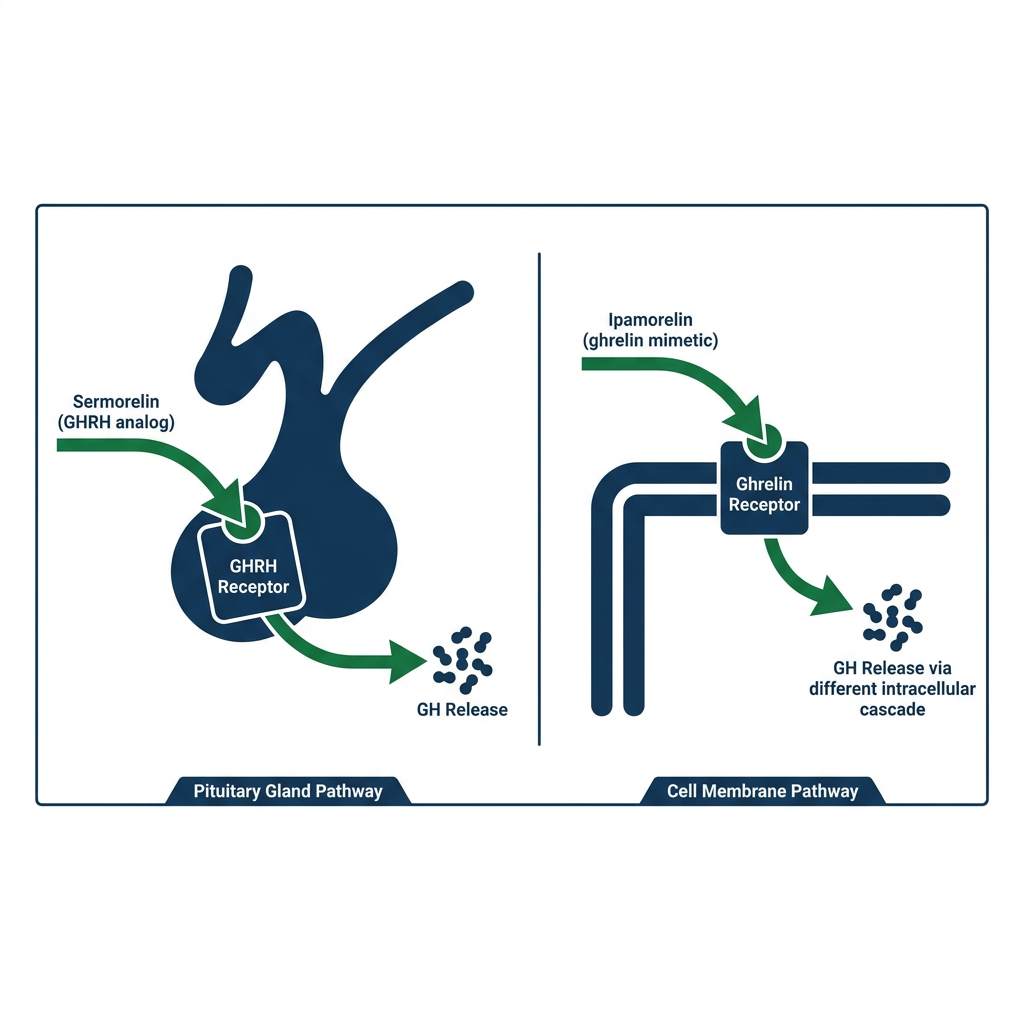
They work through different signaling routes: sermorelin uses the GHRH pathway, while ipamorelin uses the ghrelin/GHS-R pathway. Those are related endocrine systems, not identical ones.
Sermorelin acts within the hypothalamic-pituitary-somatotropic axis by mimicking part of endogenous growth hormone-releasing hormone. In plain terms, it engages the GHRH side of the axis and stimulates the anterior pituitary to release growth hormone.
Ipamorelin is grouped with growth hormone secretagogues rather than GHRH analogs. The supplied 2020 review describes it as a selective agonist of the ghrelin/GHS receptor pathway. That matters because ghrelin signaling is its own receptor story, with distinct pharmacology from GHRH-based compounds.
Understanding Sermorelin vs Ipamorelin: 7 Research Differences Today requires separating the GHRH axis from ghrelin signaling. If a paper, chart, or product page discusses GHRH analogs, then sermorelin belongs in that bucket. If it discusses ghrelin receptor agonists or GHS compounds, then ipamorelin belongs there. Pro tip: if you cannot identify the receptor target in the first few lines of a claim, the comparison is probably too vague to trust.
💡 Key Takeaway: How Do Sermorelin and Ipamorelin Work Through Different Pathways?
What Are the 7 Biggest Research Differences Between Sermorelin vs Ipamorelin: 7 Research Differences Today?
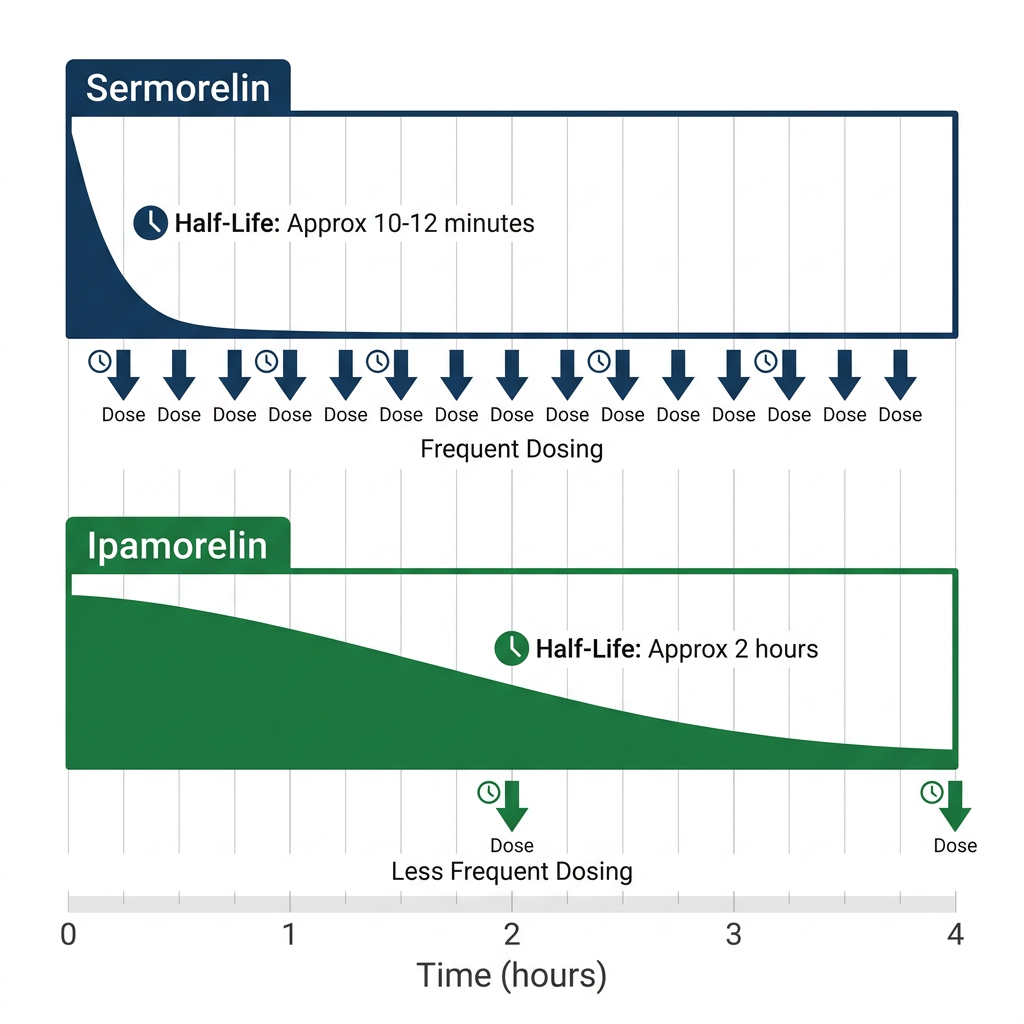
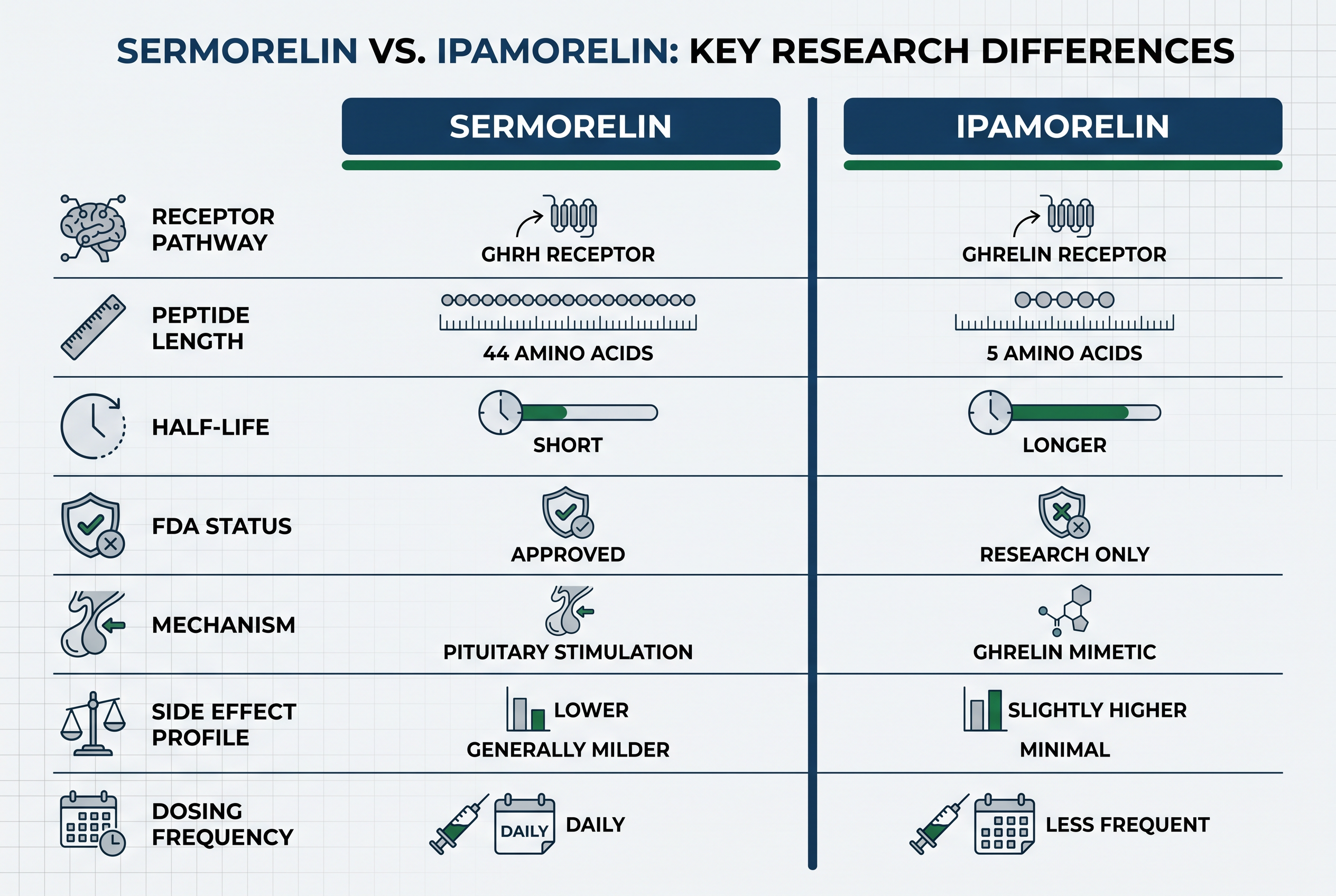
The main differences are receptor target, peptide class, peptide length, half-life evidence, physiologic framing, regulatory status, and evidence interpretation. Those seven points cover most serious comparisons.
When readers ask “sermorelin vs ipamorelin,” they often want one headline answer. A better method is to break the comparison into discrete research variables, because the two peptides differ across more than one dimension. The seven-point framework below keeps Sermorelin vs Ipamorelin: 7 Research Differences Today from collapsing into a vague “both raise GH” claim.
1. Receptor pathway: Sermorelin acts through GHRH signaling; ipamorelin acts through the ghrelin/GHS-R pathway. For Sermorelin vs Ipamorelin: 7 Research Differences Today, receptor pathway is the first filter.
2. Peptide class: Sermorelin is a GHRH analog; ipamorelin is a selective growth hormone secretagogue. Peptide class also separates Sermorelin vs Ipamorelin: 7 Research Differences Today into GHRH analog and selective secretagogue.
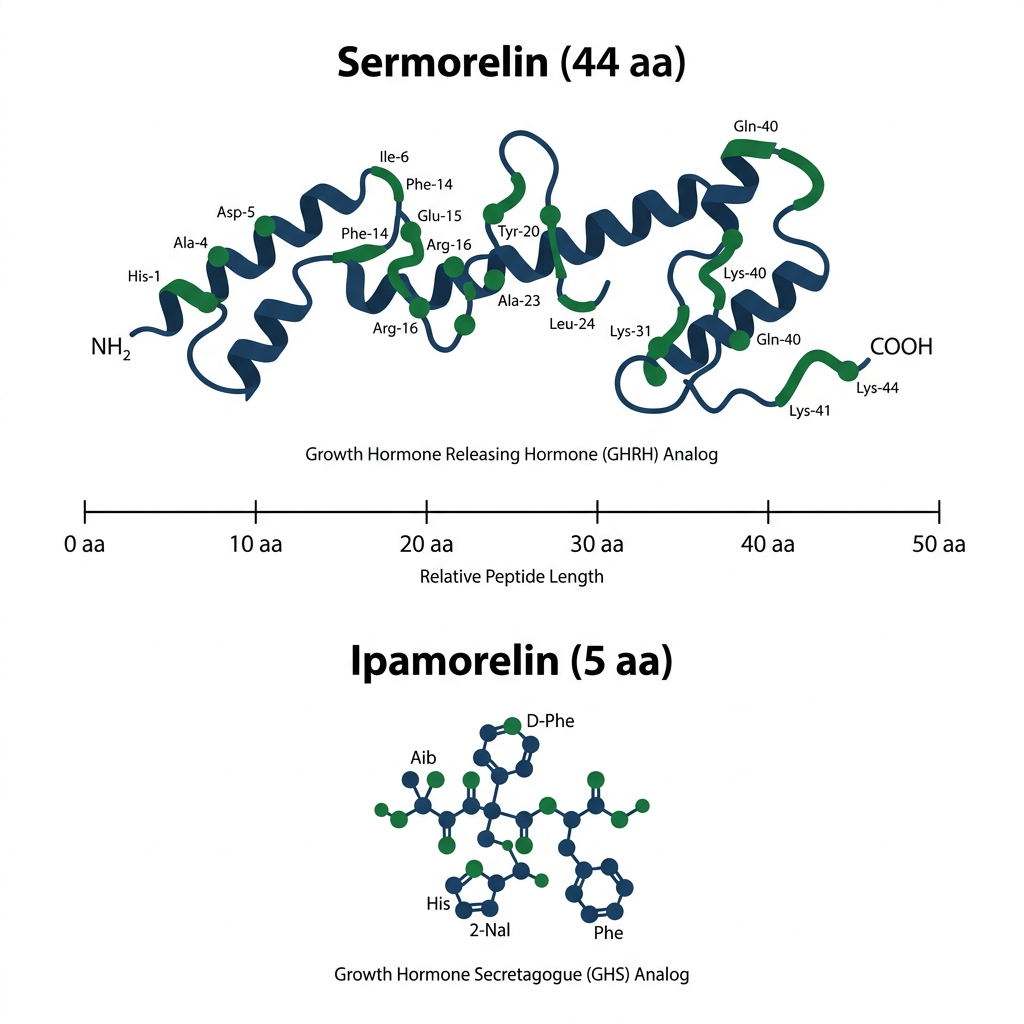
3. Peptide length: Sermorelin is a 29-amino-acid peptide; ipamorelin is described in the supplied review as a pentapeptide. Peptide length is a simple numeric anchor in Sermorelin vs Ipamorelin: 7 Research Differences Today.
4. Named reference structure: Sermorelin corresponds to GRF1-29, the N-terminal 29 amino acids of GHRH1-44.
5. Half-life evidence: Sermorelin has a reported human plasma half-life of about 10 to 20 minutes; the provided comparison sources do not give a matching headline half-life fact for ipamorelin.
6. Regulatory category: FDA material lists sermorelin with approved pediatric indication history under NDA 020443; ipamorelin is referenced in compounding discussions, not as an approved indication.
7. Interpretation risk: “Both affect GH” is true but incomplete, because it hides receptor and regulatory differences that change how evidence should be read. This seventh point is the most common place where Sermorelin vs Ipamorelin: 7 Research Differences Today gets misread.
That seventh point is where many mistakes begin. In peptide science, two compounds can share a broad outcome category and still belong to meaningfully different mechanistic and regulatory classes.
| Difference | Sermorelin | Ipamorelin |
|—|—|—|
| Receptor pathway | GHRH signaling | Ghrelin/GHS-R pathway |
| Peptide class | GHRH analog | Selective growth hormone secretagogue |
| Peptide length | 29 amino acids | Pentapeptide (5 amino acids) |
| Named structure | GRF1-29, N-terminal 29 of GHRH1-44 | Not a truncated GHRH analog |
| Half-life evidence | About 10–20 min human plasma half-life | No matching headline figure in supplied sources |
| Regulatory category | NDA 020443, pediatric indication history | Compounding discussions, no approved indication |
| Interpretation risk | GHRH-axis framing | Ghrelin/GHS framing |
How Should You Compare Receptor Targets Step by Step?
Start with receptor biology, then map the peptide class, then confirm whether the article or source uses GHRH terms or ghrelin terms. That sequence prevents category errors.
Step 1 is to identify the primary pathway name in the source. If the text mentions GHRH, GRF1-29, or hypothalamic growth hormone-releasing hormone, you are dealing with the sermorelin side of the comparison.
Step 2 is to look for ghrelin, GHS receptor, or growth hormone secretagogue language. Those terms place a compound on the ipamorelin side. This is why “secretagogue” is not just a stylistic label. It signals a distinct receptor framework.
Step 3 is to check whether the source blurs the two pathways into one claim. If it does, slow down. A common mistake is to treat pathway convergence as pathway identity. The fact that both routes can influence growth hormone release does not erase the receptor difference.
A stepwise receptor check is the core of Sermorelin vs Ipamorelin: 7 Research Differences Today. For further peptide classification resources, see the Peptide Research Library: A Complete Reference Guide.
How Should You Compare Peptide Structure and Length Step by Step?
Compare sequence category first, amino-acid count second, and relation to native hormone third. Structure tells you what kind of analog or secretagogue you are actually looking at.
Step 1 is simple: sermorelin is a 29-amino-acid analog of human GHRH. The supplied PubMed material says it has the same amino-acid composition as the N-terminal 29 amino acids of natural GHRH1-44.
Step 2 is to contrast that with ipamorelin, which the supplied review identifies as a synthetic pentapeptide. Even before receptor biology enters the picture, 29 amino acids versus 5 amino acids suggests different design logic and different structure-function assumptions.
Step 3 is to ask whether the compound is presented as a truncated analog of a native hormone or as a separate secretagogue scaffold. Sermorelin fits the first model. Ipamorelin fits the second. Pro tip: many low-quality summaries skip this distinction, but it is one of the cleanest ways to separate the two peptides accurately.
Structure comparison makes Sermorelin vs Ipamorelin: 7 Research Differences Today concrete: 29 amino acids versus 5 amino acids. Researchers who need to verify peptide structure can consult the Peptide Library: Research-Grade Peptides for Laboratories resource for reference-grade classification.
💡 Key Takeaway: How Should You Compare Peptide Structure and Length Step by Step?
How Should You Compare Half-Life and Timing Step by Step?
Use human half-life data where available, ask what clears the peptide, and avoid assuming one compound’s timing applies to the other. Sermorelin has the clearer supplied half-life fact.
PubMed material cited in the background states that sermorelin’s human plasma half-life is about 10 to 20 minutes. The same source attributes that short half-life mainly to renal ultrafiltration and enzymatic degradation at the N terminus. That gives readers an actual pharmacokinetic anchor.
For ipamorelin, the supplied source set emphasizes class, selectivity, and receptor pathway rather than a matching headline human plasma half-life figure. That does not mean timing is irrelevant. It means the source-backed comparison here is asymmetrical, and a careful writer should say so.
The half-life step in Sermorelin vs Ipamorelin: 7 Research Differences Today shows why one compound has a direct human plasma figure and the other does not in supplied sources. Peptides Library treats sermorelin’s roughly 10 to 20 minute plasma half-life as a core comparison point because the supplied human data support that number directly.
That kind of pharmacokinetic caution is familiar beyond peptides as well, and a thyroid medication timing review makes the same basic point that timing claims become weak quickly when they are not tied to compound-specific data. For a similar seven-difference framework applied to another peptide pair, see AOD 9604 vs Retatrutide: 7 Research Differences Today.
Why Does Regulatory Status Matter in Sermorelin vs Ipamorelin: 7 Research Differences Today?
Regulatory status matters because it changes how evidence should be interpreted and what clinical history can be claimed for each peptide. Sermorelin has a documented FDA approval history, while ipamorelin does not in the supplied source set.
FDA material lists sermorelin with approved pediatric indication history under NDA 020443. That is a verifiable regulatory anchor. Ipamorelin is referenced in compounding discussions, not as an approved treatment indication. This asymmetry is one of the least discussed but most decisive parts of Sermorelin vs Ipamorelin: 7 Research Differences Today.
For research-use-only purposes, regulatory history does not make one peptide automatically better or worse. It does mean that product claims, marketing language, and study citations should be sorted by what each compound has actually demonstrated in approved or published contexts. FDA material makes Sermorelin vs Ipamorelin: 7 Research Differences Today easy to verify through NDA 020443 for sermorelin.
Researchers should always request a certificate of analysis for any peptide and verify the supplier’s stated purity and storage conditions. Research-use-only framing means no human consumption, no dosing guidance, and no therapeutic claims. The FDA website provides primary regulatory documents, and PubMed offers peer-reviewed abstracts for both peptides.
Which Evidence Types Best Support Sermorelin vs Ipamorelin: 7 Research Differences Today Claims?
Peer-reviewed PubMed abstracts and primary FDA documents are the strongest evidence types. Product pages and forum summaries are weaker, especially when they omit receptor class or amino acid count.
When you review Sermorelin vs Ipamorelin: 7 Research Differences Today, ask whether the source cites PubMed abstracts, FDA documents, or only product pages. A source that names GHRH versus ghrelin/GHS-R pathways is more useful than one that only says “GH support.”
Evidence hierarchy keeps Sermorelin vs Ipamorelin: 7 Research Differences Today research-use-only and source-backed. The supplied PubMed material for sermorelin includes human plasma half-life data and structural identity as GRF1-29. The supplied review for ipamorelin describes it as a selective growth hormone secretagogue and synthetic pentapeptide.
For researchers building a reference library, the Peptide Library: Research-Grade Peptides for Laboratories page offers classification guidance without therapeutic claims. Always check the primary source before repeating any comparison claim.
💡 Key Takeaway: Which Evidence Types Best Support Sermorelin vs Ipamorelin: 7 Research Differences Today Claims?
What Common Misconceptions Create Confusion Around Sermorelin vs Ipamorelin: 7 Research Differences Today?
The biggest misconception in Sermorelin vs Ipamorelin: 7 Research Differences Today is that GHRH and ghrelin pathways are interchangeable. They are not. A second misconception is that both peptides have identical half-life evidence, when the supplied sources only give a direct human plasma half-life for sermorelin.
Marketing language often blurs Sermorelin vs Ipamorelin: 7 Research Differences Today by using “GH support” without naming a receptor. That is too broad to be scientifically useful. Another common error is treating ipamorelin as a GHRH analog simply because it appears in growth hormone secretagogue discussions.
A third misconception is that regulatory history is irrelevant for research peptides. In fact, FDA material under NDA 020443 for sermorelin provides a historical anchor that ipamorelin does not have in the supplied source set. Researchers who ignore this asymmetry risk overstating the evidence base for one compound.
How Can Researchers Use a Comparison Checklist for Sermorelin vs Ipamorelin: 7 Research Differences Today?
A clean checklist for Sermorelin vs Ipamorelin: 7 Research Differences Today should start with receptor target, not with growth hormone outcome. Then move to peptide class, amino acid length, named reference structure, half-life evidence, regulatory category, and interpretation risk.
Use this sequence for any claim you encounter:
- Identify the receptor pathway: GHRH or ghrelin/GHS-R.
- Confirm peptide class: GHRH analog or selective secretagogue.
- Check amino acid count: 29 for sermorelin, 5 for ipamorelin.
- Verify named structure: GRF1-29 for sermorelin.
- Look for human plasma half-life data: about 10–20 minutes for sermorelin.
- Check regulatory status: NDA 020443 for sermorelin, compounding discussions for ipamorelin.
- Assess interpretation risk: does the source hide receptor and regulatory differences?
A checklist prevents researchers from accidentally treating Sermorelin vs Ipamorelin: 7 Research Differences Today as a single-peptide story. For additional peptide classification tools, see Cell Penetrating Peptides for Research | Peptides Library.
FAQ
What is the most important single difference in Sermorelin vs Ipamorelin: 7 Research Differences Today?
For Sermorelin vs Ipamorelin: 7 Research Differences Today, the receptor target is the fastest accurate separator: GHRH versus ghrelin/GHS-R. Sermorelin is a 29-amino-acid GHRH analog; ipamorelin is a synthetic pentapeptide selective for the ghrelin/GHS receptor pathway.
Why does sermorelin have a reported half-life but ipamorelin does not in the same source set for Sermorelin vs Ipamorelin: 7 Research Differences Today?
In Sermorelin vs Ipamorelin: 7 Research Differences Today, the half-life asymmetry is a source coverage issue, not proof that ipamorelin has no half-life. The supplied PubMed material gives sermorelin a human plasma half-life of about 10 to 20 minutes, while the supplied ipamorelin review focuses on selectivity and receptor pathway instead of a matching headline half-life figure.
Can Sermorelin vs Ipamorelin: 7 Research Differences Today be reduced to just peptide length?
No, Sermorelin vs Ipamorelin: 7 Research Differences Today spans seven separate variables, including regulatory category and evidence interpretation. Peptide length matters—29 amino acids versus 5 amino acids—but receptor target, peptide class, named reference structure, half-life evidence, regulatory status, and interpretation risk are all part of the comparison.
What should a researcher check first on a product page claiming Sermorelin vs Ipamorelin: 7 Research Differences Today benefits?
For any research-use-only claim about Sermorelin vs Ipamorelin: 7 Research Differences Today, verify receptor class, amino acid count, and COA availability before anything else. Check whether the page names GHRH or ghrelin/GHS-R, states 29 versus 5 amino acids, and offers a certificate of analysis with purity and storage conditions.
Is Sermorelin vs Ipamorelin: 7 Research Differences Today the same as asking which peptide is better?
No, Sermorelin vs Ipamorelin: 7 Research Differences Today is a mechanistic and regulatory comparison, not a ranking. The two peptides have different receptor pathways, different structural classes, and different evidence profiles. Research-use-only framing means no human consumption, no dosing guidance, and no therapeutic superiority claims.
Ready to Take the Next Step?
Every product includes lot-specific documentation and third-party purity testing.
Explore Our Research Products →Free shipping on qualifying orders · Batch COA on request