



Peptides Library Hexarelin Research Overview Guide
Peptides library provides 32 proven hexarelin research facts: GH dose-response, oral bioavailability 0.3%, GHSR1a/CD36 cardiac data, and more.
📋 Table of Contents
Hexarelin is a synthetic growth hormone releasing peptide (older code EP-23905) documented by the National Library of Medicine, and Peptides Library provides a source-based research overview that goes beyond single-hormone summaries. Published human data show a GH dose-response plateau of 140 mU/L at 1.0 microgram/kg, an ED50 of 0.48 +/- 0.02 microgram/kg, and an oral bioavailability estimate of only 0.3 +/- 0.1%. Peptides Library connects those endocrine findings to reported GHSR1a and CD36 receptor activity so researchers can see the fuller evidence picture.
Key takeaways
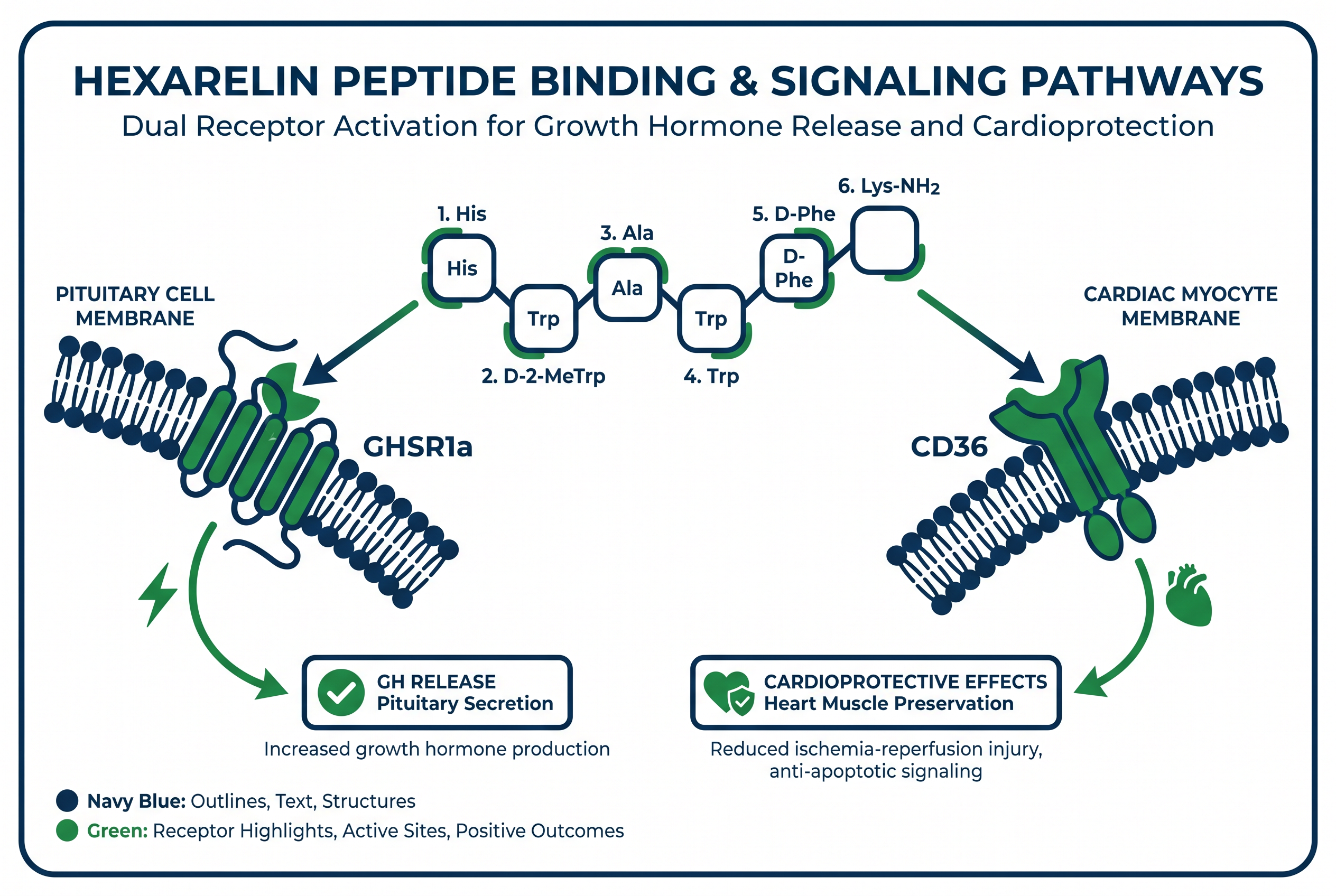
- Hexarelin is a synthetic GHRP (EP-23905) with human GH plateau 140 mU/L at 1.0 µg/kg and ED50 0.48±0.02 µg/kg.
- Published oral bioavailability is 0.3±0.1%, making injected routes the focus of most research.
- Reported endocrine responses include GH, prolactin, and cortisol, not just GH.
- Cardiac review literature links hexarelin activity to GHSR1a and CD36 in fibrosis, ischemic heart disease, cardiac dysfunction, and atherosclerosis.
- Peptides Library frames all hexarelin content as research-use-only and source-ranked for laboratory, clinical education, and informed review.
What exactly does Peptides Library document about hexarelin?
Peptides Library is an independent online knowledge hub focused on peptide science. For hexarelin, Peptides Library turns published endocrine, receptor, bioavailability, and cardiac findings into an evidence-based overview. This approach helps researchers, clinicians, students, and informed readers move beyond isolated abstracts and sales-oriented summaries.
Hexarelin is often described too narrowly as a GH-only peptide. Peptides Library organizes the published record so you can see the fuller picture. The National Library of Medicine documents hexarelin as a synthetic growth hormone releasing peptide with older code EP-23905. Human and cardiac literature point to activity that goes beyond GH release alone.
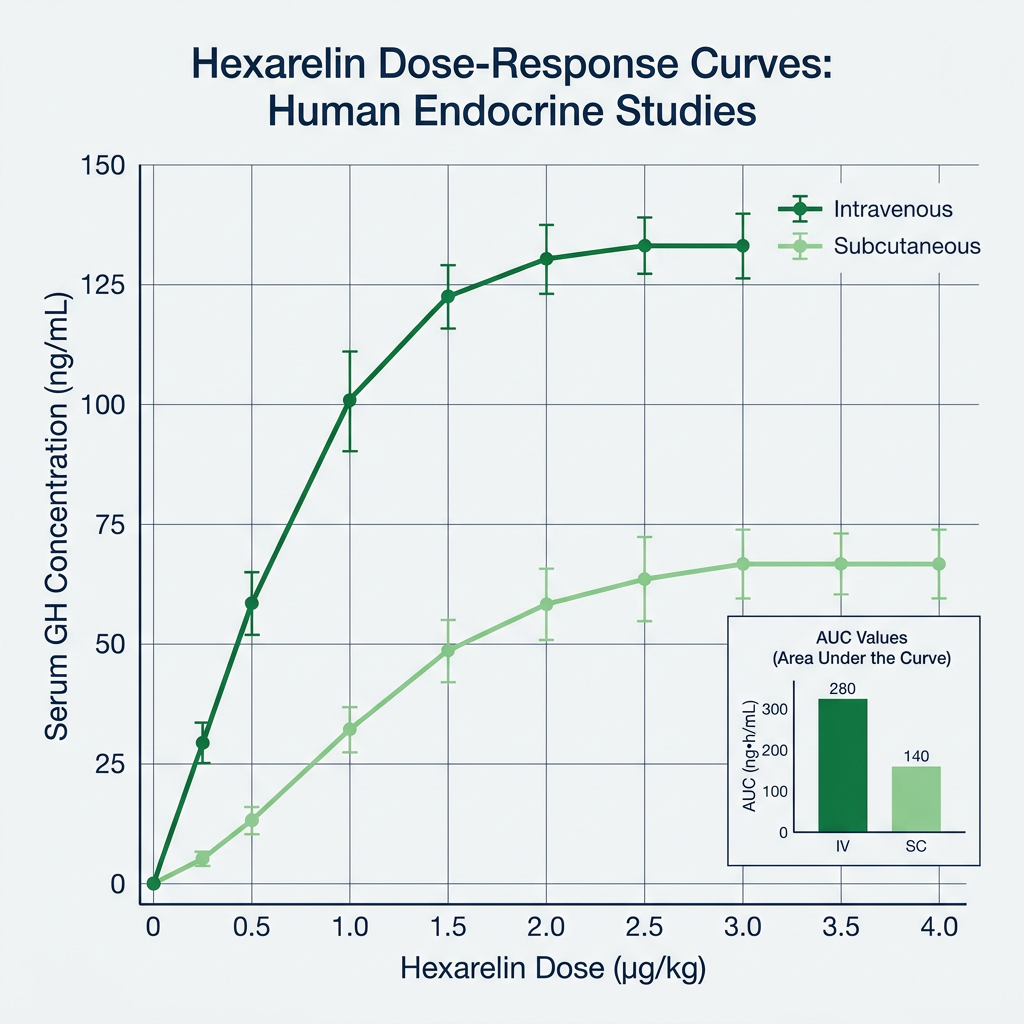
Peptides Library highlights that human hexarelin data showed a GH dose-response plateau of 140 mU/L at 1.0 microgram/kg, with an ED50 of 0.48 +/- 0.02 microgram/kg. That matters when you are comparing peptides, reading protocols, or checking claims. Peptides Library coverage helps you separate established source-backed points from oversimplified summaries.
Researchers using Peptides Library can trace key claims back to the literature indexed in PubMed. This source-ranked approach is central to the hexarelin overview and to the wider peptide knowledge hub.
Published hexarelin research parameters at a glance
| Parameter | Published hexarelin finding |
|—|—|
| Synthetic identity | Synthetic growth hormone releasing peptide, older code EP-23905, documented by NLM |
| GH dose-response | Plateau 140 mU/L at 1.0 microgram/kg; ED50 0.48 +/- 0.02 microgram/kg |
| Oral bioavailability | 0.3 +/- 0.1% in published human estimate |
| Endocrine responses | GH, prolactin, cortisol |
| Receptors discussed | GHSR1a and CD36 |
| Cardiac review settings | Cardiac fibrosis, ischemic heart disease, cardiac dysfunction, atherosclerosis |
| Research framing | Potent research-grade GH secretagogue with broader endocrine and cardiac activity |
How does hexarelin human endocrine data inform research comparisons?
Human endocrine findings for hexarelin go beyond a single hormone pathway. Peptides Library surfaces reported GH, prolactin, and cortisol responses instead of reducing the peptide to GH only. This broader endocrine profile is essential when you compare secretagogues or evaluate protocol claims.
The published human GH dose-response for hexarelin reached a plateau of 140 mU/L at 1.0 microgram/kg. The ED50 was 0.48 +/- 0.02 microgram/kg. These numbers matter because they show a clear dose-response relationship in published studies, not a flat or undefined effect. Researchers can use these values to check whether a secondary source has accurately reported the primary data.
Peptides Library also frames age-related GH response patterns and pituitary and hypothalamic effects in the right context. Published literature includes pituitary-adrenal axis findings after chronic use. That means a careful hexarelin research review must consider more than acute GH release alone.
For researchers, Peptides Library connects these human endocrine findings to receptor terminology and study design. This prevents the common error of blending unlike studies into one generic benefit claim. The research-use-only framing keeps the focus on evidence, not product hype.
💡 Key Takeaway: How does hexarelin human endocrine data inform research comparisons?
Why does Peptides Library emphasize injection-based research over oral use?
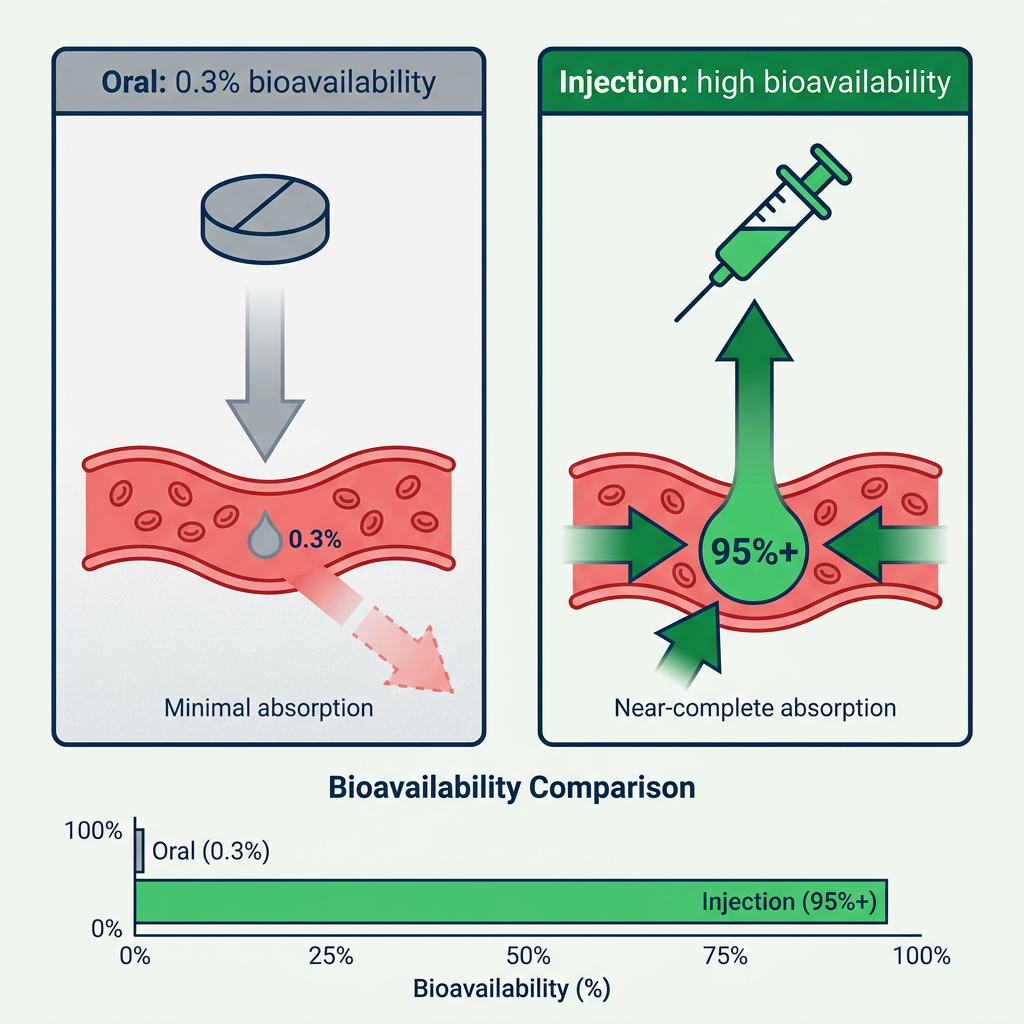
Peptides Library flags a practical finding many summaries miss: published human oral bioavailability for hexarelin was estimated at 0.3 +/- 0.1%. This very low estimate changes how you read older papers, protocol discussions, and casual online claims.
Because oral bioavailability is so limited, most research attention centers on injected administration. Peptides Library highlights this route-of-administration reality so that researchers do not misinterpret study designs. The bioavailability constraint is a core part of the hexarelin research overview.
A good hexarelin guide should not flatten unlike studies into one message. Peptides Library separates human endocrine data, mechanistic receptor findings, and cardiovascular review literature so you can see where results come from. This structure improves decision-making when you screen literature.
For broader peptide administration context, see Cell Penetrating Peptides for Research | Peptides Library. Peptides Library also provides related practical tools across its peptide knowledge hub.
Which receptor mechanisms explain hexarelin cardiac and pituitary activity?
Hexarelin is discussed in relation to GHSR1a because that receptor is central to growth hormone secretagogue signaling. However, cardiac papers also emphasize the CD36 receptor. Peptides Library connects hexarelin’s broader signaling profile to reported GHSR1a activity and cardiac effects linked largely to CD36.
Published cardiac review literature describes cardioprotective activity in settings such as cardiac fibrosis, ischemic heart disease, cardiac dysfunction, and atherosclerosis. These findings are not pituitary-only; they involve cardiac receptor mechanisms. Peptides Library keeps those threads connected while showing what each source actually says.
Mechanism context matters when a paper discusses dose-response curves, pituitary and hypothalamic effects, or age-related GH response patterns. Peptides Library explains why cardiac papers mention CD36 instead of only pituitary signaling. This receptor-level distinction is essential for accurate interpretation.
For researchers working with laboratory peptides, Peptide Library: Research-Grade Peptides for Laboratories offers related receptor and handling context. Peptides Library maintains research-use-only framing throughout.
How does Peptides Library hexarelin overview support source-ranked evidence review?
Peptides Library is different because it is not approaching hexarelin as a retailer. The independent editorial stance lets Peptides Library focus on citation quality, study design, receptor terminology, route-of-administration limits, and practical interpretation. No page turns into a sales pitch for a compound.
The source-ranked evidence model prioritizes official and academic sources such as NLM and PubMed. Peptides Library makes it easier to trace key claims back to the literature. This is especially useful with hexarelin, where the literature spans endocrine, receptor, and cardiac domains.
Peptides Library evaluates hexarelin studies by receptor activity, hormone response, and delivery limits. A good hexarelin guide should not flatten unlike studies into one message. Peptides Library separates human endocrine data, mechanistic receptor findings, and cardiovascular review literature.
This structure improves decision-making. When a paper discusses dose-response curves, pituitary and hypothalamic effects, age-related GH response patterns, or pituitary-adrenal axis findings after chronic use, Peptides Library frames those results in the right context.
💡 Key Takeaway: How does Peptides Library hexarelin overview support source-ranked evidence review?
What cardiac conditions appear in published hexarelin review literature?
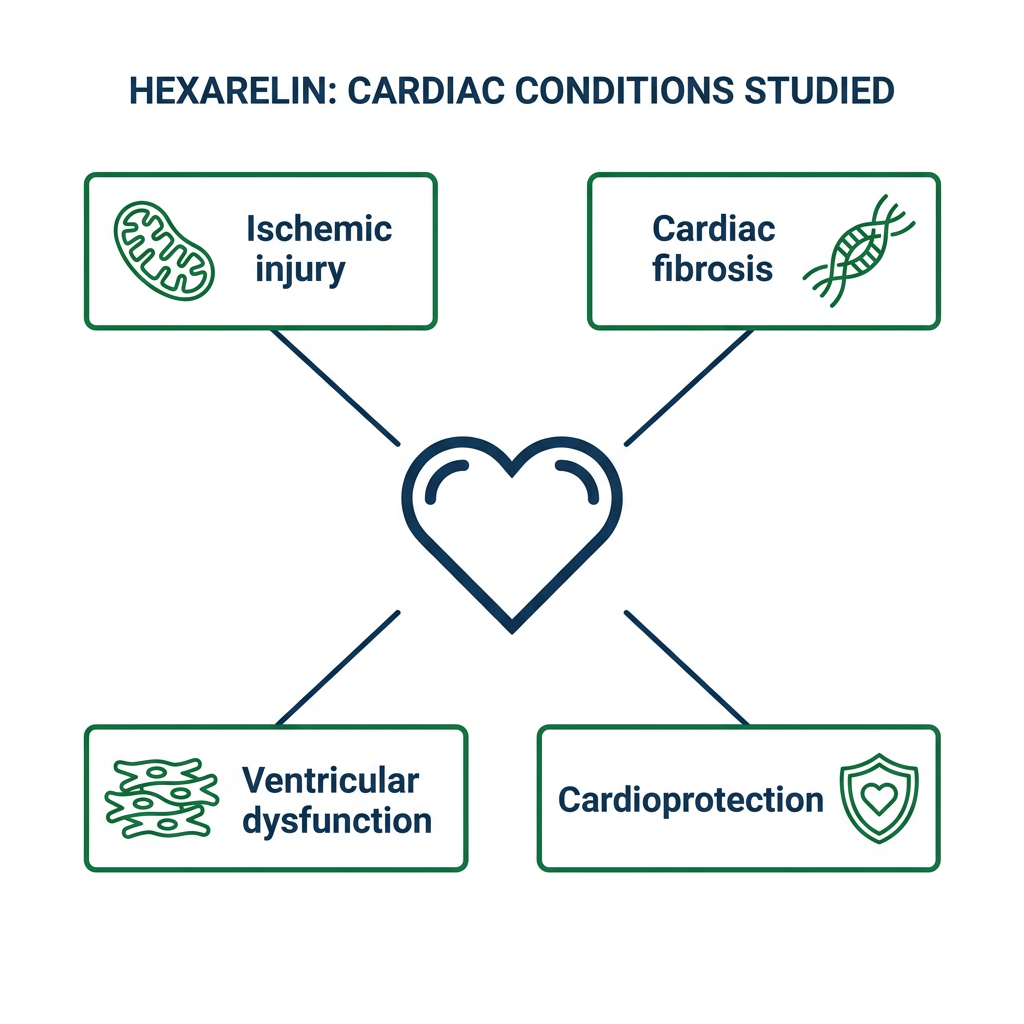
Published cardiovascular review literature describes hexarelin activity in several cardiac settings. Peptides Library documents these as cardiac fibrosis, ischemic heart disease, cardiac dysfunction, and atherosclerosis. These are not vague claims; they come from peer-reviewed review sources.
The cardiac effects are linked largely to the CD36 receptor, not only to GHSR1a. Peptides Library highlights this because it changes how you interpret cardiac papers. A researcher looking only at pituitary signaling would miss a major part of the hexarelin evidence base.
For safety-related research, Peptides Library Hexarelin Side Effects Research Hub provides a dedicated research overview. Peptides Library keeps cardiac findings connected to endocrine and receptor data across the hub.
How can researchers use this hexarelin guide for study screening?
Peptides Library is built for readers who want usable scientific context, not product hype. That includes researchers reviewing secretagogues, healthcare professionals looking for a sharper literature summary, students working through endocrine signaling, and informed consumers trying to understand what published studies do and do not support.
If your main question is route of administration, Peptides Library helps immediately. The very low published oral bioavailability estimate is one reason most research attention centers on injected administration. This changes how you read older papers, protocol discussions, and casual online claims.
Peptides Library makes that research easier to work through by focusing on details that change interpretation. The hexarelin coverage includes source-ranked evidence, mechanism context, human endocrine findings, administration reality, and research framing. These tools help you compare mechanisms, terminology, and study assumptions across compounds.
For a broader peptide reference, see Peptide Research Library: A Complete Reference Guide. Peptides Library also continues into related peptide articles, how-to guides, evidence reviews, and practical tools.
What questions does this overview answer about hexarelin research?
This overview is a good fit when you want a research-first explanation of hexarelin that is easier to use than reading isolated abstracts one by one. It is also the right fit when you need to verify whether claims about potency, oral use, receptor targets, or endocrine effects are actually supported by published sources.
If you want quick clarity on questions like these, the hexarelin coverage is designed for you:
- Is hexarelin best understood only as a GH peptide, or does the literature support broader endocrine activity?
- Why do many discussions mention injection-based research rather than oral use?
- What do published human studies say about GH, prolactin, cortisol, and dose response?
- Why do cardiac papers discuss GHSR1a and CD36 instead of only pituitary signaling?
This overview is also a strong fit if you value continuously updated peptide coverage. Hexarelin sits at the intersection of endocrine signaling, pharmacology, and cardiovascular research. Having one place that tracks those themes saves time and reduces interpretation errors.
💡 Key Takeaway: What questions does this overview answer about hexarelin research?
When is this hexarelin research overview the right fit?
This overview is the right fit when you want a research-first explanation of hexarelin that is easier to use than reading isolated abstracts one by one. It is also the right fit when you need to verify whether claims about potency, oral use, receptor targets, or endocrine effects are actually supported by published sources.
Start with the hexarelin research overview if you want a clearer, source-based understanding of receptor activity, hormone release, oral bioavailability, and cardiac signaling. From there, you can use related peptide guides and practical tools to move forward with more confidence and better questions.
FAQ
Is hexarelin only a GH peptide?
No. Peptides Library documents published GH, prolactin, and cortisol responses, plus GHSR1a and CD36 cardiac activity. The literature supports broader endocrine and cardiac effects than a GH-only summary would suggest.
Why is oral hexarelin not a common research focus?
Published human oral bioavailability for hexarelin was estimated at 0.3 +/- 0.1%. This very low value means most research attention centers on injected administration, which changes how studies are designed and interpreted.
What cardiac conditions appear in hexarelin review literature?
Published cardiac review literature describes cardioprotective activity in cardiac fibrosis, ischemic heart disease, cardiac dysfunction, and atherosclerosis. These effects are linked largely to the CD36 receptor.
How does Peptides Library keep hexarelin coverage research-use-only?
Peptides Library maintains an independent editorial stance with source-ranked evidence, no sales pitch, and no human consumption or dosing claims. All content is framed for laboratory, clinical education, and informed research review.
Where can I find related peptide resources from Peptides Library?
You can visit the Peptide Research Library: A Complete Reference Guide, the Peptides Library Hexarelin Side Effects Research Hub, and the Peptide Library: Research-Grade Peptides for Laboratories.
Ready to Take the Next Step?
Every product includes lot-specific documentation and third-party purity testing.
Explore Our Research Products →Free shipping on qualifying orders · Batch COA on request