


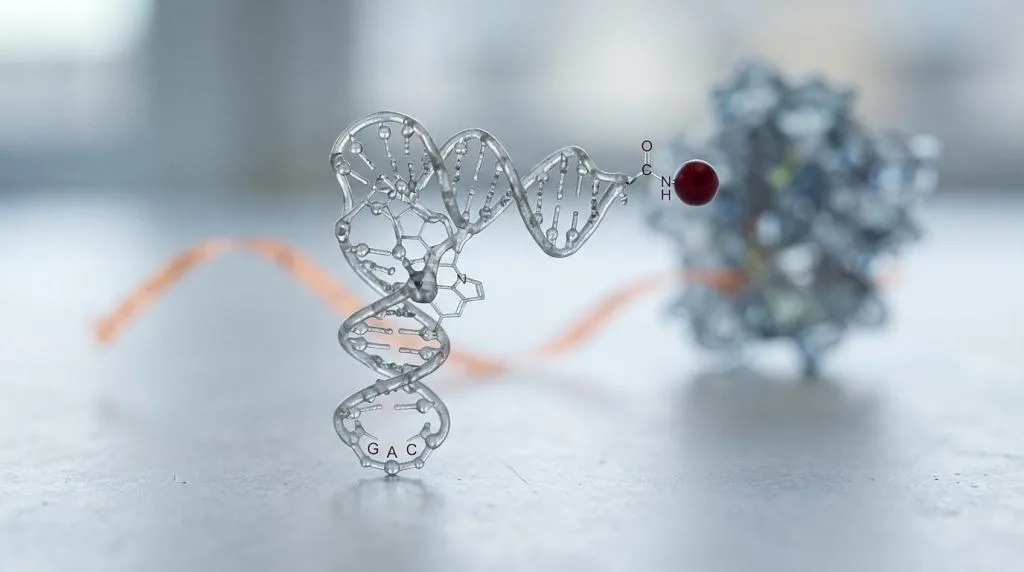
Protein synthesis is one of the most important processes in biology because it turns genetic information into working molecules. Genes store instructions, but proteins do the daily labor of the cell: catalyzing reactions, building structures, moving signals, and responding to stress. If DNA is the archive, protein synthesis is the step that makes those instructions usable.
This topic matters even more in peptide science. Every peptide and every protein begins as a growing chain of amino acids assembled by the translation machinery. That shared starting point helps explain why peptide research often overlaps with broader molecular biology, biochemistry, and cell physiology.
What protein synthesis means in gene expression
Protein synthesis usually refers to translation, the stage of gene expression in which a ribosome reads a messenger RNA, or mRNA, and builds an amino acid chain in the correct order. Standard references from NHGRI and NCBI describe the same core framework: mRNA carries the code, ribosomes read it, and transfer RNA, or tRNA, brings in the matching amino acids.
Translation comes after transcription. During transcription, a DNA sequence is copied into RNA. During translation, that RNA sequence is decoded into a peptide chain, which may then fold into a functional protein. So while people sometimes use “gene expression” as a broad term, protein synthesis is the part that converts nucleotide language into amino acid language.
That conversion is elegant because it depends on a fixed code. mRNA is read in three-letter units called codons, and each codon specifies an amino acid or a stop signal. The cell does not improvise here. It follows a structured decoding system that is conserved across life, with only a few specialized variations.
Key molecules in protein synthesis: mRNA, ribosomes, and tRNA
Three components define the basic mechanism.
mRNA provides the template. Ribosomes supply the decoding machinery. tRNA acts as the adaptor that matches the codon on mRNA with the correct amino acid.
A quick side-by-side view helps:
| Component | Primary role in protein synthesis | Key detail |
|---|---|---|
| mRNA | Carries the coding sequence | Read in codons, three nucleotides at a time |
| Ribosome | Decodes mRNA and catalyzes chain growth | Built from ribosomal RNA and proteins |
| tRNA | Delivers amino acids to the ribosome | Uses an anticodon to pair with the mRNA codon |
| Amino acids | Building blocks of peptides and proteins | Linked by peptide bonds |
| Stop codon | Signals the end of translation | Does not code for an amino acid |
This framework is simple on paper, but the chemistry is precise. The ribosome must maintain the correct reading frame. The right tRNA must arrive at the right codon. The peptide chain must grow one amino acid at a time without losing fidelity.
How mRNA, ribosomes, and tRNA work together during translation
A useful way to think about protein synthesis is as a coordinated relay. The genetic message is copied into mRNA, the mRNA docks with a ribosome, and tRNAs cycle through the ribosome to add amino acids in the encoded order.
Here is the division of labor:
- mRNA: carries the codon sequence copied from a gene
- Ribosome: reads the codons and catalyzes peptide bond formation
- tRNA: matches each codon with its corresponding amino acid
- Anticodon: the three-base tRNA sequence that pairs with a codon
- Peptide bond: the chemical bond that links adjacent amino acids
The ribosome is more than a passive scaffold. It is an active molecular machine made of RNA and protein, and it moves along the mRNA as translation proceeds. In doing so, it creates an ordered environment where codon recognition, amino acid addition, and chain transfer happen in sequence.
tRNA is the key adaptor in that system. Each tRNA carries a specific amino acid and contains an anticodon that base-pairs with the complementary mRNA codon. When the match is correct, the ribosome adds that amino acid to the growing chain. Repeating this cycle builds the nascent peptide one residue at a time.
Accuracy matters because a single wrong amino acid can alter folding, stability, binding, or activity. Cells devote substantial energy to maintaining that accuracy, beginning with the charging of tRNAs by aminoacyl-tRNA synthetases and continuing through ribosomal proofreading steps during translation.
Translation stages: initiation, elongation, termination, and ribosome recycling
Most textbooks divide translation into three major phases: initiation, elongation, and termination. Some also separate ribosome recycling as a fourth operational step because the ribosomal subunits must be released and prepared for another round.
Translation initiation sets the reading frame
Initiation is where the ribosome assembles on the mRNA and identifies the correct start site. This step matters because it establishes the reading frame, which determines how every downstream codon will be interpreted. If the frame shifts, the resulting amino acid sequence changes, often dramatically.
The initiator tRNA pairs with the start codon, usually AUG, and the larger ribosomal subunit joins to form a functional complex. At that point, the machinery is positioned to begin chain growth.
Translation elongation adds amino acids one by one
Elongation is the repetitive core of protein synthesis. A charged tRNA enters the ribosome, its anticodon is checked against the mRNA codon, and if the pairing is correct, the ribosome forms a new peptide bond. The growing chain is transferred to the incoming amino acid, and the ribosome then shifts to the next codon.
This cycle continues rapidly and with high accuracy. The mRNA is read 5’ to 3’, while the peptide grows from the amino terminus to the carboxyl terminus.
A short list of key elongation features makes the logic easier to remember:
- codon-by-codon reading
- anticodon matching
- peptide bond formation
- ribosome translocation
- repeated tRNA entry and exit
Translation termination releases the peptide chain
Termination begins when the ribosome encounters a stop codon. No tRNA matches these codons. Instead, release factors recognize the stop signal and trigger hydrolysis of the bond linking the peptide to the tRNA in the ribosome.
The newly synthesized chain is then released. In many descriptions, a recycling step follows, where the ribosomal components dissociate and become available for another round of translation.
Peptides and proteins in protein synthesis
Protein synthesis produces a chain of amino acids, but that chain does not start life as a fully formed protein. It begins as a nascent peptide.
That distinction is useful. A peptide is generally a shorter chain of amino acids, while a protein is usually longer and folded into a stable, functional three-dimensional structure. The boundary is not always rigid, and naming conventions can vary by context, but the conceptual difference helps.
During translation, the ribosome creates peptide bonds, so the immediate product is a polypeptide or peptide chain. What happens next depends on the molecule. Some chains fold quickly into active proteins. Others are cut, modified, transported, or assembled with partner molecules before they become functional.
In peptide science, this matters because many biologically active peptides are not just small versions of proteins. They can be signaling molecules, hormones, antimicrobial agents, or fragments derived from larger precursor proteins. Their biological effects depend on sequence, length, structure, stability, and how the body processes them.
A peptide’s sequence is only the starting point.
Post-translational events can shape activity in major ways, including cleavage, phosphorylation, glycosylation, disulfide bond formation, and folding assistance from chaperones. So protein synthesis is central, but it is only one layer of how cells produce active biomolecules.
Common misconceptions about protein synthesis
Protein synthesis is often taught as a neat linear script, which is useful early on, but it can hide important details. One common mistake is to assume that DNA directly makes protein. In reality, the information usually moves from DNA to RNA to protein, with translation specifically using mRNA as the template.
Another common mistake is to treat the ribosome as if it simply “reads” RNA like a scanner. The ribosome is a catalytic machine, not just a reading device. It coordinates structural changes, codon recognition, peptide bond formation, and translocation through a tightly ordered mechanism.
A few quick corrections help clear up the basics:
- DNA is not translated directly
- codons are read in triplets
- tRNA carries amino acids, not mRNA
- stop codons signal release, not amino acid addition
- the first product is a peptide chain, not always a finished protein
It is also easy to think that every mRNA produces one protein in one simple pass. Real cells are more dynamic. Translation efficiency can change, ribosomes can stall, initiation can be regulated, and different transcripts can be translated at different rates depending on cellular conditions.
Why protein synthesis matters in peptide science and biomedical research
A solid grasp of protein synthesis helps readers judge claims about peptides more carefully. If a peptide is proposed to alter growth, repair, signaling, inflammation, or metabolism, the next question is often mechanistic: does it affect transcription, translation, stability, receptor signaling, or downstream protein turnover?
That question separates surface-level marketing language from biologically meaningful discussion.
Protein synthesis is also central in disease biology. Cancer, neurodegeneration, infection, and metabolic disorders can all involve altered translation control, ribosome function, stress responses, or protein quality control. Researchers studying peptides often encounter these systems because peptides can serve as signals, therapeutics, biomarkers, or research tools within those pathways.
From a practical research angle, protein synthesis informs experimental design. It affects how cell-free systems are built, how reporter assays are interpreted, how translation inhibitors are used, and how peptide expression systems are optimized. Even when the goal is to study a single small peptide, the broader translation machinery still sets the rules.
This is why protein synthesis remains a foundation for reading peptide papers, evaluating biological plausibility, and asking better mechanistic questions about what a sequence can do once the cell starts turning code into chemistry.