



TB 500 Benefits: 8 Evidence Questions Researchers Ask
500 benefits in research are best supported for corneal and skin wound healing. Explore 8 evidence questions researchers ask about TB-500 and thymosin beta-4.
📋 Table of Contents
500 benefits in research are best supported for corneal and skin wound healing. The most defensible evidence clusters around localized tissue-repair effects, especially faster re-epithelialization and reduced inflammation, not performance or muscle gain. Below, Peptides Library answers eight evidence questions researchers ask about TB-500 and thymosin beta-4.
*Research use only: all products discussed on this site are sold strictly for in vitro laboratory research purposes only. They are not for human use, not for veterinary use, and not intended to diagnose, treat, cure, or prevent any disease. All information is educational in a research context.*
Key takeaways
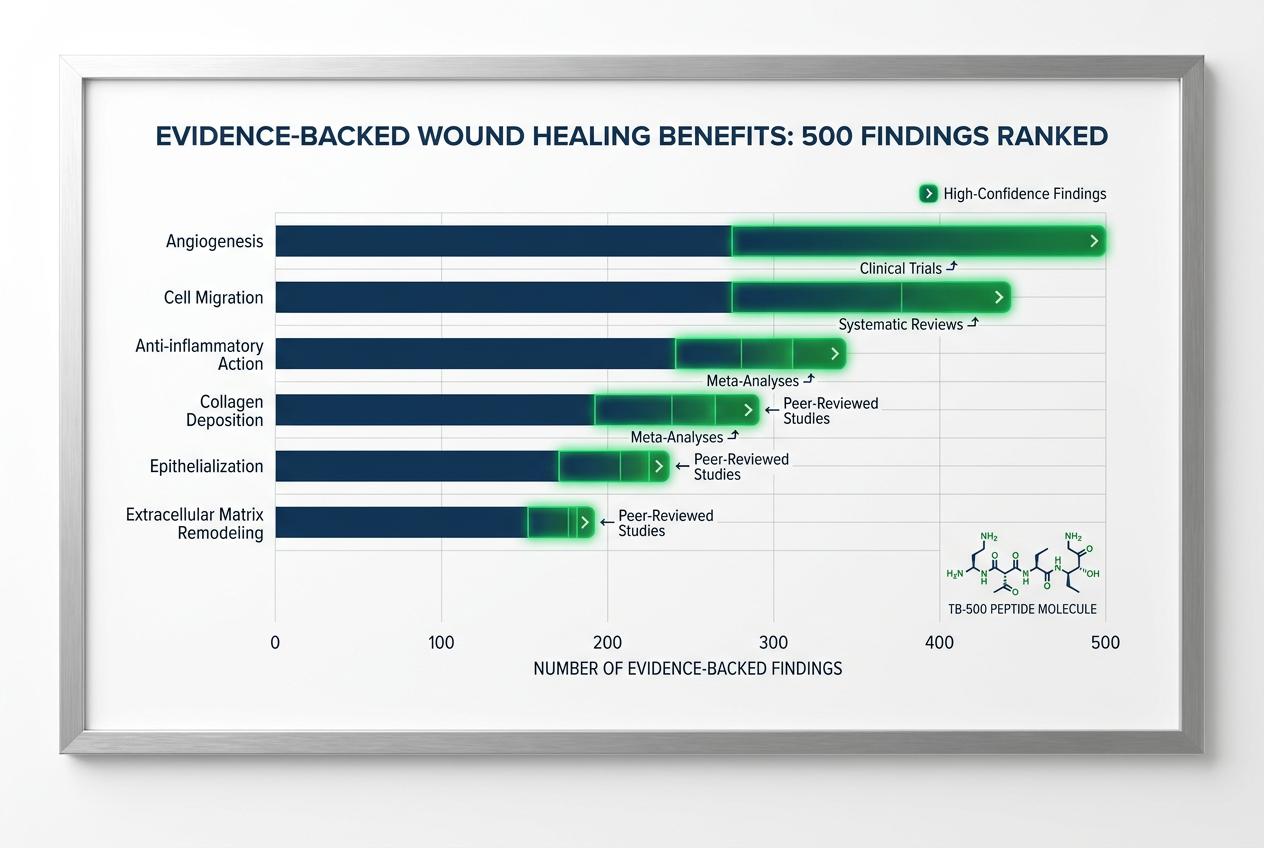
- The best-supported 500 benefits are localized wound-healing effects, not muscle gain or athletic performance.
- One rat wound model reported 42% greater re-epithelialization by day 4 and up to 61% by day 7 versus saline.
- Human research is limited to corneal wounds and venous ulcers; a phase 2 corneal study was terminated, not positive proof.
- FDA identifies TB-500 as thymosin beta-4 fragment (LKKTETQ) and flags immunogenicity risks from aggregation and peptide impurities.
- Any 500 benefits claim far removed from wound repair needs much stronger evidence.
What does current evidence actually say about 500 benefits?
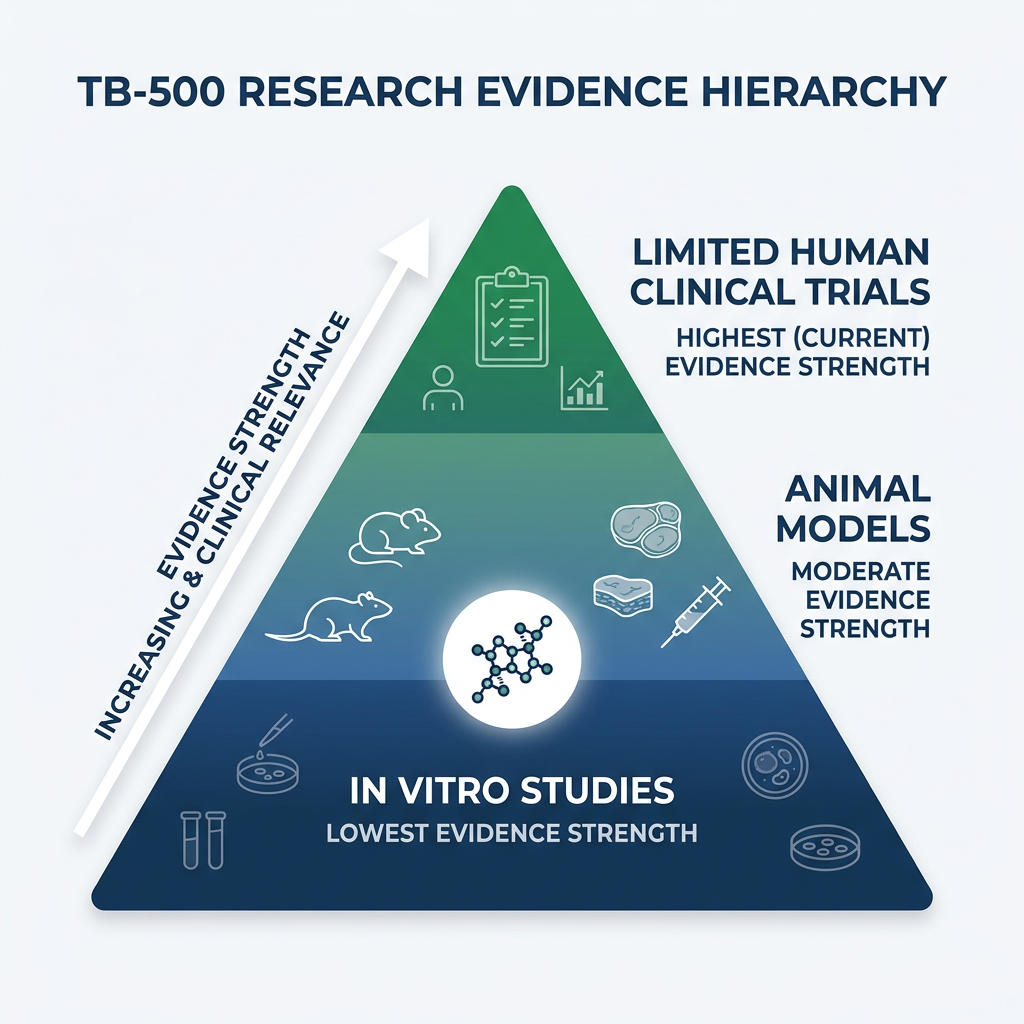
The strongest supported 500 benefits involve tissue repair, not broad performance enhancement. Peptides Library reads the evidence in the same narrow frame reflected by FDA materials, PubMed wound models, and ClinicalTrials.gov records: healing-related effects show up; generalized recovery claims do not.
The background evidence clusters around wound-healing mechanisms. Across preclinical models, researchers repeatedly report faster re-epithelialization, lower inflammatory activity, and structural signs of repair like angiogenesis and collagen deposition. Those endpoints matter because they describe how damaged tissue closes, stabilizes, and restores barrier function.
PubMed records for thymosin beta-4 wound models can be reviewed at pubmed.ncbi.nlm.nih.gov. This search returns peer-reviewed studies on the full 43-amino-acid peptide and related fragments.
FDA framing also affects how the topic should be discussed. In FDA materials, TB-500 is identified as thymosin beta-4 fragment (LKKTETQ), and the agency warns that compounded products containing that fragment may present safety risks for some routes of administration.
Peptides Library treats TB-500 as a wound-healing evidence question first, because FDA materials identify TB-500 as thymosin beta-4 fragment (LKKTETQ).
So if someone asks whether TB-500 has benefits, the most accurate answer is yes, but mainly in tissue-repair research contexts. If the question is whether the evidence supports routine systemic use for performance or muscle gain, the answer is much weaker.
For researchers building a broader peptide reference set, the Peptide Research Library: A Complete Reference Guide covers how to organize preclinical and clinical peptide data.
How is TB-500 related to thymosin beta-4?
TB-500 and thymosin beta-4 are related but not interchangeable research labels. Full-length thymosin beta-4 is a 43-amino-acid peptide, while FDA materials identify TB-500 as the thymosin beta-4 fragment LKKTETQ.
This is one of the biggest sources of confusion in the topic. Some published studies evaluate full-length thymosin beta-4, including wound-healing and anti-inflammatory effects, while many online discussions speak as if every thymosin beta-4 paper automatically proves the same thing about the 500 benefits. That shortcut can distort the evidence.
A practical rule helps here. If a study used the full 43-amino-acid peptide, then you should not transfer the findings directly to the fragment without checking the exact sequence, route of administration, formulation, and endpoint. Related molecules can behave similarly, but they are not automatically equivalent.
Peptides Library flags a common mistake: studies on full-length thymosin beta-4 are not automatically the same as evidence on the TB-500 fragment.
Route matters too. A topical ophthalmic preparation, a dermal application, and a compounded injectable product raise different pharmacology and safety questions. Readers often focus on the peptide name and skip the delivery context, which is where many of the real trade-offs sit.
For researchers comparing delivery systems, Cell Penetrating Peptides for Research | Peptides Library explains how transport mechanisms differ.
💡 Key Takeaway: How is TB-500 related to thymosin beta-4?
Which 500 benefits are most evidence-backed in wound healing?
The most evidence-backed 500 benefits are localized wound-healing effects, especially re-epithelialization and inflammatory control. Claims about muscle gain, whole-body recovery, or sports performance sit far outside the strongest published evidence.
The clearest claims come from injury models and early wound-focused clinical work rather than lifestyle or athletic settings.
- Faster re-epithelialization: Multiple wound models report quicker resurfacing of damaged tissue, which is a core marker of healing progress.
- Reduced inflammatory response: Corneal injury work found less polymorphonuclear leukocyte infiltration and lower inflammatory cytokine and chemokine mRNA after treatment.
- More angiogenesis: Some skin wound data show increased new vessel formation, which can support oxygen and nutrient delivery to healing tissue.
- Greater collagen deposition and wound contraction: Histologic and gross wound findings in animal models suggest stronger structural repair.
- Potential benefit in selected human wound settings: Clinical investigation has centered on corneal wounds and venous ulcers, not broad systemic enhancement.
That list is narrower than the marketing language readers may encounter elsewhere, but it is much closer to the published record for 500 benefits.
Does TB-500 help skin wound healing in the published data?
Yes, skin wound-healing signals appear repeatedly in preclinical data, especially in rodent injury models. The key published study reported faster re-epithelialization, more wound contraction, and histologic signs of angiogenesis and collagen deposition versus saline controls.
One often-cited rat full-thickness wound model reported a 42% increase in re-epithelialization by day 4 and up to 61% by day 7 compared with saline controls. The same study found at least 11% greater wound contraction by day 7. Those are meaningful differences in a controlled injury model, and they help explain why thymosin beta-4 biology attracted continued regenerative medicine interest.
Peptides Library gives the rat wound model weight because it reported 42% higher re-epithelialization by day 4 and up to 61% by day 7 versus saline.
The misconception to avoid is simple: strong animal wound data do not equal proven human benefit in routine use. They do, however, support the idea that wound closure and tissue remodeling are the most plausible 500 benefits category. That is a much stronger position than claiming general recovery effects across unrelated tissues.
PubMed records for thymosin beta-4 wound models can be reviewed at pubmed.ncbi.nlm.nih.gov.
What does the corneal repair research show?
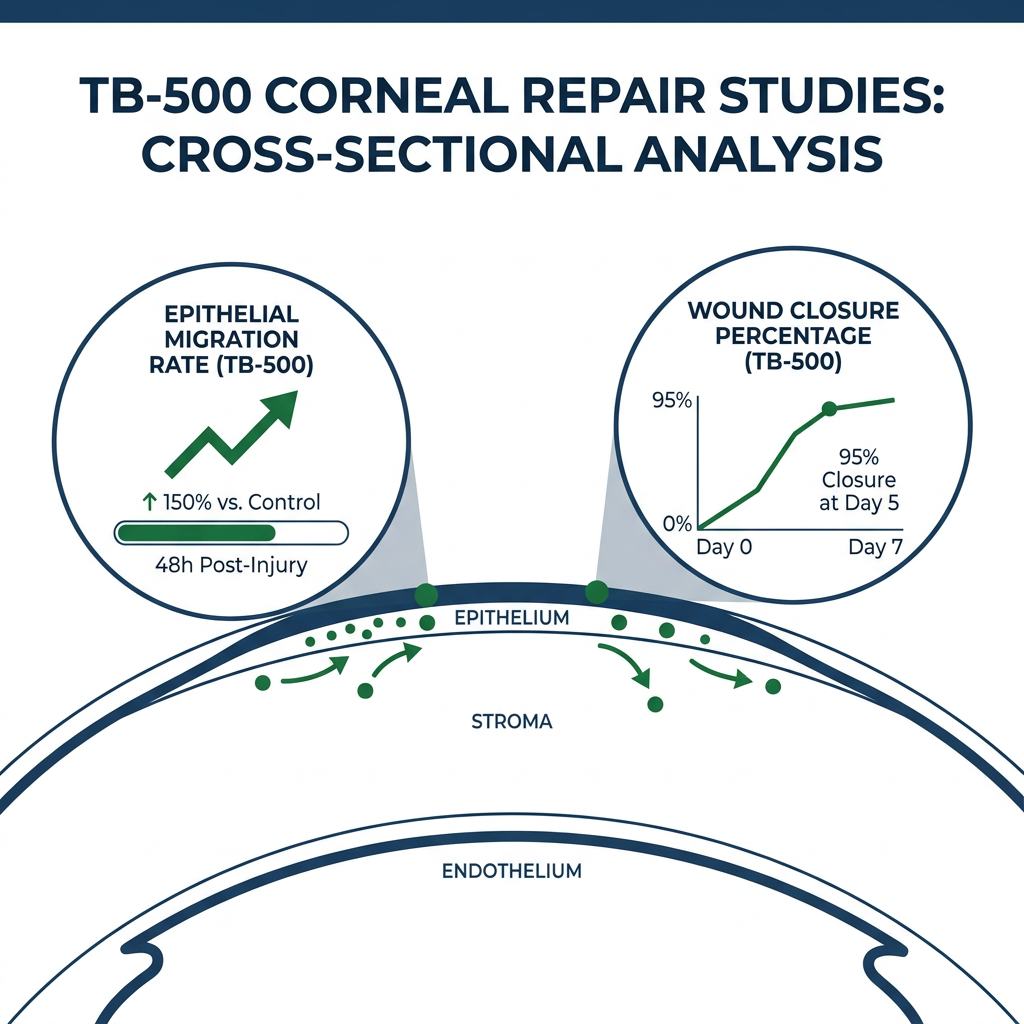
Corneal repair is one of the clearest TB-500 related research areas. In mouse corneal alkali injury models, topical thymosin beta-4 accelerated re-epithelialization and lowered inflammatory readouts after injury.
The eye is useful for healing research because epithelial closure can be measured carefully, and the inflammatory environment can be tracked with both clinical and molecular markers. In the corneal alkali injury model, researchers reported faster surface repair at all measured time points. They also found reduced polymorphonuclear leukocyte infiltration and lower inflammatory cytokine and chemokine mRNA levels. That combination suggests not only faster coverage of the injured cornea but also a less destructive inflammatory phase.
For researchers interested in 500 benefits, this corneal data is important because it represents a controlled injury setting with clear endpoints. The localized nature of the effect also matches the strongest evidence pattern: tissue repair at the site of injury, not systemic enhancement elsewhere.
One caution applies. Human corneal research has not produced a positive phase 3 confirmation. A phase 2 corneal study was terminated, not positive proof. That termination does not erase the preclinical signals, but it means the human translation remains unresolved.
💡 Key Takeaway: What does the corneal repair research show?
How do animal studies compare with human clinical trials?
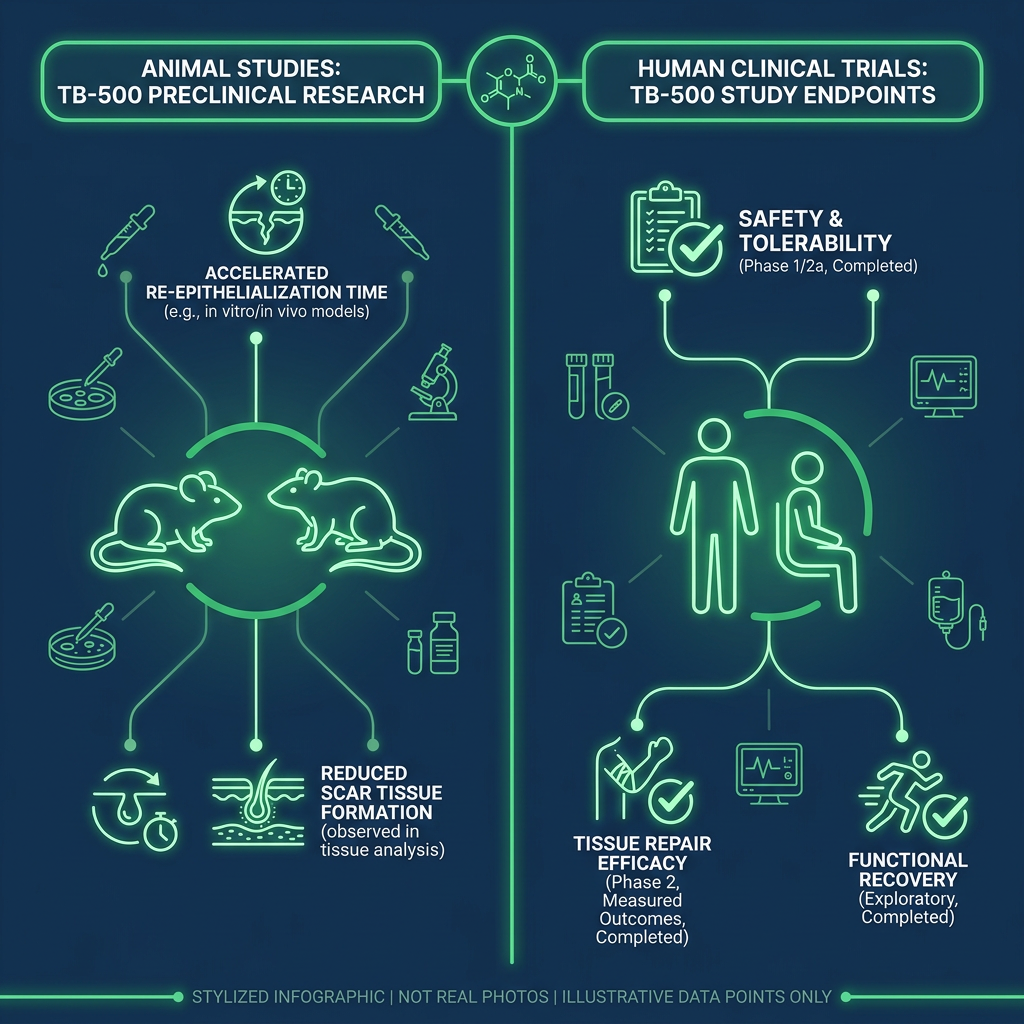
Animal studies and human clinical trials answer different questions about 500 benefits. Preclinical wound models can control injury, dosing, and measurement tightly, but they do not prove human efficacy or safety.
In the published record, the strongest 500 benefits evidence comes from rodent skin wound and corneal alkali injury models. Those studies report faster re-epithelialization, reduced inflammatory markers, and structural repair signs. The effect sizes are often large in relative terms, such as the 42% and 61% re-epithelialization increases noted earlier.
Human evidence is much narrower. Clinical investigation has centered on corneal wounds and venous ulcers. A phase 2 corneal study was terminated, which means the human dataset remains incomplete and does not support broad claims.
The gap between animal and human data matters because many online claims about 500 benefits skip from a mouse study to a general performance statement. That is not a valid evidentiary step. Researchers should treat animal findings as hypothesis-generating and human trial results as the only basis for clinical-grade conclusions.
For laboratory researchers organizing this type of comparison, the Peptide Library: Research-Grade Peptides for Laboratories offers a structured approach to cataloging study types and endpoints.
Why do researchers ask eight specific evidence questions about 500 benefits?
Researchers ask eight specific evidence questions about 500 benefits because the topic sits at the intersection of promising preclinical biology and weak human translation. A structured question set prevents overclaiming and helps separate wound-healing evidence from performance mythology.
The eight questions covered in this article are: what current evidence says, how TB-500 relates to thymosin beta-4, which benefits are most evidence-backed, whether skin wound data support use, what corneal research shows, how animal and human data compare, which endpoints matter, and how to evaluate claims. Each question targets a specific failure point where researchers commonly misread the 500 benefits literature.
Asking these questions in sequence also mirrors the way regulatory reviewers approach peptide data. They check molecular identity first, then preclinical signals, then human trial status, then safety signals. That sequence reduces the risk of anchoring on a single positive animal study.
For researchers who want a complete reference set, the Peptide Research Library: A Complete Reference Guide includes a checklist for evaluating preclinical and clinical peptide evidence.
Which research endpoints matter most for 500 benefits?
The research endpoints that matter most for 500 benefits are direct measures of tissue repair, not surrogate performance metrics. Re-epithelialization percentage, wound contraction, inflammatory cell counts, cytokine mRNA levels, angiogenesis markers, and collagen deposition are the strongest endpoints in the published record.
For skin wound models, re-epithelialization is the most frequently reported endpoint. The rat full-thickness wound model reported 42% greater re-epithelialization by day 4 and up to 61% by day 7 versus saline. Wound contraction was also measured, with at least 11% greater contraction by day 7.
For corneal injury models, epithelial closure time, polymorphonuclear leukocyte infiltration, and inflammatory cytokine and chemokine mRNA levels are the key readouts. Faster closure plus lower inflammatory markers is a coherent healing signature.
Endpoints that do not appear in the strongest 500 benefits evidence include muscle mass, strength, endurance, or subjective recovery scores. If a claim relies on those endpoints, it is not grounded in the wound-healing literature.
A simple endpoint checklist for researchers:
- Does the study measure tissue repair directly?
- Are the time points consistent with healing biology?
- Are inflammatory markers reported alongside closure data?
- Is the effect size clinically meaningful, not just statistically significant?
- Was the delivery route localized to the injury?
💡 Key Takeaway: Which research endpoints matter most for 500 benefits?
What are the common misconceptions about 500 benefits?
Several misconceptions distort how researchers interpret 500 benefits. The most common is that full-length thymosin beta-4 data automatically applies to the TB-500 fragment. That is false because FDA materials identify TB-500 as the LKKTETQ fragment, and sequence differences can change pharmacology.
A second misconception is that animal wound data prove human performance benefits. The rat skin wound model showed strong re-epithelialization, but that does not translate to muscle gain or athletic recovery. Human research is limited to corneal wounds and venous ulcers, and a phase 2 corneal study was terminated.
A third misconception is that all administration routes are equivalent. A topical ophthalmic preparation is not the same as a dermal application or a compounded injectable product. Each route raises different safety and delivery questions.
A fourth misconception is that any positive preclinical signal means the peptide is safe. FDA specifically flags immunogenicity risks from aggregation and peptide impurities for TB-500. That safety concern is separate from efficacy.
Researchers can avoid these misconceptions by sticking to the narrow wound-healing frame supported by the published record.
What FDA safety considerations apply to 500 benefits research?
FDA safety considerations for 500 benefits research center on molecular identity and immunogenicity. FDA identifies TB-500 as thymosin beta-4 fragment (LKKTETQ) and flags immunogenicity risks from aggregation and peptide impurities.
The agency’s concern is not about wound-healing efficacy but about product quality and route-dependent safety. Peptide aggregation can trigger immune responses, and impurities in compounded products can add unknown risks. That is why researchers must verify the exact sequence, purity, and formulation before using any TB-500 sample in vitro.
For laboratory research, the safety framing means three practical checks. First, request a certificate of analysis (COA) that matches the LKKTETQ sequence. Second, document storage conditions because peptide stability affects aggregation. Third, use only research-grade materials with no implied human application.
The phase 2 corneal study termination also sits within the safety picture. A terminated trial does not prove harm, but it means the human safety database is incomplete. Researchers should treat that gap as a reason for caution, not as a reason to extrapolate from animal data.
How do different administration routes change the evidence for 500 benefits?
Administration route changes the evidence for 500 benefits in three ways: local versus systemic exposure, tissue-specific delivery, and safety profile. Topical ophthalmic application delivers peptide directly to the corneal surface, which matches the localized wound-healing evidence. Dermal application targets skin repair. A compounded injectable product creates systemic exposure that is not supported by the strongest published data.
The strongest 500 benefits signals come from localized routes. Corneal studies used topical application. Skin wound studies used direct application to the injury site. Those routes align with the biology of tissue repair.
Systemic use is the weakest evidence category. The published record does not show robust systemic wound-healing or performance benefits for TB-500. FDA materials also raise safety concerns for some routes of administration, especially compounded injectables.
For researchers comparing delivery systems, Cell Penetrating Peptides for Research | Peptides Library explains how transport mechanisms differ across formulations.
Route also affects dosing interpretation, but no dosing recommendations are made here because this is research-use-only content.
💡 Key Takeaway: How do different administration routes change the evidence for 500 benefits?
How should researchers evaluate 500 benefits claims?
Researchers should evaluate 500 benefits claims by checking molecular identity, evidence type, endpoint, route, and safety data. Start with the exact sequence. If the claim cites full-length thymosin beta-4, do not automatically transfer it to the TB-500 fragment LKKTETQ.
Next, ask whether the evidence is animal or human. Preclinical wound models support localized healing, but human data is limited and includes a terminated phase 2 corneal study. If the claim implies human performance benefit, demand a human trial citation.
Third, check the endpoint. Re-epithelialization, wound contraction, inflammatory markers, and collagen deposition are legitimate endpoints. Muscle mass or endurance are not present in the strongest 500 benefits evidence.
Fourth, verify the route. Topical and dermal studies do not support systemic claims. Fifth, review safety data for aggregation and impurities. A COA and storage documentation are minimum requirements for laboratory work.
A simple evaluation checklist:
- Exact sequence: LKKTETQ fragment?
- Study type: animal or human?
- Endpoint: tissue repair or performance?
- Route: localized or systemic?
- Safety: COA, purity, aggregation risk?
Using this checklist keeps 500 benefits claims within the published evidence.
FAQ
What are the most evidence-backed benefits in research?
The most evidence-backed 500 benefits are localized wound-healing effects, including faster re-epithelialization, reduced inflammation, angiogenesis, and collagen deposition in skin and corneal injury models. These benefits appear in controlled preclinical studies, not in human performance trials.
Does TB-500 have proven human benefits?
No. Human research on these benefits is limited to corneal wounds and venous ulcers. A phase 2 corneal study was terminated, so there is no positive human proof. The strongest 500 benefits evidence remains preclinical.
How is TB-500 different from thymosin beta-4?
FDA identifies TB-500 as the thymosin beta-4 fragment LKKTETQ. Full-length thymosin beta-4 is a 43-amino-acid peptide. Researchers should not transfer full-length peptide data directly to the fragment when evaluating 500 benefits.
What safety issues apply to research?
FDA flags immunogenicity risks from aggregation and peptide impurities for TB-500. Researchers should request a COA, verify the LKKTETQ sequence, and store samples properly. These 500 benefits claims must stay within research-use-only framing.
Ready to Take the Next Step?
Every product includes lot-specific documentation and third-party purity testing.
Explore Our Research Products →Free shipping on qualifying orders · Batch COA on request