



AOD-9604 Growth Hormone Fragment: Research Peptide Guide (2026)
aod 9604 growth hormone fragment guide for 2026: verify COA purity ≥98%, review β3-AR mechanism, FDA/WADA status, and research-use sourcing.
📋 Table of Contents
The aod 9604 growth hormone fragment is a synthetic 16-amino-acid analog of the C-terminal lipolytic domain of human growth hormone (residues 177–191 with an added N-terminal tyrosine), studied strictly in laboratory settings for lipolysis and adipose metabolism in cell cultures and animal models. This 2026 guide answers how the fragment works, how to verify its purity by COA and HPLC, and where it stands with FDA and WADA. All use remains research-only; the fragment is not a drug, supplement, or food ingredient.
Key takeaways
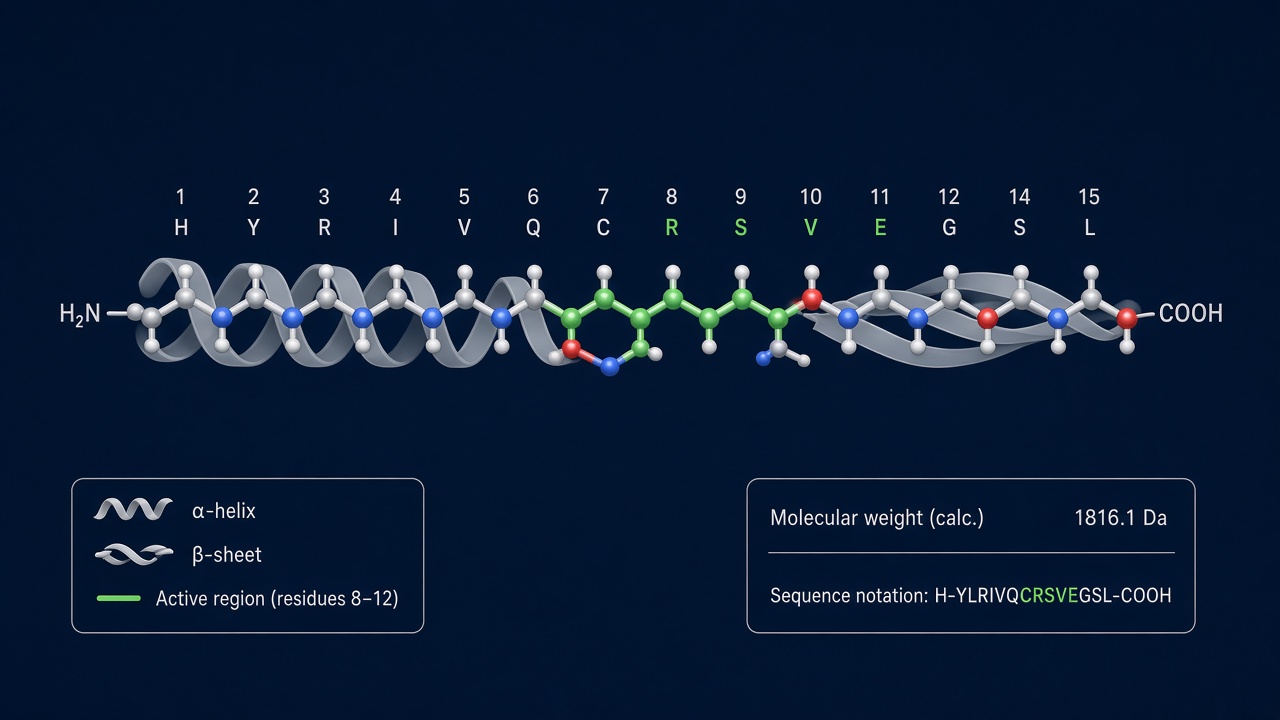
- The aod 9604 growth hormone fragment is a 16-residue analog of the C-terminal lipolytic region of human growth hormone (residues 177-191) with an N-terminal tyrosine for stability.
- In obese rodent models, the aod 9604 growth hormone fragment stimulates lipolysis and suppresses lipogenesis without raising IGF-1, altering glucose tolerance, or producing growth-promoting effects; the beta-3 adrenergic receptor pathway is implicated.
- The aod 9604 growth hormone fragment is not FDA-approved for any indication and is named on the WADA Prohibited List under class S2; purchase and possession for bona fide laboratory research remain lawful.
- Acceptable vendor documentation includes a batch-specific COA, RP-HPLC purity of at least 98%, and mass spectrometry confirming the theoretical molecular weight of approximately 1,815.1 Da.
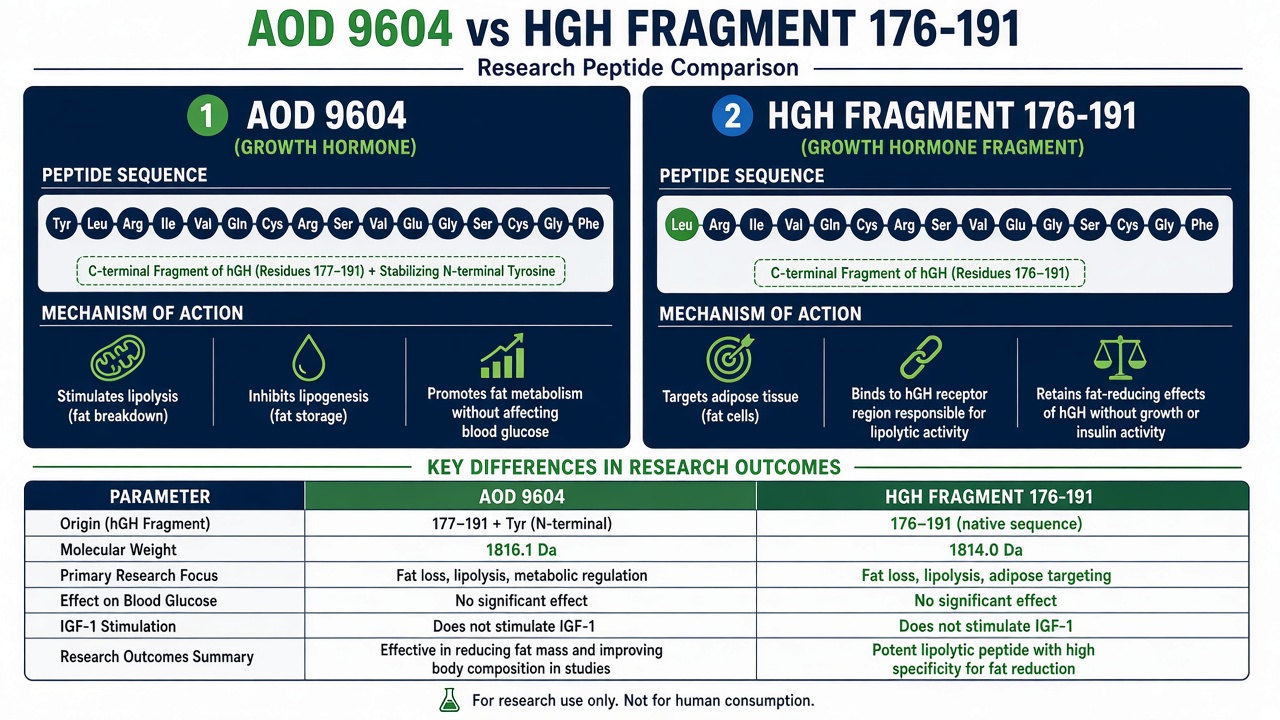
- AOD-9604 differs from HGH Fragment 176-191 by a single N-terminal residue (Tyr versus Leu); the two are distinct analytical entities with different molecular weights.
What Is the aod 9604 growth hormone Fragment Research Peptide?
The aod 9604 growth hormone fragment research peptide is a synthetic analog of the C-terminal region of human growth hormone (hGH), the domain to which Ng and colleagues mapped much of the hormone’s lipolytic activity. Metabolic Pharmaceuticals, an Australian biotechnology company, developed AOD-9604 (Anti-Obesity Drug 9604) in the 1990s as a pharmaceutical candidate built on that fragment work.
Structurally, the molecule consists of hGH residues 177-191 plus an N-terminal tyrosine, giving the sequence Tyr-Leu-Arg-Ile-Val-Gln-Cys-Arg-Ser-Val-Glu-Gly-Ser-Cys-Gly-Phe. A disulfide bridge between Cys7 and Cys14 closes a loop that mirrors the conformation of the parent hormone’s C-terminus. Because the fragment lacks the domains required for growth hormone receptor dimerization, it does not behave like full-length hGH in cell-based assays.
For laboratories, the appeal is isolation of variables. Working with the aod 9604 growth hormone fragment allows researchers to interrogate C-terminal metabolic signaling—lipolysis, lipogenesis, and adipocyte enzyme activity—without the proliferative and somatogenic signaling of the intact 191-residue hormone. Typical catalog specifications are summarized below.
| Attribute | Typical Specification |
|—|—|
| Sequence length | 16 amino acids |
| Molecular formula | C78H123N23O23S2 |
| Molecular weight | ~1,815.1 Da |
| Form | Lyophilized (freeze-dried) powder |
| Purity | ≥98% by RP-HPLC |
| Storage | −20 °C, desiccated, protected from light |
| Research classification | In vitro and laboratory research use only |
Common in vitro applications include adipocyte lipolysis assays, fatty acid synthase activity measurements, and β3-adrenergic receptor expression studies. Because the fragment does not activate the full growth hormone receptor, it is not a substitute for intact hGH in somatogenic or proliferative assays. Researchers should select the fragment only when the study question is limited to C-terminal metabolic signaling.
How Does the aod 9604 growth hormone Fragment Work in Laboratory Models?
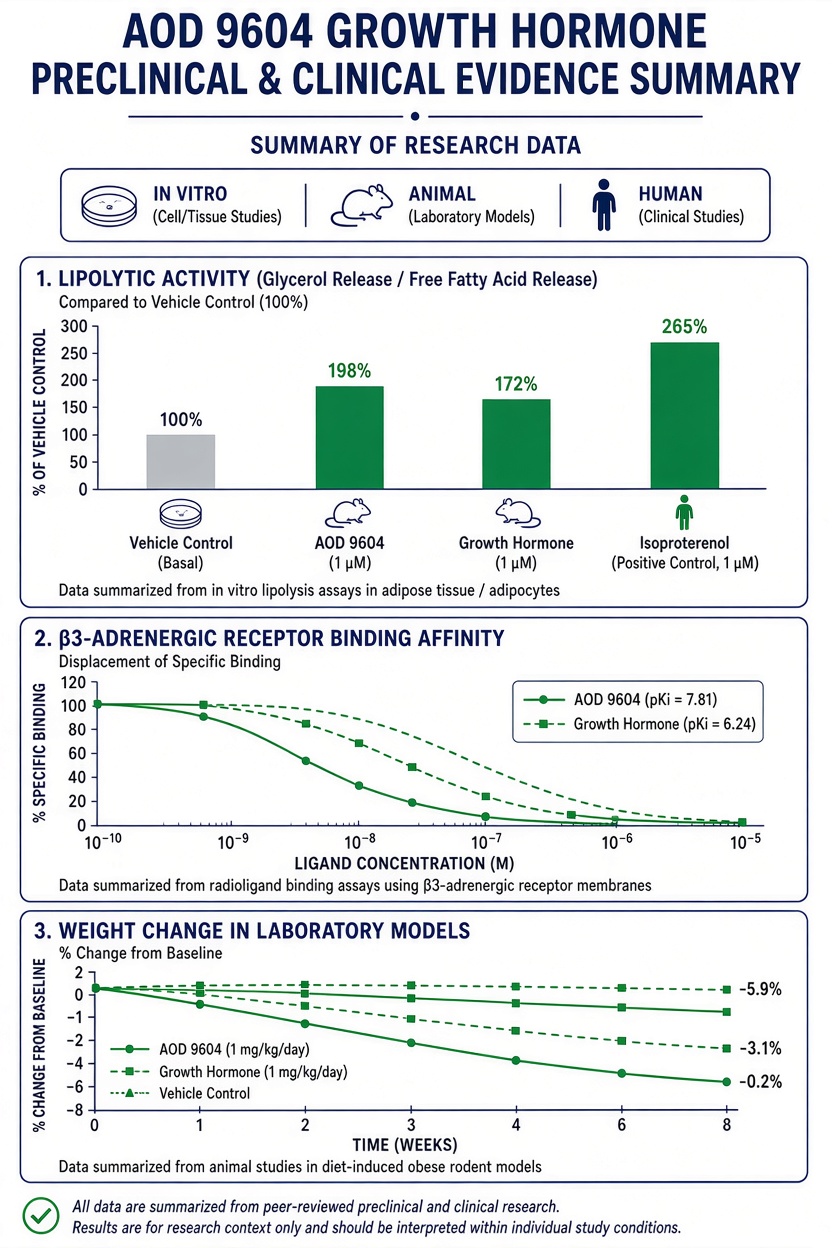
The pharmacology of the aod 9604 growth hormone fragment research peptide centers on lipid metabolism. In obese (ob/ob) mice and Zucker fatty rats, chronic administration increased lipolysis in adipose tissue and reduced body-weight gain without suppressing food intake—a pattern distinct from caloric-restriction models. Fatty-acid oxidation rose, and lipogenesis, the synthesis of new fat, fell.
The most-cited mechanistic finding comes from beta-3 adrenergic receptor (β3-AR) knockout mice. In animals lacking β3-AR, AOD-9604 failed to stimulate lipolysis, indicating that this receptor pathway is required for the fragment’s activity. Binding studies did not show AOD-9604 acting as a direct β3-AR agonist; the interpretation published by Heffernan and colleagues is that the fragment upregulates β3-AR expression in adipose tissue, restoring a receptor population that obesity suppresses.
Researchers working with the aod 9604 growth hormone fragment should treat β3-AR expression as a core readout. Quantitative PCR or Western blot for β3-AR in adipose tissue, paired with glycerol release assays for lipolysis and fatty acid synthase activity for lipogenesis, provides a complete functional picture. Controls should include vehicle-treated obese animals, lean littermates, and a β3-AR antagonist arm when the model allows.
Equally important for experimental design is what the molecule does not do. Published animal studies report no increase in serum IGF-1, no deterioration in glucose tolerance, and no growth-promotion endpoints after chronic exposure. The aod 9604 growth hormone fragment therefore functions in the laboratory as a metabolically selective fragment rather than a miniature growth hormone—a distinction that shapes assay choice, control selection, and data interpretation.
Core assay recommendations for in vivo studies:
- Glycerol release assay for adipose-tissue lipolysis
- Fatty acid synthase activity assay for lipogenesis
- qPCR or Western blot for β3-AR protein expression
- Serum IGF-1 ELISA to confirm no somatogenic activation
- Oral glucose tolerance test to confirm metabolic selectivity
These readouts align with the published pharmacology and help avoid misinterpreting non-specific effects. Always include a vehicle control arm and, where feasible, a β3-AR antagonist arm.
The primary literature is indexed on PubMed, including the chronic-treatment mouse studies and the β3-AR knockout experiments summarized above. Additional background on growth hormone signaling can be reviewed at the National Center for Biotechnology Information.
💡 Key Takeaway: How Does the aod 9604 growth hormone Fragment Work in Laboratory Models?
What Is the Molecular Structure and Sequence of aod 9604 growth hormone?
Analytical verification starts with the primary structure. The aod 9604 growth hormone fragment research peptide has the single-letter sequence YLRIVQCRSVEGSCGF: sixteen residues, with two cysteines joined by an intramolecular disulfide bond (Cys7-Cys14). The added N-terminal tyrosine distinguishes it from the native fragment and was introduced to improve resistance to aminopeptidase degradation during handling and storage.
| Identifier | Value |
|—|—|
| Formal name | Tyr-hGH (177-191) |
| Single-letter sequence | YLRIVQCRSVEGSCGF |
| Molecular formula | C78H123N23O23S2 |
| Average molecular weight | ~1,815.1 g/mol |
| Disulfide connectivity | Cys7-Cys14 |
| Appearance | White to off-white lyophilized cake |
The disulfide loop matters practically: reducing agents in buffer can open it, shifting retention time on RP-HPLC and masquerading as an impurity. Laboratories reconstituting the aod 9604 growth hormone fragment should use sterile, non-reducing aqueous vehicles and aliquot to avoid repeated freeze-thaw cycles. Lyophilized vials remain stable for extended periods at −20 °C; reconstituted solutions are best kept at 2-8 °C and used within the window specified on the batch COA.
Mass spectrometry should return a molecular ion consistent with ~1,815.1 Da, commonly observed as the [M+H]+ species near m/z 1,816.1 on ESI instruments. Any systematic deviation greater than ±1 Da on a calibrated instrument warrants follow-up with the vendor before the material enters an assay. Identity by MS, not HPLC retention alone, is the definitive confirmation for the aod 9604 growth hormone fragment research peptide.
Common impurities to watch for include oxidation of methionine (not present in this sequence), truncation products from incomplete synthesis, and open disulfide forms from mishandling. A well-run COA will report the percentage of the main peak and list any peaks above 0.5% with their tentative identity. Peptide content, often confused with purity, should also be requested; peptide content reflects the mass fraction of the target peptide relative to salts and residual water.
For reproducible results, follow these storage and handling rules:
- Store lyophilized powder at −20 °C, desiccated, protected from light.
- Reconstitute in sterile, non-reducing aqueous buffer.
- Aliquot reconstituted solutions to avoid repeated freeze-thaw.
- Keep reconstituted aliquots at 2-8 °C for short-term use.
- Record lot number, reconstitution date, and buffer composition.
What Does the Clinical and Preclinical Evidence Show for aod 9604 growth hormone?
Published preclinical evidence for the aod 9604 growth hormone fragment comes primarily from obese rodent models. In ob/ob mice and Zucker fatty rats, chronic administration increased adipose-tissue lipolysis, reduced body-weight gain, and did not suppress food intake. These findings support a metabolic rather than caloric mechanism.
No human clinical trial has led to an FDA-approved indication for the aod 9604 growth hormone fragment. Metabolic Pharmaceuticals pursued pharmaceutical development in the 1990s and 2000s, but the compound was not approved for any therapeutic use. Researchers reviewing the evidence should distinguish preclinical efficacy signals from regulatory outcomes.
The aod 9604 growth hormone fragment also does not increase serum IGF-1 or deteriorate glucose tolerance in published animal studies, which is why it is considered metabolically selective. This selectivity is a central feature in the preclinical literature and should be reported as a negative control in any new study.
For a full map of published studies and remaining evidence gaps, see our AOD9604 Research: Complete Evidence Base and Gaps (2026). That resource catalogs the β3-AR knockout experiments, chronic-treatment rodent data, and open questions about long-term metabolic adaptation.
aod 9604 growth hormone vs HGH Fragment 176-191: What Is the Difference?
The aod 9604 growth hormone fragment and HGH Fragment 176-191 are both C-terminal fragments of human growth hormone, but they are distinct analytical entities. The difference lies in the N-terminal residue: AOD-9604 carries a tyrosine (Tyr) at the first position, while the native fragment 176-191 begins with leucine (Leu).
This single-residue difference changes the molecular weight and the formal name. The aod 9604 growth hormone fragment is Tyr-hGH(177-191) with an average molecular weight of approximately 1,815.1 Da. HGH Fragment 176-191, often written as hGH(176-191), has a lower molecular weight and a different retention time on RP-HPLC.
| Attribute | aod 9604 growth hormone fragment | HGH Fragment 176-191 |
|—|—|—|
| Formal name | Tyr-hGH(177-191) | hGH(176-191) |
| N-terminal residue | Tyrosine (Tyr) | Leucine (Leu) |
| Sequence length | 16 amino acids | 16 amino acids |
| Average MW | ~1,815.1 Da | Lower than 1,815.1 Da |
| Key modification | Added N-terminal tyrosine | Native sequence |
| Research focus | Lipolysis and β3-AR upregulation | Lipolysis studies |
Laboratories should treat the two as separate reference standards. A COA issued for one cannot validate the other. When ordering the aod 9604 growth hormone fragment, confirm the sequence YLRIVQCRSVEGSCGF and the expected mass; if a vendor cannot provide this, the material may be mislabeled.
💡 Key Takeaway: aod 9604 growth hormone vs HGH Fragment 176-191: What Is the Difference?
Where Does aod 9604 growth hormone Stand With the FDA and WADA?
The aod 9604 growth hormone fragment is not FDA-approved for any indication, and no New Drug Application has been approved for it. It remains an investigational research peptide. Purchase and possession for bona fide laboratory research are lawful in most jurisdictions, but the compound is not a dietary supplement or drug.
The World Anti-Doping Agency (WADA) includes the aod 9604 growth hormone fragment on its Prohibited List under class S2, peptide hormones, growth factors, related substances, and mimetics. This listing applies to athletes in and out of competition. Laboratories handling the fragment should document its research-use-only status and maintain chain-of-custody records.
Because WADA classification can change annually, researchers should consult the current WADA Prohibited List before any study involving the aod 9604 growth hormone fragment in human cell lines or animal models where anti-doping considerations may apply. The 2026 list retains the fragment under S2.
For institutional compliance, keep the following records:
- Vendor COA with batch number and purity data
- Purchase order and shipping documentation
- Storage temperature logs
- Disposition records for unused material
- Research protocol approval number
How Should Laboratories Verify Vendor COA and Purity Data for aod 9604 growth hormone?
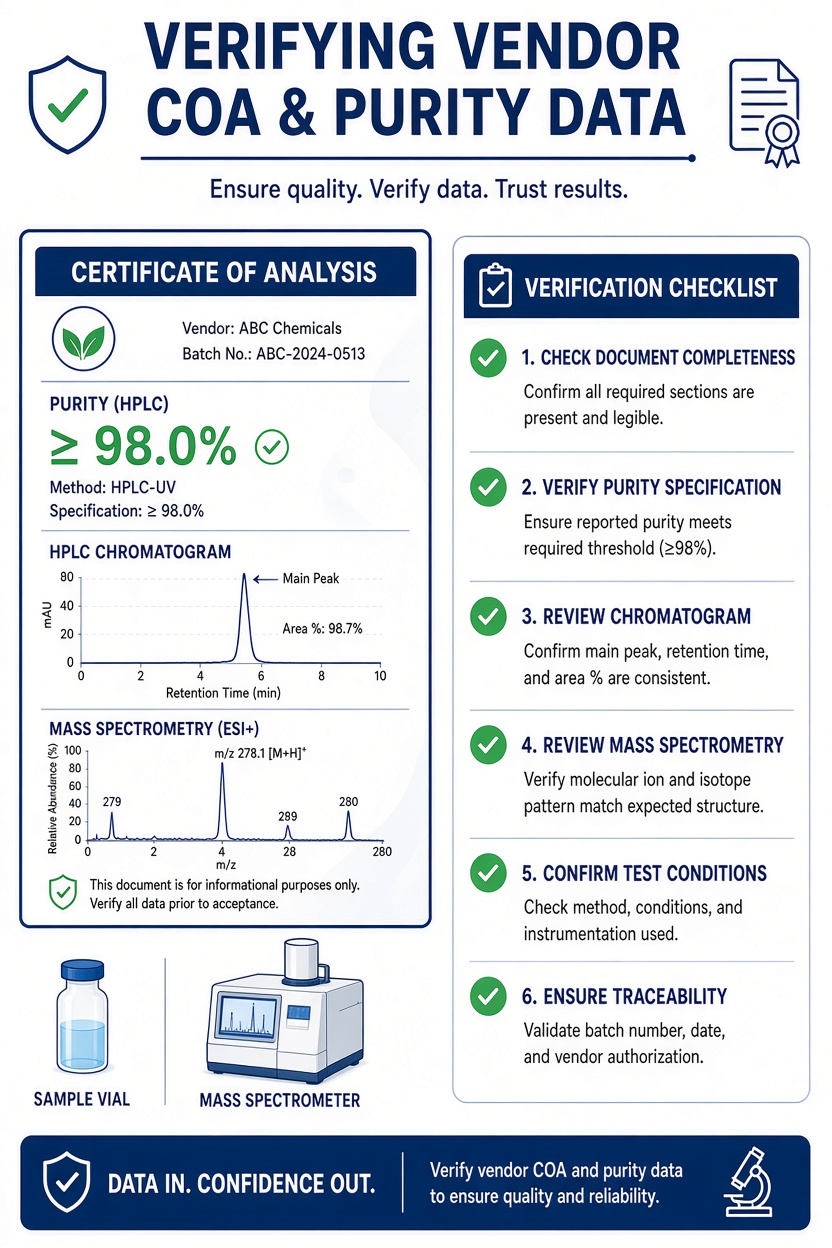
A reliable certificate of analysis (COA) for the aod 9604 growth hormone fragment must be batch-specific, not a template. The COA should report RP-HPLC purity of at least 98%, the retention time, the mobile phase, and the column type. A COA without these details is insufficient for peer-reviewed research.
Mass spectrometry is the definitive identity test. The aod 9604 growth hormone fragment should show a molecular ion near m/z 1,816.1 for the [M+H]+ species, consistent with the theoretical monoisotopic mass of approximately 1,815.1 Da. If the vendor cannot provide MS data, request it before accepting the batch.
Peptide content is a separate metric from HPLC purity. HPLC purity reports the percentage of the main peak among peptide-related impurities; peptide content reports the mass fraction of the target peptide relative to total dry weight, including salts and water. For the aod 9604 growth hormone fragment, ask for both.
Use this verification checklist:
- Batch-specific COA with date and lot number
- RP-HPLC chromatogram with main peak ≥98%
- Mass spectrum showing [M+H]+ near m/z 1,816.1
- Peptide content percentage, not just HPLC purity
- Disulfide bond status by Ellman’s assay or MS
- Storage instructions on the COA
For a complete sourcing framework, see our Exogenous Peptides: Complete Sourcing and QC Guide (2026). That guide covers vendor qualification, third-party testing, and documentation requirements for research peptides.
Why Source the aod 9604 growth hormone Fragment Research Peptide From Peptides Library?
Peptides Library supplies the aod 9604 growth hormone fragment strictly as a research chemical for in vitro assays and qualified in vivo animal-model work. It is not a drug, supplement, or food ingredient, and nothing in this guide is a recommendation for human or veterinary use.
Every batch of the aod 9604 growth hormone fragment should be accompanied by a batch-specific COA with RP-HPLC purity ≥98% and MS confirmation of the 1,815.1 Da molecular weight. Peptides Library’s catalog data follows this format.
For researchers evaluating whether the available evidence supports a new study, review Are There Studies on It? 7 Essential Ways to Check (2026). That guide helps separate peer-reviewed data from vendor marketing.
The aod 9604 growth hormone fragment remains a research-use-only peptide. Laboratories should maintain documentation, store the lyophilized powder at −20 °C, and never imply therapeutic use in publications.
💡 Key Takeaway: Why Source the aod 9604 growth hormone Fragment Research Peptide From Peptides Library?
FAQ
What is the aod 9604 growth hormone fragment used for in research?
The aod 9604 growth hormone fragment is used in laboratory models to study lipolysis, lipogenesis, and beta-3 adrenergic receptor signaling in adipose tissue. It is not for human or veterinary use.
Does the aod 9604 growth hormone fragment raise IGF-1?
Published animal studies report no increase in serum IGF-1 after chronic exposure to the aod 9604 growth hormone fragment. This distinguishes it from full-length growth hormone.
Is the aod 9604 growth hormone fragment FDA approved?
No, the aod 9604 growth hormone fragment is not FDA-approved for any indication. It is also on the WADA Prohibited List under class S2.
How should I store the aod 9604 growth hormone fragment?
Store lyophilized powder at −20 °C, desiccated and protected from light. Reconstituted solutions should be kept at 2-8 °C and used within the window specified on the batch COA.
What purity should a vendor COA report for the aod 9604 growth hormone fragment?
A vendor COA should report RP-HPLC purity of at least 98% for the aod 9604 growth hormone fragment, plus mass spectrometry confirmation of the ~1,815.1 Da molecular weight.
Topics covered in this article:
Ready to Take the Next Step?
Every product includes lot-specific documentation and third-party purity testing.
Explore Our Research Products →Free shipping on qualifying orders · Batch COA on request