



Peptides Library Nootropic Peptides Research Guide
This research guide covers Selank and Semax nootropic peptide evidence, FDA 2026 safety notes, human study design, calculators, and Peptides Library brand reviews.
📋 Table of Contents
This research guide answers what documented evidence actually supports for investigational nootropic peptides Selank and Semax, and how FDA 2026 safety notes shape research-use-only decisions. The research guide separates human data from mechanistic claims so you can evaluate cognitive-enhancement language with precision before citing any source. All products discussed are sold strictly for in vitro laboratory research purposes only; not for human or veterinary use, and not intended to diagnose, treat, cure, or prevent any disease. Must be 21+ to purchase.
Key takeaways
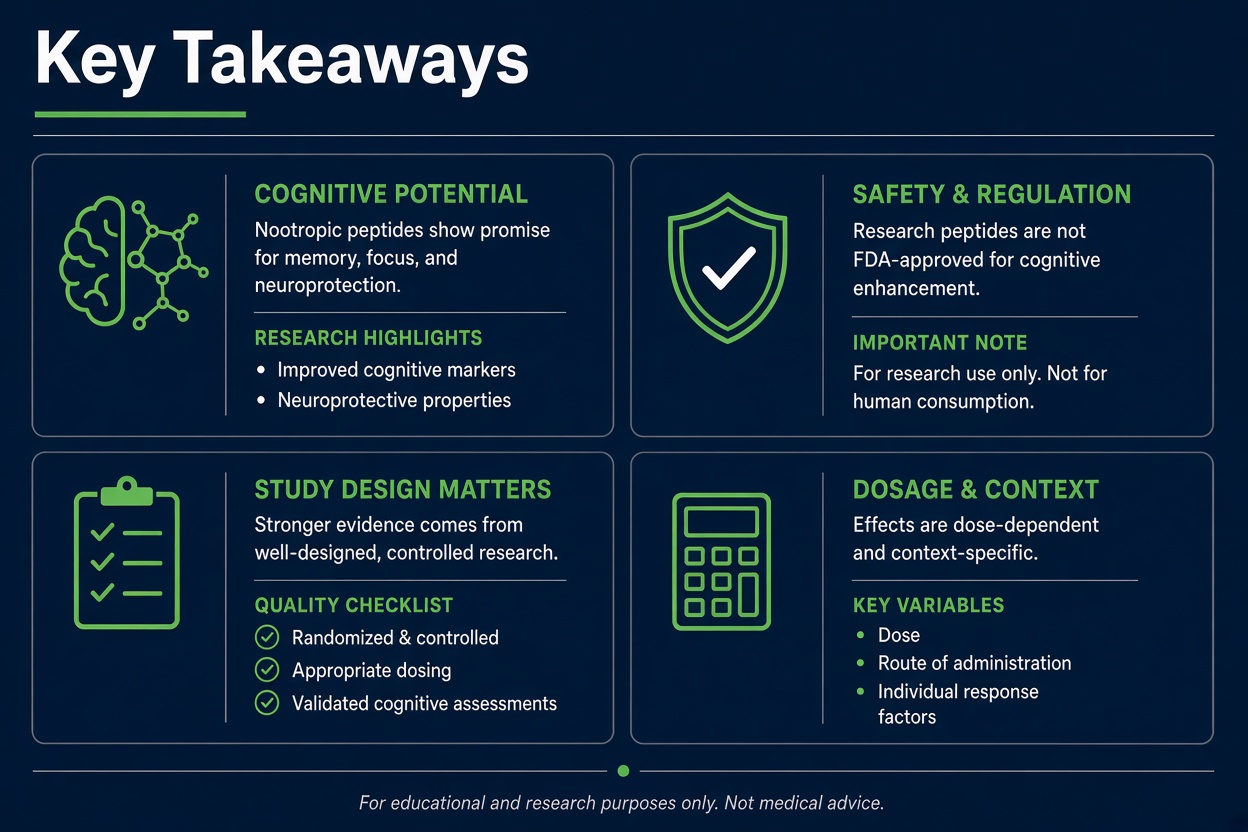
- Peptides Library offers a research guide that distinguishes Selank’s anxiolytic and nootropic literature from Semax’s cognition and neuroprotection literature.
- The research guide includes FDA 2026 safety notes on compounded Selank acetate (peptide aggregation, peptide-related impurities) and compounded Semax (no or limited safety-related information for proposed routes of administration).
- A 52-participant human study evaluated anxiolytic Selank and nootropic Semax using resting-state functional connectivity analysis focused on the amygdala and dorsolateral prefrontal cortex.
- The research guide keeps mechanistic claims (PKC/PI3K signaling, AMPA receptor delivery, hippocampal-dependent memory in rodents) clearly separated from established human cognitive outcomes.
- Free peptide calculators, how-to guides, and independent brand reviews are integrated into the research guide for evidence-first evaluation.
What Does the Peptides Library Research Guide Cover for Nootropic Peptides?
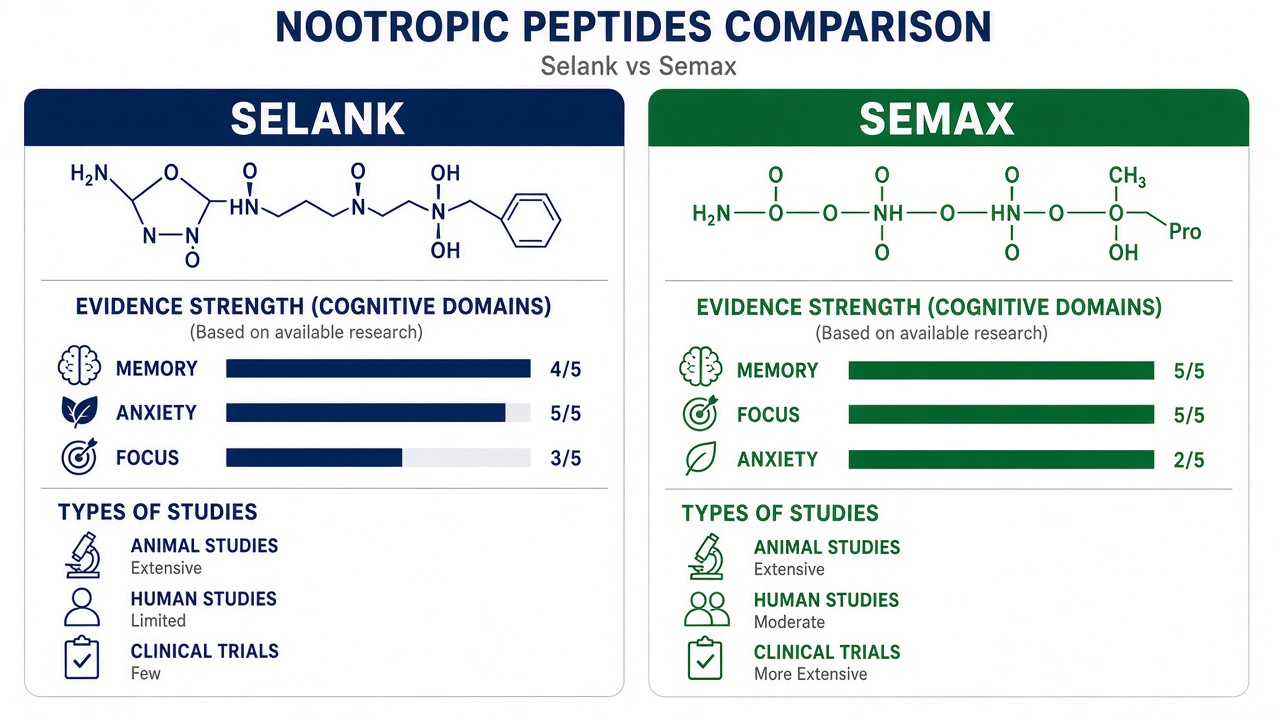
This research guide is built for researchers, healthcare professionals, students, and informed consumers who need to move beyond broad cognitive-enhancement claims. Peptides Library publishes evidence-based articles, citation-focused research guides, safety reviews, free peptide calculators, and brand or product reviews in one place. The research guide helps you compare mechanism, human data, and regulatory status for Selank, Semax, and related peptides without retailer bias.
The research guide organizes nootropic peptide coverage around the literature split that actually appears in published research. For Selank, the research guide surfaces its identity as the heptapeptide Thr-Lys-Pro-Arg-Pro-Gly-Pro and published discussion of positive allosteric modulation of GABA binding. For Semax, the research guide frames coverage around cognition and neuroprotection claims. This split saves time if you are writing, reviewing, comparing, or fact-checking claims.
Peptides Library centers nootropic peptide coverage on documented human and mechanistic evidence, not generic “brain peptide” marketing. The research guide makes it easier to ask the right question first: are you looking at anxiety-focused literature, cognition-focused literature, or preclinical synaptic-function work that should not be overstated as a human outcome? That clarity is essential in a category where FDA materials point to limited safety information for some compounded peptides.
Beyond the Selank and Semax split, the Peptides Library guide also covers related peptides when the evidence base supports inclusion. Each peptide entry is tagged by research framing, study type, and regulatory status. That structure lets a reader jump directly to the evidence that matches a specific question, whether that question is about anxiolytic mechanisms, neuroprotection claims, or human imaging outcomes. The guide avoids mixing animal data with human data without explicit labels.
How Does the Research Guide Separate Selank and Semax Evidence?
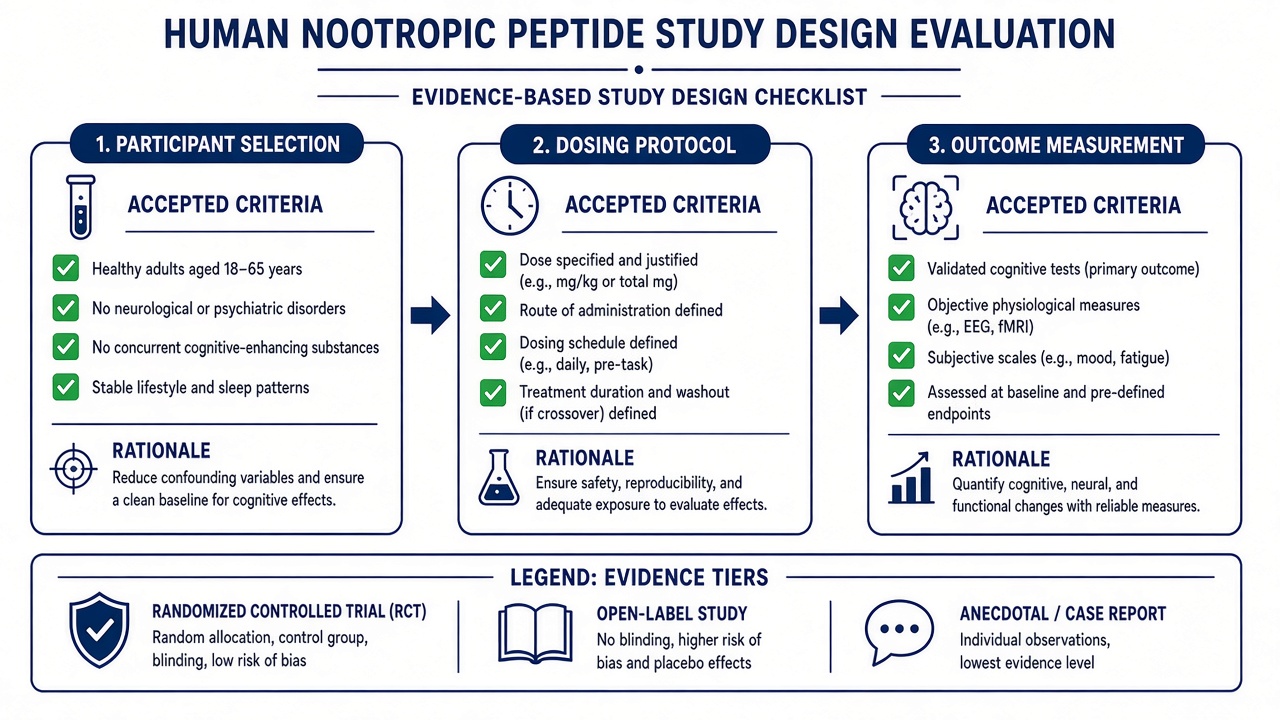
One of the biggest mistakes in this category is treating “nootropic peptides” like a single effect class. The research guide explicitly separates Selank and Semax because the available studies support different research framings. Selank is more often discussed for anxiolytic and nootropic effects, while Semax is more often framed around cognition and neuroprotection. The research guide does not collapse these distinctions.
For Selank, the research guide includes the heptapeptide sequence Thr-Lys-Pro-Arg-Pro-Gly-Pro and mechanistic claims tied to positive allosteric modulation of GABA binding. These details let you see what the mechanism claims are based on before you treat a vendor description as evidence. The research guide also notes that FDA 2026 safety communications on compounded Selank acetate highlight concerns such as peptide aggregation and peptide-related impurities.
For Semax, the research guide covers the human study that evaluated nootropic Semax alongside anxiolytic Selank in healthy participants. The research guide highlights the 52-participant resting-state functional connectivity analysis, including amygdala and dorsolateral prefrontal cortex regions of interest. This level of detail helps you understand what was actually measured before you treat a study as proof of broad cognitive enhancement.
| Feature | Selank (as covered in the research guide) | Semax (as covered in the research guide) |
|—|—|—|
| Primary literature framing | Anxiolytic and nootropic effects | Cognition and neuroprotection |
| Key sequence or structure | Heptapeptide Thr-Lys-Pro-Arg-Pro-Gly-Pro | Synthetic peptide derived from ACTH fragment |
| Documented mechanism claims | Positive allosteric modulation of GABA binding | Neuroprotective and cognitive function pathways |
| FDA 2026 safety note | Compounded Selank acetate lacks important safety information; aggregation and impurity concerns | Compounded Semax has no or limited safety-related information for proposed routes of administration |
| Human study detail | Included in 52-participant resting-state fMRI study | Included in same 52-participant resting-state fMRI study |
The research guide does not present either peptide as an approved therapy. It treats both as investigational research topics. That boundary is critical for researchers who need to avoid confusing active research with established treatment.
💡 Key Takeaway: How Does the Research Guide Separate Selank and Semax Evidence?
Why Does the Research Guide Include FDA Safety Notes on Compounded Peptides?
For nootropic peptide research, safety and regulatory status are part of the buying decision, not a footnote. The research guide brings study coverage together with FDA safety notes on compounded peptide substances. The research guide includes the agency’s statements that compounded Selank acetate lacks important safety information for human use and raises concerns such as peptide aggregation and peptide-related impurities. The research guide also notes that compounded Semax has no or limited safety-related information for proposed routes of administration.
This matters if you need to assess risk, explain investigational status, or avoid confusing active research with established treatment. The research guide makes those limits explicit, including the point that investigational drugs are still being studied for safety and effectiveness and are not the same as approved therapies. Peptides Library tracks FDA’s 2026 safety notes on Selank acetate and Semax so you can weigh evidence against regulatory uncertainty. You can cross-check primary regulatory updates on NCBI and PubMed.
A citation alone is not enough if the study design does not match the claim being made. The research guide reviews nootropic peptide studies by separating human findings from animal data, identifying sample size, noting the outcome type, and calling out whether the paper is measuring symptoms, cognition, imaging, or mechanism. That level of rigor prevents overstatement of preclinical synaptic-function work as a human cognitive outcome.
FDA safety notes are especially important for compounded peptides because compounding does not follow the same approval pathway as a new drug application. The Peptides Library guide includes these notes to help researchers understand why a vendor may sell a peptide as a research chemical while the FDA simultaneously warns about missing safety data. This dual context—published studies on one side, regulatory uncertainty on the other—is what separates an evidence-first resource from a promotional page.
How Does the Research Guide Evaluate Human Nootropic Peptide Study Design?
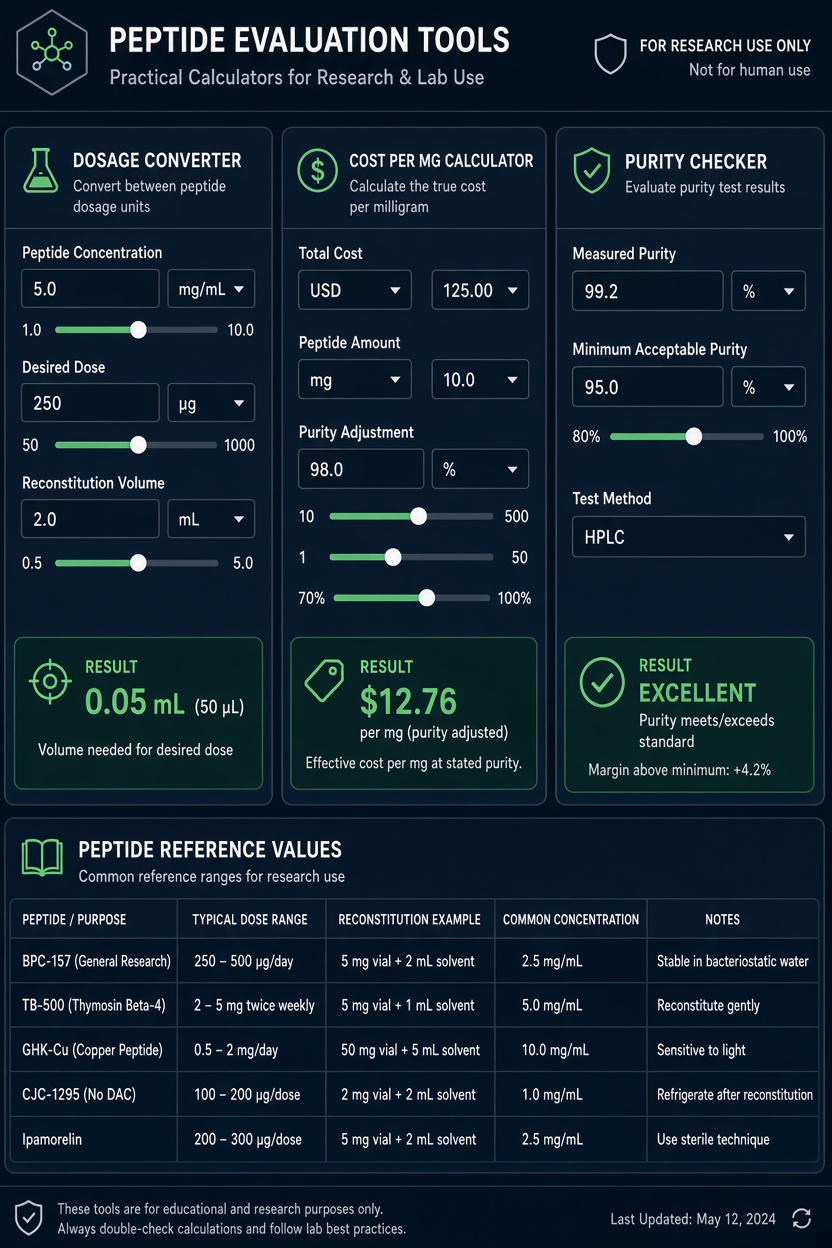
In the available human literature, the research guide highlights the 52-participant study that evaluated anxiolytic Selank and nootropic Semax in healthy participants using resting-state functional connectivity analysis. The research guide specifies the amygdala and dorsolateral prefrontal cortex regions of interest. This lets you see exactly what was measured before you cite the paper as evidence for broad cognitive enhancement.
The research guide applies a consistent checklist to human nootropic peptide studies. First, it asks whether the study enrolled healthy participants or a clinical population. Second, it asks whether the outcome was a behavioral measure, a cognitive test, an imaging metric, or a mechanistic marker. Third, it checks the sample size and whether the authors reported effect sizes. Fourth, it separates human data from animal data. Fifth, it notes whether the paper discusses statistical corrections for multiple comparisons.
For mechanistic claims, the research guide keeps PKC/PI3K signaling, AMPA receptor delivery, and hippocampal-dependent memory in rodents clearly separated from established human cognitive outcomes. This prevents the common error of citing a rodent memory study as evidence of human nootropic benefit. The research guide also flags whether a study used resting-state fMRI with region-of-interest analysis, as in the 52-participant paper, because that design measures connectivity changes rather than behavioral performance.
A key distinction in the Peptides Library guide is between statistical significance and clinical relevance. A resting-state connectivity change in the amygdala or dorsolateral prefrontal cortex does not automatically mean improved memory, reduced anxiety, or enhanced focus. The guide encourages readers to ask what the outcome actually measured and whether the authors interpreted that outcome cautiously. This is why the guide lists the specific brain regions and the connectivity metric rather than repeating a vendor’s summary sentence.
Which Practical Tools Does the Research Guide Offer for Peptide Evaluation?
The research guide integrates free peptide calculators, how-to guides, and independent brand reviews so you can evaluate a vendor before you buy. For a complete overview of peptide library sources, see Bibtides: The Complete Research Peptide Library Guide (2026). The Exogenous Peptides: Complete Sourcing and QC Guide (2026) provides additional QC criteria for purity and COA verification. Before citing any claim, use the checklist in Are There Studies on It? 7 Essential Ways to Check (2026).
Peptide calculators inside the Peptides Library guide help researchers convert between mass, molarity, and volume for reconstitution planning. These tools are built for laboratory use only and are not dosing calculators. How-to guides cover storage conditions, solubility testing, and COA interpretation. Brand reviews evaluate whether a vendor provides third-party purity testing, batch-specific COAs, and accurate sequence information. All of these resources sit inside the same evidence-first framework, so you do not have to jump between a sales page and a citation database.
💡 Key Takeaway: Which Practical Tools Does the Research Guide Offer for Peptide Evaluation?
What Makes the Peptides Library Research Guide Different from Retailer Content?
Most retailer content collapses Selank and Semax into a single “brain peptide” category. The research guide avoids that by keeping the anxiolytic/nootropic split, the cognition/neuroprotection split, and the human/animal data split visible at every step. The research guide also includes FDA safety notes that most vendor pages omit, such as peptide aggregation and peptide-related impurities for compounded Selank acetate.
Independent brand reviews inside the Peptides Library guide evaluate purity percentage, COA availability, storage conditions, and third-party testing claims, not marketing language. That evidence-first approach is what separates this resource from a sales page. The guide does not assume that a higher price means higher purity, and it does not treat a vendor’s internal testing as equivalent to an independent COA. Instead, it asks whether the documentation is verifiable and whether the vendor discloses batch-specific data.
How Should Researchers Use This Evidence Before Citing Nootropic Peptide Claims?
Before citing any nootropic peptide claim, verify the source against the evidence hierarchy described above. Check whether the paper used human participants or animal models. Confirm the sample size and outcome measure. Note whether the FDA safety note applies to the compounded form you are reviewing. Then compare the vendor’s description against the sequence, mechanism, and human study details outlined in this resource. If a claim mentions cognitive enhancement but cites only a rodent hippocampal memory study, treat it as mechanistic, not as a human outcome.
Use the following checklist before citing a nootropic peptide claim:
- Does the source specify Selank or Semax, or does it lump them together?
- Does the study use human participants, and if so, what was the sample size?
- Was the outcome a behavioral test, a cognitive battery, an imaging metric, or a mechanistic marker?
- Does the paper report effect sizes and confidence intervals, or only p-values?
- Does the claim cite the 52-participant resting-state fMRI study accurately, including the amygdala and dorsolateral prefrontal cortex regions?
- Does the FDA 2026 safety note apply to the specific compounded form you are reviewing?
- Is the sequence Thr-Lys-Pro-Arg-Pro-Gly-Pro correctly stated for Selank?
- Does the vendor provide a batch-specific COA with purity percentage and storage conditions?
If any answer is unclear, the Peptides Library guide points you back to the primary literature or the FDA safety communication before you cite the claim.
FAQ
What is the core difference between Selank and Semax in the available literature?
Selank is more often discussed for anxiolytic and nootropic effects, with a heptapeptide sequence Thr-Lys-Pro-Arg-Pro-Gly-Pro and mechanistic claims tied to positive allosteric modulation of GABA binding. Semax is more often framed around cognition and neuroprotection, derived from an ACTH fragment. The available human study evaluated both together, so the distinction comes from the literature framing, not from a single head-to-head trial.
What did the 52-participant human study actually measure?
The study used resting-state functional connectivity analysis in healthy participants, focusing on the amygdala and dorsolateral prefrontal cortex regions of interest. It evaluated anxiolytic Selank and nootropic Semax together. The outcome was connectivity change, not a behavioral memory test or a clinical anxiety scale, so broad cognitive-enhancement claims should be treated cautiously.
What are the FDA 2026 safety notes on compounded Selank acetate and Semax?
For compounded Selank acetate, the FDA notes that it lacks important safety information for human use and raises concerns such as peptide aggregation and peptide-related impurities. For compounded Semax, the FDA has no or limited safety-related information for proposed routes of administration. Both are investigational, not approved therapies.
Does the Peptides Library guide include brand reviews?
Yes, the guide includes independent brand reviews that evaluate purity percentage, COA availability, storage conditions, and third-party testing claims. These reviews are integrated with free peptide calculators and how-to guides, all framed for in vitro laboratory research use only.
Can I use this information for human consumption or dosing?
No. All products discussed are sold strictly for in vitro laboratory research purposes only. They are not for human or veterinary use, and not intended to diagnose, treat, cure, or prevent any disease. The Peptides Library guide does not provide dosing, consumption, or therapeutic advice. Must be 21+ to purchase.
Ready to Take the Next Step?
Every product includes lot-specific documentation and third-party purity testing.
Explore Our Research Products →Free shipping on qualifying orders · Batch COA on request