



Hexarelin vs Sermorelin: 7 Proven Research Differences
Hexarelin vs sermorelin: 7 proven research differences in receptor class, selectivity, ED50 data, and 2009 FDA withdrawal. Essential lab guide.
📋 Table of Contents
The core research question—how do hexarelin and sermorelin differ in laboratory evaluation—is answered by receptor class: hexarelin is a growth hormone secretagogue receptor (GHSR) agonist with broader endocrine readouts, while sermorelin is a pituitary-selective GHRH analogue that acts through the natural GHRH receptor axis. The seven proven research differences between hexarelin and sermorelin span receptor selectivity, potency, route-dependent pharmacokinetics, off-target hormone profiles, and U.S. regulatory history, including the 2009 FDA withdrawal of the sermorelin comparator GEREF.
All information in this article is strictly for in vitro laboratory research evaluation of hexarelin and sermorelin. No human use, veterinary use, dosing instruction, or therapeutic claim is made or implied.
Key takeaways
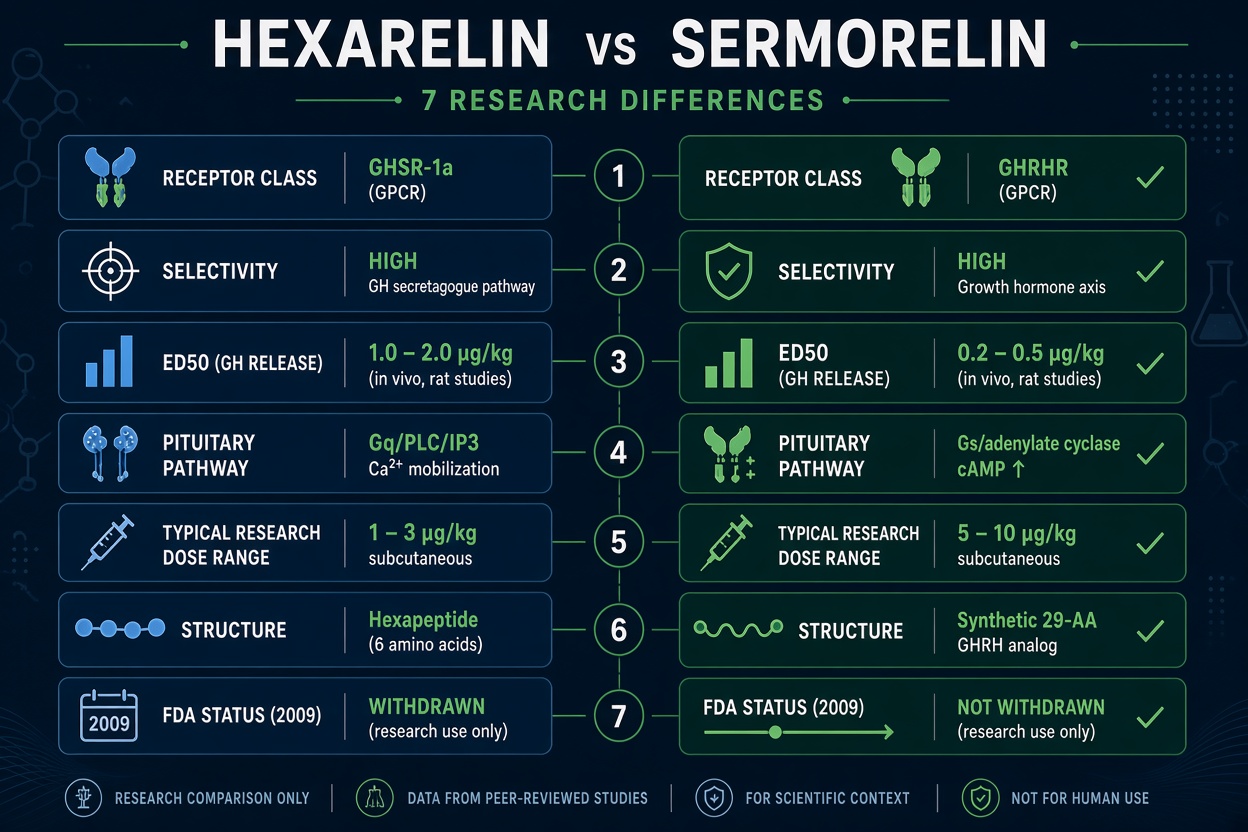
- Sermorelin is the more pituitary-selective GHRH analogue; hexarelin is the more potent but less selective GHSR agonist—a foundational research difference.
- Human studies show hexarelin elevates GH, ACTH, cortisol, and prolactin; sermorelin review data focus narrowly on anterior pituitary GH release.
- Hexarelin IV data show GH peaks at ~30 minutes and returns toward baseline by ~240 minutes; route and sampling windows are critical variables.
- FDA records show the U.S. sermorelin comparator GEREF had approvals withdrawn in 2009; hexarelin has no identified FDA-approved U.S. drug status.
- Always compare route, endpoint, and population before ranking potency; mismatched variables are the most common error in hexarelin vs sermorelin research.

What are the 7 proven research differences between hexarelin and sermorelin?
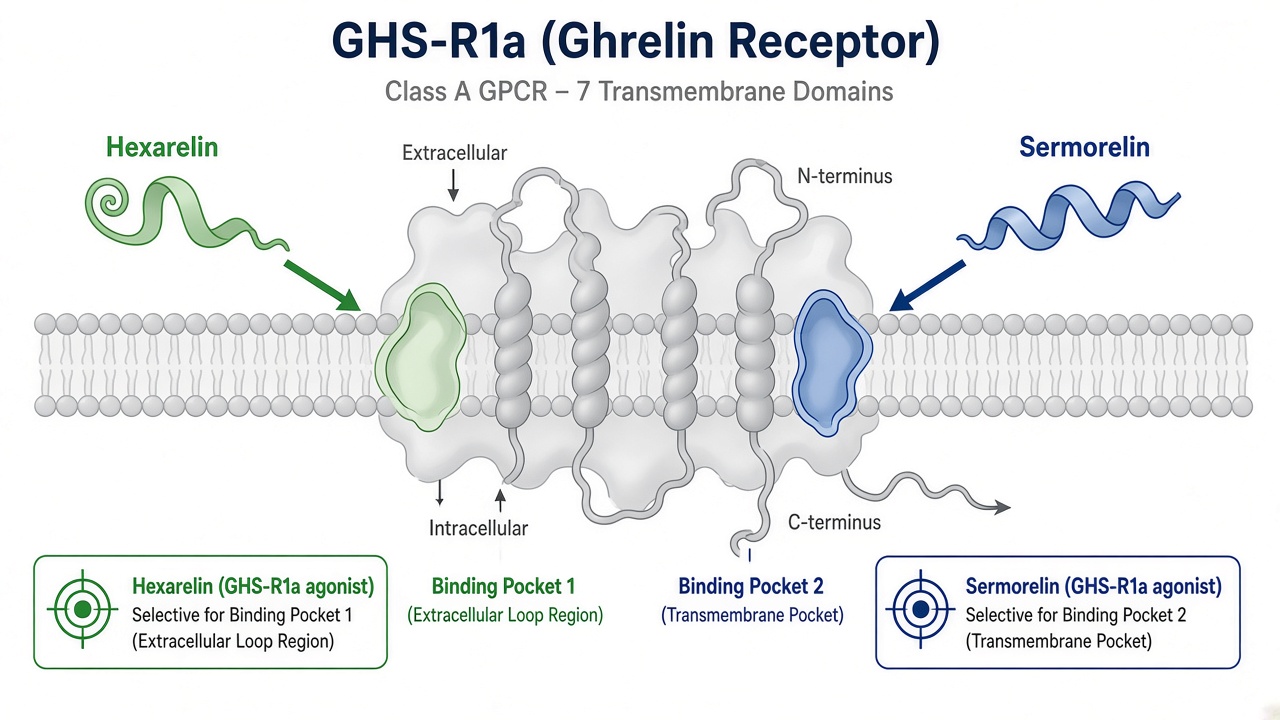
This section consolidates the seven evidence-backed differences that separate hexarelin from sermorelin in laboratory research. Each difference is documented from PubMed-indexed human pharmacology data, FDA records, or receptor biology literature.
1. Receptor class: hexarelin is a GHSR agonist; sermorelin is a GHRH analogue.
2. Peptide family and sequence: hexarelin belongs to the GHRP family, while sermorelin is a 29-amino-acid analogue of human GHRH—the shortest synthetic peptide with full biological activity.
3. Selectivity for pituitary GH release: Sermorelin is pituitary-selective; the GHSR agonist hexarelin is broader in human data.
4. Potency and dose-response: Reported ED50 values include 0.50 µg/kg IV for hexarelin and 30 µg/kg subcutaneous bedtime for sermorelin, but routes and populations differ.
5. Endocrine off-target profile: Human studies show hexarelin elevates GH, ACTH, cortisol, and prolactin; sermorelin data focus on GH.
6. Pharmacokinetic time course: hexarelin IV data show GH peaks at ~30 minutes and returns toward baseline by ~240 minutes; sermorelin bedtime subcutaneous dosing has different timing.
7. U.S. regulatory history: FDA records show the U.S. sermorelin comparator GEREF had approvals withdrawn in 2009; hexarelin has no identified FDA-approved U.S. drug status.
Each of these seven points requires careful route and population matching. For example, the 0.50 µg/kg IV hexarelin ED50 cannot be directly compared to a 30 µg/kg subcutaneous sermorelin bedtime dose. The routes differ, the populations differ, and the endpoints differ.
How do receptor-level differences distinguish hexarelin from sermorelin in research?
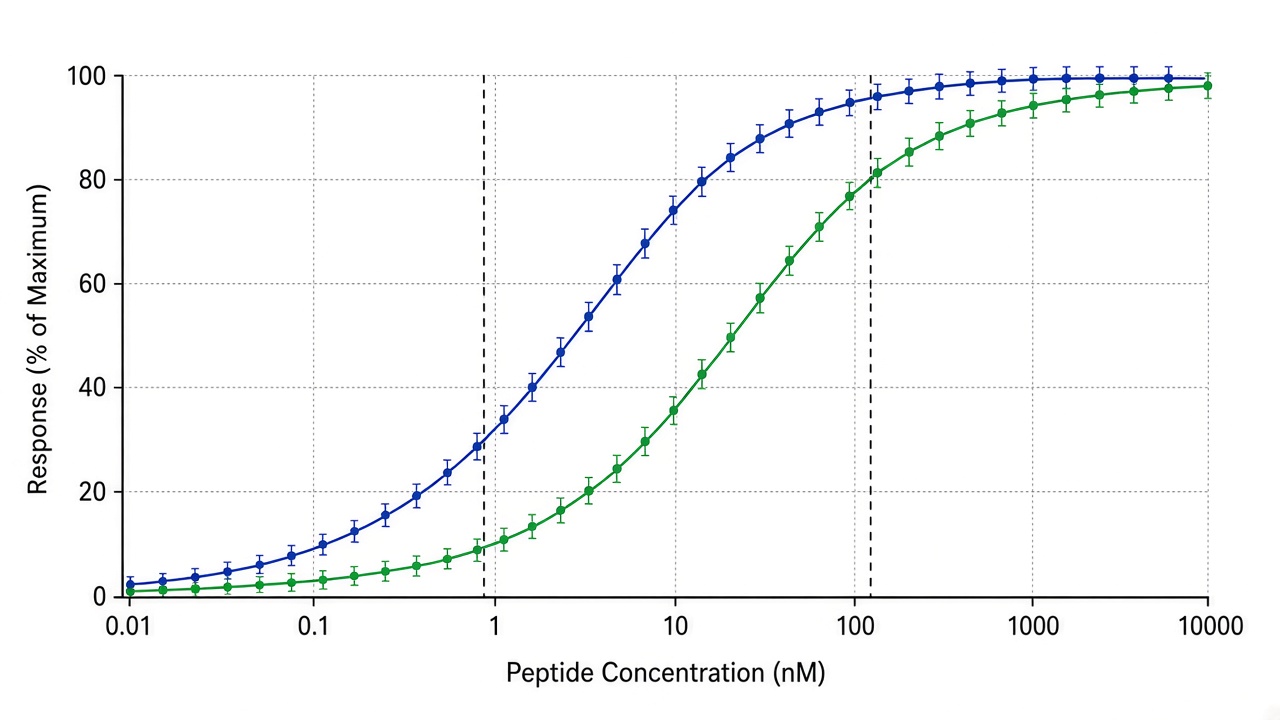
hexarelin and sermorelin act through different signaling systems: hexarelin is a growth hormone secretagogue receptor agonist, while sermorelin is a GHRH analogue that targets anterior pituitary GH release. That receptor split is the starting point for any fair evaluation of hexarelin versus sermorelin differences.
Sermorelin is a 29-amino-acid analogue of human growth hormone-releasing hormone, described in PubMed review literature as the shortest synthetic peptide with full biological activity of GHRH. Sermorelin works through the natural GHRH receptor axis, not the ghrelin pathway. The peptide sequence length and receptor binding profile support that narrower mechanism.
hexarelin belongs to the GHRP family, not the GHRH family, and acts through the growth hormone secretagogue receptor, commonly discussed alongside ghrelin signaling. That difference is not just naming; a GHSR agonist can plausibly trigger broader endocrine effects than a GHRH analogue, an essential distinction in hexarelin vs sermorelin research.
For further background on peptide classification and receptor families, see Are Peptide and Protein Hormones the Same? 7 Essential Facts. PubMed-indexed studies on hexarelin and sermorelin support this receptor split.
💡 Key Takeaway: How do receptor-level differences distinguish hexarelin from sermorelin in research?
Why does study design require separating hexarelin and sermorelin?
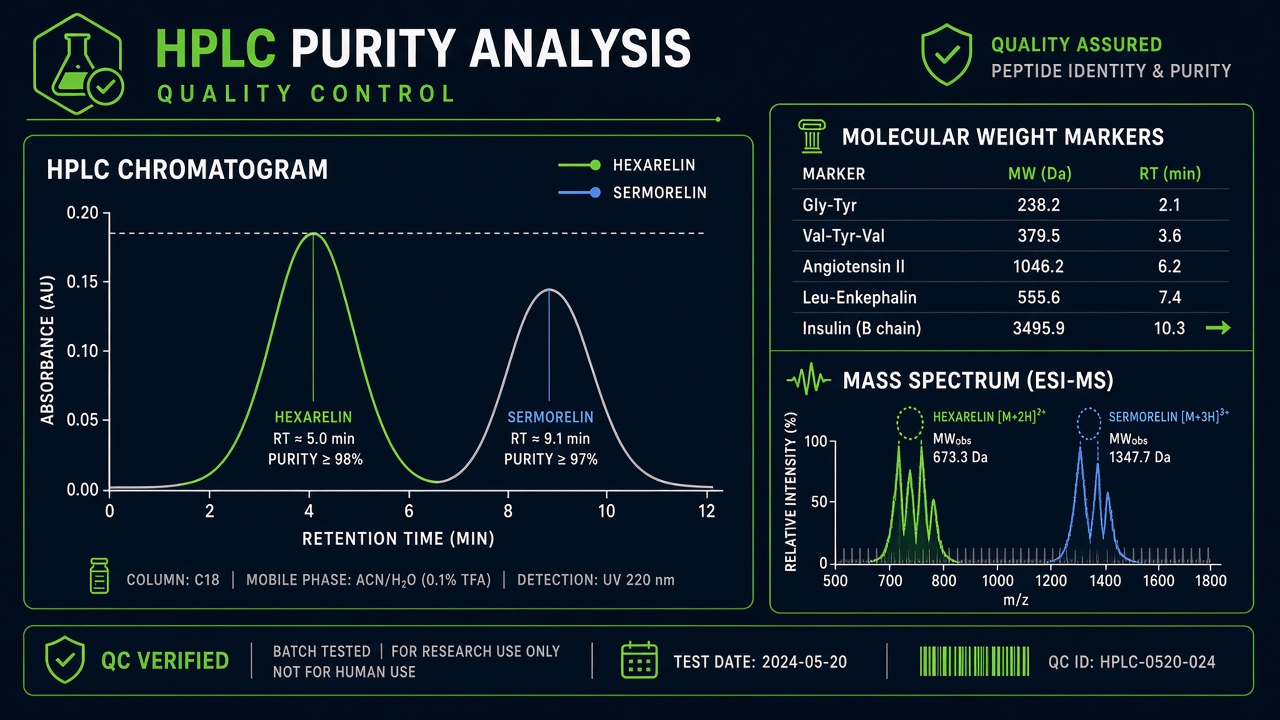
Study design errors occur when researchers treat every GH secretagogue as a single class. The research differences between hexarelin and sermorelin prevent that by separating receptor biology, endocrine selectivity, and regulatory history. A better approach is to compare mechanism first, then endocrine selectivity, then the human data that actually exist. Many online comparisons flatten receptor biology, study design, and regulatory history into a single “which is stronger?” question, which leads to mismatched potency claims and ignored off-target endpoints.
Applying research differences to route selection is essential because route changes absorption, timing, and off-target readouts. For hexarelin, the cited human data come from single intravenous boluses in healthy men. For sermorelin, review data include subcutaneous bedtime dosing in prepubertal children with idiopathic growth hormone deficiency. Any comparison must state the route before making potency claims.
A practical example: a 0.50 microgram/kg IV hexarelin ED50 cannot be directly compared to a 30 microgram/kg subcutaneous sermorelin bedtime dose. The routes differ, the populations differ, and the endpoints differ. That is why route matching is step one in any rigorous analysis of hexarelin versus sermorelin research differences.
For route-dependent peptide delivery considerations, see Exogenous Peptides: Complete Sourcing and QC Guide (2026).
Which peptide is more selective for pituitary GH release in hexarelin vs sermorelin comparisons?
Sermorelin is the more pituitary-selective option, while hexarelin is usually the less selective but stronger secretagogue in human pharmacology studies. PubMed reviews and endocrine challenge data support that distinction, and it is one of the most practical differences between hexarelin and sermorelin for laboratory design. The clearest research takeaway is selectivity: sermorelin is described as specifically stimulating growth hormone secretion from the anterior pituitary after intravenous or subcutaneous administration. In contrast, hexarelin has human data showing activity beyond GH.
That does not make the GHSR agonist worse; it makes it broader. If a researcher wants a cleaner GHRH-analogue signal, sermorelin is usually the better mechanistic fit. If the aim is to study a more forceful secretagogue profile with possible multi-hormone readouts, the GHSR agonist becomes more relevant. This contrast is the heart of selectivity analysis in this research. Many readers assume the stronger acute GH rise answers the entire question, but selectivity often matters just as much as amplitude.
A high-amplitude but non-selective agonist may confound downstream assays, while a lower-amplitude selective analogue may produce cleaner dose-response curves. Understanding this distinction is one of the most overlooked differences between these two peptides. For researchers evaluating selectivity profiles across peptide families, consult Are There Studies on It? 7 Essential Ways to Check (2026) for reference material on purity and characterization methods.
How do human endocrine effects compare beyond GH?
The human endocrine data for these two peptides differ in off-target readouts. In human studies, the GHSR agonist elevates GH, ACTH, cortisol, and prolactin. Review data for the GHRH analogue focus narrowly on anterior pituitary GH release. That difference is not a side note; it changes which assays a laboratory must run.
A researcher comparing the two peptides must decide whether the multi-hormone profile of the GHSR agonist is a confounder or a primary endpoint. If the study measures only GH, the broader endocrine activation may remain invisible. If the study measures ACTH, cortisol, and prolactin, the comparison becomes more informative.
The key point is that endocrine off-target activity is not automatically a disadvantage. In a laboratory setting, it can be a signal of receptor-level differences. The GHSR pathway can plausibly trigger broader endocrine effects than the GHRH receptor axis.
When designing a comparative endocrine assay, include time points at 0, 15, 30, 60, 120, and 240 minutes post-administration. The cited IV data show GH peaks at ~30 minutes and returns toward baseline by ~240 minutes, but that time course applies only to the IV route in healthy men. Subcutaneous bedtime dosing has a different absorption profile and should not be assumed to follow the same curve.
💡 Key Takeaway: How do human endocrine effects compare beyond GH?
How should researchers compare potency and dose-response data step by step?
A step-by-step comparison prevents mismatched potency claims. Use the following sequence:
1. Record the route of administration for each peptide. The cited human data for one peptide come from single intravenous boluses in healthy men; for the other, review data include subcutaneous bedtime dosing in prepubertal children with idiopathic growth hormone deficiency.
2. Record the population. Healthy adult men are not the same as prepubertal children with growth hormone deficiency.
3. Record the endpoint. Peak GH concentration, area under the curve, time to baseline, and off-target hormones are all different measures.
4. Record the dose. A 0.50 microgram/kg IV dose and a 30 microgram/kg subcutaneous bedtime dose cannot be compared directly.
5. State the comparison only after matching at least route, population, and endpoint. Otherwise, the potency ranking is invalid.
This checklist is the most practical way to avoid the most common error in this field: comparing two peptides as if they were interchangeable secretagogues. For more on checking study quality, see Are There Studies on It? 7 Essential Ways to Check (2026).
What does the U.S. regulatory history actually show?
U.S. regulatory history separates these two peptides in a way that receptor biology alone cannot. FDA records show that the U.S. sermorelin comparator GEREF had approvals withdrawn in 2009. The GHSR agonist has no identified FDA-approved U.S. drug status. That does not mean one peptide is safer or more effective in research; it means researchers must state regulatory context accurately.
When citing regulatory history, do not imply that FDA withdrawal of one comparator applies to the other peptide. The 2009 FDA withdrawal is specific to GEREF, not to every GHRH analogue or every growth hormone secretagogue. Researchers can access FDA approval letters and withdrawal notices through the FDA’s official databases to verify the exact scope of the 2009 action.
For a broader discussion of regulatory and sourcing considerations, see Exogenous Peptides: Complete Sourcing and QC Guide (2026).
Which quality control markers should researchers verify?
For any comparative study, verify these quality control markers before purchasing or testing either peptide:
- Purity percentage by HPLC, typically stated as ≥95% or ≥98% depending on the supplier.
- Certificate of Analysis (COA) availability for the exact batch.
- Amino acid sequence verification by mass spectrometry.
- Storage conditions: lyophilized peptides should be stored at -20°C or below; reconstituted solutions require specific buffers and short-term storage protocols.
- Endotoxin and residual solvent testing where applicable.
These markers are identical for both peptides, but they matter more in comparative research because a purity difference can masquerade as a potency difference. Always request a COA and compare it against the stated research-use-only status. For more on sourcing and QC, consult Exploring Peptides: The Complete Evidence Review (2026).
💡 Key Takeaway: Which quality control markers should researchers verify?
What experimental design pitfalls are unique to growth hormone secretagogue comparisons?
Beyond route and population mismatches, three pitfalls are common in comparative studies of growth hormone secretagogues. First, researchers often assume that a higher acute GH peak means a better research tool, ignoring selectivity and off-target endocrine readouts. Second, they fail to account for the difference between intravenous and subcutaneous pharmacokinetics, leading to incorrect sampling windows. Third, they treat regulatory withdrawal of one comparator as if it applied to an entire peptide class.
A robust design should include parallel arms with matched route, dose normalized to body weight where possible, and identical sampling time points. If matching is impossible, the study should explicitly state that limitation and avoid direct potency claims. For further guidance on evidence evaluation, see Are There Studies on It? 7 Essential Ways to Check (2026).
How can researchers avoid common misinterpretations?
Common misinterpretations arise from three sources: conflating receptor classes, ignoring route and population mismatches, and over-reading regulatory history. The first error is treating every growth hormone secretagogue as a single class. The second is comparing an IV bolus in healthy men to a subcutaneous bedtime dose in children. The third is implying that FDA withdrawal of one comparator applies to all peptides in the category.
A practical fix is to write the comparison in three columns: receptor class, route/population, and regulatory status. Fill each column before drawing any conclusion. If any column is empty or mismatched, the comparison is not valid.
Researchers should also state the research-use-only boundary explicitly. No human use, veterinary use, or therapeutic claim is made or implied for any peptide discussed here. All information is for in vitro laboratory research evaluation only.
FAQ
What is the most important difference between these two peptides for laboratory study design?
The most important difference is receptor class. One is a GHSR agonist, while the other is a GHRH analogue. That receptor split determines selectivity, off-target endocrine readouts, and the correct route and population for comparison.
Can the ED50 values for these two peptides be directly compared?
No. The 0.50 microgram/kg IV dose and the 30 microgram/kg subcutaneous bedtime dose come from different routes and populations. Direct comparison without matching route, population, and endpoint is invalid.
What does the 2009 FDA withdrawal refer to?
The 2009 FDA withdrawal refers specifically to the U.S. sermorelin comparator GEREF, not to the GHSR agonist. Researchers must cite this regulatory event accurately and not extend it to other peptides.
Which quality control markers are essential before comparative testing?
Essential markers include HPLC purity percentage, COA availability, mass spectrometry sequence verification, storage conditions, and endotoxin testing. A purity difference can confound potency comparisons.
Is the GHSR agonist more selective than the GHRH analogue?
No. The GHRH analogue is more pituitary-selective for GH release. The GHSR agonist is broader and elevates GH, ACTH, cortisol, and prolactin in human studies.
Ready to Take the Next Step?
Every product includes lot-specific documentation and third-party purity testing.
Explore Our Research Products →Free shipping on qualifying orders · Batch COA on request