

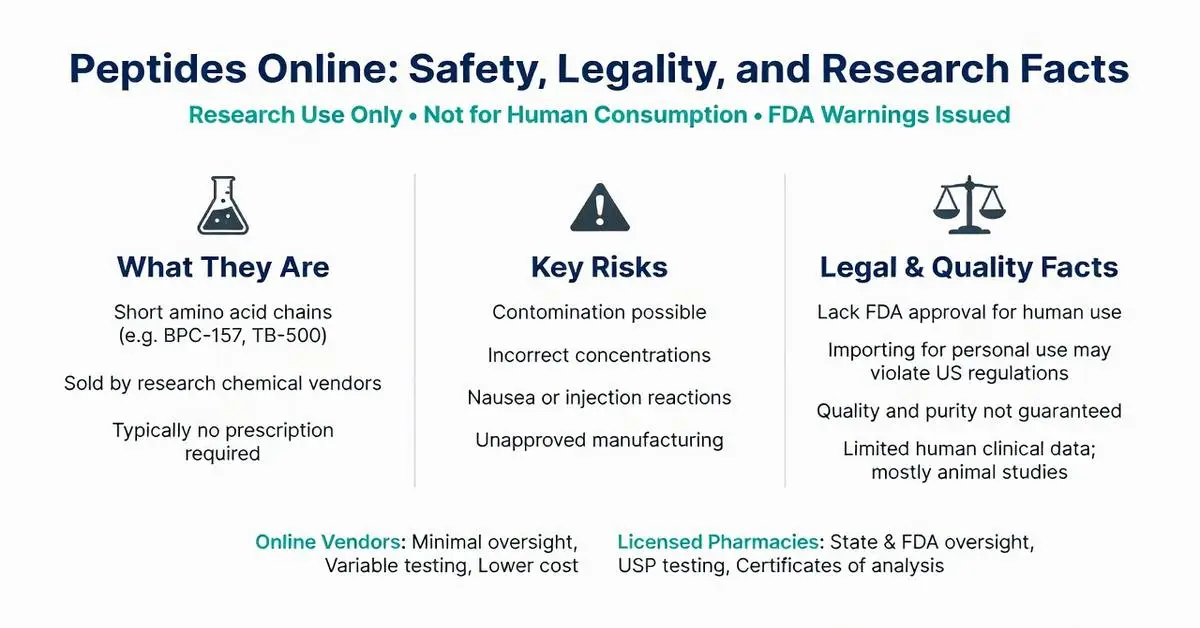
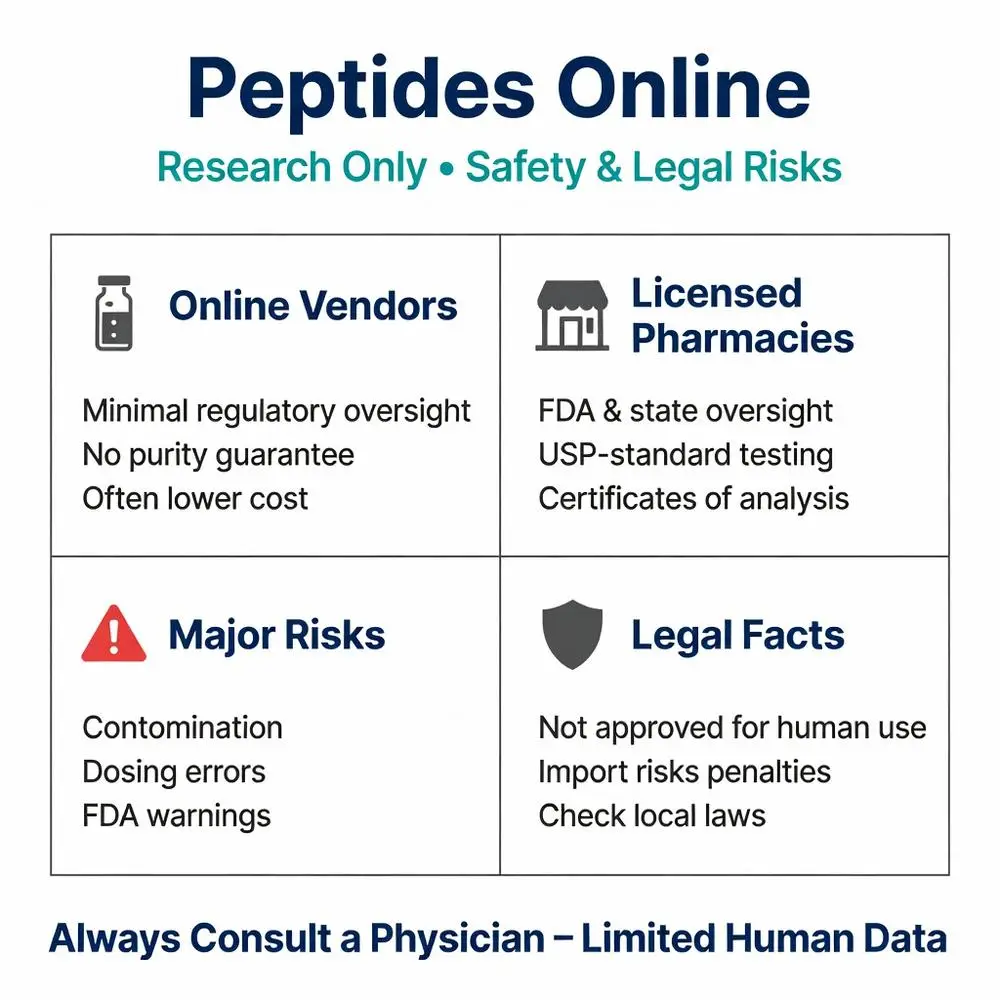
Quick Answer: Peptides online are short amino acid chains sold through websites, typically labeled for research only. Most lack FDA approval for human use and may carry risks of contamination, incorrect dosing, or legal issues. Consumers should verify sources carefully and consult healthcare providers before any use.
This article is for informational purposes only and does not constitute medical advice. Consult a qualified healthcare provider before using any peptide.
Vendors ship products directly to consumers after online checkout. Most require no prescription because the items are labeled “research use only.”
Payment usually occurs through credit cards or cryptocurrency. Shipping times range from a few days to several weeks depending on the supplier’s location and customs rules.

Vendors ship products directly to consumers after online checkout. Most require no prescription because the items are labeled “research use only.”
Payment usually occurs through credit cards or cryptocurrency. Shipping times range from a few days to several weeks depending on the supplier’s location and customs rules.
Some users report convenience when sourcing research materials that are difficult to obtain locally. Online platforms may list a wider variety of peptide sequences than local compounding pharmacies.
Limited animal studies suggest certain peptides could support tissue repair, yet human data remain scarce for most compounds sold online.
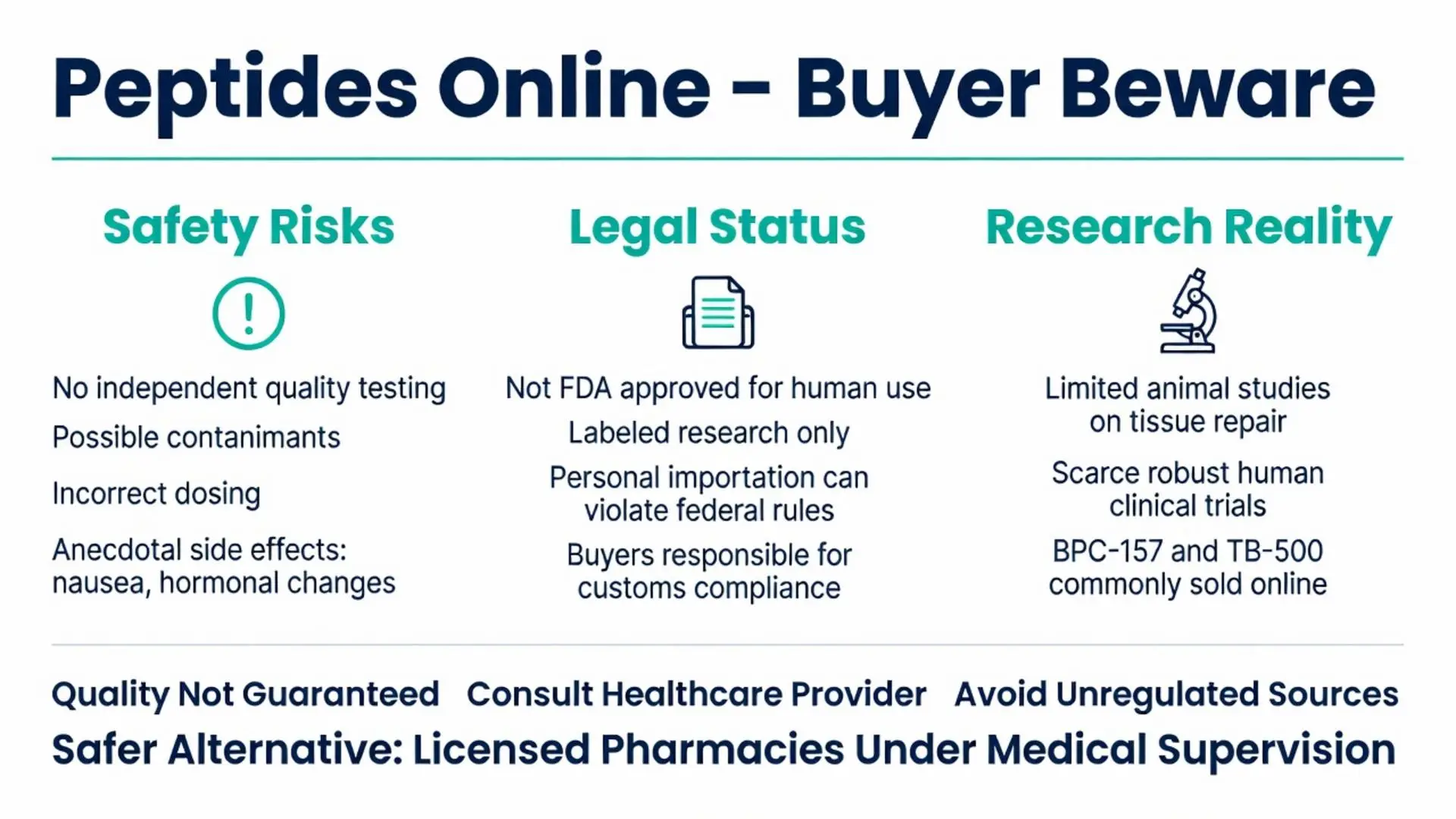
Products bought online may contain incorrect concentrations or unknown contaminants because they bypass standard pharmaceutical quality controls. Injection-site reactions, nausea, or unexpected hormonal changes have been reported anecdotally.
The FDA has issued warnings about unapproved peptides sold online, noting potential safety hazards from poor manufacturing practices.
Only researchers working under institutional review board approval should consider purchasing peptides strictly for laboratory experiments. Individuals seeking personal health benefits should avoid unregulated online sources.
Anyone with a medical condition must speak with a licensed physician rather than rely on internet vendors.
Typical research protocols involve reconstituting lyophilized powder with bacteriostatic water and storing vials in a refrigerator. Dosing information found on vendor sites is not medically validated.
Users must follow all local regulations regarding possession and import of research chemicals.
| Feature | Peptides Online | Licensed Compounding Pharmacy | Traditional Prescription Route |
|---|---|---|---|
| Regulatory oversight | Minimal or none | State and FDA oversight | Full FDA approval required |
| Quality testing | Variable or absent | USP-standard testing required | Rigorous clinical trials |
| Legal status for human use | Usually labeled research only | Allowed under specific prescriptions | Approved indications only |
| Cost | Often lower | Higher due to compliance | Insurance may cover |
| Purity guarantee | Not assured | Documented certificates of analysis | Strict manufacturing standards |
Most peptides sold online are not approved by the FDA for human use. Importing or possessing them for personal use can violate federal regulations in the United States.
Some countries allow limited personal importation, but buyers remain responsible for confirming local laws before ordering.
Most products lack independent quality testing, so safety cannot be assured. The FDA has warned consumers about potential contamination and dosing inaccuracies.
Legality depends on the specific peptide and the buyer’s country. In the United States, many research peptides are not approved for human use and may be illegal to import for personal consumption.
Look for third-party certificates of analysis and clear “research use only” labeling. Even then, regulatory oversight is minimal compared with licensed pharmacies.
Most vendors do not require prescriptions because the products are not sold as medicines. This does not make them legal or safe for human use.
Packages may be confiscated, and repeated violations can lead to legal penalties. Buyers should understand import rules before placing an order.
Some animal studies explore tissue repair, but human evidence is insufficient. Never rely on online peptides for medical treatment without physician supervision.
Most require refrigeration after reconstitution and protection from light. Always follow the supplier’s storage instructions for laboratory materials.
Working with a licensed compounding pharmacy under medical supervision provides greater quality assurance and legal protection than unregulated online sources.
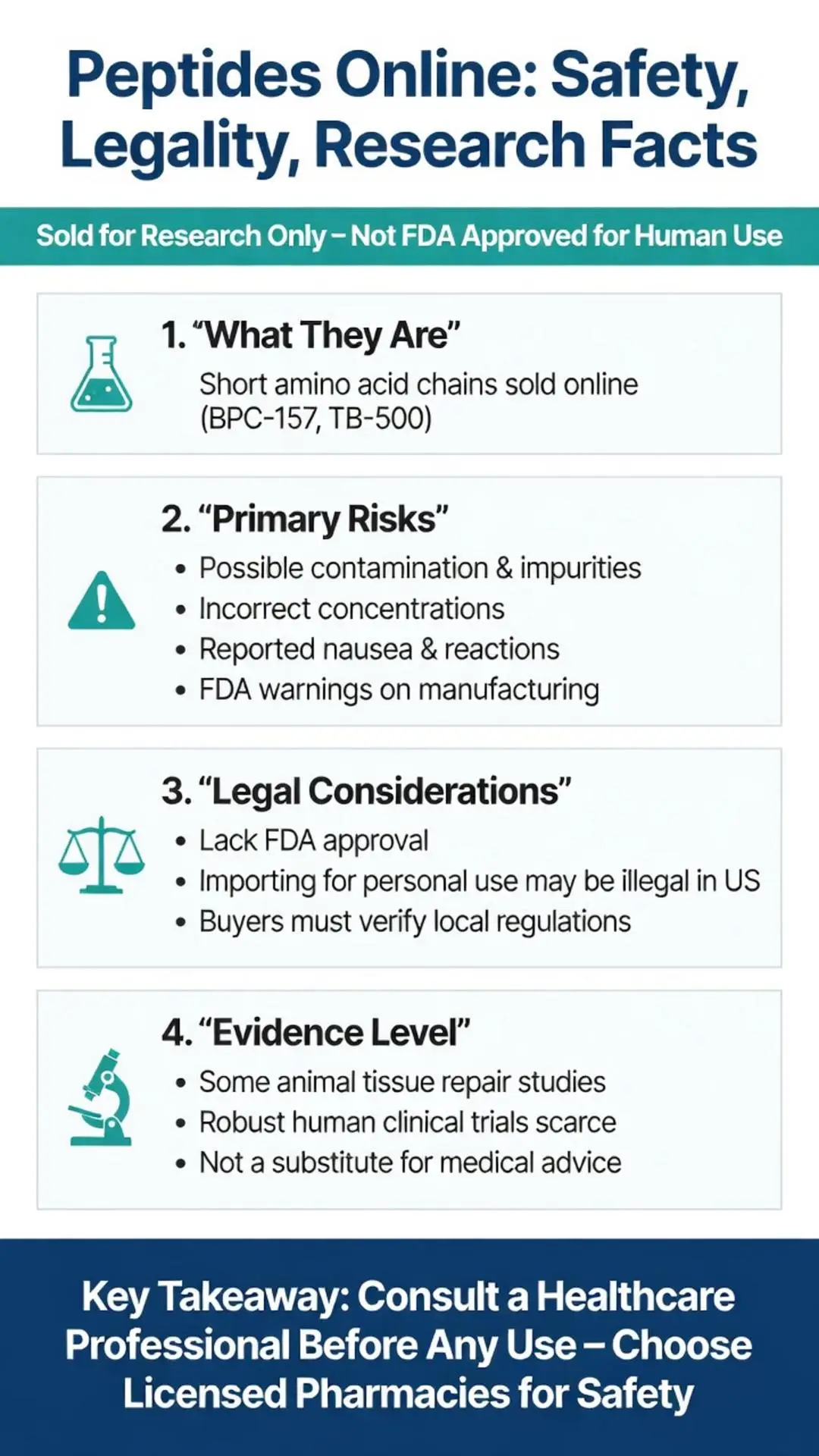
Most products lack independent quality testing, so safety cannot be assured. The FDA has warned consumers about potential contamination and dosing inaccuracies.
Legality depends on the specific peptide and the buyer’s country. In the United States, many research peptides are not approved for human use and may be illegal to import for personal consumption.
Look for third-party certificates of analysis and clear “research use only” labeling. Even then, regulatory oversight is minimal compared with licensed pharmacies.
Most vendors do not require prescriptions because the products are not sold as medicines. This does not make them legal or safe for human use.
Packages may be confiscated, and repeated violations can lead to legal penalties. Buyers should understand import rules before placing an order.
Some animal studies explore tissue repair, but human evidence is insufficient. Never rely on online peptides for medical treatment without physician supervision.
Most require refrigeration after reconstitution and protection from light. Always follow the supplier’s storage instructions for laboratory materials.
Working with a licensed compounding pharmacy under medical supervision provides greater quality assurance and legal protection than unregulated online sources.