


Cell Penetrating Peptides for Research | Peptides Library
Research-grade cell penetrating peptides (TAT, penetratin, polyarginine) at ≥98% purity with COA and HPLC/MS data. For in vitro laboratory research only.
📋 Table of Contents
Cell penetrating peptides (CPPs) are short peptide sequences — typically 5 to 30 amino acids in length — that traverse cellular membranes and are used in laboratory research to investigate the intracellular delivery of cargo molecules in vitro. Peptides Library supplies research-grade peptides in this class at ≥98% purity, with every production batch verified by reversed-phase HPLC and mass spectrometry and shipped with full analytical documentation.
Key takeaways
- Cell penetrating peptides are short sequences (5–30 amino acids) that facilitate cellular uptake of conjugated or co-administered cargo in cell culture models.
- Three principal classes — cationic, amphipathic, and hydrophobic — are distinguished by charge distribution, structural origin, and uptake mechanism.
- Every CPP supplied by Peptides Library ships at ≥98% purity with a certificate of analysis, HPLC chromatogram, and mass spectrometry verification.
- All peptides are supplied strictly for in vitro and laboratory research applications; no human or veterinary use is permitted.
What are cell penetrating peptides?
Cell penetrating peptides are defined by a single functional property: the capacity to cross the plasma membrane of cells in culture while transporting molecular cargo — fluorophores, nucleic acids, proteins, or small molecules — into the intracellular space. The field traces to two landmark observations: the TAT peptide, derived from the trans-activator of transcription protein of HIV-1 (Frankel and Pabo, 1988), and penetratin, corresponding to the third helix of the Drosophila Antennapedia homeodomain (Derossi et al., 1994).
Since those reports, hundreds of natural, chimeric, and fully synthetic CPP sequences have been characterized. In contemporary laboratory settings, CPPs function as molecular tools for studying membrane translocation, endocytic trafficking, and the intracellular delivery of research compounds in cell cultures and, where protocol-approved, in vivo (animal model) systems.
How do cell penetrating peptides cross cell membranes?
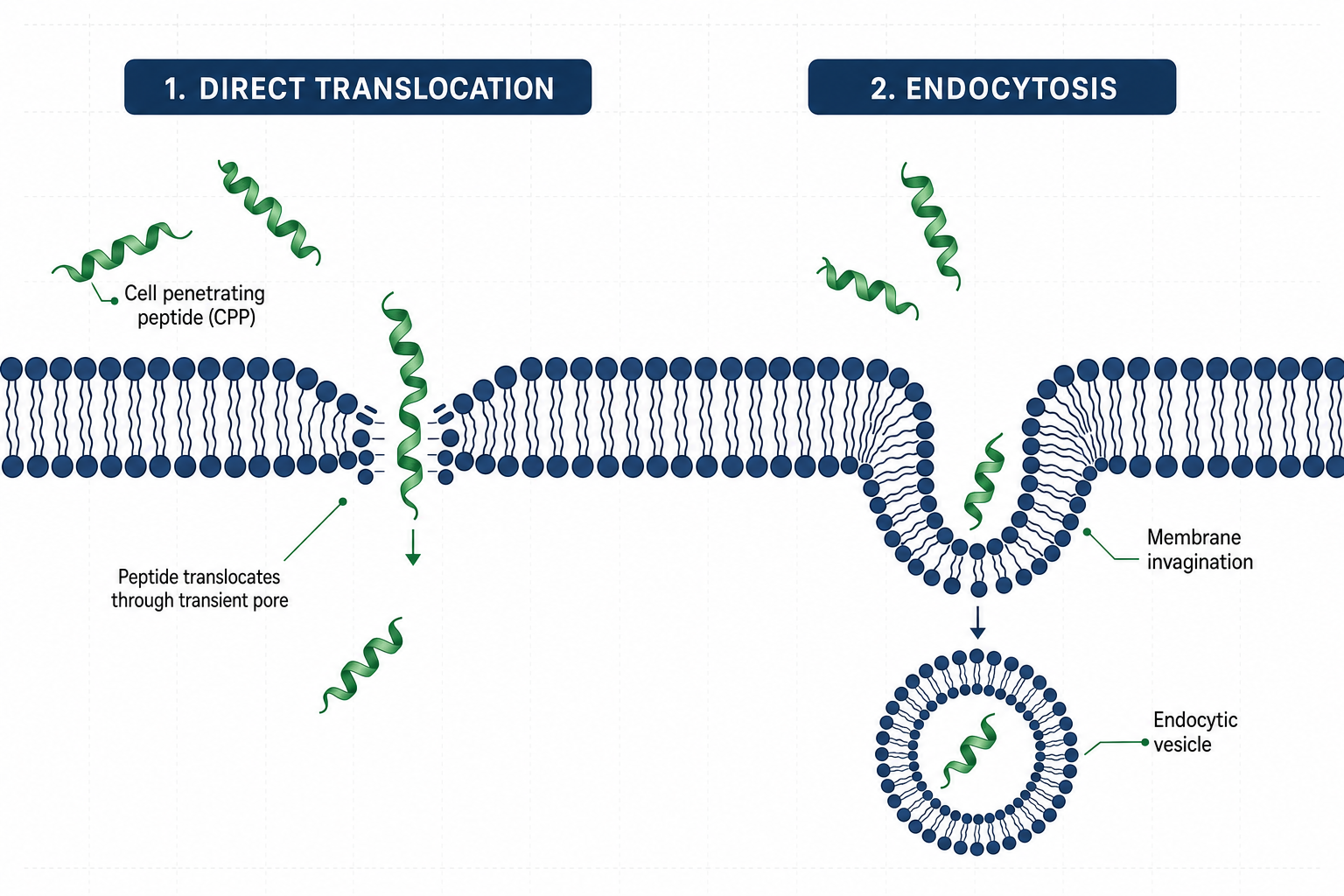
Two broadly defined routes are described in the literature. The first is energy-independent direct translocation, in which the peptide partitions into the lipid bilayer and crosses via transient pore formation, inverted micelle intermediates, or membrane thinning. The second is energy-dependent endocytosis — including clathrin-mediated endocytosis, caveolae-mediated endocytosis, and macropinocytosis — followed by endosomal escape.
The relative contribution of each route depends on sequence, peptide concentration, cargo identity, and the cell line under study. For a mechanistic treatment of these pathways, see our reference article on how cell penetrating peptide delivery really works.
| Class | Representative CPPs | Structural origin | Defining properties |
| — | — | — | — |
| Cationic | TAT peptide (47–57), polyarginine (R8–R9) | HIV-1 TAT protein; synthetic oligoarginines | High net positive charge; arginine-rich; guanidinium-mediated membrane interaction |
| Amphipathic | Penetratin, transportan | Antennapedia homeodomain; chimeric galanin–mastoparan | Segregated hydrophobic and cationic faces; frequently α-helical |
| Hydrophobic | C105Y, K-FGF signal sequence | Synthetic; growth-factor signal peptides | Low net charge; uptake driven by hydrophobic membrane partitioning |
💡 Key Takeaway: How do cell penetrating peptides cross cell membranes?
Which cell penetrating peptides are available for research?
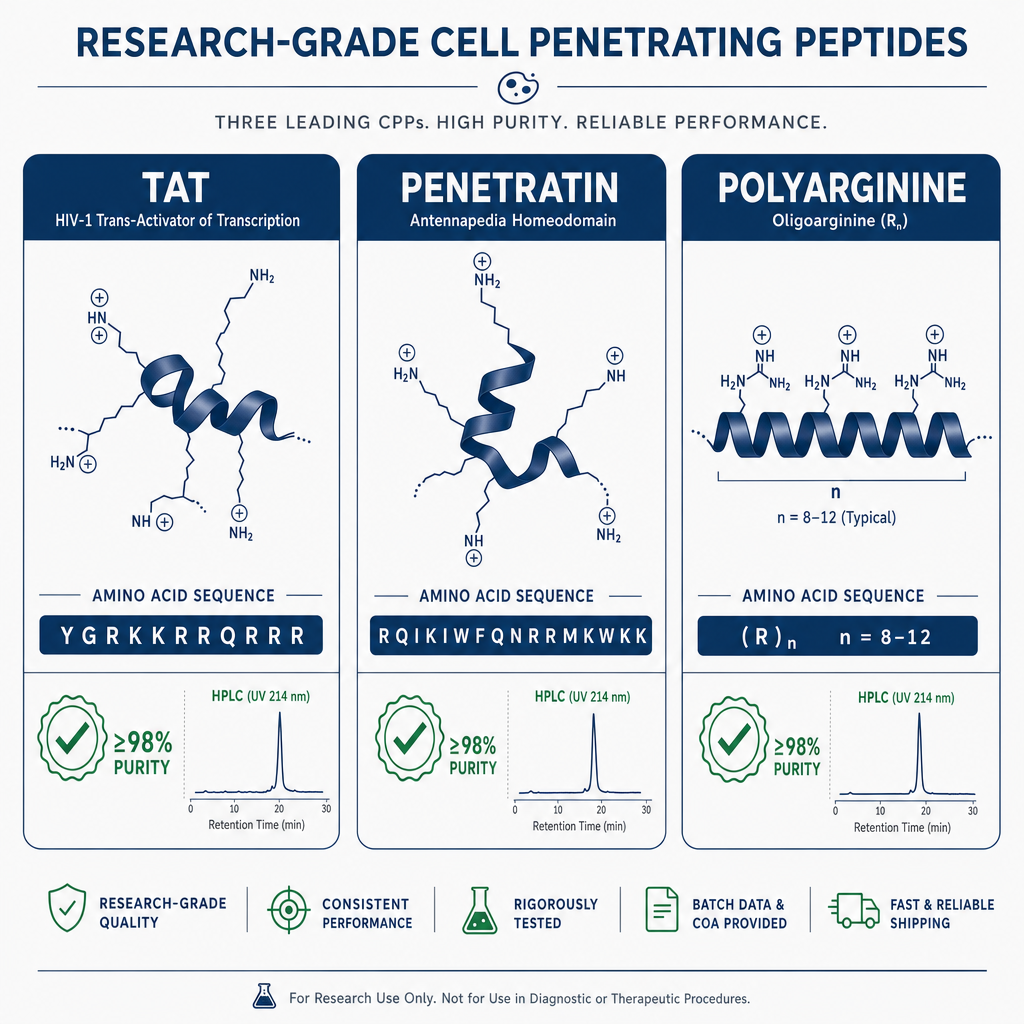
The Peptides Library catalog includes the canonical sequences used throughout the CPP literature:
- TAT peptide (47–57) — GRKKRRQRRRPQ, the arginine-rich transduction domain of HIV-1 TAT
- Penetratin — RQIKIWFQNRRMKWKK, the 16-residue Antennapedia-derived sequence
- Polyarginine (R8 and R9) — synthetic oligoarginines used as benchmark cationic CPPs
- Transportan — a chimeric galanin–mastoparan amphipathic sequence
Each CPP is supplied as a lyophilized powder in quantities from 1 mg to bulk scale. Custom synthesis options include N-terminal fluorescent labeling (FITC, TAMRA), biotinylation, D-amino acid substitutions, and cargo conjugation for delivery assays. The full range is listed in our [research-grade peptide library](/peptide-library/).
Why do laboratories source CPPs from Peptides Library?
- Verified purity. Every batch is released at ≥98% purity by analytical RP-HPLC, with molecular identity confirmed by mass spectrometry.
- Complete documentation. A lot-specific certificate of analysis, HPLC chromatogram, and MS spectrum accompany each shipment, supporting assay reproducibility and institutional record-keeping.
- Stability-controlled fulfillment. Peptides are lyophilized, desiccated, and shipped under temperature-controlled conditions to preserve integrity in transit.
- Custom synthesis and scale. Sequence modifications, labels, and conjugates can be produced to specification, from milligram screening quantities to bulk.
- Transparent procurement. Our [price and quality comparison](/peptides-library-price-quality-comparison/) outlines how purity tiers map to cost, and our [laboratory supplier guide](/trustworthy-peptide-suppliers-2026/) details the documentation standards researchers should expect from any vendor.
How are CPPs applied in in vitro research?
In laboratory settings, cell penetrating peptides support several established assay formats:
- Uptake mechanism studies. Flow cytometry and confocal microscopy of fluorescently labeled CPPs quantify cellular uptake and intracellular distribution in cell cultures.
- Structure–activity relationship studies. Systematic sequence variants clarify how charge, hydrophobicity, and helicity govern membrane interaction.
- Cargo delivery experiments. CPPs are conjugated to nucleic acids, proteins, or small molecules to study intracellular delivery in vitro.
- Biophysical membrane assays. Model membranes and liposome systems are used to characterize binding, partitioning, and translocation at the molecular level.
💡 Key Takeaway: How are CPPs applied in in vitro research?
How should CPPs be stored and handled in the laboratory?
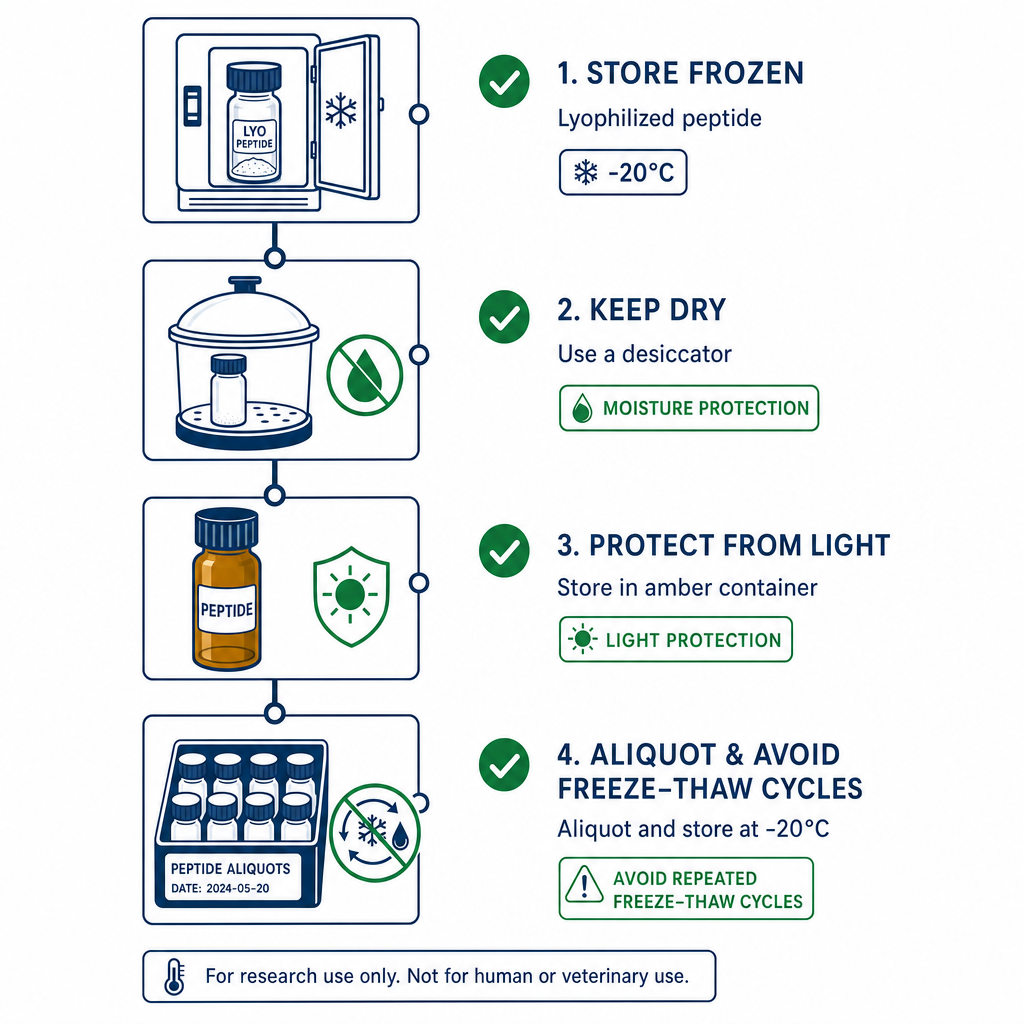
Standard peptide-handling practice applies. Lyophilized CPPs are stored at −20 °C, desiccated and protected from light. Reconstituted solutions are prepared in sterile water or appropriate buffer, aliquoted to working volumes, and kept at 2–8 °C for short-term use; repeated freeze–thaw cycles are avoided to preserve sequence integrity. Lot-specific handling notes are included with each certificate of analysis.
Ready to equip your laboratory? Browse the catalog above or contact our team for batch documentation, custom synthesis specifications, or a quotation. Every order ships with the analytical data researchers need to proceed directly to assay.
Research-use-only notice: All products supplied by Peptides Library are intended strictly for in vitro and laboratory research applications. They are not intended for human or veterinary use, consumption, injection, or any form of personal use, and no therapeutic, diagnostic, or clinical application is implied or supported.
FAQ
What are cell penetrating peptides used for in research?
Cell penetrating peptides are used as molecular tools to study intracellular delivery in vitro — including uptake mechanism assays, structure–activity studies, and cargo transport experiments in cell cultures.
What purity and documentation accompany each CPP?
Each batch is released at ≥98% purity by RP-HPLC with identity confirmed by mass spectrometry, and ships with a lot-specific certificate of analysis, chromatogram, and MS spectrum.
How are CPPs shipped and stored?
CPPs are supplied as lyophilized powders under temperature-controlled shipping and stored at −20 °C, desiccated and protected from light.
Are cell penetrating peptides available for human use?
No. All peptides from Peptides Library are sold strictly for in vitro and laboratory research and are not intended for human or veterinary use of any kind.
Can CPPs be ordered with fluorescent labels or cargo conjugation?
Yes. Custom synthesis options include FITC and TAMRA labeling, biotinylation, D-amino acid substitutions, and cargo conjugation for delivery assays.
Topics covered in this article:
Ready to Take the Next Step?
Every product includes lot-specific documentation and third-party purity testing.
Explore Our Research Products →
Free shipping on qualifying orders · Batch COA on request