



AOD Peptide With Retatrutide: 7 Essential Facts for 2026
AOD peptide with retatrutide: compare triple-agonist GLP-1/GIP/GCGR pharmacology vs hGH fragment 177-191 lipolysis, safety unknowns, and lab sourcing standards.
📋 Table of Contents
AOD peptide with retatrutide is a mechanistically complementary but entirely unvalidated research concept. Retatrutide is an investigational single-molecule triple agonist at GLP-1, GIP, and glucagon receptors, while AOD-9604 is a synthetic hGH fragment 177-191 analog studied for lipolysis signaling. No peer-reviewed study has ever administered the two compounds together, and both are supplied strictly as research-use-only laboratory chemicals.
Key takeaways
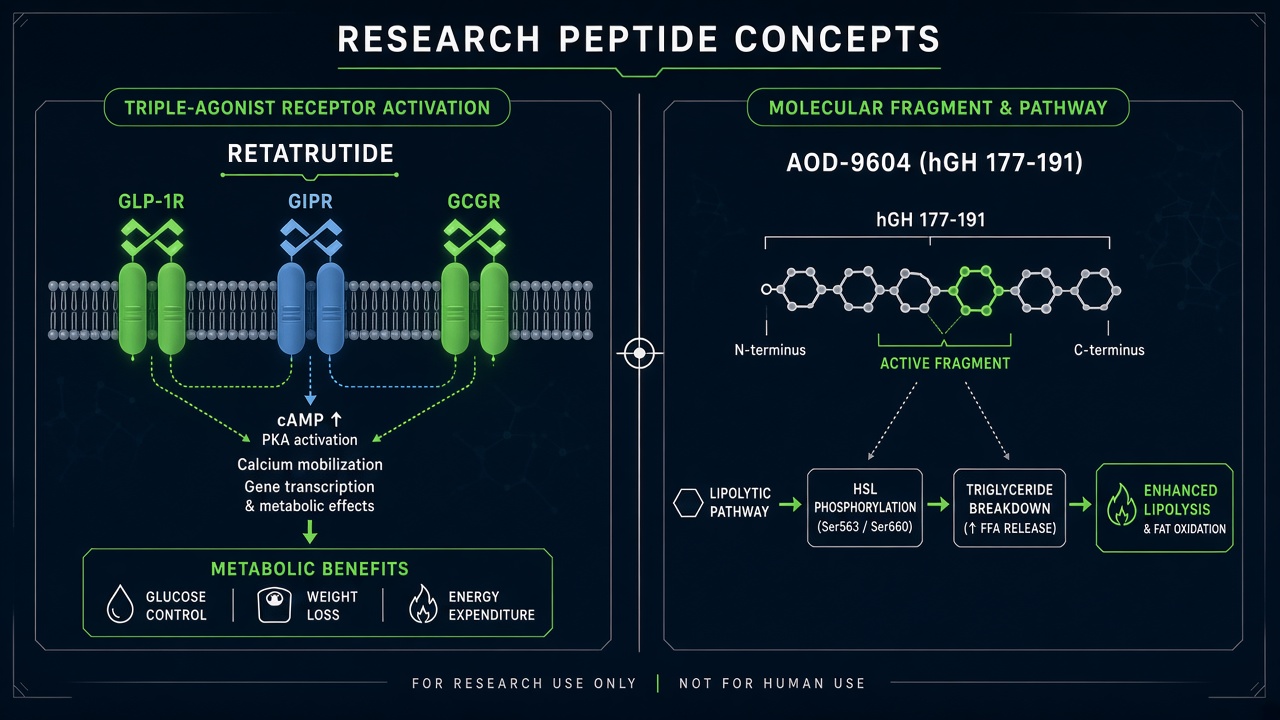
- Retatrutide is a single-molecule triple agonist at GLP-1/GIP/glucagon receptors, with a completed Phase 2 obesity trial and an ongoing Phase 3 program.
- AOD-9604 is a 16-amino-acid hGH fragment 177-191 analog; human trials reported favorable tolerability but failed efficacy endpoints, and pharmaceutical development was discontinued.
- No published dataset exists for aod peptide with retatrutide as a combination; every rationale for pairing them remains hypothesis-level.
- The dominant controllable risk variable is sourcing: identity, purity, and endotoxin verification through a batch-specific certificate of analysis.
- All compounds discussed — including any aod peptide with retatrutide pairing — are research-use-only materials intended for qualified laboratories and institutional research settings.
What is aod peptide with retatrutide as a research concept?
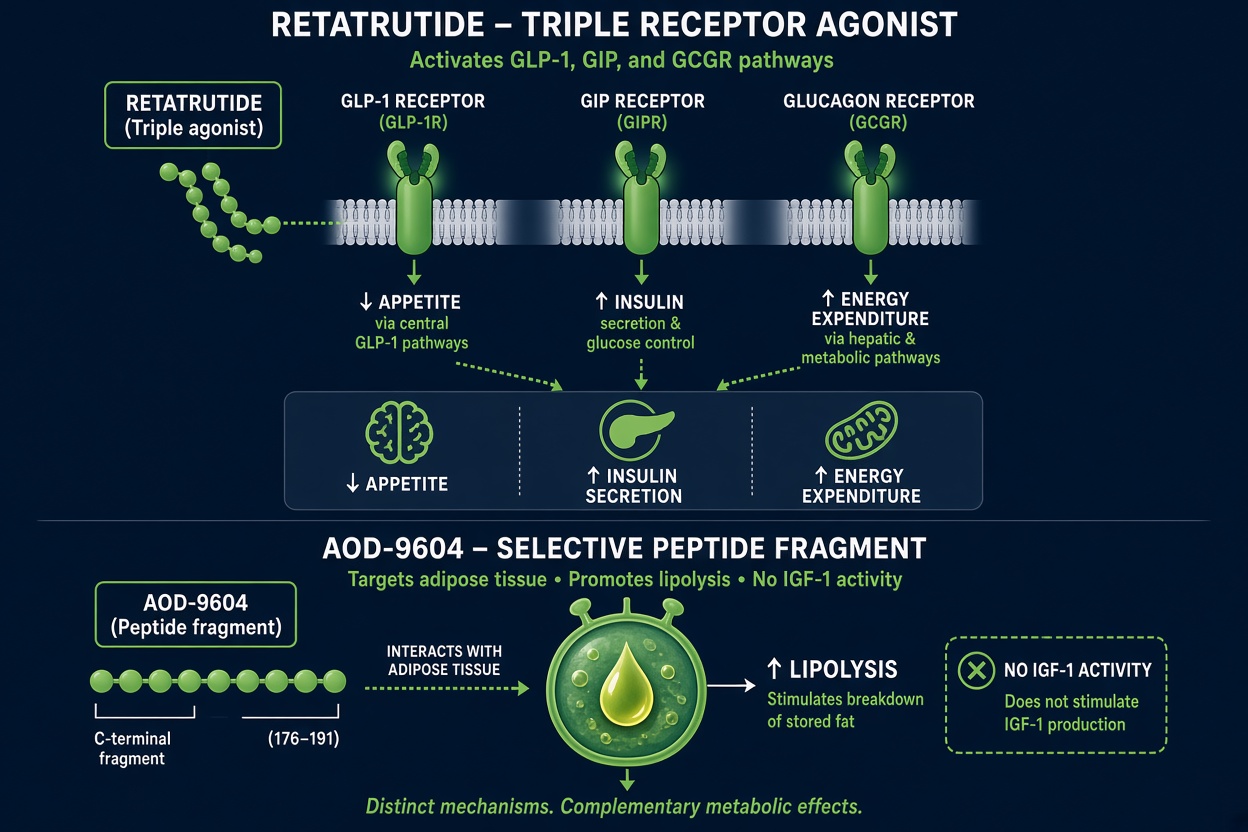
The phrase aod peptide with retatrutide describes the deliberate co-administration of two structurally unrelated peptides within a single experimental design — typically cell cultures first and animal models second. Informal literature calls this pairing a “stack”; formal research would describe it as a combination arm.
AOD-9604 is a synthetic analog of the C-terminal region of human growth hormone, comprising residues 177-191 plus an added N-terminal tyrosine. It was originally developed by Metabolic Pharmaceuticals as an anti-obesity candidate, and it is now distributed exclusively as a research chemical. Its molecular weight is approximately 1.8 kDa.
Retatrutide (development code LY3437943) is a 39-amino-acid engineered peptide built on a glucose-dependent insulinotropic polypeptide backbone, conjugated for an extended half-life. It activates GIP, GLP-1, and glucagon receptors and is in Phase 3 development by Eli Lilly.
Interest in aod peptide with retatrutide persists because the two molecules do not compete for any shared receptor. One acts through incretin and glucagon pharmacology; the other acts through adipocyte lipid-handling pathways that remain incompletely characterized.
For procurement teams, aod peptide with retatrutide is therefore a sourcing question as much as a pharmacology question. Neither molecule holds regulatory approval anywhere; retatrutide remains investigational, and AOD-9604’s pharmaceutical program was discontinued. Both circulate to laboratories as research chemicals, which places the burden of verification on the purchasing institution.
For a deeper look at the AOD-9604 evidence base, see AOD9604 Research: Complete Evidence Base and Gaps (2026).
How do retatrutide and AOD-9604 mechanisms differ?
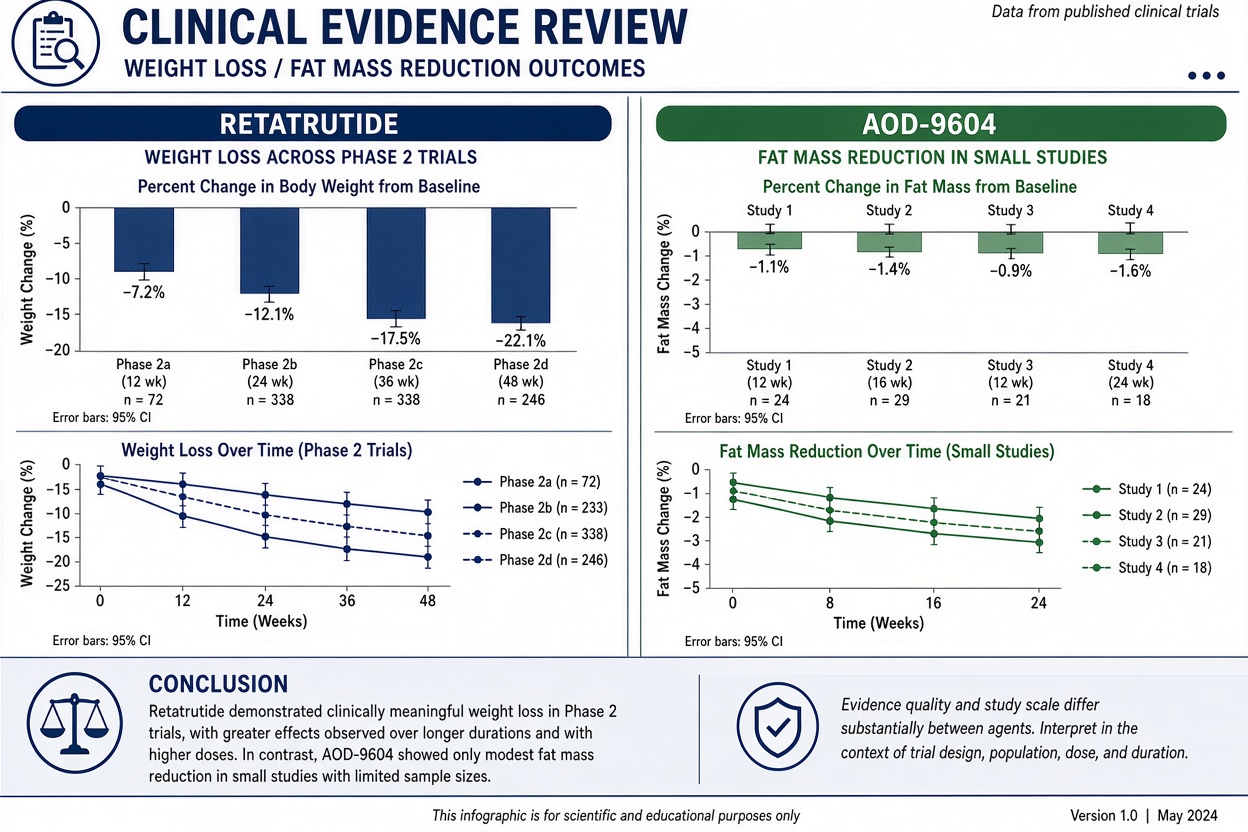
Retatrutide’s receptor binding profile spans three metabolically active targets. GLP-1 receptor agonism drives glucose-dependent insulin secretion and slowed gastric emptying in animal models; GIP receptor agonism adds insulinotropic and adipose-tissue signaling; glucagon receptor agonism increases hepatic glucose output while also raising energy expenditure in preclinical species. The pharmacology observed in trials reflects all three receptor systems acting together.
AOD-9604’s mechanism is narrower and less completely mapped. Rodent studies associate the fragment with stimulated lipolysis and inhibited lipogenesis in adipose tissue, with evidence implicating β3-adrenergic receptor pathways. Published toxicology reported no meaningful growth hormone receptor activation, no IGF-1 elevation, and no impairment of glucose tolerance.
It is this fragment pharmacology that aod peptide with retatrutide designs aim to add to incretin-based models. One compound engages three defined receptors with quantified binding affinities, while the other engages a lipid-mobilization pathway whose molecular target remains debated.
| Attribute | Retatrutide | AOD-9604 |
|—|—|—|
| Molecular class | 39-aa conjugated peptide | 16-aa fragment analog (hGH 177-191 + Tyr) |
| Receptor targets | GIPR, GLP-1R, GCGR (triple agonist) | Proposed β3-adrenergic-linked lipolysis; no meaningful GHR activation reported |
| Approximate size | ~4.7 kDa conjugated peptide | ~1.8 kDa |
| Development stage | Phase 2 complete; Phase 3 ongoing | Phase 2b failed; program discontinued |
| Endpoints studied | Body weight, glycemic markers, cardiometabolic measures | Body weight, fat mass, lipolysis markers, IGF-1 safety |
| Regulatory status | Investigational; not approved | Not approved; research chemical |
| Supplied form | Lyophilized powder, stored at −20 °C | Lyophilized powder, stored at −20 °C |
Because the receptor targets do not overlap, aod peptide with retatrutide is discussed as a test of pathway additivity rather than receptor-level synergy. For structural and classification comparisons, review Are Peptide and Protein Hormones the Same? 7 Essential Facts.
💡 Key Takeaway: How do retatrutide and AOD-9604 mechanisms differ?
What does the clinical evidence show for each compound?
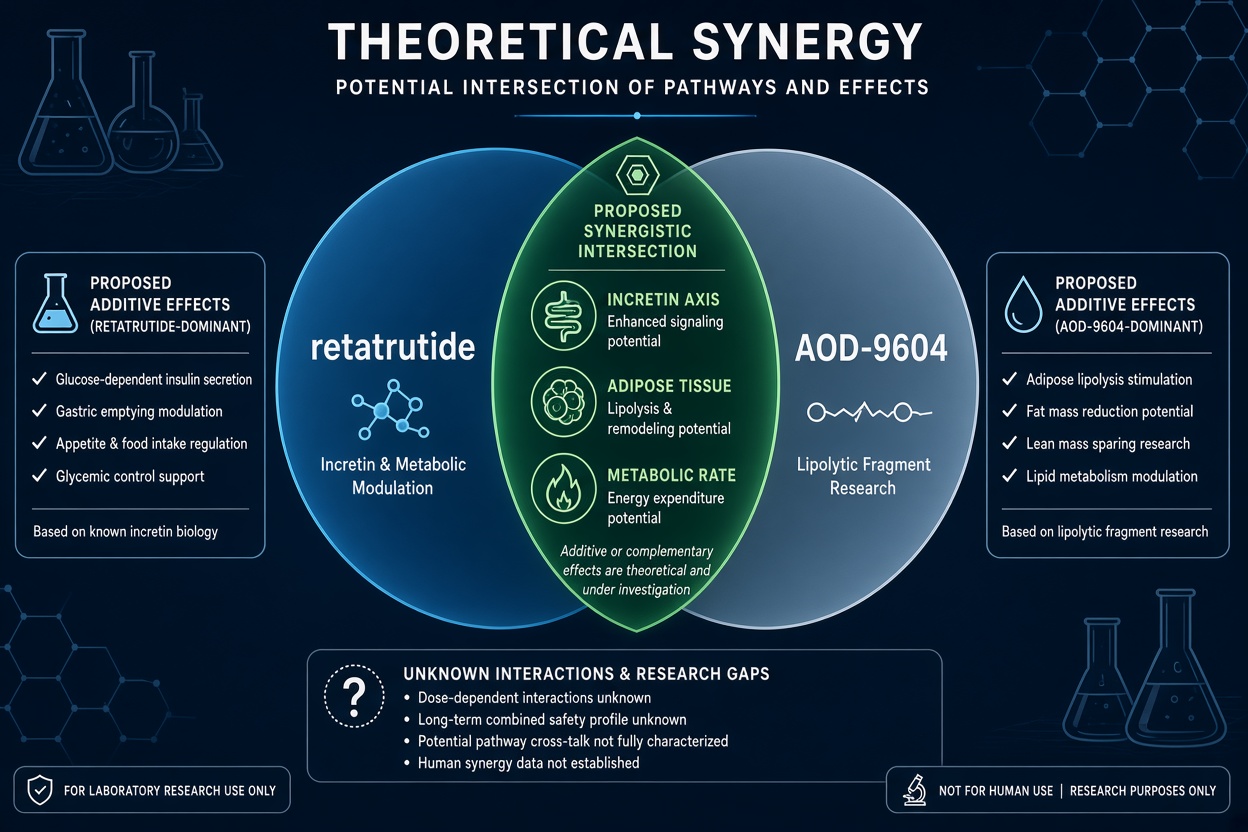
Retatrutide carries the stronger human dataset. The pivotal Phase 2 obesity trial, published in the New England Journal of Medicine in 2023, randomized 338 participants to once-weekly retatrutide or placebo across 48 weeks. Reported outcomes included dose-dependent reductions in body-weight endpoints, with the highest cohorts exceeding 24 percent mean reduction; gastrointestinal adverse events were most common, and a dose-dependent heart-rate increase peaked around week 24 before declining.
The full report is indexed as Jastreboff et al., 2023, on PubMed. A Phase 3 program (TRIUMPH) is currently enrolling across obesity and cardiometabolic indications, with registered designs listed on ClinicalTrials.gov. None of these programs involves aod peptide with retatrutide; all are single-agent designs.
AOD-9604’s human record is older and mixed. Metabolic Pharmaceuticals ran multiple randomized trials through the 2000s. A 12-week study reported statistically significant but modest body-weight differences versus placebo, while the larger Phase 2b program failed its primary endpoint, and commercial development was discontinued. The PubMed-indexed AOD9604 literature is small but consistent on one point: tolerability.
Across those trials, investigators reported no IGF-1 elevation, no glucose intolerance, and no clinically significant immunogenicity — a safety profile that kept the fragment available to laboratories long after efficacy development stopped.
This asymmetry defines the evidence base for aod peptide with retatrutide: one molecule carries current, large-scale trial momentum; the other carries an older dataset whose strongest signal is tolerability rather than efficacy. Trial findings describe investigational pharmaceuticals, not the research chemicals discussed here, and no finding constitutes use guidance.
To verify whether new combination data have emerged, use the step-by-step framework in Are There Studies on It? 7 Essential Ways to Check (2026).
Why combine aod peptide with retatrutide? The theoretical rationale
The theoretical rationale for aod peptide with retatrutide rests on pathway additivity, not receptor overlap. Retatrutide modulates incretin and glucagon signaling to alter energy intake and expenditure. AOD-9604 is proposed to act directly on adipose tissue lipolysis and lipogenesis without engaging growth hormone receptors.
In a preclinical combination arm, researchers might test whether the lipid-mobilizing action of AOD-9604 adds measurable fat-mass reduction to the body-weight effects already observed with retatrutide alone. Because the two molecules do not compete for binding sites, aod peptide with retatrutide avoids the receptor-level antagonism that complicates some peptide pairings.
However, every element of this rationale remains hypothesis-level. No published in vitro or animal-model dataset has measured combined effects, dose-response relationships, or adverse-event profiles for aod peptide with retatrutide. The absence of data is itself a primary finding for any laboratory reviewing the concept.
| Proposed pathway | Retatrutide contribution | AOD-9604 contribution | Overlap? |
|—|—|—|—|
| Energy intake | GLP-1/GIP-mediated satiety and slowed gastric emptying | None established | No |
| Energy expenditure | Glucagon receptor agonism increases expenditure | Proposed β3-adrenergic lipolysis | No |
| Adipose tissue | GIP-related adipose signaling | Stimulated lipolysis, inhibited lipogenesis | Possible downstream convergence |
| Glucose handling | Glucose-dependent insulin secretion, hepatic glucose output | No impairment of glucose tolerance reported | No |
For laboratories evaluating aod peptide with retatrutide, the first experimental question is not whether the combination works, but whether the two materials can be reliably identified and quantified in the same assay matrix.
What are the risks and safety unknowns of the combination?
The safety unknowns of aod peptide with retatrutide are total. No toxicology study, no pharmacokinetic interaction study, and no chronic-dosing animal model has administered the two compounds together. Any safety claim about the combination is extrapolation from single-agent datasets.
Retatrutide’s known adverse-event profile from the Phase 2 trial includes gastrointestinal effects and a transient, dose-dependent heart-rate increase. AOD-9604’s human trial record reported tolerability without IGF-1 elevation or glucose intolerance, but those data come from a discontinued development program with failed efficacy endpoints.
Combining aod peptide with retatrutide introduces at least three categories of unknown risk. First, pathway interaction risk: both compounds influence energy handling, and combined effects on glucose, heart rate, or adipose signaling have never been mapped. Second, material risk: research chemicals are not manufactured to pharmaceutical standards, and identity or purity failures can confound any result. Third, regulatory risk: neither compound is approved for any use outside research, and aod peptide with retatrutide is not an approved protocol.
Every laboratory considering aod peptide with retatrutide must document these unknowns in its institutional review and treat the pairing as an unvalidated experimental condition, not a validated tool.
💡 Key Takeaway: What are the risks and safety unknowns of the combination?
What do published studies suggest about timing and monitoring?
Published studies contain no timing or monitoring data for aod peptide with retatrutide. No study has co-administered the compounds, so there is no evidence-based schedule, no validated sampling window, and no accepted biomarker panel for the combination.
For single-agent retatrutide, the Phase 2 protocol used once-weekly administration and monitored body weight, glycemic markers, and heart rate over 48 weeks. For single-agent AOD-9604, historical trials used daily or multi-dose regimens in human obesity studies, with monitoring of IGF-1, glucose tolerance, and immunogenicity.
Any preclinical timing design for aod peptide with retatrutide must therefore be built from first principles. Researchers typically map receptor half-lives, peptide stability in the chosen vehicle, and the assay window for lipolysis markers before selecting a schedule. Without published combination data, every timing decision is a laboratory-specific variable.
Monitoring should include, at minimum, batch identity confirmation, endotoxin testing, and stability checks under storage conditions. These steps reduce the risk that a negative or positive result reflects material failure rather than biology.
How should laboratories source aod peptide with retatrutide?
Sourcing aod peptide with retatrutide requires the same verification discipline as sourcing any unapproved research peptide. The two compounds should be purchased separately, never as a pre-mixed “stack,” because pre-mixed materials cannot be independently verified for identity, purity, or stability.
For retatrutide, laboratories should require a batch-specific certificate of analysis showing peptide content by HPLC, mass identity by mass spectrometry, and purity of at least 95 percent. For AOD-9604, the same standard applies, with additional attention to the 1.8 kDa molecular weight and the hGH 177-191 plus N-terminal tyrosine sequence.
Storage conditions matter. Both retatrutide and AOD-9604 are supplied as lyophilized powder and should be stored at −20 °C. Reconstituted peptide should be aliquoted and stored according to the supplier’s research-use-only guidance, with freeze-thaw cycles minimized.
A practical sourcing checklist for aod peptide with retatrutide includes:
- Request a batch-specific COA for each peptide before ordering.
- Confirm HPLC purity ≥95 percent for each material.
- Confirm mass spectrometry identity matches the expected sequence.
- Request endotoxin testing results, especially for cell-culture work.
- Verify the supplier’s research-use-only compliance statement.
- Store lyophilized vials at −20 °C and document lot numbers.
- Never accept pre-mixed combination vials; source each peptide separately.
For a complete sourcing and QC framework, see Exogenous Peptides: Complete Sourcing and QC Guide (2026).
Why source research peptides from Peptides Library?
Peptides Library supplies research-use-only peptides with the documentation that combination experiments demand. Every batch of aod peptide with retatrutide component material — retatrutide and AOD-9604 — is supported by a certificate of analysis covering identity, purity, and endotoxin where applicable.
The platform maintains a structured evidence library that helps laboratories verify what is known and unknown before starting work. For aod peptide with retatrutide, that means access to the same published record reviewed here, alongside sourcing standards that flag unvalidated combinations rather than marketing them as protocols.
All materials are sold strictly for in vitro laboratory research purposes only. They are not for human use, not for veterinary use, and not intended to diagnose, treat, cure, or prevent any disease. Must be 21+ to purchase. The research-use-only framing applies to every aod peptide with retatrutide inquiry, with no exceptions.
For a broader orientation to peptide library research tools, see Exploring Peptides: The Complete Evidence Review (2026).
💡 Key Takeaway: Why source research peptides from Peptides Library?
FAQ
Is aod peptide with retatrutide an approved treatment?
No. Neither retatrutide nor AOD-9604 is approved for human use anywhere. Retatrutide is investigational, and AOD-9604’s pharmaceutical development was discontinued. The combination aod peptide with retatrutide has never been studied in humans and is strictly a research-use-only concept.
Has any study administered aod peptide with retatrutide together?
No peer-reviewed study has co-administered aod peptide with retatrutide. All rationale for the pairing is hypothesis-level, based on non-overlapping receptor pharmacology and pathway additivity. No published dataset exists for the combination.
What purity and documentation should laboratories require for aod peptide with retatrutide components?
Laboratories should require a batch-specific certificate of analysis for each compound. For both retatrutide and AOD-9604, the COA should show HPLC purity of at least 95 percent, mass spectrometry identity matching the expected sequence, and endotoxin results where relevant. Pre-mixed combination vials should be rejected.
How should aod peptide with retatrutide components be stored?
Both retatrutide and AOD-9604 are supplied as lyophilized powder and should be stored at −20 °C. After reconstitution, aliquots should be stored according to the supplier’s research-use-only guidance, with freeze-thaw cycles minimized.
Why is aod peptide with retatrutide described as unvalidated?
The combination has no clinical, toxicological, or pharmacokinetic interaction data. The single-agent evidence bases differ sharply: retatrutide has a completed Phase 2 trial and ongoing Phase 3 program, while AOD-9604 has discontinued development after failed efficacy endpoints. Combining them remains an experimental question, not an established protocol.
Topics covered in this article:
Ready to Take the Next Step?
Every product includes lot-specific documentation and third-party purity testing.
Explore Our Research Products →Free shipping on qualifying orders · Batch COA on request