


AOD 9604 vs Frag 176-191: The Essential Guide (2026)
aod 9604 vs Frag 176-191 compared for lab research: sequences, mechanisms, human trial evidence, safety, and COA purity verification. Research use only.
📋 Table of Contents
For researchers comparing aod 9604 and Fragment 176-191, the core answer is a single N-terminal residue difference and a vastly different evidence base: aod 9604 is a tyrosine-extended analogue of the hGH 177-191 core, while Fragment 176-191 is the native 16-residue C-terminal hGH segment beginning with phenylalanine. Only aod 9604 has published human clinical trial data; Fragment 176-191 is supported by preclinical work. Both remain research use only materials.
Key takeaways
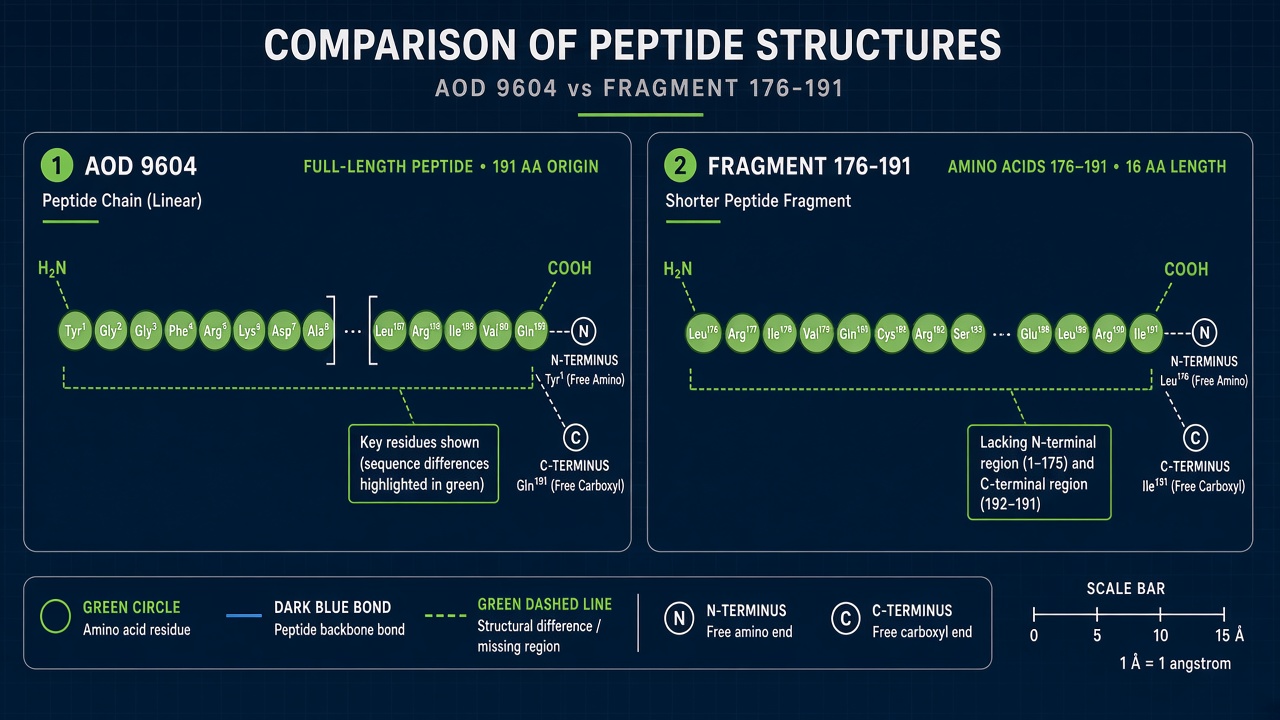
- The aod 9604 versus Fragment 176-191 structural difference is one sequence offset plus one N-terminal residue: aod 9604 carries an N-terminal tyrosine; Fragment 176-191 begins with phenylalanine.
- aod 9604 reached Phase IIb human clinical trials as an investigational compound; Fragment 176-191 has preclinical data only.
- Both peptides are studied for lipolysis in cell and animal models, with published evidence pointing to beta-3 adrenergic receptor involvement.
- Neither peptide is FDA-approved; both are research use only materials, and WADA prohibits growth hormone fragments in sport.
- For any aod 9604 procurement decision, a batch-specific certificate of analysis with mass spectrometry confirmation is the decisive quality factor.
What is aod 9604?
aod 9604 is a synthetic peptide corresponding to residues 177-191 of human growth hormone with an additional tyrosine residue at the N-terminus, written in the literature as Tyr-hGH177-191. It is a hexadecapeptide of approximately 1,815 Da. The molecule was developed by Metabolic Pharmaceuticals, an Australian company associated with Monash University research, as an investigational anti-obesity compound. The AOD designation derives from Advanced Obesity Drug, reflecting that original program.
The development program progressed through early-phase human studies and into a Phase IIb trial using oral capsules. The program was discontinued after the pivotal trial did not meet its primary endpoint, and the peptide subsequently transitioned into the research-chemical market, where it is supplied to laboratories as a lyophilized reagent.
Within the aod 9604 comparison, this molecule has human pharmacology and toxicology documentation, which matters for laboratories designing translational in vitro assays. The full evidence base for aod 9604 is covered in AOD9604 Research: Complete Evidence Base and Gaps (2026).
aod 9604 attributes for laboratory reference:
- Full sequence: Tyr-Leu-Arg-Ile-Val-Gln-Cys-Arg-Ser-Val-Glu-Gly-Ser-Cys-Gly-Phe
- Single-letter sequence: YLRIVQCRSVEGSCGF
- Approximate molecular weight: 1,815 Da
- Number of amino acids: 16
- Cysteine residues: 2 (Cys7 and Cys14 in the sequence above)
- N-terminal modification: additional tyrosine beyond the native hGH 177-191 core
What is Fragment 176-191?
Fragment 176-191 (often written hGH fragment 176-191) is the native 16-amino-acid C-terminal segment of human growth hormone, spanning residues 176 through 191, with an approximate molecular weight of 1,799 Da. Research interest in this region dates to the late 1970s, when investigators reported that this C-terminal domain retained lipid-mobilizing activity in animal models without the growth-promoting actions of full-length hGH.
Unlike aod 9604, Fragment 176-191 never entered a formal clinical development program. Its published evidence base consists of rodent studies and cell-culture assays examining lipolysis and lipid metabolism. It is distributed to laboratories exclusively as a research use only material.
A naming caution: vendors occasionally market Fragment 176-191 loosely as aod 9604 and vice versa. The molecules are distinct, and the certificate of analysis mass data is the only reliable discriminator. Fragment 176-191 anchors the native-sequence side of the aod 9604 comparison: it is the reference molecule for laboratories that want the unmodified hGH domain rather than a tyrosine-extended analogue.
Fragment 176-191 attributes for laboratory reference:
- Full sequence: Phe-Leu-Arg-Ile-Val-Gln-Cys-Arg-Ser-Val-Glu-Gly-Ser-Cys-Gly-Phe
- Single-letter sequence: FLRIVQCRSVEGSCGF
- Approximate molecular weight: 1,799 Da
- Number of amino acids: 16
- Cysteine residues: 2
- N-terminal residue: phenylalanine (native hGH residue 176)
💡 Key Takeaway: What is Fragment 176-191?
How do aod 9604 and Fragment 176-191 differ in structure?
The structural core of the aod 9604 comparison is a one-position offset plus one residue substitution. Fragment 176-191 spans hGH residues 176-191 and begins with phenylalanine (Phe176). aod 9604 spans residues 177-191 and adds an N-terminal tyrosine. Functionally, both molecules present the same 15-residue hGH 177-191 core behind a single aromatic N-terminal residue — tyrosine in one, phenylalanine in the other.
| Attribute | aod 9604 | Fragment 176-191 |
|—|—|—|
| Parent region | hGH 177-191 plus N-terminal tyrosine | hGH 176-191 |
| Length | 16 amino acids | 16 amino acids |
| N-terminal residue | Tyrosine | Phenylalanine |
| Approximate mass | ~1,815 Da | ~1,799 Da |
| Cysteine residues | Two; disulfide-capable | Two; disulfide-capable |
In single-letter notation, the shared hGH 177-191 core is LRIVQCRSVEGSCGF. Fragment 176-191 prepends phenylalanine (F), giving FLRIVQCRSVEGSCGF; aod 9604 prepends tyrosine (Y) to the same 177-191 core, giving YLRIVQCRSVEGSCGF. Sequence verification by MS/MS should therefore resolve the N-terminal residue unambiguously.
Both peptides contain two cysteine residues derived from the hGH C-terminus, so each can exist in a reduced (linear) or oxidized (intramolecular disulfide) state. That redox state shifts observed mass on mass spectrometry and should be documented on the certificate of analysis. The 16 Da mass difference between the two peptides — the oxygen atom distinguishing tyrosine from phenylalanine — is readily resolved by standard ESI-MS, which makes identity confirmation between them straightforward for any equipped laboratory.
For analytical chemists, the expected monoisotopic masses are approximately 1,814.9 Da for aod 9604 and 1,798.9 Da for Fragment 176-191. These values assume the reduced, linear form; an intramolecular disulfide bond would lower each mass by 2 Da. A COA that reports only average mass may not resolve the pair clearly, so request exact monoisotopic or deconvoluted mass data.
Why the 16 Da difference matters in analytical identity
The 16 Da difference between tyrosine and phenylalanine is small but analytically decisive. A low-resolution mass spectrometer may not distinguish the two peptides, but a high-resolution ESI-MS or MALDI-TOF instrument can. Laboratories purchasing aod 9604 should therefore request a COA with the deconvoluted monoisotopic mass, not merely an average mass. The presence of the correct N-terminal tyrosine in aod 9604 is confirmed by an MS/MS fragment ion series that includes the Y residue; Fragment 176-191 will instead show an F residue at the same position.
What mechanisms do researchers study for aod 9604 and Fragment 176-191?
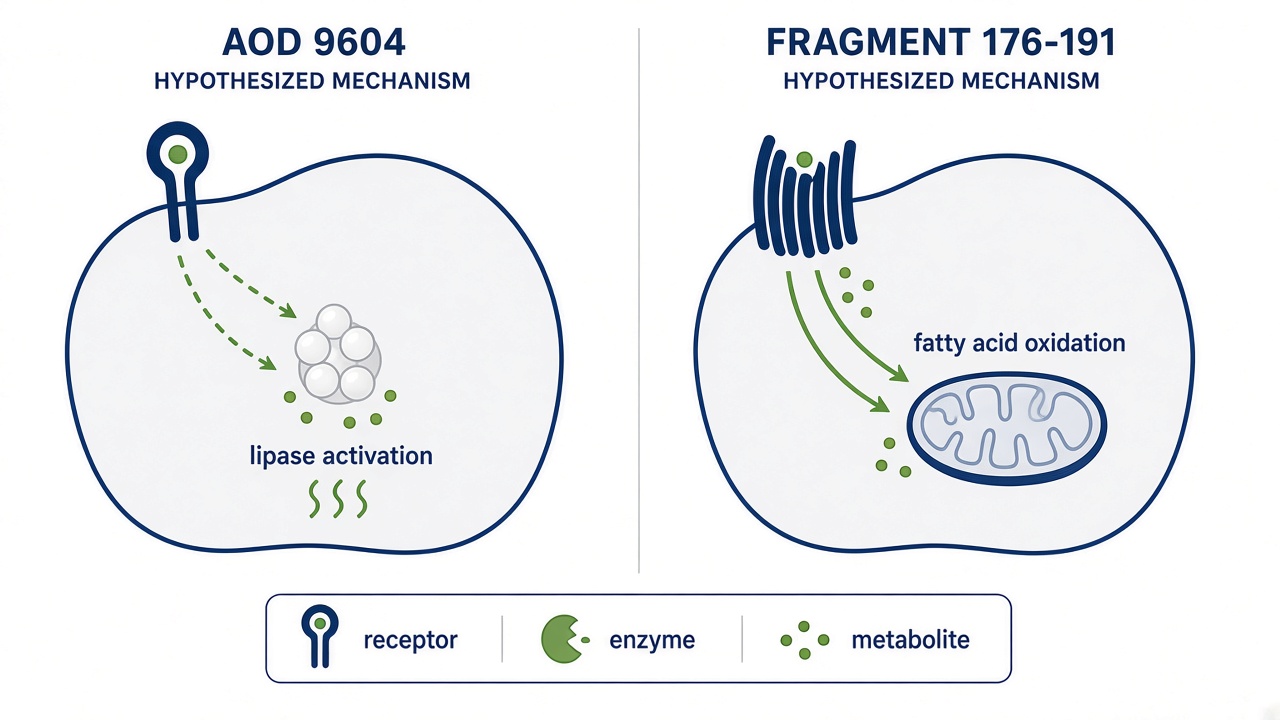
Both aod 9604 and Fragment 176-191 are investigated for lipolytic activity in adipocyte models and animal studies. The published literature points to beta-3 adrenergic receptor involvement as a key pathway, particularly for the native fragment. Researchers comparing the two peptides often ask whether the N-terminal tyrosine modification in aod 9604 alters receptor binding or downstream signaling.
In vitro, both peptides have been tested in isolated adipocytes for glycerol release, a proxy for triglyceride breakdown. Animal models include rodent obesity studies. However, the mechanistic data for aod 9604 are embedded within its clinical development program, which included oral administration studies in humans; Fragment 176-191 mechanistic work is limited to preclinical cell and animal assays. This evidence gap is central to the aod 9604 versus Fragment 176-191 decision for translational research.
The native hGH C-terminal region has long been associated with lipid mobilization without the growth-promoting actions of full-length hGH. The beta-3 adrenergic receptor is expressed primarily in adipose tissue and mediates lipolysis through cAMP-dependent pathways. Both peptides are hypothesized to interact with this receptor system, but the exact binding kinetics and downstream effectors remain under investigation. For laboratories planning receptor-binding assays, the choice of peptide may depend on whether the N-terminal aromatic residue influences affinity or selectivity.
What does the published evidence show for aod 9604 versus Fragment 176-191?
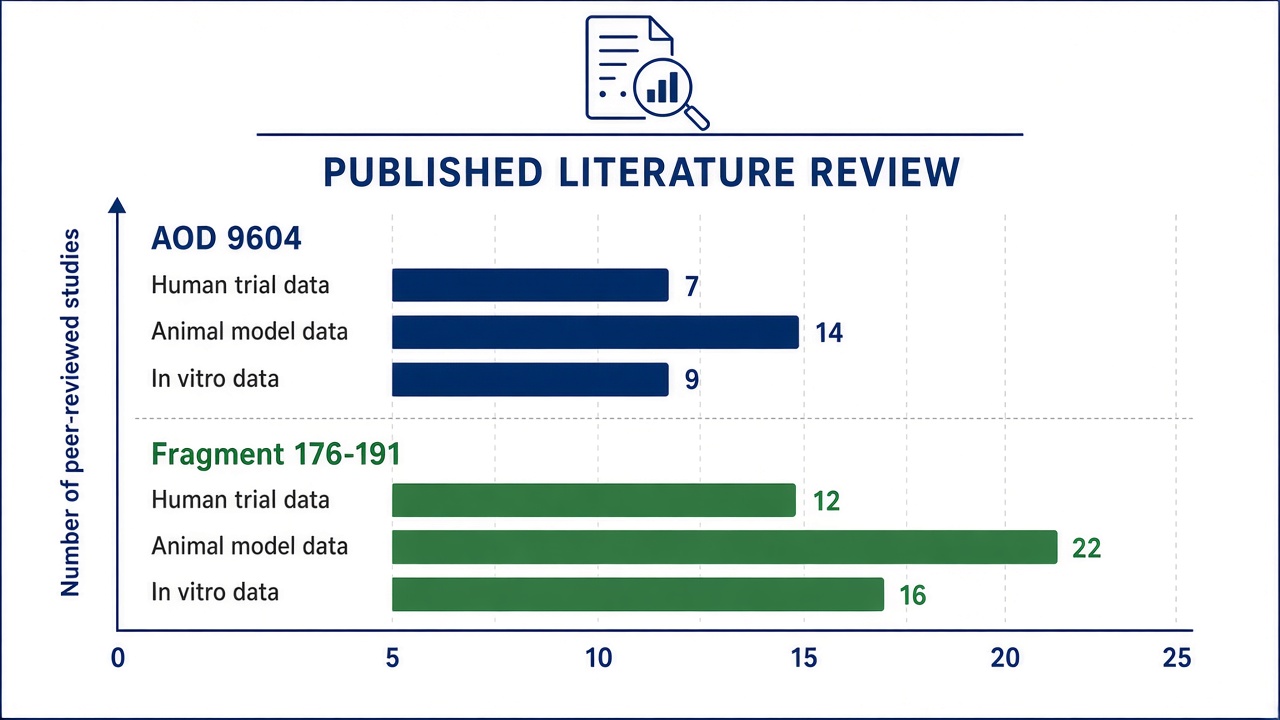
The published evidence diverges sharply. aod 9604 advanced through early-phase human studies and into a Phase IIb trial using oral capsules; the trial did not meet its primary endpoint, and development was discontinued. Despite discontinuation, the compound retains human safety, tolerability, and pharmacokinetic data from those trials, which are accessible via public registries and peer-reviewed publications. Fragment 176-191, by contrast, has no published human trial data. Its evidence base is limited to rodent and cell-culture studies from the late 1970s onward.
For researchers evaluating the aod 9604 evidence base, the key distinction is not whether either peptide works but what level of evidence exists for a given model. Human clinical data exist only for aod 9604; preclinical data exist for both. A systematic review of the aod 9604 literature is available in the internal link above.
Published studies can be located through public databases. A PubMed search for AOD9604 returns clinical trial reports and preclinical papers. The WADA Prohibited List confirms that growth hormone fragments, including these peptides, are banned in sport. These external sources provide independent verification of regulatory and scientific status without relying on vendor claims.
💡 Key Takeaway: What does the published evidence show for aod 9604 versus Fragment 176-191?
Why do safety and regulatory status differ between aod 9604 and Fragment 176-191?
Safety and regulatory status differ because aod 9604 entered formal human clinical development, while Fragment 176-191 did not. aod 9604 was studied in Phase I and Phase II trials, generating human safety data that remain part of the public record. Fragment 176-191 has no such human safety dossier; its safety profile is inferred from animal studies only. Neither peptide is approved by the FDA or any other regulatory agency for therapeutic use. Both are sold exclusively as research chemicals for in vitro laboratory use, and purchase requires age 21+.
The World Anti-Doping Agency (WADA) prohibits growth hormone fragments, including both aod 9604 and Fragment 176-191, in sport. This prohibition applies regardless of whether the peptide is obtained as a research chemical. Laboratories handling aod 9604 or Fragment 176-191 must maintain strict chain-of-custody documentation and ensure that no material leaves the laboratory for any non-research purpose.
The clinical development history of the tyrosine-extended analogue is particularly instructive for risk assessment. Because it progressed to Phase IIb, there are published human safety data covering adverse events, tolerability, and pharmacokinetics after oral administration. However, those data apply to a specific formulation and dose range from a discontinued program. They do not translate to research-grade lyophilized powder used in cell or animal models. Researchers must therefore treat the clinical dossier as background context, not as evidence that the research chemical is safe for any purpose outside the laboratory.
How should laboratories verify aod 9604 and Fragment 176-191 with a COA?
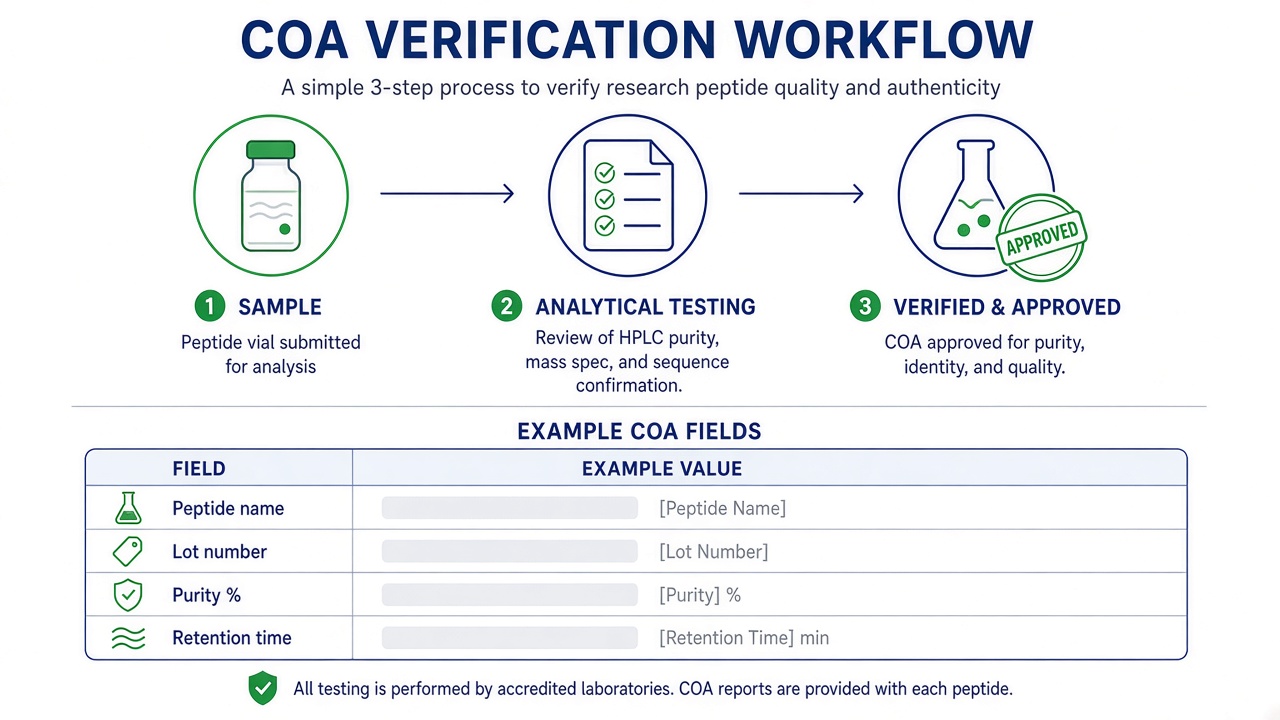
For any research purchase, the certificate of analysis is the primary identity and purity document. A complete COA for these two peptides should include three elements: HPLC purity, exact mass by mass spectrometry, and sequence confirmation by MS/MS where available. Because the two peptides differ by only 16 Da in monoisotopic mass, a COA that reports only average mass or only HPLC retention time is insufficient to distinguish them. Laboratories should request a deconvoluted ESI-MS spectrum showing the expected monoisotopic peak: approximately 1,814.9 Da for the tyrosine-extended analogue and 1,798.9 Da for the native phenylalanine fragment.
HPLC purity thresholds vary by protocol, but many research groups require at least 95% purity by area under the curve at 214 nm or 220 nm. Some laboratories set a stricter 98% threshold for sensitive assays. The COA should state the column type, mobile phase, and detection wavelength so the purity result can be reproduced. Without these details, a purity percentage alone has limited value.
Storage conditions should also be documented. Lyophilized peptides are typically stored at -20°C or below, protected from light and moisture. After reconstitution, aliquots should be kept at -80°C if not used immediately. Repeated freeze-thaw cycles can degrade peptide integrity, so laboratories should aliquot upon first reconstitution and use each aliquot only once. For sourcing and QC best practices, see Exogenous Peptides: Complete Sourcing and QC Guide (2026).
A COA verification checklist for these two peptides:
- Confirm the reported monoisotopic mass matches 1,814.9 Da (tyrosine-extended) or 1,798.9 Da (native fragment), assuming reduced form.
- Check for disulfide state notation; an oxidized peptide will be 2 Da lower.
- Request MS/MS fragmentation data showing the N-terminal residue (Y for the analogue, F for the fragment).
- Verify HPLC purity is reported at a specific wavelength with column and gradient details.
- Confirm the batch number on the COA matches the vial label.
- Ask about residual solvent content and endotoxin levels if the peptide will be used in cell culture.
Which peptide should a laboratory choose for lipolysis research?
The choice between the tyrosine-extended analogue and the native fragment depends on the research question. For laboratories that require a molecule with human clinical documentation, even if the development program was discontinued, the tyrosine-extended analogue is the only option. For laboratories that need the exact native hGH C-terminal sequence without modification, the phenylalanine-starting fragment is the appropriate reference.
A practical decision framework follows:
| Research requirement | Choose tyrosine-extended analogue | Choose native phenylalanine fragment |
|—|—|—|
| Human clinical trial data required | Yes | No |
| Native hGH 176-191 sequence fidelity | No (adds N-terminal tyrosine) | Yes |
| Preclinical lipolysis model only | Acceptable | Acceptable |
| Analytical mass difference | 1,814.9 Da monoisotopic | 1,798.9 Da monoisotopic |
Neither peptide should be selected based on vendor marketing claims alone. Instead, laboratories should evaluate the published evidence for the specific model, verify the batch COA, and confirm the sequence by mass spectrometry before any experiment. For guidance on checking whether studies exist for a given peptide, see Are There Studies on It? 7 Essential Ways to Check (2026).
When planning a lipolysis assay, consider the following experimental variables:
- Cell type: primary adipocytes versus 3T3-L1 differentiated adipocytes may respond differently.
- Receptor expression: confirm beta-3 adrenergic receptor presence in the chosen model.
- Peptide form: reduced versus oxidized disulfide state can affect solubility and activity.
- Concentration range: published preclinical studies often use micromolar concentrations, but exact ranges vary by model.
- Endpoint measurement: glycerol release, free fatty acid quantification, or cAMP accumulation.
By addressing these variables alongside the structural and evidence differences, a laboratory can make a defensible choice between the two peptides without relying on unverified vendor assertions.
💡 Key Takeaway: Which peptide should a laboratory choose for lipolysis research?
FAQ
What is the key structural difference between the two peptides?
The tyrosine-extended analogue has an N-terminal tyrosine residue added to the hGH 177-191 core, while the native fragment begins with phenylalanine at hGH position 176. The mass difference is 16 Da.
Does the tyrosine-extended analogue have human clinical trial data?
Yes. It reached Phase IIb human trials as an oral capsule before the program was discontinued after missing its primary endpoint. The native fragment has no human trial data.
Are either of these peptides FDA-approved?
No. Neither peptide is approved by the FDA or any regulatory agency for therapeutic use. Both are research chemicals sold strictly for in vitro laboratory use.
What should a certificate of analysis include for these peptides?
A COA should include HPLC purity, exact monoisotopic mass by ESI-MS or MALDI-TOF, and MS/MS sequence confirmation. Average mass alone cannot reliably distinguish the two peptides.
How should these peptides be stored for laboratory use?
Lyophilized peptides are typically stored at -20°C or below, protected from light and moisture. After reconstitution, aliquots should be stored at -80°C and freeze-thaw cycles minimized.
Ready to Take the Next Step?
Every product includes lot-specific documentation and third-party purity testing.
Explore Our Research Products →Free shipping on qualifying orders · Batch COA on request