


All 3 in one: Complete Research on Triple Agonists 2026
Triple agonists in 2026: research-grade GIP/GLP-1/glucagon peptides, ≥98% purity, COA, storage, and lab ordering from Peptides Library. Complete guide.
📋 Table of Contents
Triple agonists are unimolecular research peptides engineered to activate the GIP receptor, GLP-1 receptor, and glucagon receptor within a single amino acid sequence, allowing laboratories to study three metabolic signaling pathways with one purified compound. The reference molecule for this class is retatrutide (LY3437943), a 39-amino-acid peptide with a C20 fatty diacid conjugate that extends its half-life to roughly six days in published pharmacokinetic work. This article covers specifications, storage, and ordering research-grade triple agonists from Peptides Library.
Key takeaways
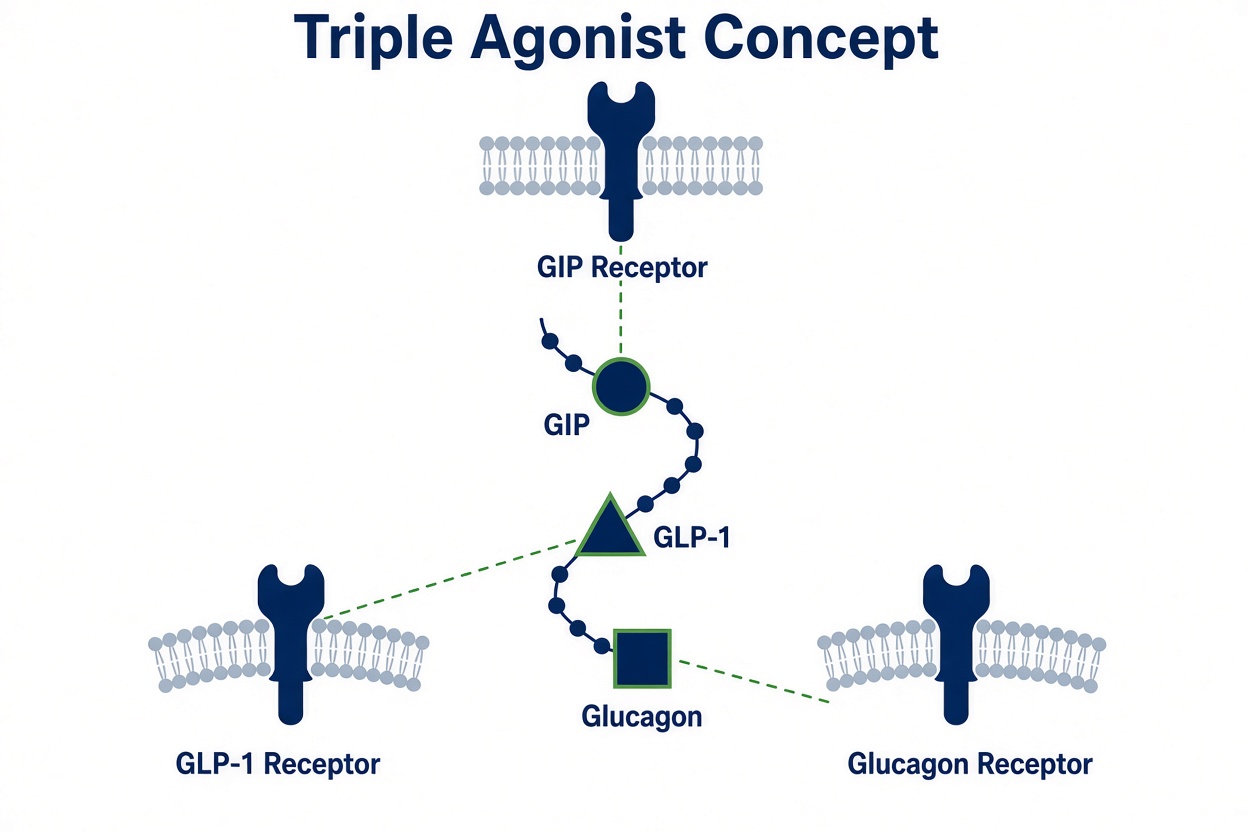
- The term “all 3 in one” refers to unimolecular triple agonists that bind GIPR, GLP-1R, and GCGR within one peptide chain.
- Retatrutide (LY3437943) is the most extensively studied compound in this class, with phase 2 data published and phase 3 programs ongoing as of 2026.
- Research-grade material should be documented at ≥98% HPLC purity, mass spectrometry identity, endotoxin screening, and batch-specific COA.
- Lyophilized peptide of this class remains stable at −20 °C when desiccated; reconstituted solutions require refrigerated short-term handling.
- Every vial from Peptides Library is restricted to in vitro and in vivo animal model investigation; no human or veterinary use.
⚠️ Research Use Only Notice: The products discussed on this site are sold strictly for in vitro laboratory research purposes only. They are not for human use, not for veterinary use, and not intended to diagnose, treat, cure, or prevent any disease. All information presented is for educational purposes in a research context. Must be 21+ to purchase.
What are triple agonists in peptide research?
In catalog and literature contexts, the term refers to a unimolecular triple agonist: one synthetic peptide whose sequence has been rationally engineered to activate three class B G protein-coupled receptors. Instead of administering three separate ligands, researchers can interrogate three signaling pathways with a single molecular entity, which simplifies assay design, pharmacokinetic modeling, and structure-activity analysis.
The concept emerged from incretin physiology. GLP-1 and GIP are gut-derived hormones that potentiate glucose-dependent insulin secretion through their respective receptors, while glucagon acts primarily on hepatocytes to mobilize stored energy. Medicinal chemists reasoned that one sequence carrying balanced activity at all three receptors could be built by merging pharmacophores from each native hormone. A landmark 2015 study demonstrated such a rationally designed monomeric peptide triagonist in rodent models, establishing the template for every candidate that followed.
The reference molecule for the class, retatrutide (LY3437943), illustrates the engineering involved. It is a 39-amino-acid peptide built on a GIP-derived backbone, substituted with GLP-1 and glucagon pharmacophore elements and conjugated to a C20 fatty diacid moiety that promotes albumin binding. That lipidation extends circulating half-life to roughly six days in published pharmacokinetic work, which is why the sequence is studied as a long-acting research tool rather than a native-hormone mimic.
Terminology varies across suppliers and databases. The same class appears as triagonist, triple receptor agonist, unimolecular triple agonist, or GIP/GLP-1/glucagon agonist. When a catalog lists this class as triple agonists peptides, it signals that one vial contains a single sequence with three defined receptor targets—not a blend of three separate peptides. That distinction matters to laboratories, because blends introduce molar-ratio variability that a single purified sequence avoids.

How do triple agonists work at the receptor level?
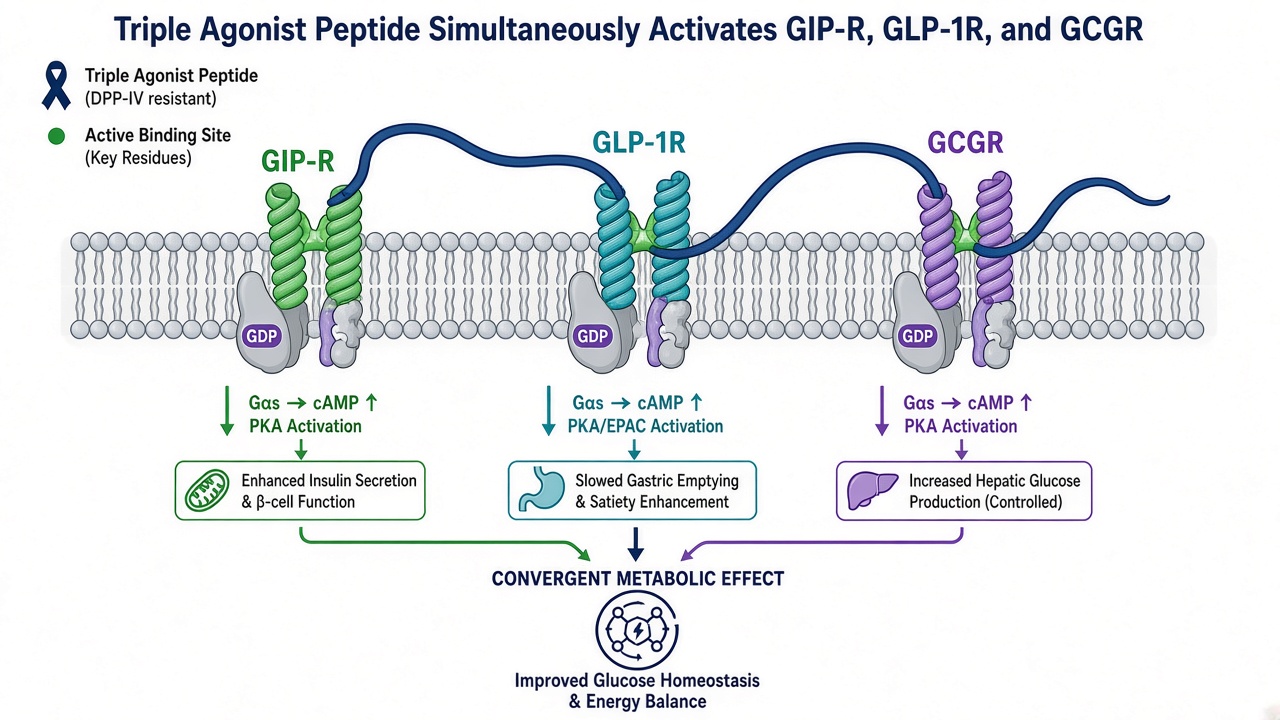
The triple agonists mechanism is best understood as three receptor interactions proceeding concurrently after administration in a model system. Each target is a class B1 GPCR that signals predominantly through Gs proteins, adenylyl cyclase activation, and cyclic AMP accumulation, although downstream physiology differs by receptor and tissue. Research assays therefore quantify each interaction separately before interpreting the integrated profile.
GIP receptor binding
The GIP receptor component derives from sequence elements homologous to native glucose-dependent insulinotropic polypeptide. In transfected cell systems, commonly HEK293 or CHO lines expressing the human receptor, the molecule produces concentration-dependent cAMP accumulation, and potency is reported as an EC50 value relative to native GIP. GIPR activity is of research interest for adipose-tissue signaling, lipid handling, and central pathways examined in animal models.
GLP-1 receptor binding
GLP-1 receptor engagement is the most extensively characterized arm of the triple agonists profile. Standard in vitro work includes radioligand displacement binding, cAMP reporter assays, and β-arrestin-2 recruitment measurements. In the animal-model literature, GLP-1R activation is associated with reduced food intake and slowed gastric emptying; in this context, researchers examine how this arm interacts with the other two receptor activities rather than acting in isolation.
Glucagon receptor binding
The glucagon receptor arm distinguishes triple agonists from dual agonists such as tirzepatide. GCGR is expressed at high density in hepatocytes, where Gs-mediated signaling drives glycogenolysis and influences amino acid metabolism and energy expenditure in preclinical models. Because unopposed glucagon activity elevates blood glucose, the engineered sequence balances GCGR potency against the incretin arms—a ratio that laboratories can verify in receptor-selective cell assays.
Integrated signaling profile
Because the three receptors co-express in several tissues, the integrated profile is not simply additive. Research groups therefore map each arm independently in single-receptor cell lines, then compare the intact triple agonists against equimolar combinations of selective agonists in tissue models. Divergence between those conditions identifies genuine cross-talk, which is one of the most active questions in current research.

💡 Key Takeaway: How do triple agonists work at the receptor level?
Why do laboratories choose triple agonists for research?
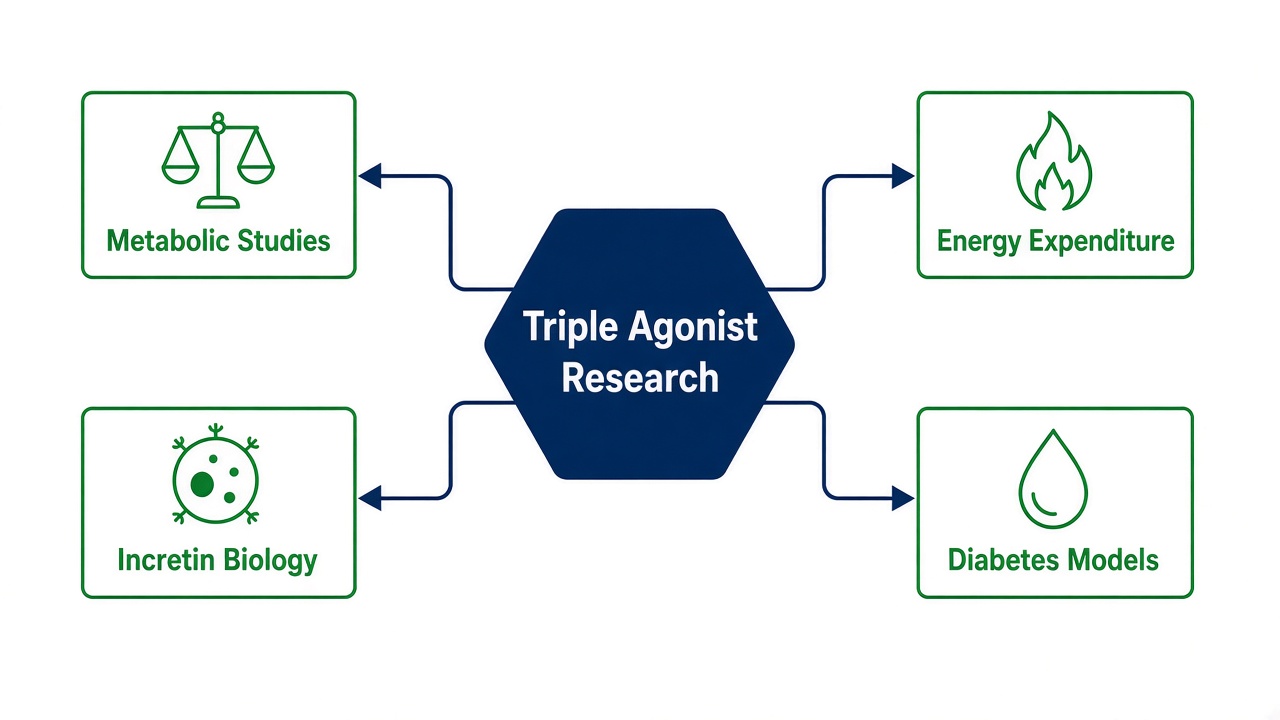
The practical argument for triple agonists material is experimental economy. One vial replaces three separate ligands in multi-pathway studies, which reduces reconstitution steps, pipetting error, and inventory complexity. Because the three receptor activities are fixed within one covalent structure, the activity ratio cannot drift between batches the way a manual three-compound mixture can—an important control consideration for reproducible concentration-response work in cell culture and animal models.
There is also a mechanistic argument. Metabolic signaling is redundant and networked, and single-receptor probes can miss cross-talk that appears only when incretin and glucagon pathways are co-activated. The published phase 2 program for retatrutide was designed specifically around the hypothesis that three-way receptor engagement produces physiology distinct from GLP-1R agonism alone. Laboratories studying that hypothesis in vitro or in animal models require the molecule itself, not a surrogate combination.
Reproducibility expectations in the literature reinforce the choice. Journals increasingly ask authors to report peptide source, lot number, and purity documentation in methods sections, and reviewers flag studies that omit them. Laboratories that standardize on documented reference material—such as this class with full COA documentation—can answer those queries immediately, whereas undocumented material often triggers revision requests or desk rejection. For a step-by-step method to verify published evidence, see Are There Studies on It? 7 Essential Ways to Check (2026).
What specifications define research-grade triple agonists?
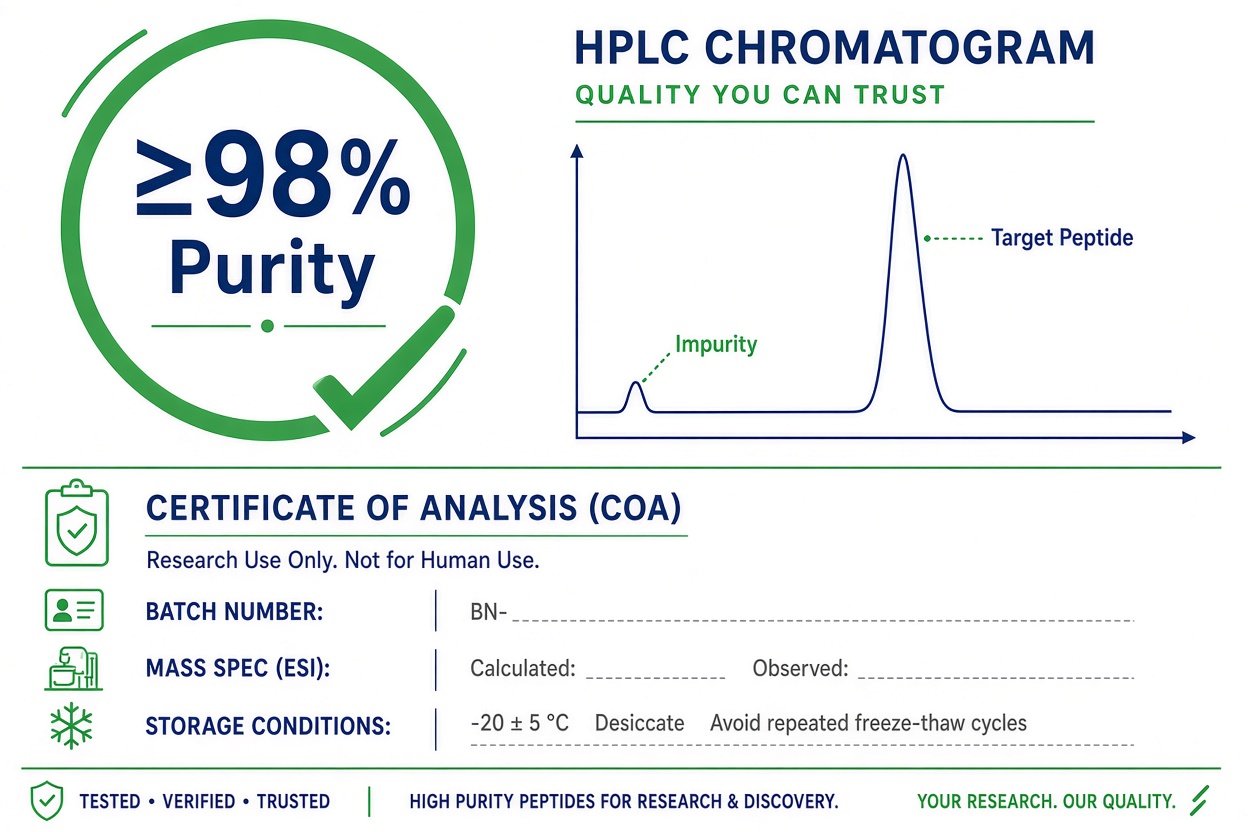
Research-grade triple agonists are defined by a set of orthogonal analytical documents rather than a supplier’s assertion. The minimum expectation is a batch-specific certificate of analysis (COA) showing HPLC purity at ≥98%, which ensures that the vial contains predominantly the intended sequence and not truncated or oxidized variants.
Mass spectrometry identity confirmation is equally important. The COA should report the observed monoisotopic mass and match it to the theoretical mass of the sequence, with a tolerance typically within 1 Da. For lipidated sequences, such as the C20 fatty diacid on retatrutide, the mass shift must reflect the conjugate, not the naked peptide.
Endotoxin screening is a third pillar. Because cell-based assays and in vivo models are sensitive to bacterial endotoxin, documented triple agonists should include a limulus amebocyte lysate (LAL) result below a defined threshold, commonly ≤1 EU/mg for research material. Residual solvent and counterion content may also be reported.
Peptides Library provides a COA for every batch of triple agonists, with HPLC, MS, and endotoxin data available before ordering. Laboratories that need additional characterization can request solubility testing or stability data under specific buffers. For more on sourcing and QC, see Exogenous Peptides: Complete Sourcing and QC Guide (2026).
How should laboratories store and handle triple agonists?
Lyophilized triple agonists are supplied as a sterile, dry powder in sealed vials. The recommended long-term storage condition is −20 °C in a desiccated environment protected from light; repeated freeze-thaw cycles should be avoided. Under these conditions, the powder remains stable for extended periods as documented by stability-indicating HPLC.
For short-term use, unopened vials may be held at 2–8 °C for a limited time, but the −20 °C condition is preferable for any storage beyond a few days. Moisture is the primary degradation risk: even brief exposure to humid air can initiate hydrolysis or aggregation in this material, so vials should be equilibrated to room temperature before opening.
Once reconstituted, triple agonists solutions are not stable for long periods. Use sterile, peptide-compatible solvents such as phosphate-buffered saline (pH 7.4) or dilute acetic acid as recommended in the COA. Keep reconstituted solutions at 2–8 °C and use within the short-term window stated in the documentation; do not refreeze after thawing.

💡 Key Takeaway: How should laboratories store and handle triple agonists?
What research applications use triple agonists?
The primary application of triple agonists is receptor pharmacology profiling across GIPR, GLP-1R, and GCGR in parallel. Researchers use cAMP accumulation assays, calcium mobilization, or β-arrestin recruitment in single-receptor cell lines to establish potency and efficacy for each arm, then compare the intact molecule in co-expression systems.
Metabolic research in animal models is the second major use. Published studies have examined food intake, body weight, glucose handling, and hepatic lipid content after administration of triple agonists to diet-induced obese rodents and non-human primates. These studies require careful dose selection, because simultaneous GCGR and incretin activation can produce opposing effects on glucose in fasted versus fed states.
Structure-activity relationship (SAR) work is a third application. By synthesizing analogs with point substitutions, laboratories can map which residues in triple agonists contribute to GIPR versus GLP-1R versus GCGR selectivity. This work informs next-generation candidates and is well supported by the 39-amino-acid retatrutide template described above. For a broader catalog of related research peptides, see Bibtides: The Complete Research Peptide Library Guide (2026).
What are the strengths and limitations of triple agonists?
Strengths of triple agonists include the built-in activity ratio, the ability to probe three pathways with one sequence, and the availability of a well-characterized reference compound in retatrutide. The fixed covalent structure removes molar-ratio variability, and the long half-life from C20 fatty diacid conjugation allows less frequent administration in chronic animal models.
Limitations are equally important to acknowledge. The integrated activity at three receptors makes it difficult to attribute an observed effect to any single arm without parallel single-receptor controls. Some triple agonists may show reduced potency at one receptor relative to native ligands, and the lipidation that improves half-life can alter solubility or receptor binding kinetics.
Researchers must also consider species differences. Rodent GIPR, GLP-1R, and GCGR sequences differ from human receptors in ways that can shift potency, so data from mouse models require careful translation. The research-use-only status of this material from Peptides Library means all findings are confined to laboratory or animal-model contexts.
What does the research literature say about triple agonists?
Peer-reviewed publications on this class have expanded since the 2015 proof-of-concept study. The most cited work is the phase 2 randomized trial of retatrutide, which reported dose-dependent changes in body weight and metabolic parameters in participants with obesity. As of 2026, phase 3 programs are ongoing, and preclinical papers continue to map receptor-specific contributions.
PubMed is the primary database for tracking this literature. Researchers can search PubMed for triple agonists to retrieve primary studies, reviews, and registered trial protocols. A second external resource is the National Center for Biotechnology Information, which aggregates sequence data and structural models relevant to triple agonists.
Literature quality varies. Some studies use poorly characterized material, making replication difficult. Researchers should verify that any cited triple agonists source reports COA, purity, and lot number, as discussed in the specifications section.
💡 Key Takeaway: What does the research literature say about triple agonists?
How to order triple agonists from Peptides Library?
Ordering research-grade triple agonists from Peptides Library follows a standard catalog workflow. Select the desired sequence and vial size, review the batch-specific COA before purchase, and confirm that your institution accepts research-use-only material. Peptides Library ships lyophilized vials with storage instructions and documentation, and all orders require age verification of 21 years or older. For related peptide and protein hormone background, see Are Peptide and Protein Hormones the Same? 7 Essential Facts.

FAQ
What is the difference between triple agonists and dual agonists?
Dual agonists activate two receptors, typically GIPR and GLP-1R, as in tirzepatide. Triple agonists add a third receptor target—the glucagon receptor—within the same unimolecular peptide sequence. This third arm distinguishes the class pharmacologically and is the focus of active research.
Are triple agonists the same as retatrutide?
Retatrutide (LY3437943) is the most extensively studied compound within the triple agonists class, but it is not the only sequence. Other research-grade candidates with similar three-receptor profiles exist, and laboratories may synthesize analogs for structure-activity work.
What purity should I require when purchasing triple agonists for research?
Research-grade triple agonists should have documented HPLC purity of ≥98%, mass spectrometry identity confirmation, and endotoxin screening. A batch-specific COA from the supplier is the minimum documentation expected for reproducible work.
How long can I store reconstituted triple agonists?
Reconstituted triple agonists solutions should be kept at 2–8 °C and used within the short-term window stated in the COA. Do not refreeze after thawing, and always use sterile, peptide-compatible solvents.
Can triple agonists be used in human studies?
No. All triple agonists sold by Peptides Library are restricted to in vitro and in vivo animal model investigation. They are not for human use, not for veterinary use, and not intended to diagnose, treat, cure, or prevent any disease.
Topics covered in this article:
Ready to Take the Next Step?
Every product includes lot-specific documentation and third-party purity testing.
Explore Our Research Products →Free shipping on qualifying orders · Batch COA on request