


Bibtides: The Complete Research Peptide Library Guide (2026)
Bibtides defined: what the term means, how laboratories source research-grade peptide libraries with COA documentation, and how to order in 2026.
📋 Table of Contents
Bibtides is an emerging term used by research laboratories to describe curated collections of synthetic peptides supplied in library format for in vitro research applications. Because the word has no standardized dictionary definition, this page explains what bibtides means, separates it from near-identical terms such as BibTeX and tide tables, and sets out how Peptides Library supplies research-grade peptide collections to qualified laboratories.
Key Takeaways
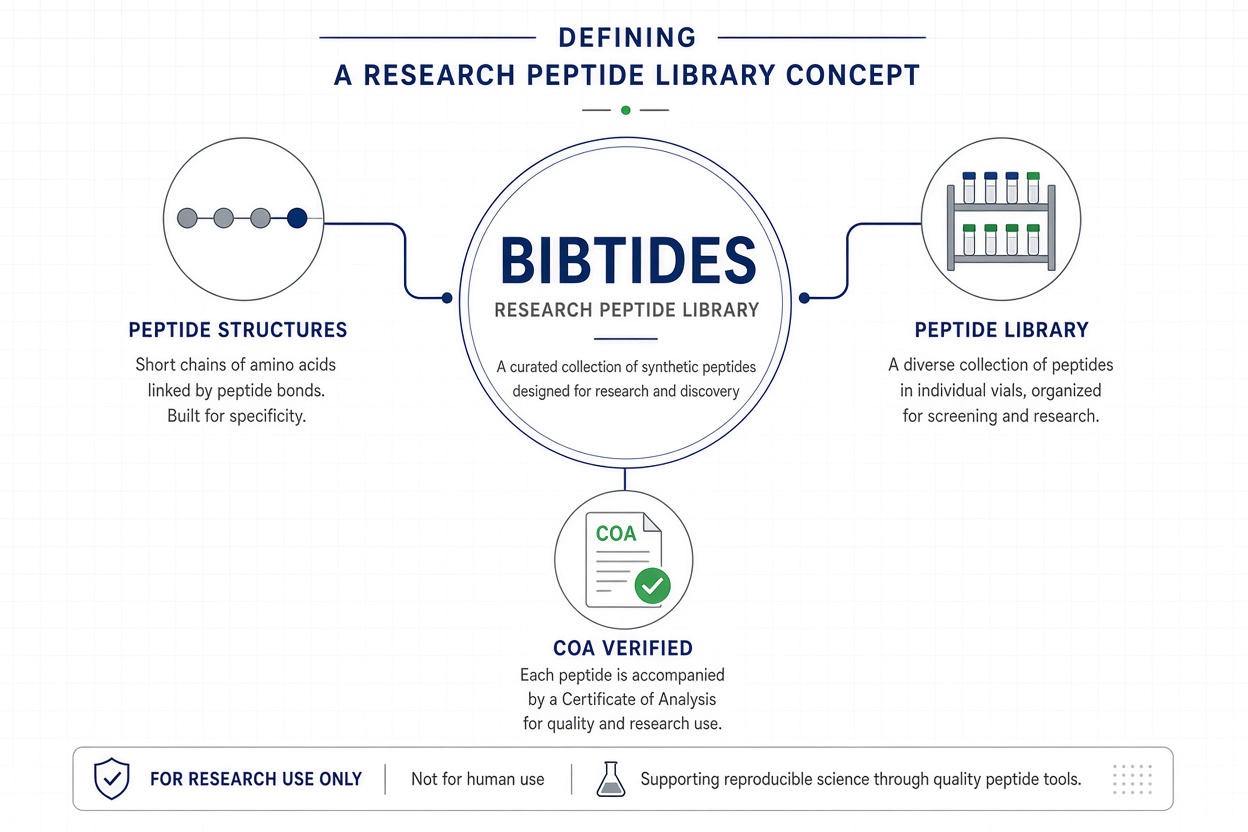
- Bibtides denotes library-format collections of synthetic research peptides supplied strictly for in vitro and laboratory research applications.
- The string is frequently confused with BibTeX reference files, tide tables, ebb tide schedules, and the BabyTides parenting app; none of these relate to peptide research.
- In computational linguistics, searches for the term often surface BiTimeBERT, a pre-trained language model for temporal information from an unrelated field.
- Laboratories evaluating a collection should confirm purity grade, certificate of analysis (COA) documentation, storage conditions, and research-use-only labeling before purchase.
- Peptides Library supplies catalog and custom peptide collections with batch-specific COAs to qualified research institutions.
What Does “Bibtides” Mean?
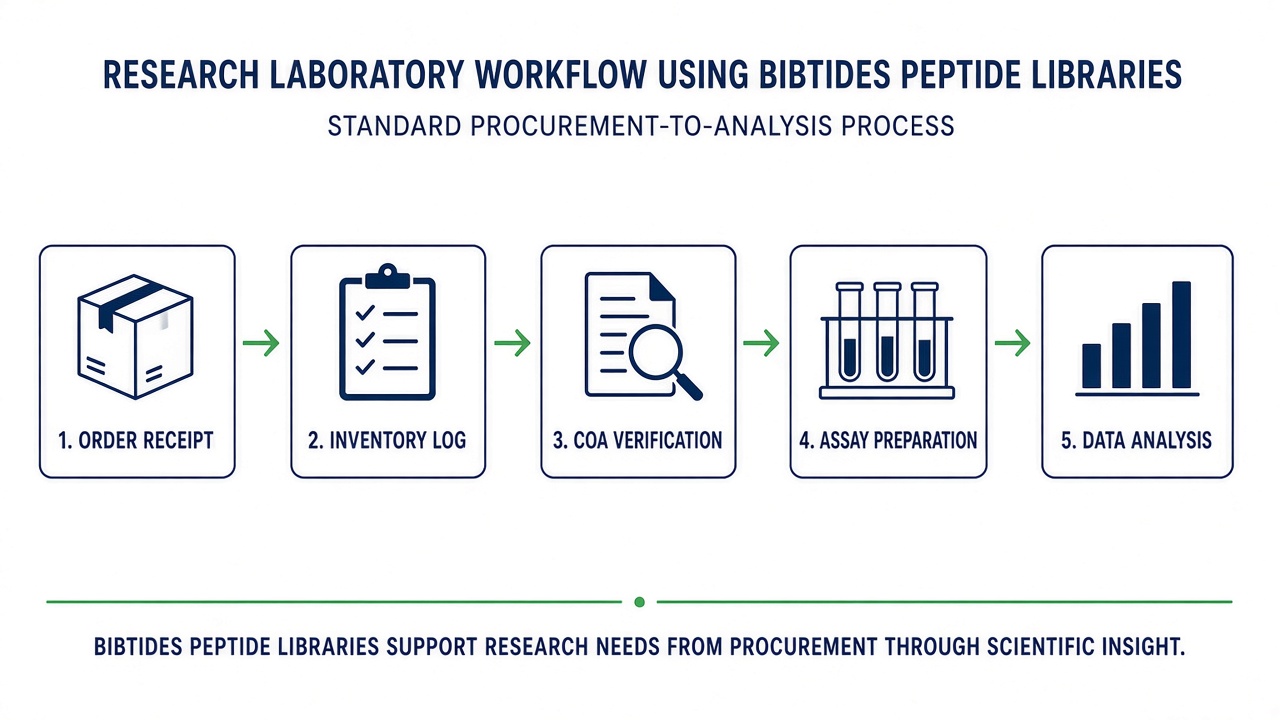
Bibtides is a coined term rather than a dictionary entry. In procurement and laboratory-supply contexts, it functions as shorthand for bundled peptide sets ordered as a collection rather than as individual sequences. A typical order of this kind might contain dozens of related sequences — an alanine scan series, a truncation set, or an overlapping peptide panel — packaged together for a single screening project.
The morphology supports this reading. The word appears to compress a prefix such as “bi-” or “library” into the root “peptides,” producing a short label that is easy to type into a supplier search bar. Different communities parse it differently: some read it as “bioactive peptides,” others as “bibliographic peptides,” and others treat it purely as a brand-style label with no literal expansion.
Because no standards organization has adopted the term, its meaning is fixed by usage rather than regulation. On this site, bibtides refers specifically to research-grade peptide library collections: sets of synthetic peptides manufactured to a stated purity, supplied with analytical documentation, and restricted to in vitro and laboratory research applications.
Where Did the Term Come From?
Search behavior offers the clearest explanation. Queries for bibtides show the classic signature of a consolidating navigational term: modest volume, wide variance in intent, and no authoritative result. Some searchers are laboratory staff looking for peptide collections; others mistyped “BibTeX” or “big tides.” Over time the string has settled into a recognizable keyword that suppliers and researchers now use deliberately, which is why a stable definition is useful.
How Do Search Engines Interpret the Term Today?
Current search results for bibtides are a patchwork. Bibliography tools, marine charts, app listings, and linguistics papers all appear, because fuzzy matching substitutes the nearest documented term. No knowledge panel, dictionary card, or authoritative definition exists. For laboratories, the practical effect is that a precise, stable definition — tied to measurable product attributes such as purity grade, documentation, and storage conditions — serves the query better than any fuzzy substitute.
Which Terms Are Commonly Confused with Bibtides?
Four established terms sit close to bibtides in string distance, and each pulls search results in a different direction. Distinguishing them matters for laboratories, because a page optimized for the wrong neighbor will not describe peptide products at all.
BibTeX is the oldest and most established neighbor. It is a reference-management format used with the LaTeX document preparation system, maintained since the 1980s and documented at bibtex.org. A researcher who types the wrong vowel while thinking about citations lands on bibliography tooling rather than laboratory supplies.
Tide tables and ebb tide predictions form the second cluster. Mariners, anglers, and coastal walkers searching for “big tides” or “bay tides” frequently produce the string through autocorrect. Authoritative predictions are published by NOAA Tides and Currents, a federal resource with no connection to peptide research.
BabyTides, an infant sleep and routine tracking application, forms the third cluster. App-store searches for the app can collide with the peptide keyword, and app listings occasionally surface in peptide-related searches. The fourth cluster, BiTimeBERT, is technical enough to warrant its own section below.
For procurement teams, the collision carries a practical cost. A buyer who searches the string and lands on bibliography software or marine charts loses time, and a supplier who ranks for the wrong intent attracts the wrong audience. Clear disambiguation shortens the path from query to qualified product.
The comparison below summarizes all four neighbors alongside the term as this site defines it.
| Term | Field | What It Actually Refers To |
| — | — | — |
| BibTeX | Academic writing | Reference file format for LaTeX documents |
| Tide tables | Marine navigation | Predicted times of high, low, and ebb tide |
| BabyTides | Parenting software | Infant sleep and routine tracking application |
| BiTimeBERT | Computational linguistics | Pre-trained model encoding temporal information |
| Bibtides | Research procurement | Coined label for library-format peptide collections |
💡 Key Takeaway: Which Terms Are Commonly Confused with Bibtides?
How Does “Bibtides” Appear in Academic and Technical Contexts?
The strongest technical collision is BiTimeBERT, a pre-trained language model that extends BERT-style representations with bi-temporal information for event ordering and temporal reasoning. A searcher who mistypes the model name can easily produce bibtides.
The “bi-temporal” element refers to two timelines at once: the time an event occurred and the time it was recorded in text. That distinction matters for tasks such as event ordering and temporal question answering, and it places the model within the broader research program of temporal language models, which train neural networks to interpret when events occur, how long they last, and how they relate on a timeline.
Papers in this area are indexed on the arXiv preprint server, where temporal information extraction remains an active subfield. The two topics share nothing beyond spelling: one concerns text and timelines, the other concerns physical peptide specimens in a laboratory freezer. Laboratories should therefore expect no useful overlap when the wrong result surfaces.
For academic teams, the practical consequence is citation hygiene. A manuscript that draws on a peptide library should name the supplier, catalog numbers, batch identifiers, and analytical documentation rather than the informal label bibtides, which peer reviewers and indexing services will not recognize as a controlled term.
Where Does “Bibtides” Appear in Everyday Life?
Outside laboratories, the string bibtides surfaces most often in two places. The first is recreational marine activity: anglers, kayakers, and beach walkers searching for tide tables or the next ebb tide occasionally generate it through typing errors, and search engines return NOAA charts in response.
Consumer tide apps and smartwatch complications add further noise. These tools repackage official predictions for recreational use, and their store listings lean on phrases such as “tide tables” and “ebb tide” that sit one edit away from the peptide term inside a search index.
The second is parenting software, where BabyTides sits close enough in spelling to collide in app-store search. Neither context involves laboratory materials. That spread is precisely why a clear definition matters: one ambiguous string currently serves mariners, new parents, computational linguists, and peptide researchers simultaneously, and each audience needs a different answer.
How Do Research Laboratories Use Bibtides?
Within peptide science, the library format is the point. Rather than ordering one sequence at a time, a laboratory procures a coordinated set: overlapping fragments for epitope mapping, truncated analogs for structure–activity relationship studies, or alanine-substituted variants for residue scanning. Bibtides, in the sense used on this site, names exactly this procurement pattern.
Bibtides sets support a defined range of in vitro applications. Receptor binding assays use them to map ligand selectivity across related sequences. Cell culture assays use them to probe signaling pathways under controlled conditions. Biochemical screens use them to identify enzyme substrates and inhibitors. Peer-reviewed examples of each application are indexed on PubMed, and the [complete guide to research peptides](/complete-guide-research-peptides-2025/) on this site examines assay design considerations in more depth.
Library design follows recognizable patterns. Overlapping libraries step a fixed window along a parent sequence to localize active regions. Alanine scans substitute each residue in turn to identify positions critical for receptor binding. Truncation sets remove terminal residues systematically. Each pattern answers a different structural question, and each is ordered as a single coordinated collection.
The choice between qualitative and quantitative screening shapes the order. Qualitative epitope mapping tolerates ≥95% purity in many assay designs, while quantitative affinity measurements typically justify ≥98% material with verified net peptide content, because impurities bias measured constants.
Whatever the pattern, every vial in a set must match its documentation. A single mislabeled sequence can invalidate an entire screening campaign, which is why batch-level analytical data matters more for collections than for individual vials.
In vivo work, where performed, occurs exclusively in animal models under institutional animal care protocols, and the materials remain research chemicals throughout. No product discussed on this page is manufactured, labeled, or sold for human use of any kind.
💡 Key Takeaway: How Do Research Laboratories Use Bibtides?
What Should Laboratories Verify Before Ordering Bibtides?
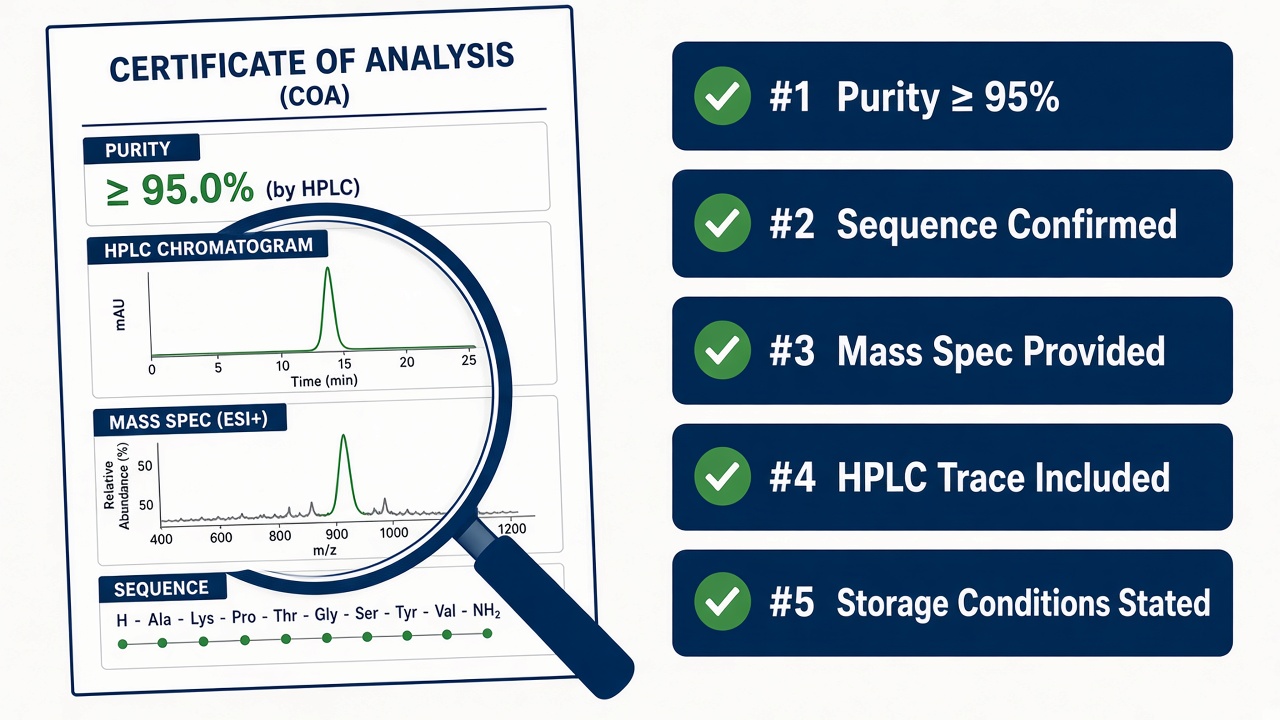
Purity is the first checkpoint. Research-grade peptides are typically offered at ≥95% or ≥98% purity by reverse-phase HPLC, with identity confirmed by mass spectrometry. For quantitative receptor binding work, the higher grade reduces the risk that truncated or deletion sequences confound assay readouts. Any bibtides collection should state its grade explicitly on the product page and on the certificate of analysis.
Documentation is the second checkpoint. A batch-specific COA should report the analytical method, the measured purity, the observed molecular mass, and the manufacturing lot. Our guide to [buying a peptide research library with a COA](/buy-peptide-research-library-coa/) explains how to read each field and which gaps indicate incomplete testing.
Two further specifications deserve attention. Net peptide content accounts for counterions and residual water in the lyophilized cake, so weighed mass is not identical to active peptide mass. Counterion identity — commonly trifluoroacetate or acetate — can influence solubility and assay compatibility, and suppliers should state it on request.
Solubility and reconstitution are handled at the bench according to the supplier datasheet and institutional standard operating procedures. Sequences rich in hydrophobic residues may require different solvents than polar sequences, and the datasheet should state this clearly for every vial in a collection.
Physical format and storage form the next checkpoint. Lyophilized peptides shipped as dry powder remain stable at −20 °C for extended periods, while reconstituted solutions degrade faster and require aliquoting. Catalog bibtides are commonly supplied in 1–5 mg aliquots per vial, which suits multi-assay screening without repeated freeze–thaw cycles.
Supplier transparency is the final checkpoint. Trustworthy vendors publish analytical methods, batch records, and research-use-only terms openly, and they answer specification questions before purchase rather than after.
How Do Bibtides Supply Formats Compare?
Three supply formats dominate the market, and each suits a different research program.
| Attribute | Catalog Bibtides | Custom Synthesis | Pre-Mixed Panels |
| — | — | — | — |
| Typical purity | ≥95–98% by HPLC | ≥98% by HPLC on request | ≥95% by HPLC |
| Documentation | Batch-specific COA | COA plus synthesis report | Batch-specific COA |
| Lead time | 3–7 business days | 2–6 weeks | 3–7 business days |
| Format | Lyophilized, 1–5 mg per vial | Lyophilized, scale to order | Lyophilized or pre-dissolved |
| Best research use | Established screening assays | Novel or unpublished sequences | High-throughput plate assays |
Catalog sets suit laboratories running established assays against known sequences. Custom synthesis suits groups working with unpublished structures or unusual modifications. Pre-mixed panels suit high-throughput facilities that prioritize consistency across plates. Pricing is quoted per set and scales with sequence count, sequence length, and purity grade; institutional quotations are available on request. Lead time is measured from order confirmation to dispatch and excludes customs clearance for international institutions.
What Belongs on a Bibtides Procurement Checklist?
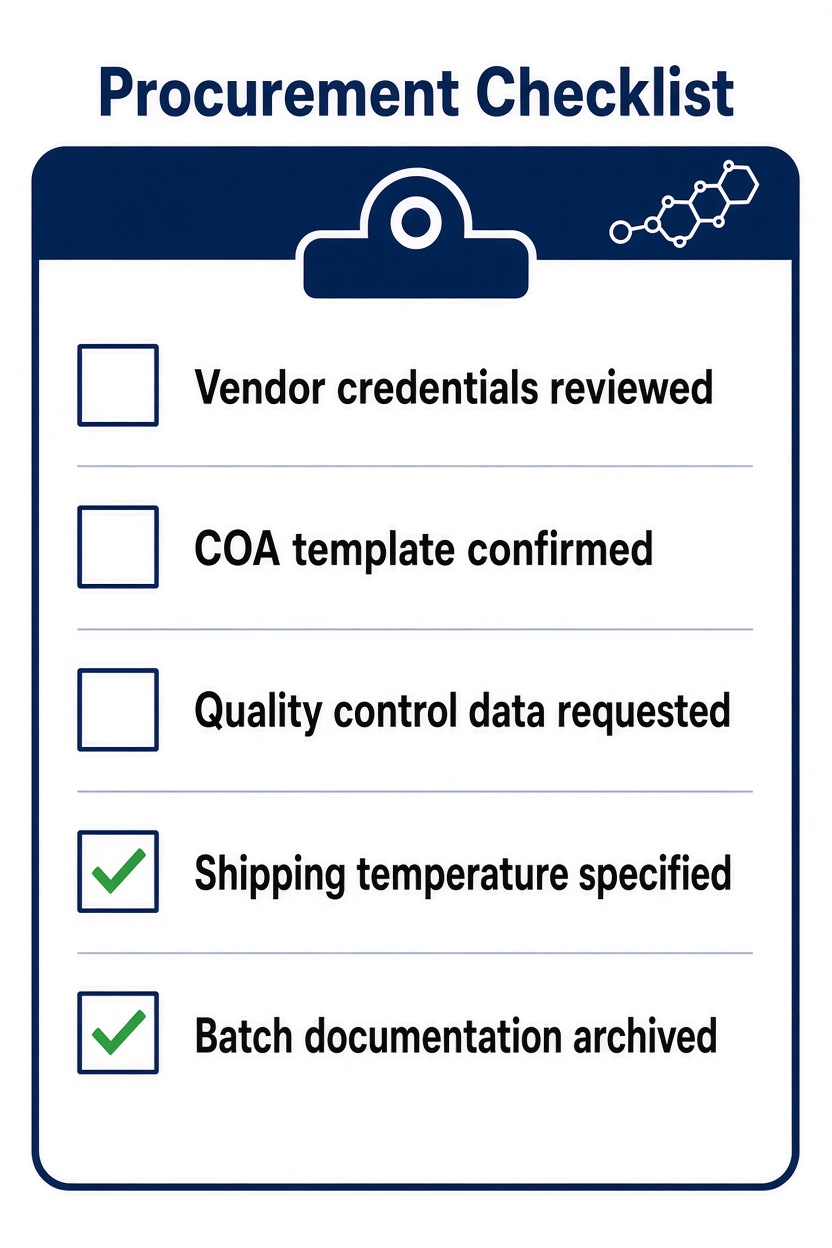
A disciplined purchasing process treats bibtides like any other critical reagent: specifications verified before ordering, documentation filed on receipt, and storage logged in the inventory system. The checklist below condenses the verification steps into a form suitable for laboratory purchasing records.
- Confirm the stated purity grade (≥95% or ≥98% by HPLC) and the analytical method behind it.
- Verify that a batch-specific certificate of analysis accompanies every vial in the set.
- Record the physical format: lyophilized powder, aliquot mass, and vial count per collection.
- Log storage requirements, typically −20 °C desiccated, in the laboratory inventory system.
- Confirm research-use-only labeling and the institution’s eligibility to purchase research chemicals.
- Compare quoted pricing against documented quality using our [peptide library price and quality comparison](/peptide-libraries-price-quality-comparison/).
Many institutions also require a chemical-inventory entry and an environmental health and safety review before a new research chemical is accepted on site. Building that step into the purchasing timeline avoids delays when the shipment arrives.
How Should Laboratories Document Their Purchases?
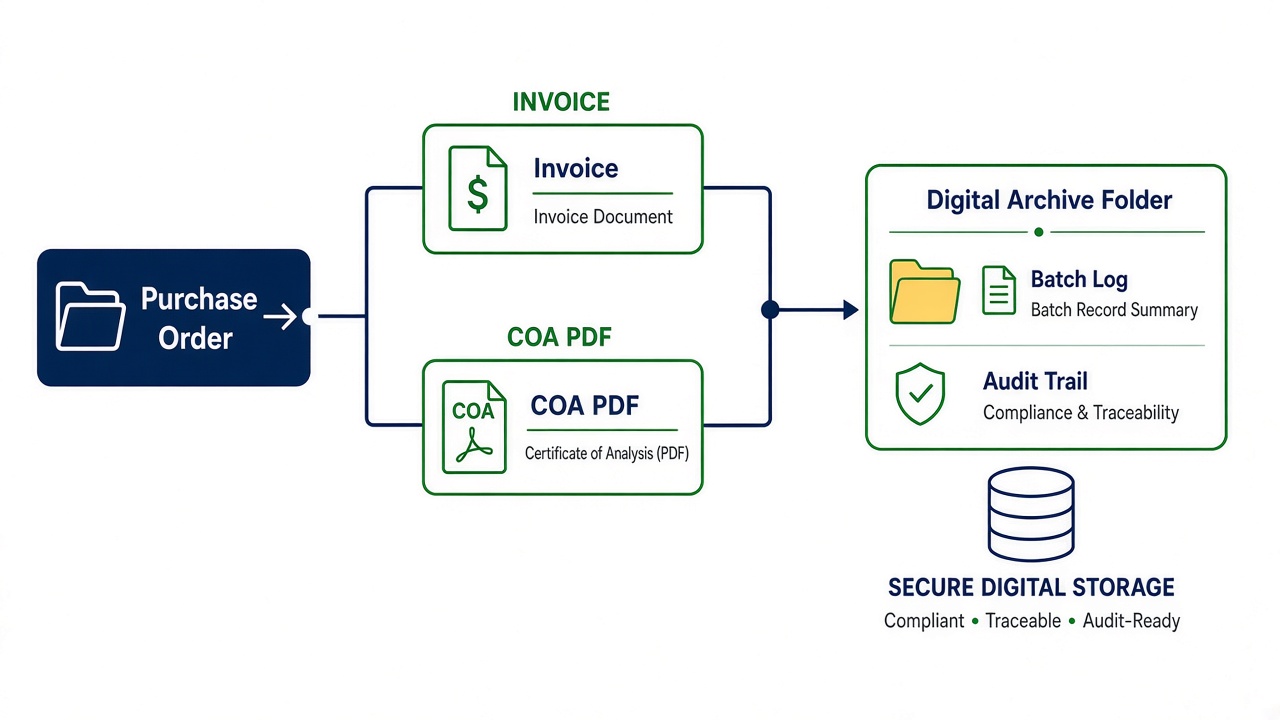
Grant-funded laboratories face audit requirements that make documentation as important as the material itself. Purchasing records should capture the supplier name, catalog numbers, batch identifiers, COA copies, and the receiving date for every collection.
Inventory systems should log storage location, temperature, and aliquot consumption so that assay records can be traced back to a specific batch. When results are published, the methods section can then cite exact batch numbers, which strengthens reproducibility and simplifies later verification by collaborating laboratories.
Retention policies matter as well. Laboratories commonly keep COAs and batch records for the life of the project plus the period required by the funding agency, so that any later audit can reconstruct exactly which material produced which dataset.
💡 Key Takeaway: How Should Laboratories Document Their Purchases?
How Does Peptides Library Supply Bibtides?
Peptides Library curates bibtides as cataloged research collections rather than loose vials. Each set is manufactured to a stated purity grade, verified by HPLC and mass spectrometry, and released only with a batch-specific COA. Collections are supplied lyophilized in 1–5 mg aliquots with storage guidance of −20 °C desiccated.
Availability is stated per set on the catalog page, and most in-stock collections ship to qualified laboratories within 3–5 business days. Institutional purchasing is supported through purchase orders, invoicing, and documentation packs suitable for grant compliance files. Custom collections are quoted individually, with synthesis reports available for novel sequences, and technical support is available for specification questions before purchase.
Laboratories ready to evaluate bibtides can browse the research peptide catalog, request the COA for any batch before purchase, or review our analysis of [who sells research-grade peptide libraries online](/research-grade-peptide-library-sellers/) for an independent comparison of documentation standards across vendors. Specification sheets, analytical methods, and example COAs are available on request before any purchase commitment. New collections are added to the catalog as synthesis batches complete quality control.
All products referenced on this page are research chemicals supplied strictly for in vitro and laboratory research. They are not intended for human or veterinary use, consumption, or diagnostic application, and they are sold only to qualified laboratories and research institutions. Nothing on this page constitutes medical, clinical, or therapeutic guidance.
FAQ
What does bibtides mean?
Bibtides is a coined term for library-format collections of synthetic research peptides supplied for in vitro laboratory research. It has no dictionary definition and is distinct from BibTeX, tide tables, and the BabyTides app.
Is bibtides the same as BibTeX or BiTimeBERT?
No. BibTeX is a reference-management format for LaTeX documents, and BiTimeBERT is a pre-trained language model for temporal information. Neither has any connection to peptide research; the resemblance is purely orthographic.
Is the term related to tide tables or ebb tide schedules?
No. Searches for tide tables and ebb tide times sometimes produce the string through autocorrect, but marine tide predictions and peptide collections are unrelated subjects with no shared products or data.
What purity should bibtides have for laboratory research?
Research-grade collections are typically supplied at ≥95% or ≥98% purity by HPLC with mass spectrometry confirmation, and every batch should include a certificate of analysis reporting the measured values for each vial.
Where can laboratories order bibtides with a COA?
Peptides Library supplies research-grade peptide collections with batch-specific COAs to qualified laboratories and research institutions. Each catalog listing states purity, format, storage guidance, and availability for the set.
Topics covered in this article:
Ready to Take the Next Step?
Every product includes lot-specific documentation and third-party purity testing.
Explore Our Research Products →Free shipping on qualifying orders · Batch COA on request