


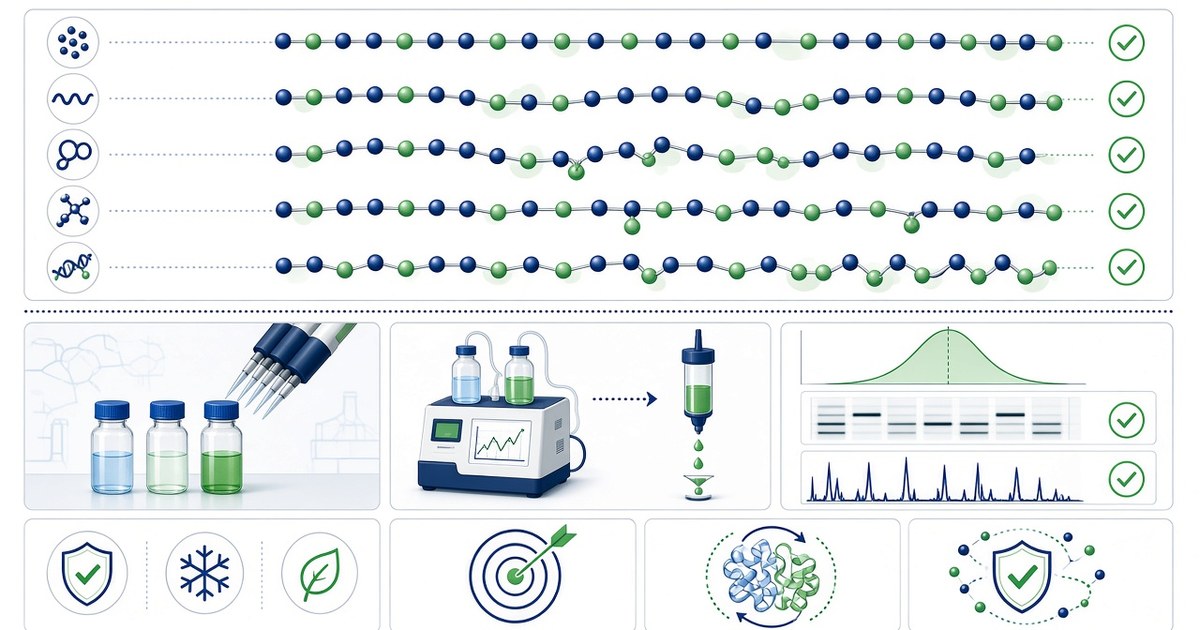
Exogenous Peptides: Complete Sourcing and QC Guide (2026)
Exogenous peptides explained for laboratories: sources, SPPS synthesis, HPLC and MS verification, and research-grade sourcing criteria with COA documentation.
📋 Table of Contents
Exogenous peptides are short chains of amino acids produced outside the biological system under study—by chemical synthesis, recombinant expression, or enzymatic hydrolysis of food proteins—and introduced into laboratory systems to investigate receptor binding, enzyme kinetics, and signal transduction. Because exogenous peptides are manufactured rather than extracted, researchers control their exact sequence, modifications, purity, and concentration, which makes them indispensable standards and probes for in vitro assays and in vivo (animal model) research.
This guide covers the full workflow: where research peptides originate, how solid-phase synthesis produces them, how HPLC and mass spectrometry verify every batch, and what laboratories should demand from suppliers. It also explains how Peptides Library supports reproducible science with research-grade, batch-documented material sold strictly for laboratory investigation.
Key takeaways
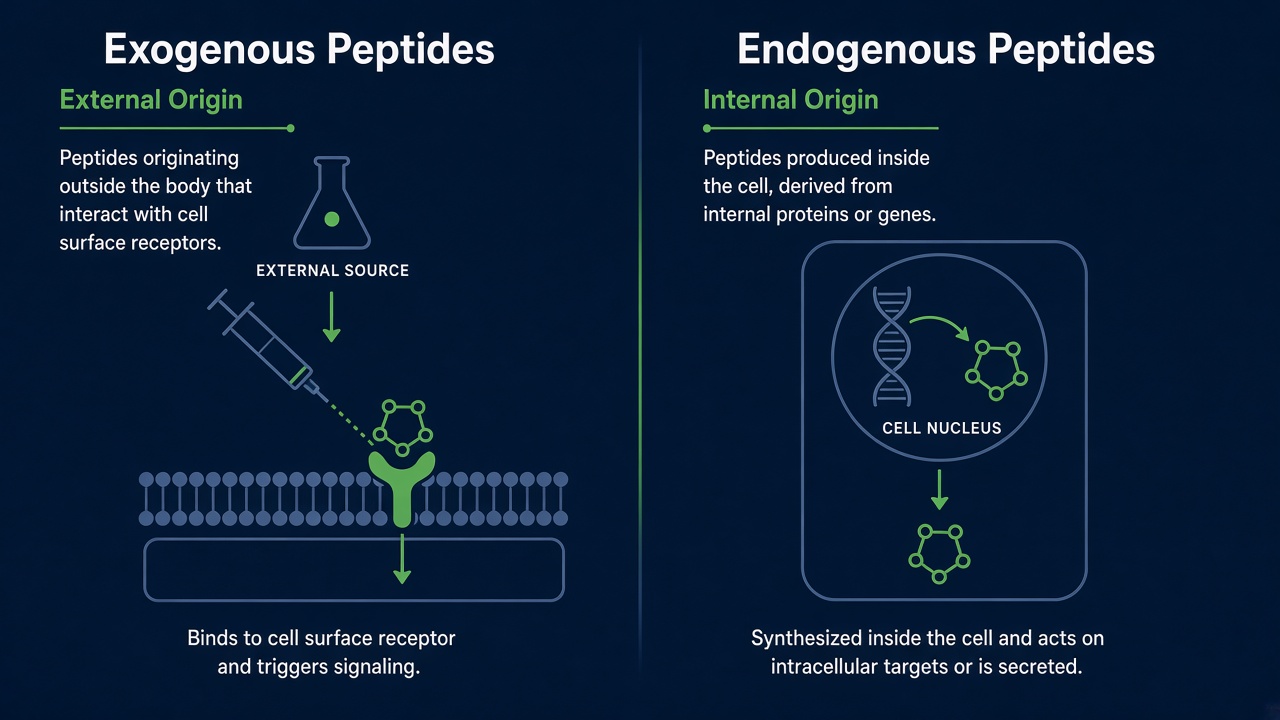
- Exogenous peptides are externally manufactured amino-acid chains that give laboratories full control over sequence, purity, and assay concentration.
- Three production routes dominate research supply: food-derived protein hydrolysates, solid-phase peptide synthesis (SPPS), and recombinant expression.
- Batch quality is measured, not claimed: high-performance liquid chromatography (HPLC) establishes purity and mass spectrometry (MS) confirms identity, with both reported on a certificate of analysis (COA).
- GLP-1 receptor agonists illustrate how externally supplied peptide sequences evolve into powerful pharmacological research tools.
- Every product discussed here is intended for in vitro and laboratory research only—not for human or veterinary use.
What Are Exogenous Peptides? Key Distinctions from Endogenous Peptides
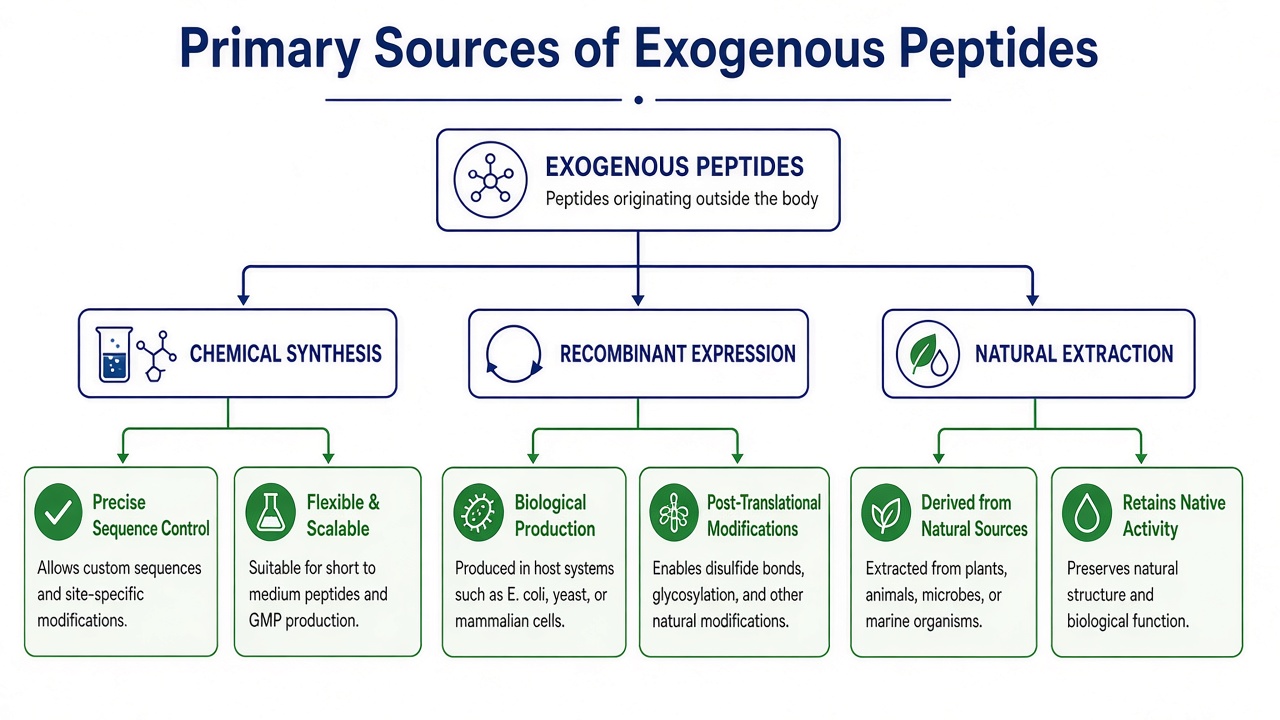
In peptide science, origin defines the experiment. Endogenous peptides—insulin, oxytocin, glucagon-like peptide-1, and the neuropeptide families—are produced inside an organism through ribosomal translation and enzymatic processing of precursor proteins. Exogenous peptides, by contrast, are manufactured outside the research subject and deliberately introduced into cell cultures, tissue preparations, or animal models by investigators. The distinction sounds semantic, but it determines how much control a laboratory actually has over experimental variables.

Endogenous production is governed by feedback loops, fluctuating baseline concentrations, and tissue-specific processing enzymes—all of which confound quantitative measurement. Manufactured sequences bypass those constraints: a synthesized peptide arrives chemically defined, so its concentration in an assay reflects the researcher’s pipette, not the specimen’s physiology. For structure-activity relationship mapping, dose-response curves in vitro, and receptor binding assays, that control is the entire point.
| Attribute | Endogenous peptides | Exogenous peptides |
|—|—|—|
| Origin | Synthesized within the organism | Produced externally (SPPS, recombinant, hydrolysis) |
| Researcher control | Limited to stimulation or inhibition | Full control of sequence, purity, concentration |
| Typical examples | Insulin, GLP-1, oxytocin | Synthetic fragments, analogs, food-derived peptides |
| Role in assays | Experimental targets or biomarkers | Probes, standards, defined ligands |
The practical implication is reproducibility. A batch of exogenous peptides characterized once by HPLC and MS can serve as a shared reference standard across laboratories and across years, whereas endogenous levels vary with circadian rhythm, fed state, and disease model. That standardization is why externally supplied sequences anchor modern peptide pharmacology.
Where Do Exogenous Peptides Come From? Primary Sources
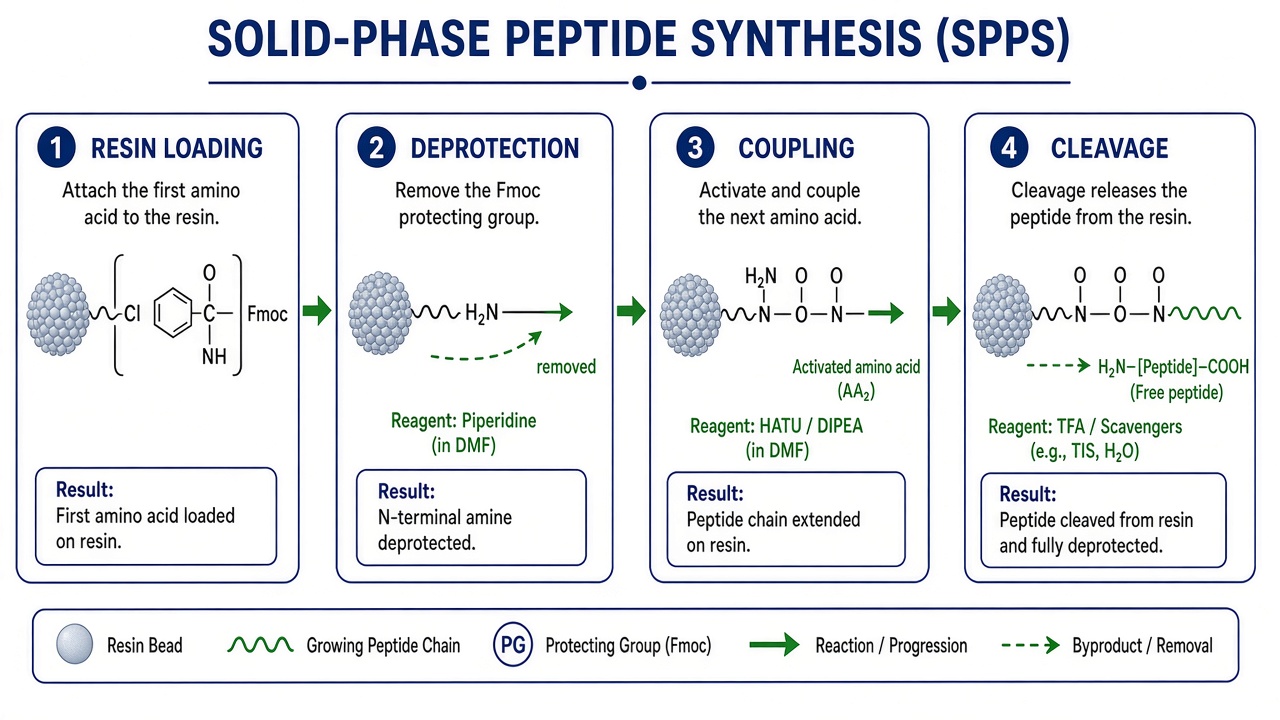
Research laboratories obtain exogenous peptides from three production routes—food-protein hydrolysis, chemical synthesis, and recombinant expression. Each route carries distinct implications for sequence fidelity, modification options, scale, and cost, and each suits different experimental designs.
Food-Derived Peptides and Protein Hydrolysates
Food-derived peptides are released from dietary proteins—milk casein, whey, soy, fish, and egg—through enzymatic hydrolysis, microbial fermentation, or simulated gastrointestinal digestion. Many behave as bioactive peptides in assay systems: ACE-inhibitory activity in enzyme-kinetics assays, radical-scavenging effects in antioxidant assays, and growth inhibition in microbial culture models. A widely cited review by Kitts and Weiler in Current Pharmaceutical Design (2003) catalogs these food-derived peptides and their measurable in vitro activities.
Because hydrolysates are complex mixtures rather than single sequences, they suit screening programs more than single-target work. Individual active fractions must be separated chromatographically and sequenced before quantitative assays are possible.
Synthetic Production via Chemical Synthesis
Chemical synthesis—solution-phase or solid-phase—builds a sequence residue by residue according to a defined reaction scheme. Synthetic exogenous peptides dominate the research market because the route delivers exact sequences, accommodates non-natural modifications (D-amino acids, N-acetylation, C-terminal amidation, cyclization, fluorescent labels), and routinely reaches purities above 95 percent at milligram-to-gram scale. When a laboratory orders a catalog peptide with a stated sequence and purity, it is almost always ordering a synthetic product.
Recombinant Expression Systems
Longer peptides and small proteins that exceed practical synthetic length are produced in Escherichia coli, yeast, insect, or mammalian expression systems. Recombinant production scales economically for long sequences but restricts chemistry to the canonical amino acids and typically requires downstream processing—fusion-tag cleavage, refolding, and multi-step purification. For short research sequences under roughly 50 residues, recombinant routes are usually impractical relative to SPPS.

| Source | Typical length | Modification flexibility | Cost profile | Best-fit research use |
|—|—|—|—|—|
| Food hydrolysates | 2-20 residues (mixtures) | None | Low | Bioactive peptides screening |
| SPPS (synthetic) | 2-50 residues | High | Moderate | Receptor binding, standards |
| Recombinant | 30-200+ residues | Low | High at small scale | Longer peptides, enzymes |
Because the majority of single-sequence research compounds are SPPS products, synthesis literacy is a procurement skill. Understanding how exogenous peptides are built clarifies why purity specifications, deletion-sequence impurities, and batch documentation differ so widely between suppliers.
💡 Key Takeaway: Where Do Exogenous Peptides Come From? Primary Sources
How Does Solid-Phase Peptide Synthesis (SPPS) Work?
Solid-phase peptide synthesis (SPPS), introduced by R. Bruce Merrifield in 1963 in the Journal of the American Chemical Society, transformed peptide chemistry by anchoring the growing chain to an insoluble polymer resin. Instead of purifying each intermediate, chemists simply wash the resin between reaction cycles. The method earned Merrifield the 1984 Nobel Prize in Chemistry and remains the standard platform for manufacturing exogenous peptides at research scale.
Step-by-Step SPPS Protocol
A standard Fmoc-based synthesis proceeds through six operations:
1. Resin loading. The C-terminal amino acid, protected with an Fmoc group, is covalently attached to the resin support.
2. Deprotection. A base—typically 20 percent piperidine in dimethylformamide—removes the Fmoc group and exposes a free amine.
3. Coupling. The next protected amino acid is activated with reagents such as HBTU, HATU, or DIC and coupled to the free amine.
4. Iteration. Deprotection-coupling cycles repeat until the full sequence is assembled; every cycle must proceed at near-quantitative yield.
5. Cleavage. A trifluoroacetic acid cocktail releases the peptide from the resin and strips side-chain protecting groups.
6. Isolation. The crude peptide is precipitated in cold diethyl ether and lyophilized to a stable powder ahead of purification.
Scale-Up Considerations
Cycle efficiency compounds. At 99 percent coupling efficiency per step, a 30-residue synthesis yields roughly 74 percent full-length product; at 98 percent, only about 55 percent. The remainder is a mixture of deletion sequences that can co-elute near the target peak—one reason crude exogenous peptides require preparative HPLC purification before research use. Difficult sequences rich in hydrophobic residues aggregate on-resin and demand pseudoproline building blocks, microwave assistance, or low-substitution resins.
At gram scale, solvent consumption, resin costs, and purification throughput dominate the economics. For procurement teams, scale-up discipline is visible in the paperwork: suppliers running controlled syntheses can provide batch-specific chromatograms and mass spectra for exogenous peptides rather than generic certificates, and they can reproduce those profiles lot after lot.

How Are Exogenous Peptides Verified? HPLC and Mass Spectrometry
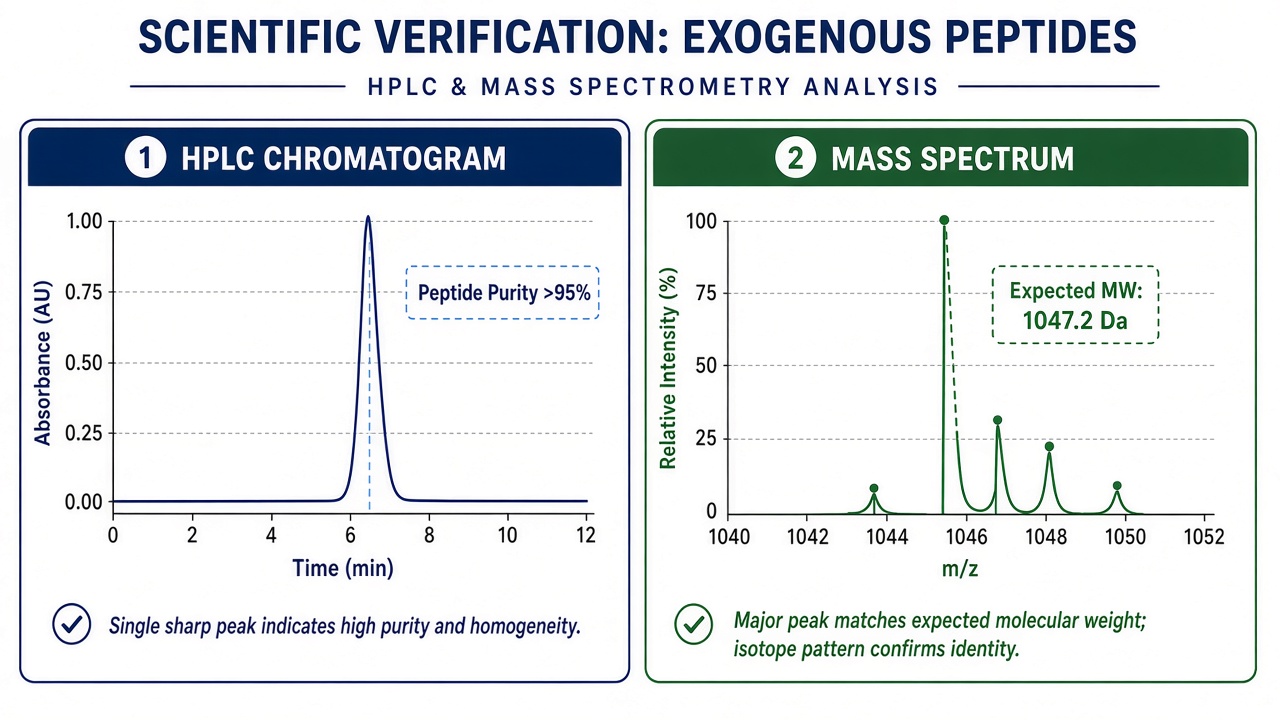
Identity and purity are measurements, not marketing claims. Reputable suppliers verify exogenous peptides with two orthogonal analytical techniques—one that quantifies purity and one that confirms molecular identity—then report both on a batch-specific certificate of analysis.
High-Performance Liquid Chromatography (HPLC)
Reversed-phase high-performance liquid chromatography (HPLC) separates the target sequence from truncated fragments, deletion sequences, and residual synthesis reagents, typically on a C18 column with a water-acetonitrile gradient. Purity is reported as the percentage of total peak area detected at 214-220 nm. Research-grade exogenous peptides are usually specified at 95 percent purity or higher; quantitative receptor binding assays often justify material at 98 percent or higher.
Mass Spectrometry (MS)
Mass spectrometry (MS)—electrospray ionization or MALDI-TOF—measures the molecular weight of the dominant species and matches it against the calculated mass of the intended sequence. Agreement between observed and theoretical mass establishes identity. LC-MS platforms combine separation and mass detection in a single run, and amino acid analysis can quantify net peptide content for accurate molar calculations.
| Method | What it establishes | Typical acceptance criterion |
|—|—|—|
| RP-HPLC | Purity (percent peak area) | 95-98 percent or higher |
| ESI / MALDI MS | Molecular identity (m/z) | Observed mass equals calculated mass |
| LC-MS | Identity and purity in one run | Both criteria above |
| Amino acid analysis | Net peptide content | Batch-specific value reported |
These data converge on the certificate of analysis (COA), the document that converts a white powder into a characterized reagent. A defensible COA lists the batch number, HPLC chromatogram, MS spectrum, purity percentage, and net peptide content. Laboratories assembling a documented catalog can consult our guide on [where to buy a peptide research library with a COA](/buy-peptide-research-library-coa/) for procurement criteria. Without batch-specific analytics, exogenous peptides are uncharacterized reagents—and uncharacterized reagents produce unreproducible data.

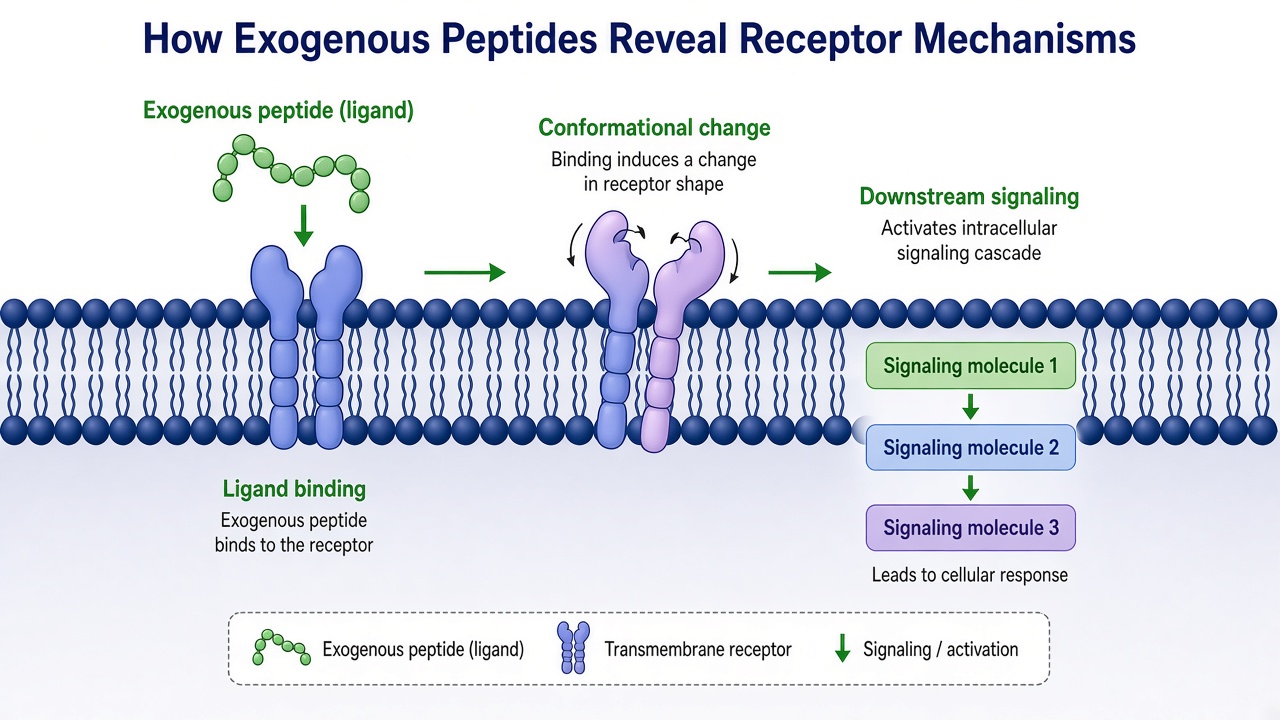
What Do Exogenous Peptides Reveal About Receptor Mechanisms?
In molecular pharmacology, exogenous peptides function as precision probes. Because their sequences are defined, researchers can map receptor binding sites, measure agonist or antagonist potency in cell cultures, and dissect structure-activity relationships by substituting single residues. Truncated fragments identify minimal active sequences; alanine scans identify indispensable side chains; labeled analogs visualize receptor internalization. None of these experiments is possible against an uncharacterized endogenous background.
The GLP-1 receptor agonist class illustrates the trajectory from probe to drug development program. Exendin-4, a peptide isolated from Gila monster venom, showed that GLP-1 receptor activation could be sustained pharmacologically, and analog engineering then produced approved agents such as exenatide, liraglutide, and semaglutide. Drucker’s review in Cell Metabolism (2018) details the receptor mechanisms these molecules exploit. The example matters here because it shows how exogenous peptides, studied first as research tools, generate the mechanistic knowledge that pharmaceutical pipelines later industrialize. Research-use compounds remain distinct materials, supplied only for laboratory investigation.
Beyond G protein-coupled receptors, bioactive peptides serve enzyme research as substrates and inhibitors—ACE-inhibitory food-derived peptides in enzyme-kinetics assays, for instance—and serve microbiology as antimicrobial peptides tested against bacterial and fungal cultures. Each research application depends on the same property: a defined sequence producing a measurable, reproducible molecular effect.
Fragment studies demonstrate structure-function mapping in practice. [AOD-9604, a modified growth hormone fragment](/aod-9604-growth-hormone-fragment-peptide/), is investigated in laboratory and animal models for its influence on adipose-tissue signaling pathways, illustrating how researchers use exogenous peptides to isolate the activity of one region of a parent hormone without engaging the parent’s full receptor profile.
Outside pharmacology, food science programs study hydrolysates as functional ingredients, materials laboratories investigate self-assembling peptides for hydrogel formation, and analytical laboratories use synthetic sequences as instrument calibration standards. The common thread is controlled molecular composition.
💡 Key Takeaway: What Do Exogenous Peptides Reveal About Receptor Mechanisms?
How Should Researchers Source Exogenous Peptides? A Quality-Control Checklist
Sourcing determines data quality. When evaluating suppliers of exogenous peptides, procurement teams and principal investigators should verify the following attributes before purchase:
- Purity specification. At least 95 percent by RP-HPLC for screening; 98 percent or higher for quantitative binding or kinetic assays.
- Identity confirmation. Mass spectrometry data matching the calculated mass for the same batch.
- Batch-specific COA. Chromatograms and spectra tied to a lot number—not a generic template.
- Physical form and storage. Lyophilized, sealed, and desiccated, with recommended storage at minus 20 degrees Celsius, protected from light and moisture.
- Net peptide content. Peptide mass versus counterion and water mass disclosed for accurate molar calculations.
- Research-use-only labeling. Clear terms restricting sale to laboratory research applications.
- Lot-to-lot consistency. Documented reproducibility across production runs.
Independent vendor assessments apply these same criteria. Our analyses of [research-grade peptide library sellers](/research-grade-peptide-library-sellers/) and [trusted peptide library suppliers in 2026](/peptide-research-library-trusted-suppliers/) score vendors on analytical documentation, transparency, and fulfillment practices, and they are useful starting points for laboratories qualifying new sources of exogenous peptides.
Price per milligram is a weak proxy for value. A failed assay consumes labor, consumables, and weeks of schedule; verified exogenous peptides with complete documentation are the economical choice at the level of the project, even when the individual vial costs more.

Why Source Exogenous Peptides from Peptides Library?
Peptides Library exists to make the checklist above effortless. Every vial of exogenous peptides in the catalog ships with batch-specific HPLC and MS documentation, a lot-numbered certificate of analysis, and research-use-only terms that satisfy institutional compliance offices. The catalog spans synthetic fragments, modified analogs, and curated research libraries produced under controlled solid-phase synthesis conditions.
What laboratories receive with every order:
- Verified purity: 95-98 percent by reversed-phase HPLC, chromatogram included
- Confirmed identity: ESI or MALDI mass spectra matched to calculated mass
- Full documentation: batch-specific COA with net peptide content
- Stability by design: lyophilized format, desiccated packaging, minus 20 degrees Celsius storage guidance
- Procurement support: documentation packages suitable for grants, audits, and institutional review
Equip the laboratory with characterized reagents. [Browse the research catalog](/buy-peptide-research-library-coa/) or review our [2026 supplier assessment](/peptide-research-library-trusted-suppliers/) to see how documentation standards compare across vendors. Every order of exogenous peptides includes the complete analytical file—chromatogram, spectrum, and COA—before the vial leaves the facility.
Research use only. All products referenced on this page are research chemicals sold strictly for in vitro and laboratory research. They are not intended for human or animal administration, diagnostic use, or any application outside controlled laboratory settings. Nothing on this page constitutes medical advice or a recommendation for personal use.
FAQ
What are exogenous peptides in laboratory research?
Exogenous peptides are amino-acid chains manufactured outside the research subject—by solid-phase synthesis, recombinant expression, or food-protein hydrolysis—and introduced into in vitro assays or animal models as defined reagents. Their value lies in control: sequence, purity, and concentration are established before the experiment begins.
How do externally supplied peptides differ from endogenous peptides?
Endogenous peptides are produced inside an organism and fluctuate with physiological state. Externally supplied sequences are manufactured to a specification: they can be purified, verified by HPLC and mass spectrometry, and added to assays at exact concentrations, which an endogenous background cannot provide.
What purity level do research assays require?
Screening work typically accepts material at 95 percent purity or higher by reversed-phase HPLC. Quantitative receptor binding, enzyme kinetics, and standard-curve work generally justify 98 percent or higher. The certificate of analysis should report the chromatogram for the specific batch, not a representative example.
How should research peptides be stored?
Lyophilized research peptides should be kept sealed, desiccated, and frozen at minus 20 degrees Celsius or below, protected from light and moisture. Reconstituted solutions are less stable; laboratories typically aliquot and freeze working stocks rather than subjecting material to repeated freeze-thaw cycles.
Are these products intended for human use?
No. All compounds discussed are research chemicals supplied exclusively for in vitro and laboratory research. They are not drugs, supplements, or cosmetics, and they are not intended for human or veterinary administration under any circumstances.
Topics covered in this article:
Ready to Take the Next Step?
Every product includes lot-specific documentation and third-party purity testing.
Explore Our Research Products →Free shipping on qualifying orders · Batch COA on request