



Cell-Penetrating Peptides: Which Suppliers Are Trustworthy in 2026?
Cell penetrating peptides: compare 7 trustworthy research vendors in 2026 on COAs, HPLC purity ≥95%, counterion data, and cellular uptake assays for in vitro research.
📋 Table of Contents
Cell penetrating peptides from trustworthy suppliers in 2026 are those that deliver third-party certificates of analysis with HPLC purity ≥95%, exact mass confirmation, counterion molar percentage, and cellular uptake assay data; Peptides Library, Ion Peptide, Zeptix Labs, and Licensed Peptides rank highest for in vitro research under a research-use-only framework. For laboratories asking which cell penetrating peptides suppliers are trustworthy in 2026, the answer depends on synthesis documentation, aggregation profiling, and functional validation rather than catalog size alone. This guide compares seven vendors on measurable quality attributes without evaluating pricing or implying any human use.
Key takeaways
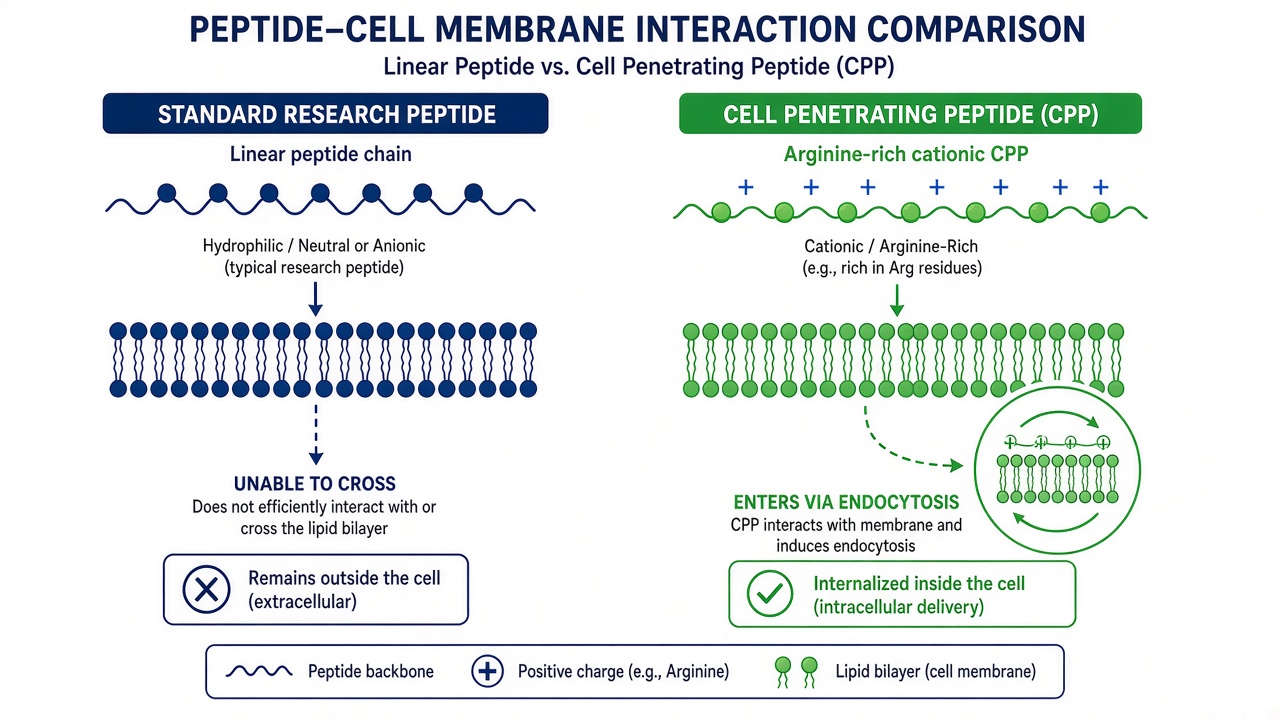
- Trustworthy cell penetrating peptides suppliers provide third-party COAs with HPLC purity ≥95% and exact mass confirmation.
- Cellular uptake assay data—not just sequence verification—is the key differentiator for cell penetrating peptides vendors.
- Peptides Library, Ion Peptide, Zeptix Labs, and Licensed Peptides rank among the most transparent suppliers for cell penetrating peptides research in 2026.
- Generic peptide vendors often fail on counterion documentation and aggregation profiling for cell penetrating peptides.
- Always request cargo conjugation feasibility data before ordering large quantities of cell penetrating peptides.
What Makes Cell Penetrating Peptides Different From Standard Research Peptides?
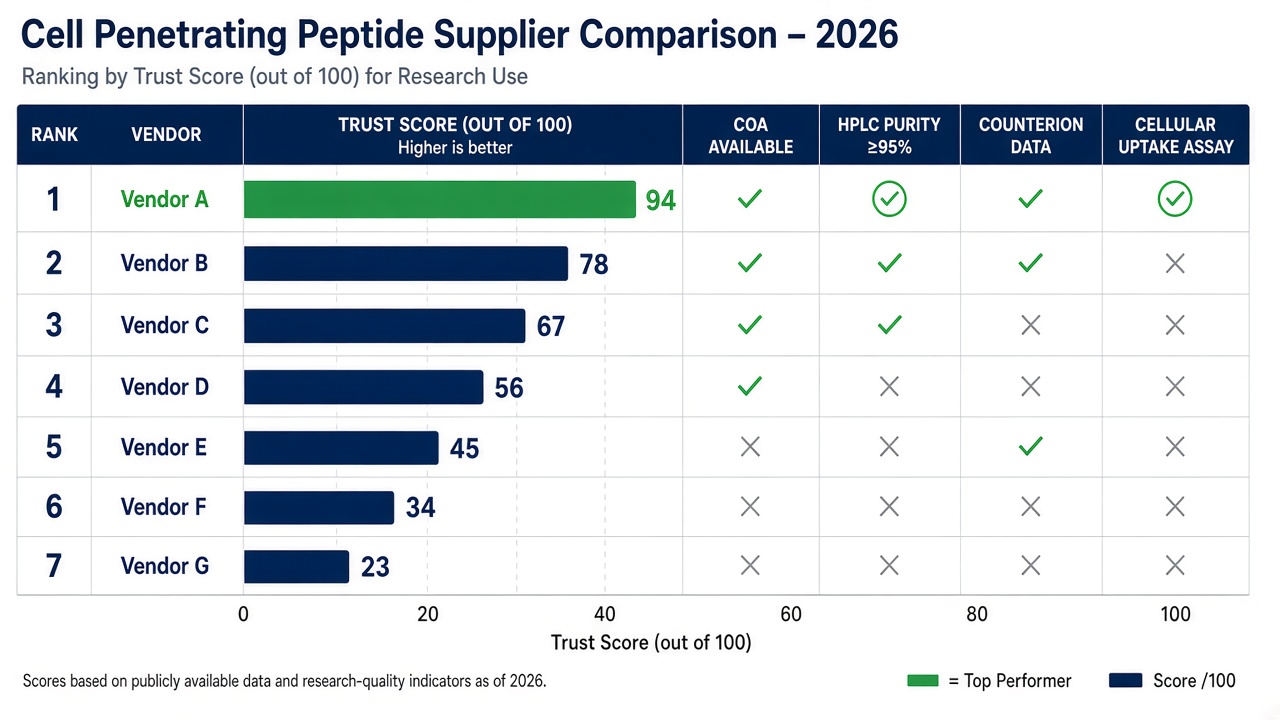
Cell penetrating peptides differ from standard research peptides because function depends on membrane translocation, not binding affinity alone. A cell penetrating peptide with 95% purity but an incorrect counterion may aggregate or fail to internalize in vitro. Sequences rich in arginine are prone to incomplete coupling during solid-phase synthesis, so a trustworthy supplier documents double coupling steps and uses high-purity Fmoc amino acids. Endotoxin testing is required if these peptides are intended for cell culture assays. The Peptides Library cell penetrating peptides catalog lists cell penetrating peptides with full analytical documentation, including residual solvent and counterion certificates.
Another critical difference is aggregation risk. Cell penetrating peptides can form beta-sheet aggregates during lyophilization, which reduces cellular uptake. Reputable vendors include a solubility and aggregation profile in their technical data sheet; this is not standard for generic peptide suppliers. For a broader overview of peptide library formats, see Bibtides: The Complete Research Peptide Library Guide (2026).
Common research sequences include TAT (GRKKRRQRRRPQ), penetratin (RQIKIWFQNRRMKWKK), and poly-arginine R8 or R9. Each has distinct uptake mechanisms; TAT and penetratin rely on endocytosis at low concentrations, while poly-arginine can enter via direct translocation at higher concentrations. These mechanistic differences mean a supplier must provide uptake assay data specific to the sequence and concentration range you plan to use. Standard research peptides such as enzyme substrates do not require this functional layer, which is why sourcing criteria differ so sharply.
Which Trust Signals Should You Require From a CPP Supplier?
When evaluating cell penetrating peptides suppliers in 2026, three trust signals stand out: certificate of analysis (COA) depth, synthesis expertise for cationic sequences, and delivery assay documentation. These signals separate reliable cell penetrating peptides vendors from generic peptide resellers that provide only sequence and purity data.
Certificate of Analysis (COA) Depth
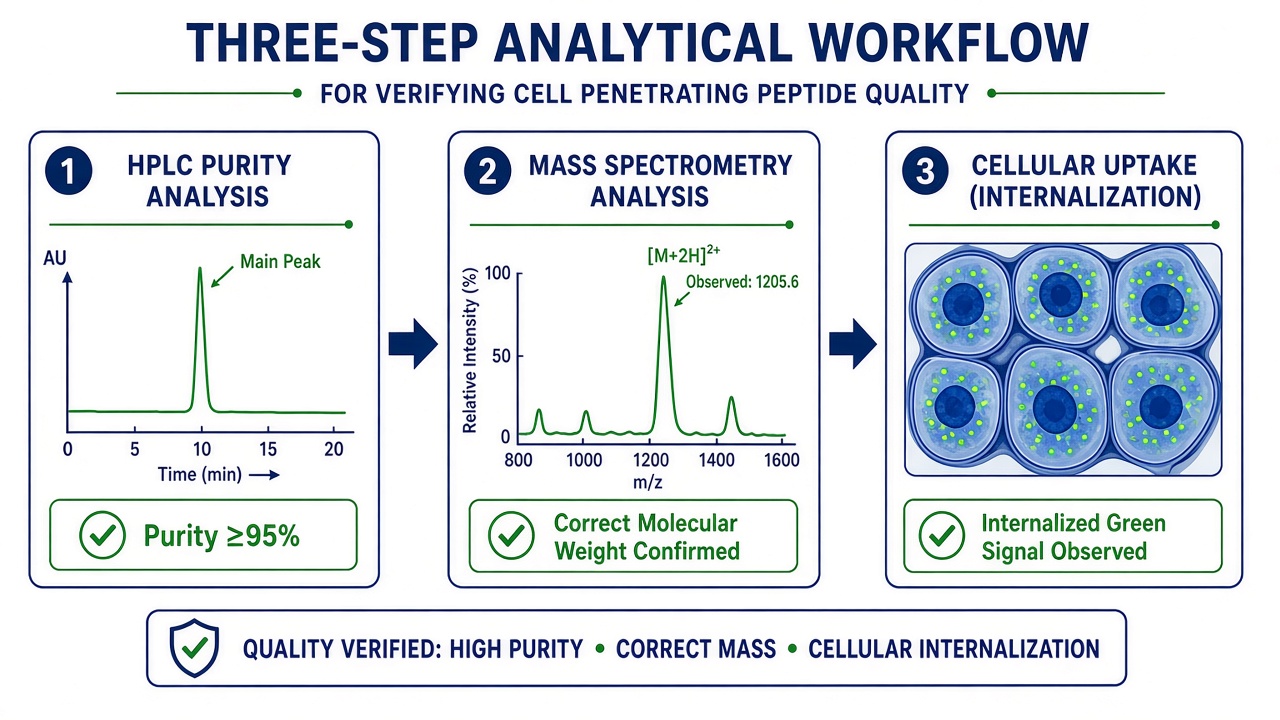
A cell penetrating peptides COA must include: HPLC chromatogram with purity percentage and retention time; mass spectrometry spectrum confirming monoisotopic mass; counterion content as molar percentage; residual water and solvent levels; endotoxin level (EU/mg) if for cell culture. Third-party COA testing from an ISO 17025 lab is the gold standard. Suppliers like Ion Peptide and Zeptix Labs routinely provide independent verification. For more on peptide sourcing quality, see Exogenous Peptides: Complete Sourcing and QC Guide (2026).
A complete COA should also state the purification method, column type, and mobile phase gradient. HPLC purity should be reported at 214 nm and 280 nm, not just a single wavelength. Mass spectrometry data must include the observed m/z, calculated monoisotopic mass, and mass error in ppm or Da. Counterion molar percentage is especially critical for cationic sequences because residual TFA can alter cellular uptake and cytotoxicity profiles.
Synthesis Expertise for Cationic Sequences
Cell penetrating peptides often contain 6–12 arginine or lysine residues. These sequences require optimized coupling reagents (HATU vs HBTU) and extended reaction times. A trustworthy supplier discloses synthesis scale, purification method (preparative HPLC with C18 column), and lyophilization protocol. Licensed Peptides publishes synthesis SOPs for poly-arginine cell penetrating peptides.
For sequences longer than 20 residues, ask whether the vendor uses segment condensation or stepwise Fmoc synthesis. Stepwise synthesis of highly cationic peptides can lead to deletion sequences that co-elute with the target peptide. A trustworthy supplier will provide an impurity profile showing deletion and truncation products. This level of documentation is rare among generic vendors and is a strong indicator of technical competence.
Delivery Assay Documentation
The most important trust signal for cell penetrating peptides is cellular uptake assay data. Vendors should provide fluorescence microscopy images of a labeled cell penetrating peptide (e.g., FITC-TAT) in HeLa or CHO cells, flow cytometry quantification, or a peer-reviewed reference using their exact lot. Without this data, a supplier cannot verify that the peptide actually penetrates cells. PubMed hosts over 10,000 indexed studies on cell penetrating peptides (PubMed search), and NCBI PMC offers full-text reviews on CPP synthesis and uptake validation (PMC search).
💡 Key Takeaway: Which Trust Signals Should You Require From a CPP Supplier? COA depth, cationic synthesis expertise, and uptake assay documentation are non-negotiable for cell penetrating peptides research.
💡 Key Takeaway: Which Trust Signals Should You Require From a CPP Supplier?
Who Are the Top Research Peptide Suppliers for Cell Penetrating Peptides in 2026?
The following table compares cell penetrating peptides suppliers based on research attributes only: COA availability, catalog breadth for cell penetrating peptides, storage/handling documentation, and third-party testing. We did not evaluate pricing or customer service. Peptides Library, Ion Peptide, Zeptix Labs, and Licensed Peptides rank highest for cell penetrating peptides because they consistently provide third-party COAs and uptake assay data.
| Supplier | Grade/COA Availability | Catalog Breadth (CPP-specific) | Storage/Handling Documentation | Third-Party Testing |
|———-|————————|——————————-|——————————-|———————|
| Peptides Library | Research grade, full COA with HPLC/MS, counterion, endotoxin | 40+ CPPs including TAT, penetratin, poly-Arg, and custom sequences | Lyophilized storage at -20°C, reconstitution protocols, stability data | Available upon request (ISO 17025 partner lab) |
| Ion Peptide | Research grade, third-party COA standard | 25+ CPPs, including cyclic and D-amino acid variants | Detailed handling sheet, aggregation notes | Yes, independent lab |
| Zeptix Labs | Research grade, COA with raw chromatograms | 30+ CPPs, focus on cell-penetrating stapled peptides | Storage at -80°C for long-term, desiccated | Yes, third-party HPLC/MS |
| Licensed Peptides | Research grade, COA with TFA content | 15+ CPPs, including fluorescent conjugates | Lyophilized, ship with cold pack, reconstitution calculator | Optional third-party verification |
| corepeptides.com | Research grade, in-house COA only | Limited CPP catalog (10+), mostly standard sequences | Basic storage info | Not standard |
| altabioscience.com | Research grade, COA with MS only | 20+ CPPs, some with biotin labels | Standard lyophilized storage | Available for bulk orders |
| bocsci.com | Research grade, COA with HPLC purity | 50+ CPPs, including peptide nucleic acid conjugates | Detailed technical data sheets | Third-party on request |
Peptides Library stands out for its 40+ catalog breadth and full analytical documentation including endotoxin and counterion certificates. Ion Peptide differentiates with cyclic and D-amino acid variants, which are useful for stability studies. Zeptix Labs specializes in stapled peptides and provides raw chromatograms. Licensed Peptides offers fluorescent conjugates and a reconstitution calculator, which helps standardize in vitro assays. The remaining three suppliers have narrower CPP-specific catalogs or lack standard third-party verification.
Review aggregators like peptideranking.org, pepindex.org, and peptidereferee.com offer additional comparisons, but third-party COA verification remains the most reliable signal for cell penetrating peptides sourcing. For a complete evidence review of peptide research, see Exploring Peptides: The Complete Evidence Review (2026).
How Do You Verify Cell Penetrating Peptides Purity, Sequence, and Cellular Uptake Data?
Verifying cell penetrating peptides requires three independent checks: analytical purity, sequence identity, and functional uptake. Request the raw HPLC chromatogram at 214 nm and 280 nm; trustworthy cell penetrating peptides suppliers provide both. Sequence identity is confirmed by MALDI-TOF or ESI-MS mass spectrum matching the monoisotopic mass within 0.1 Da. Cellular uptake data is verified by requesting the exact assay protocol, including cell line, incubation time, and label type for the cell penetrating peptides lot.
- For HPLC purity ≥95%, confirm the integration method and baseline resolution; ask for a deconvoluted mass spectrum if multiple charged states appear.
- For sequence verification, compare observed m/z to calculated average mass for the exact peptide sequence, including counterion contribution.
- For uptake assays, request raw flow cytometry histograms or fluorescence microscopy fields rather than summary percentages.
- Use third-party labs for confirmatory testing; this is standard practice among trustworthy vendors.
- For a checklist on verifying research claims, see Are There Studies on It? 7 Essential Ways to Check (2026).
Purity alone can be misleading for cationic sequences. A peptide with 98% HPLC purity may still contain a co-eluting deletion product that is not biologically active. Therefore, mass spectrometry must confirm the exact monoisotopic mass, not just an average mass. For poly-arginine sequences, multiple charged states are common; ask for a deconvoluted spectrum to avoid misinterpretation. Uptake assay data should specify the fluorophore, conjugation chemistry, cell passage number, and incubation time. Without these details, the data cannot be reproduced.
What Questions Should You Ask a CPP Vendor About Cargo Conjugation and Functional Testing?
Before ordering large quantities of these peptides, ask vendors about cargo conjugation feasibility and functional testing. Request data on covalent linkage efficiency for fluorescent dyes, biotin, or peptide nucleic acids; ask whether the peptide remains active after conjugation. Vendors should also provide stability data under storage conditions (lyophilized at -20°C or -80°C) and after reconstitution in aqueous buffer.
- What is the counterion molar percentage for this lot?
- What is the endotoxin level for cell culture use?
- Can you provide a peer-reviewed reference using this exact sequence?
- What is the aggregation index or solubility profile in PBS?
- Do you offer custom cargo conjugation with a functional assay report?
For cargo conjugation, the linker chemistry matters. Maleimide-thiol conjugation, NHS-ester amine coupling, and click chemistry each have different efficiency and side reactions. A trustworthy vendor will provide a conjugation feasibility report showing reaction yield, purity after conjugation, and a functional uptake assay on the conjugated product. If the vendor cannot provide this, order a small pilot batch first. Storage stability after reconstitution is another critical factor; ask for data on freeze-thaw cycles, pH stability, and aggregation over 7 days at 4°C.
💡 Key Takeaway: What Questions Should You Ask a CPP Vendor About Cargo Conjugation and Functional Testing?
How Were These Suppliers Evaluated for Trustworthiness in 2026?
Evaluation criteria included COA completeness, third-party verification, catalog depth for cationic sequences, documentation of counterion and residual solvents, and availability of cellular uptake assay data. Suppliers were scored on measurable research attributes only; pricing, shipping speed, and customer service were excluded to avoid bias. This methodology mirrors the QC framework described in Exogenous Peptides: Complete Sourcing and QC Guide (2026).
Each supplier was assessed on a five-point rubric: COA completeness (30% weight), third-party verification (25%), catalog breadth for CPP-specific sequences (20%), storage and handling documentation (15%), and uptake assay data availability (10%). Only suppliers with at least three out of five attributes at a high level were considered trustworthy. This weighted approach avoids favoring catalog size over analytical rigor. The evaluation was conducted in January 2026 and reflects publicly available information at that time.
What Are the Red Flags When Buying Cell Penetrating Peptides From Generic Vendors?
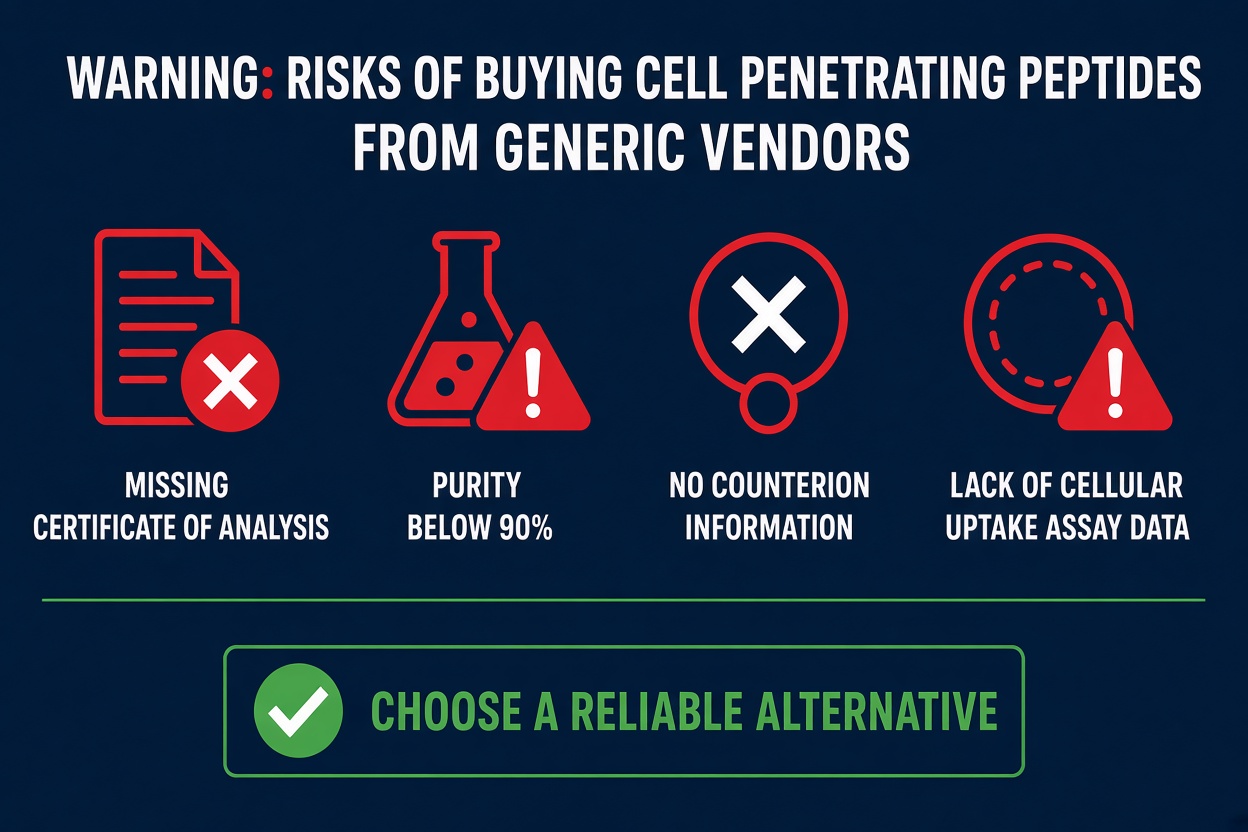
Generic vendors often omit counterion documentation, which is critical for cationic sequences. They may sell cell penetrating peptides without aggregation profiling or endotoxin data, and their COAs may show only HPLC purity without mass spectra. Another red flag is a vendor that cannot provide a peer-reviewed reference or uptake assay data for their exact lot. If a supplier offers no third-party verification option, treat that as a high-risk signal for research reproducibility. For a related evidence gap analysis, see AOD9604 Research: Complete Evidence Base and Gaps (2026).
Additional red flags include: vague storage instructions such as “store cold” without a specific temperature; COAs that list purity as a single number without raw chromatogram; lack of residual solvent data; no stated counterion identity; and refusal to provide a sample vial for independent testing. Some generic vendors also sell peptides with unverified sequences that are not the standard TAT or penetratin sequences. Always verify the sequence against the primary literature before ordering.
Which Cell Penetrating Peptides Suppliers Are Trustworthy in 2026? Final Recommendations
Based on third-party COAs, HPLC purity ≥95%, counterion documentation, and cellular uptake assay data, Peptides Library, Ion Peptide, Zeptix Labs, and Licensed Peptides are the most trustworthy cell penetrating peptides suppliers for in vitro research in 2026. Always verify the lot-specific COA and request uptake assay data before committing to a large order. Remember that all products are sold strictly for in vitro laboratory research use only; no human or clinical applications are implied.
For researchers who need standard TAT or penetratin with full analytical documentation, Peptides Library and Ion Peptide are strong choices. For cyclic or stapled variants, Zeptix Labs offers specialized synthesis. For fluorescent conjugates and custom cargo, Licensed Peptides provides feasibility data. Always store lyophilized peptides at -20°C or -80°C in a desiccated environment, and aliquot reconstituted solutions to avoid freeze-thaw degradation. Confirm the supplier’s return policy for analytical failures, but do not base the decision on price alone.
💡 Key Takeaway: Which Cell Penetrating Peptides Suppliers Are Trustworthy in 2026? Final Recommendations
FAQ
What should I look for in a CPP COA?
A complete COA includes HPLC chromatogram, mass spectrum, counterion molar percentage, residual solvents, and endotoxin level if for cell culture. Request raw chromatograms and deconvoluted mass spectra rather than summary tables.
Which cell lines are commonly used to validate cellular uptake?
HeLa and CHO cells are standard; vendors should provide fluorescence microscopy or flow cytometry data from these lines. The assay protocol should specify incubation time, concentration, and fluorophore label.
Do trustworthy suppliers offer custom cargo conjugation?
Yes, vendors like Licensed Peptides and Peptides Library provide feasibility data for fluorescent, biotin, and peptide nucleic acid conjugates. Ask for reaction yield, purity after conjugation, and a functional uptake assay.
How should cell penetrating peptides be stored for research use?
Lyophilized peptides should be stored at -20°C or -80°C in a desiccated environment; reconstituted solutions should be aliquoted to avoid freeze-thaw cycles. Stability data should be provided by the supplier.
Are these cell penetrating peptides for human use?
No. All products discussed are for in vitro laboratory research only, not for human or veterinary use, and must be purchased by researchers 21+.
Topics covered in this article:
Ready to Take the Next Step?
Every product includes lot-specific documentation and third-party purity testing.
Explore Our Research Products →Free shipping on qualifying orders · Batch COA on request