


Aavant Research Retatrutide: 7 Essential Checks (2026)
Aavant research retatrutide reviewed: third-party COA purity, vendor legitimacy signals, laboratory handling guidance, and supplier comparisons for 2026.
📋 Table of Contents
Aavant research retatrutide is a lyophilized peptide supplied by Aavant Research through aavantacr.com, sold with batch-specific Certificates of Analysis (COAs) for identity and purity verification, and typically listed at 98% purity or higher by HPLC. This page evaluates aavant research retatrutide across seven quality checks — vendor legitimacy, independent testing, purity percentage, handling requirements, community reputation, competitive positioning, and sourcing risk — so laboratories can decide whether it belongs on their procurement shortlist.
Key takeaways
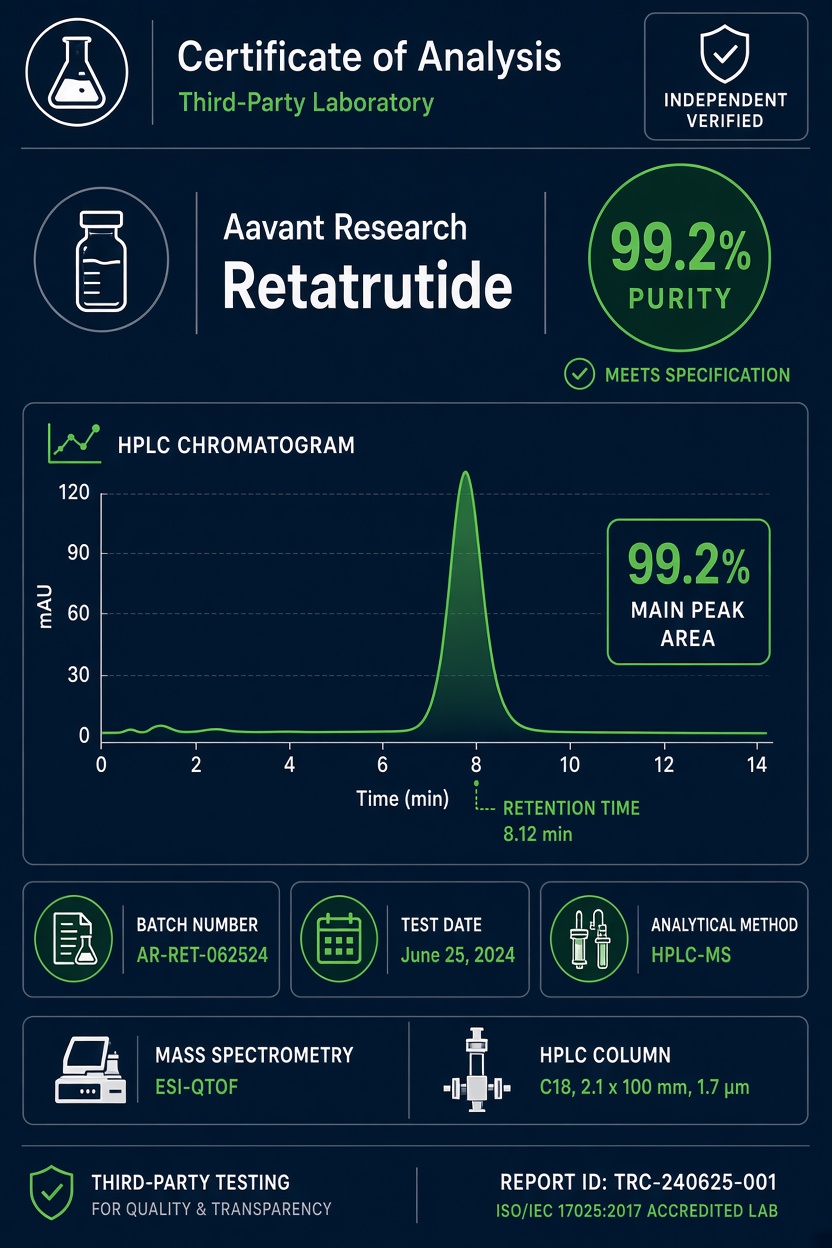
- Aavant research retatrutide is a lyophilized research peptide, typically listed at 98% purity or higher by HPLC, with batch-specific COAs published on the vendor site.
- Retatrutide is an investigational GLP-1 receptor agonist class molecule with no FDA approval; every vial is sold strictly for in vitro research and authorized animal-model studies.
- Community trackers such as Finnrick have catalogued aavant research retatrutide, giving laboratories an external reference point beyond the vendor’s own claims.
- Pricing sits in the mid-market tier; independent HPLC-MS spot-checks remain the buyer’s responsibility.
- Lyophilized vials store best at minus 20 degrees Celsius, desiccated and protected from light.
What Is Aavant Research Retatrutide?
Aavant research retatrutide is the catalog version of retatrutide sold by Aavant Research, an online research-chemical supplier operating at aavantacr.com. The product ships as a lyophilized peptide in sealed vials, most commonly listed in 10 mg and 20 mg formats, and is labeled for laboratory research use only.
The underlying molecule is a 39-amino-acid synthetic peptide engineered as a triple agonist at the glucose-dependent insulinotropic polypeptide (GIP), glucagon-like peptide-1 (GLP-1), and glucagon receptors (PubChem). In a 2023 phase 2 trial, pharmaceutical-grade retatrutide produced dose-dependent metabolic effects under controlled clinical conditions (New England Journal of Medicine). Those data describe a GMP trial material; they do not describe any research-chemical product, including aavant research retatrutide.
The triple-agonist design is what makes retatrutide analytically interesting. GLP-1 receptor agonist activity is shared with earlier incretin peptides, but retatrutide adds glucagon-receptor activity on a GIP/GLP-1 backbone, and its fatty-acid side chain extends circulating half-life in pharmacokinetic models. For assay designers, this means receptor-binding panels must cover three targets rather than one, and reference-material purity directly affects EC50 estimates in competitive binding assays.
Within the vendor’s catalog, aavant research retatrutide sits alongside other incretin-class peptides. Laboratories comparing mechanisms across this class can review our tirzepatide vs retatrutide research comparison for structural and receptor-binding differences. For broader peptide classification questions, see Are Peptide and Protein Hormones the Same? 7 Essential Facts.
The seven quality checks this page applies are: (1) vendor legitimacy, (2) independent lab testing, (3) verified purity percentage, (4) handling and storage fit, (5) community reputation, (6) competitive positioning, and (7) sourcing risk. Each is covered in its own section below.
Vendor legitimacy is measurable rather than impression-based: published batch COAs, consistent fulfillment, transparent contact channels, and third-party visibility. Aavant Research publishes COAs on its product pages and maintains a public catalog at aavantacr.com. Community databases such as Finnrick, which aggregate independent test results and vendor reports, have included entries for aavant research retatrutide, allowing cross-referencing beyond the vendor’s own presentation.
None of these signals constitutes proof. A published COA can be outdated, borrowed from another supplier, or fabricated outright, and community listings reflect community submissions rather than audits. The sound approach is to treat legitimacy as a hypothesis: order small, verify documentation, and confirm one sample independently before scaling any purchase of aavant research retatrutide.
How Is Aavant Research Retatrutide Tested?
Third-party lab testing is the central quality claim behind aavant research retatrutide. The vendor publishes a Certificate of Analysis (COA) per batch, typically reporting identity by mass spectrometry and purity by high-performance liquid chromatography (HPLC). A legitimate COA names the testing laboratory, the methods used, the batch or lot number, and the test date.
| COA field | What it establishes | Red flag to watch |
|—|—|—|
| Batch/lot number | Links the vial in hand to the document | Vial lot does not match COA |
| Purity percentage (HPLC) | Share of peak area attributable to target peptide | No chromatogram, or purity below 95% |
| Mass spectrometry | Confirms molecular weight matches retatrutide | Identity section missing |
| Testing laboratory | Accountability for the result | Unnamed or unverifiable lab |
| Test date | Freshness of the data | COA older than the batch it describes |
A purity percentage of 98% or higher by HPLC is the conventional threshold for research-grade peptides, and published aavant research retatrutide COAs have generally reported values in the 98 to 99% range. That figure describes the sample submitted to the laboratory, not necessarily every vial shipped.
The strongest verification is independent. Laboratories can submit a vial sample to an analytical service — Janoshik Analytics is a commonly used option, as are university core facilities — for HPLC-MS confirmation. At roughly $100 to $250 per analysis, spot-checking one vial per batch of aavant research retatrutide converts vendor claims into laboratory-owned data. For a broader sourcing and QC framework, see Exogenous Peptides: Complete Sourcing and QC Guide (2026).
What Analytical Methods Are Used?
HPLC with UV detection is the workhorse for purity assessment because it separates peptide species by hydrophobicity and quantifies the target peak area. Mass spectrometry, usually MALDI-TOF or LC-MS, confirms the molecular weight against the theoretical mass of retatrutide. A COA that reports both methods is stronger than one that reports only HPLC.
Some laboratories prefer UPLC for higher resolution, but HPLC remains acceptable for research-grade material. The key is that the method and column are documented, so the result can be reproduced or audited. If the COA does not state the column, gradient, or detection wavelength, the purity figure carries less weight.
A complete analytical file would also include endotoxin screening, residual-solvent analysis, and water content, but research-chemical COAs rarely extend beyond identity and purity. Laboratories running cell-culture assays should note this gap: a 99% HPLC figure says nothing about bacterial endotoxin, which can confound cytokine readouts. Where endotoxin sensitivity matters, request LAL testing data or arrange it independently before the material enters cell-based workflows.
Finally, a COA describes one batch at one time point. Purity can drift with storage and transit, and a valid certificate for batch A says nothing about batch B. Institutions with recurring retatrutide needs should budget for periodic re-testing rather than treating a single COA as permanent assurance for aavant research retatrutide.
💡 Key Takeaway: How Is Aavant Research Retatrutide Tested?
How Should Laboratories Handle Aavant Research Retatrutide?
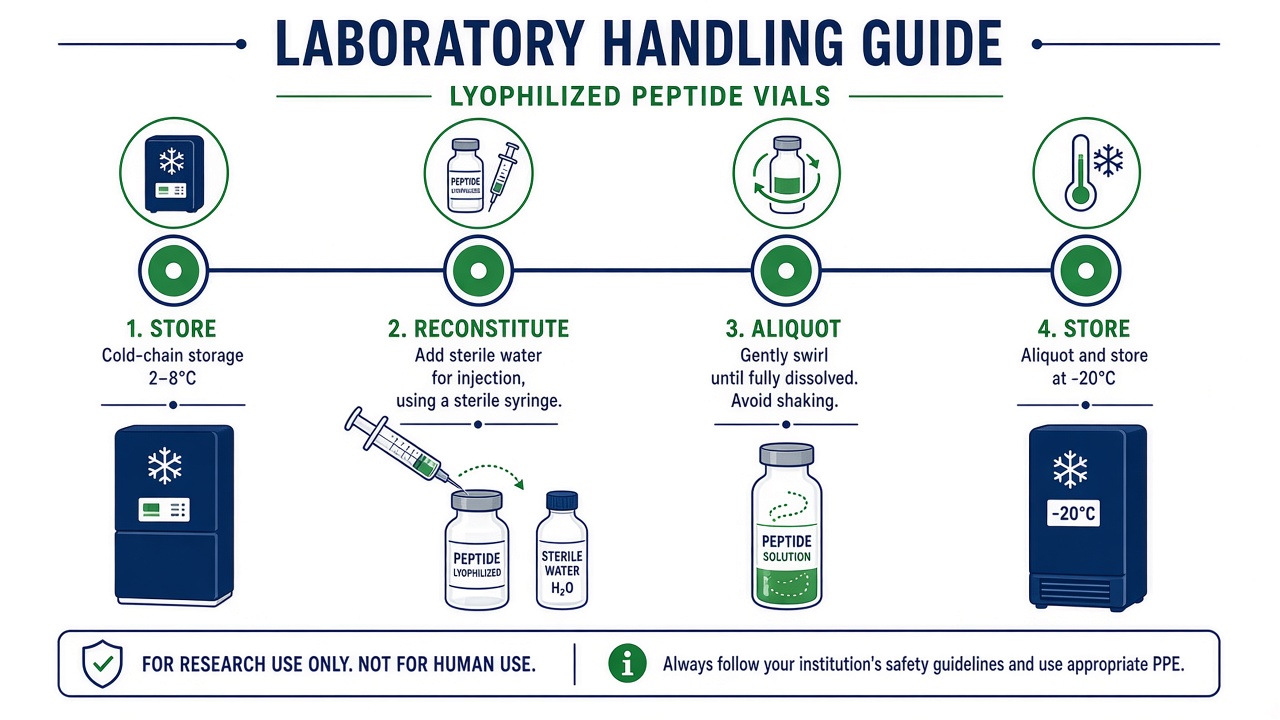
Handling practice for aavant research retatrutide follows standard lyophilized-peptide protocol used across in vitro research laboratories. Staff should wear appropriate personal protective equipment, work in a clean environment, and log every vial against its COA in the inventory system on receipt.
- Store lyophilized vials at minus 20 degrees Celsius, desiccated, protected from light.
- Let each vial equilibrate to room temperature before opening to limit condensation.
- Reconstitute with bacteriostatic water or the buffer specified by the assay, directing the stream against the vial wall and swirling gently; do not vortex.
- Hold reconstituted solutions at 2 to 8 degrees Celsius and use them within the window validated for the assay; avoid repeated freeze-thaw cycles.
These steps protect the peptide’s structural integrity and reduce variability in downstream assays. Because aavant research retatrutide is supplied as a lyophilized powder, improper storage or aggressive reconstitution can damage the molecule before any assay begins.
Storage and Reconstitution Quick Reference
| Condition | Recommendation | Reason |
|—|—|—|
| Lyophilized storage | Minus 20 degrees Celsius, desiccated, dark | Prevents hydrolysis and oxidation |
| Pre-opening | Equilibrate to room temperature | Avoids condensation inside vial |
| Reconstitution solvent | Bacteriostatic water or assay-specific buffer | Matches downstream assay requirements |
| Mixing | Gentle swirl, never vortex | Prevents aggregation and shear damage |
| Reconstituted storage | 2 to 8 degrees Celsius | Slows degradation |
| Freeze-thaw | Avoid repeated cycles | Preserves bioactivity |
Laboratories should also document storage conditions in the same record as the COA, so that a purity claim can be tied to actual handling history. If a batch of aavant research retatrutide has been in transit for extended periods or exposed to ambient temperature, independent verification becomes even more important.
What Do Community Reports Say About Aavant Research?
Community reporting on aavant research retatrutide is available through independent trackers and forums, most notably Finnrick. Finnrick aggregates user-submitted test results, vendor COAs, and anecdotal quality feedback for research peptides, creating a searchable external record that laboratories can consult before purchasing.
The value of community reports is not that they replace analytical testing. A forum thread can contain outdated, biased, or mistaken information. However, when multiple independent entries for aavant research retatrutide show consistent purity values and fulfillment reliability, the pattern adds weight to the vendor’s own COA claims.
How to Use Community Data
Use community reports as a screening tool, not a final verdict. Cross-reference any community entry with the vendor’s published COA, the lot number on the vial, and an independent spot-check where possible. A single negative report about aavant research retatrutide should not disqualify a vendor, but repeated unresolved complaints about mismatched lots or missing COAs should raise a red flag.
A useful checklist for evaluating community feedback includes: date of report, lot number mentioned, testing method used, purity result, and whether the reporter verified the vendor independently. Reports that lack these details carry less weight than detailed, dated entries with chromatograms or mass spectra attached.
How Does Aavant Research Retatrutide Compare to Other Vendors?
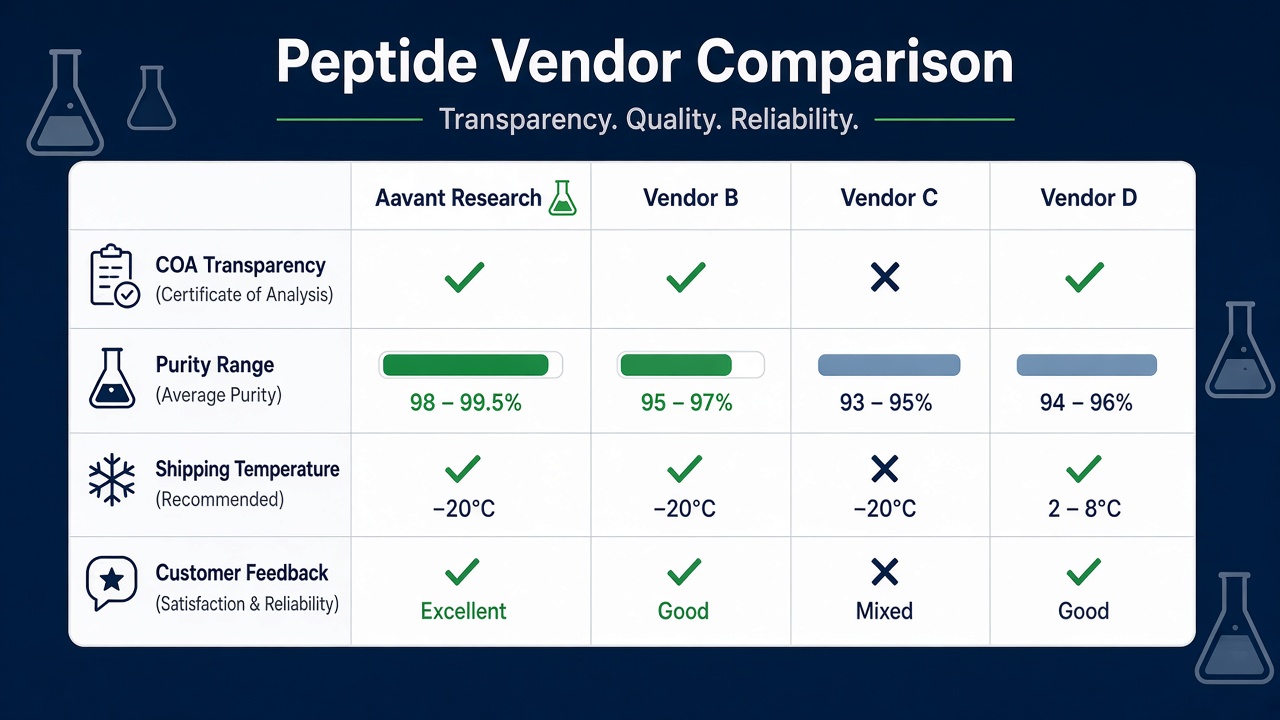
Aavant research retatrutide occupies a mid-market position among research-chemical suppliers. Pricing is neither the cheapest nor the highest, which is typical for vendors that publish batch-specific COAs and maintain a public catalog. The table below summarizes how aavant research retatrutide stacks up against common competitor tiers.
| Comparison dimension | Aavant Research retatrutide | Budget vendor | Premium vendor |
|—|—|—|—|
| Published COA per batch | Yes, with lot numbers | Often missing | Yes, with full analytical panel |
| Independent community entries | Finnrick listings | Sparse | Moderate |
| Typical HPLC purity claim | 98 to 99% | Often unverified or below 95% | 99% plus, with endotoxin data |
| Customer support | Public contact channels | Limited | Dedicated account |
| Price tier | Mid-market | Low | High |
Note: This table is a general comparison based on common vendor patterns, not a claim about any specific competitor.
The key difference between aavant research retatrutide and premium-tier offerings is often the depth of analytical documentation. Premium vendors may include endotoxin, water content, and residual solvent data, while Aavant Research typically publishes identity and purity only. Laboratories with sensitive cell-based assays may need to arrange supplemental testing regardless of vendor.
For researchers evaluating broader peptide evidence quality, Exploring Peptides: The Complete Evidence Review (2026) offers a framework for comparing vendor claims across the peptide category.
💡 Key Takeaway: How Does Aavant Research Retatrutide Compare to Other Vendors?
What Are the Risks and Red Flags When Sourcing Retatrutide?
Sourcing aavant research retatrutide carries the same risks as any unapproved research chemical. Because retatrutide has no regulatory approval anywhere in the world, there is no FDA or EMA batch review, no pharmacopeial monograph, and no legal guarantee of content. Supplier quality controls are the only barrier between a laboratory and a mislabeled vial.
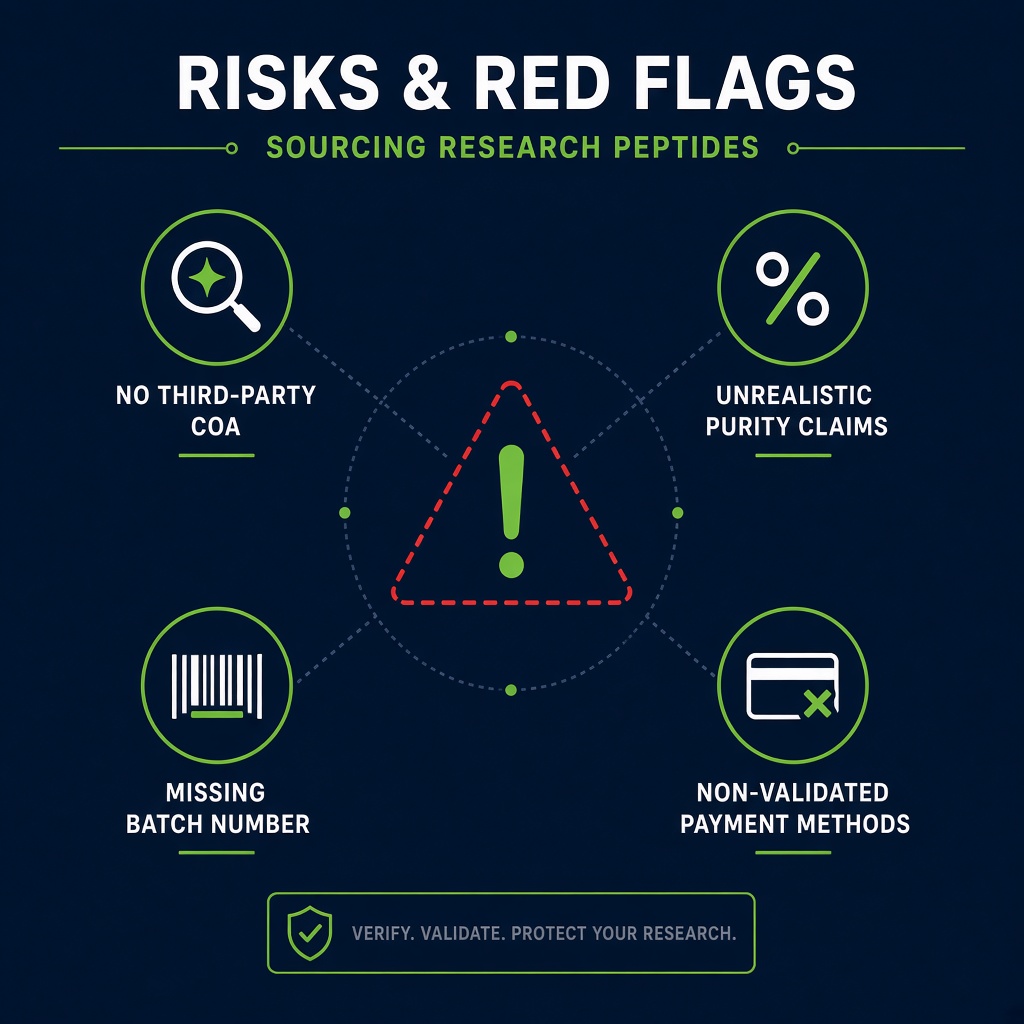
Red flags to watch for when ordering aavant research retatrutide include: COAs that lack a batch number, purity claims without a chromatogram, unverifiable testing laboratories, prices far below the market median, and vendors that refuse to answer questions about storage or handling.
Another risk is peptide degradation during shipping. Lyophilized peptides can tolerate brief ambient excursions, but extended heat exposure or moisture ingress can reduce purity before the vial reaches the lab. Requesting a lot-specific COA dated close to the shipping date is one way to reduce this risk for aavant research retatrutide.
Sourcing Risk Checklist
- Verify the COA batch number against the vial lot on receipt.
- Confirm the testing laboratory is named and searchable.
- Request a chromatogram if the COA lacks one.
- Compare pricing against at least two other research-chemical suppliers.
- Ask about shipping conditions, especially in warm months.
- Reject any vendor that implies human or veterinary use.
Laboratories should also confirm that any supplier of aavant research retatrutide states clearly that the product is for research use only. Vendors that imply human or veterinary applications should be avoided immediately; such language is both unsafe and outside the scope of legitimate research supply. To learn how to verify whether any peptide has published research, see Are There Studies on It? 7 Essential Ways to Check (2026).
Is Aavant Research Retatrutide Right for Your Laboratory?
Whether aavant research retatrutide is right for a given laboratory depends on the assay requirements, the analytical budget, and the tolerance for independent verification. For receptor-binding studies that can tolerate mid-market documentation and benefit from published COAs, aavant research retatrutide may be a reasonable shortlist candidate.
Laboratories that require endotoxin-free material, full residual solvent data, or pharmacopeial-grade documentation should look beyond any research-chemical supplier. In those cases, the missing analytical parameters may outweigh the convenience of a published COA for aavant research retatrutide.
Decision Matrix for Procurement
| Criterion | Proceed with aavant research retatrutide | Consider alternative vendor |
|—|—|—|
| Assay type | Receptor binding, enzyme assays, Western blot | Cell culture with strict endotoxin limits |
| Analytical budget | Can afford one HPLC-MS spot-check per batch | No independent testing budget |
| Documentation need | Identity and purity COA sufficient | Full panel including endotoxin and residual solvents |
| Institutional policy | Allows research chemicals from non-GMP vendors | Requires GMP or ISO certification |
A practical decision framework includes three questions: Does the assay require endotoxin data? Is the budget sufficient for one independent HPLC-MS spot-check per batch? Does the institution allow procurement from vendors without GMP certification? If the answers are no, yes, and yes, then aavant research retatrutide can proceed to a small trial order.
FAQ
What is aavant research retatrutide used for?
Aavant research retatrutide is sold strictly for in vitro laboratory research and authorized animal-model studies. It is not approved for human use and has no diagnostic or therapeutic indication.
Does the product come with a COA?
Yes. The vendor publishes batch-specific Certificates of Analysis that typically report identity by mass spectrometry and purity by HPLC, generally in the 98 to 99% range.
How should I store this peptide?
Store lyophilized vials at minus 20 degrees Celsius, desiccated and protected from light. After reconstitution, hold solutions at 2 to 8 degrees Celsius and avoid repeated freeze-thaw cycles.
Can I verify purity independently?
Yes. Laboratories can submit a vial sample to an analytical service such as Janoshik Analytics for HPLC-MS confirmation, typically costing $100 to $250 per analysis.
Is this product FDA approved?
No. Retatrutide has no regulatory approval anywhere in the world and is available only as a research chemical.
Topics covered in this article:
Ready to Take the Next Step?
Every product includes lot-specific documentation and third-party purity testing.
Explore Our Research Products →Free shipping on qualifying orders · Batch COA on request