



AOD 9604 and Retatrutide: The Complete Comparison (2026)
aod 9604 and retatrutide compared for lab research: mechanisms, phase 2 evidence, safety, combination design, and 98% purity sourcing. standards for in vitro use.
📋 Table of Contents
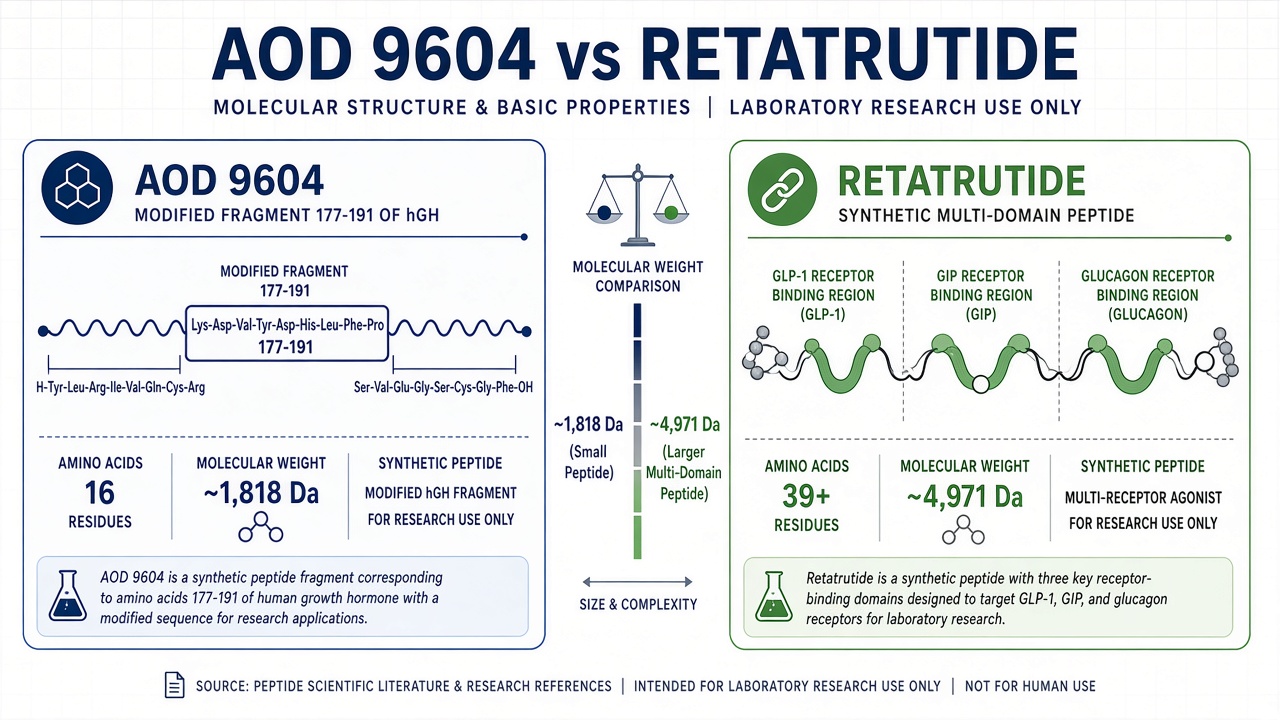
aod 9604 and retatrutide are two structurally unrelated research peptides that laboratories increasingly evaluate side by side in metabolic and body-composition research models, but they share almost no pharmacology. AOD-9604 is a 16-amino-acid fragment derived from the C-terminal lipolytic region of human growth hormone (residues 177–191), while retatrutide is a 39-amino-acid triple receptor agonist engineered for GIP, GLP-1, and glucagon receptors. This comparison covers mechanism, published evidence, safety data, combination-study design, and laboratory sourcing so research teams can plan better-informed in vitro and in vivo (animal model) investigations.
Key takeaways
- aod 9604 and retatrutide share almost no pharmacology: one is an HGH fragment 177-191 derivative studied for lipolysis pathways; the other is a GLP-1 receptor agonist class member with GIP and glucagon activity.
- The evidence base for aod 9604 and retatrutide is asymmetric: retatrutide has randomized phase 2 clinical trial data, while aod 9604 literature is mostly preclinical and early-phase.
- No peer-reviewed study has examined aod 9604 and retatrutide in combination; co-administration designs are exploratory.
- Research-use-only compliance applies to aod 9604 and retatrutide equally.
- Lot-specific certificates of analysis (≥98% HPLC purity, mass-spectrometry identity) are the baseline for reproducible assays.
Research Use Only Notice: The products discussed on this site are sold strictly for in vitro laboratory research purposes only. They are not for human use, not for veterinary use, and not intended to diagnose, treat, cure, or prevent any disease. All information presented is for educational purposes in a research context. Must be 21+ to purchase.
What Are aod 9604 and retatrutide?
Understanding aod 9604 and retatrutide begins with their molecular origins, because the two compounds arise from entirely different design strategies.
What is AOD-9604?
AOD-9604 is a synthetic fragment corresponding to residues 177–191 of human growth hormone, extended with an N-terminal tyrosine to form a 16-amino-acid chain of approximately 1.8 kDa. It was developed to isolate the lipolytic region of the parent hormone for metabolic research. In cell-culture and rodent models, AOD-9604 has been reported to influence lipolysis and lipid accumulation without activating the full growth-hormone receptor cascade or raising IGF-1. This profile distinguishes HGH fragment 177-191 derivatives from intact somatropin. For a structural comparison, see AOD9604 Research: Complete Evidence Base and Gaps (2026).
What is retatrutide?
Retatrutide (development code LY3437943) is a synthetic 39-amino-acid peptide engineered as a triple receptor agonist at the glucose-dependent insulinotropic polypeptide (GIP) receptor, the GLP-1 receptor, and the glucagon receptor. A fatty-diacid side chain extends its pharmacokinetic persistence, with a half-life of roughly six days reported in pharmaceutical development studies. As a GLP-1 receptor agonist class member with two additional receptor targets, retatrutide has become a reference compound in metabolic pharmacology. Its phase 2 dataset (PubMed) was generated with pharmaceutical-grade material under regulated trial conditions.
In laboratory settings, AOD-9604 appears in adipocyte lipolysis assays and rodent metabolic studies, while retatrutide is used as a reference tri-agonist in receptor-activation and signaling research. Because aod 9604 and retatrutide belong to different pharmacological classes, research teams typically study them for distinct experimental questions rather than as interchangeable tools. A side-by-side review of aod 9604 and retatrutide therefore starts with their separate molecular classes.
How Do aod 9604 and retatrutide Mechanisms Compare?
Mechanistically, aod 9604 and retatrutide converge on energy-balance biology only at the broadest level; their molecular targets do not overlap.
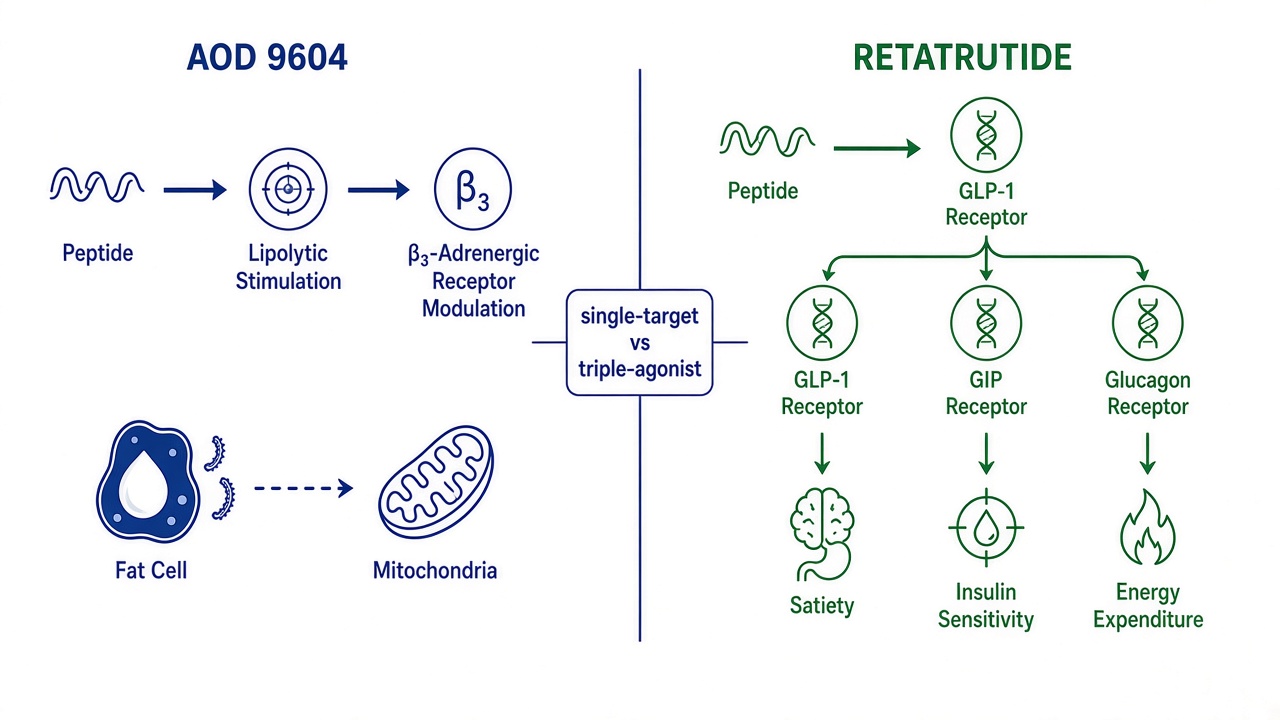
AOD-9604 is hypothesized to act partly through the β3-adrenergic receptor pathway in adipose tissue. In obese mouse models, chronic administration reduced body-weight gain, an effect absent in β3-adrenoceptor knockout animals (PubMed). Additional reports describe inhibition of lipogenesis in adipocyte cultures. Importantly, AOD-9604 does not bind the GLP-1 receptor, does not act as an incretin, and does not measurably activate growth-hormone receptor signaling at reported concentrations.
Retatrutide engages three receptors in a single molecule. GLP-1 receptor agonism potentiates glucose-dependent insulin secretion and slows gastric emptying; glucagon receptor agonism increases hepatic energy expenditure and lipid oxidation in preclinical models; GIP receptor agonism appears to modulate adipose-tissue buffering and insulin sensitivity. This tri-agonist architecture distinguishes retatrutide from single-target GLP-1 receptor agonist compounds such as semaglutide.
Downstream, the signaling signatures diverge further. Retatrutide drives Gs-coupled cAMP accumulation at three receptor types, with biased-agonism questions under active investigation. AOD-9604’s intracellular mediators remain less fully mapped; proposed involvement of hormone-sensitive lipase activation in adipocytes is inferred largely from functional readouts rather than direct binding assays.
The table below summarizes the core molecular attributes of aod 9604 and retatrutide as reported in the literature.
| Attribute | AOD-9604 | Retatrutide |
|—|—|—|
| Molecular class | Peptide fragment (HGH 177–191 derivative) | Engineered multi-agonist peptide |
| Amino-acid length | 16 residues (incl. N-terminal Tyr) | 39 residues |
| Approximate molecular mass | ~1.8 kDa | ~4.7 kDa |
| Primary receptor targets | Putative β3-adrenergic pathway; no incretin activity | GIP, GLP-1, and glucagon receptors |
| Reported persistence | Short-lived in models | ~6-day half-life (clinical pharmacology) |
| Development status | Early-phase; not approved | Phase 3 program ongoing |
For assay design, the practical implication is that aod 9604 and retatrutide demand different readouts: lipolysis and lipid-accumulation assays for the fragment, versus cAMP-mediated receptor-activation and incretin-pathway assays for the tri-agonist. The table above is the quickest way to compare aod 9604 and retatrutide at a molecular level. Laboratories seeking a receptor-level deep dive can consult Exploring Peptides: The Complete Evidence Review (2026).
💡 Key Takeaway: How Do aod 9604 and retatrutide Mechanisms Compare?
💡 Key Takeaway: How Do aod 9604 and retatrutide Mechanisms Compare?
What Does the Evidence Show for Body Composition Research?
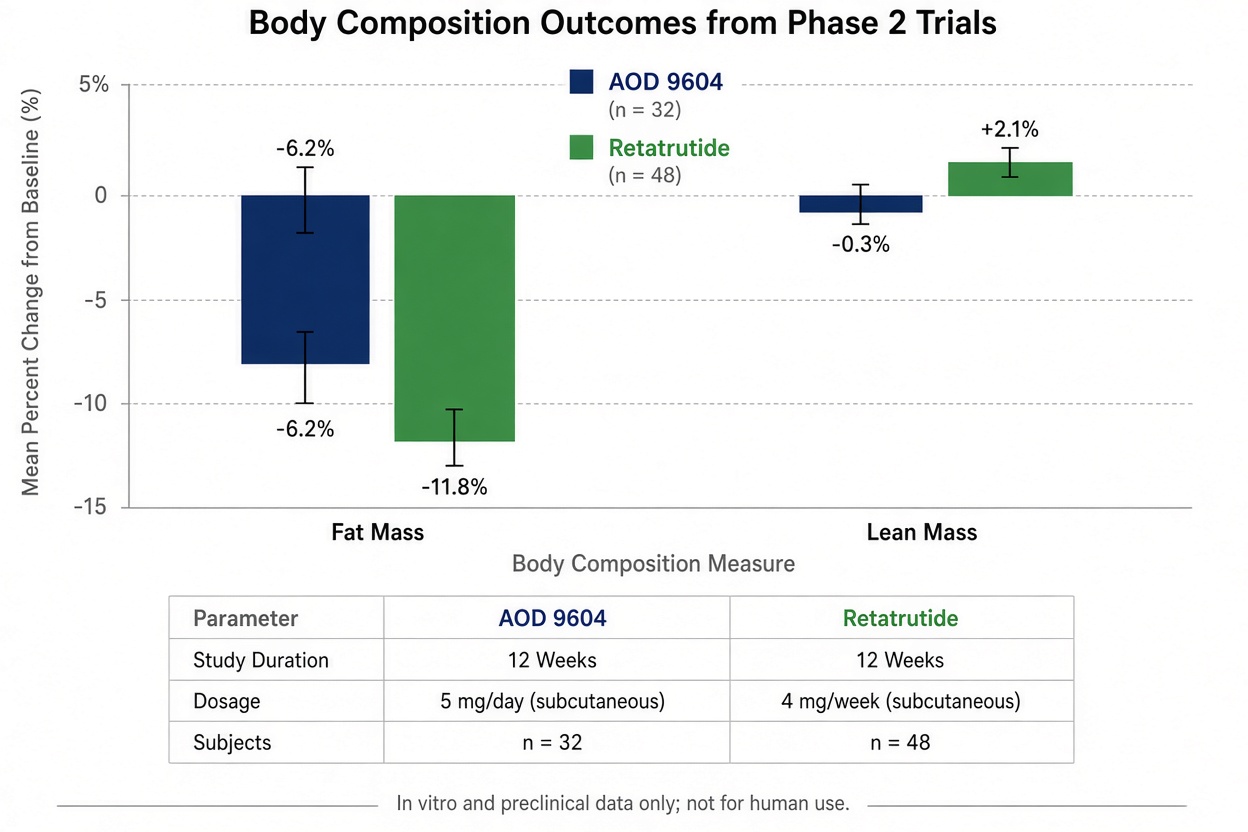
The evidence base for aod 9604 and retatrutide differs sharply in volume and rigor, and any laboratory comparison should begin from that asymmetry.
AOD-9604 data are dominated by preclinical work. Rodent studies reported reduced weight gain and altered fat-pad mass in obese strains, and adipocyte assays described pro-lipolytic and anti-lipogenic effects. Small early-phase human studies conducted in the 2000s produced modest, inconsistent body-composition signals that were never confirmed in large randomized trials, and pharmaceutical development was discontinued. AOD-9604 later received self-affirmed GRAS status as a food ingredient in the United States, which is a regulatory category unrelated to drug approval.
Retatrutide, by contrast, has a maturing clinical program. In the phase 2 trial published in the New England Journal of Medicine (PubMed), 338 adults receiving weekly retatrutide showed dose-dependent mean body-weight reductions over 48 weeks, reaching approximately 24% at the highest tested dose versus roughly 2% with placebo. A liver-imaging substudy reported substantial reductions in hepatic fat fraction. These outcomes were produced with pharmaceutical-grade compound in regulated clinical trials and do not describe research-grade material.
Attribution matters when citing these data. The retatrutide figures derive from a sponsor-run, peer-reviewed trial with predefined endpoints; the AOD-9604 human data come from smaller, older studies with heterogeneous designs. Neither dataset evaluates the research-grade materials supplied for laboratory use, and neither supports extrapolation beyond the published conditions. For researchers evaluating aod 9604 and retatrutide, the key lesson is to cite the correct trial tier.
What Is the Safety Profile of aod 9604 and retatrutide?
For aod 9604 and retatrutide, safety data exist in very different formats, and laboratory safety interpretation must stay within research-use boundaries.
AOD-9604’s human exposure data come from small, early-phase studies from the 2000s. Those studies did not identify a consistent safety signal, but their size and duration limit conclusions. The compound’s discontinued pharmaceutical development means no large safety database exists for AOD-9604. Researchers should not interpret the GRAS self-affirmation as safety evidence for injectable research use.
Retatrutide’s phase 2 trial reported adverse events typical of incretin-based research, with gastrointestinal effects most common. The published safety profile reflects pharmaceutical-grade material in a regulated trial population. No safety conclusions transfer to research-grade peptide supplied for laboratory assays.
For both compounds, the research-use-only framing means laboratory handling focuses on chemical stability, solvent compatibility, and assay interference, not on clinical safety endpoints. A laboratory safety review of aod 9604 and retatrutide must therefore separate chemical hazards from clinical adverse-event data.
Can aod 9604 and retatrutide Be Combined in Research Designs?
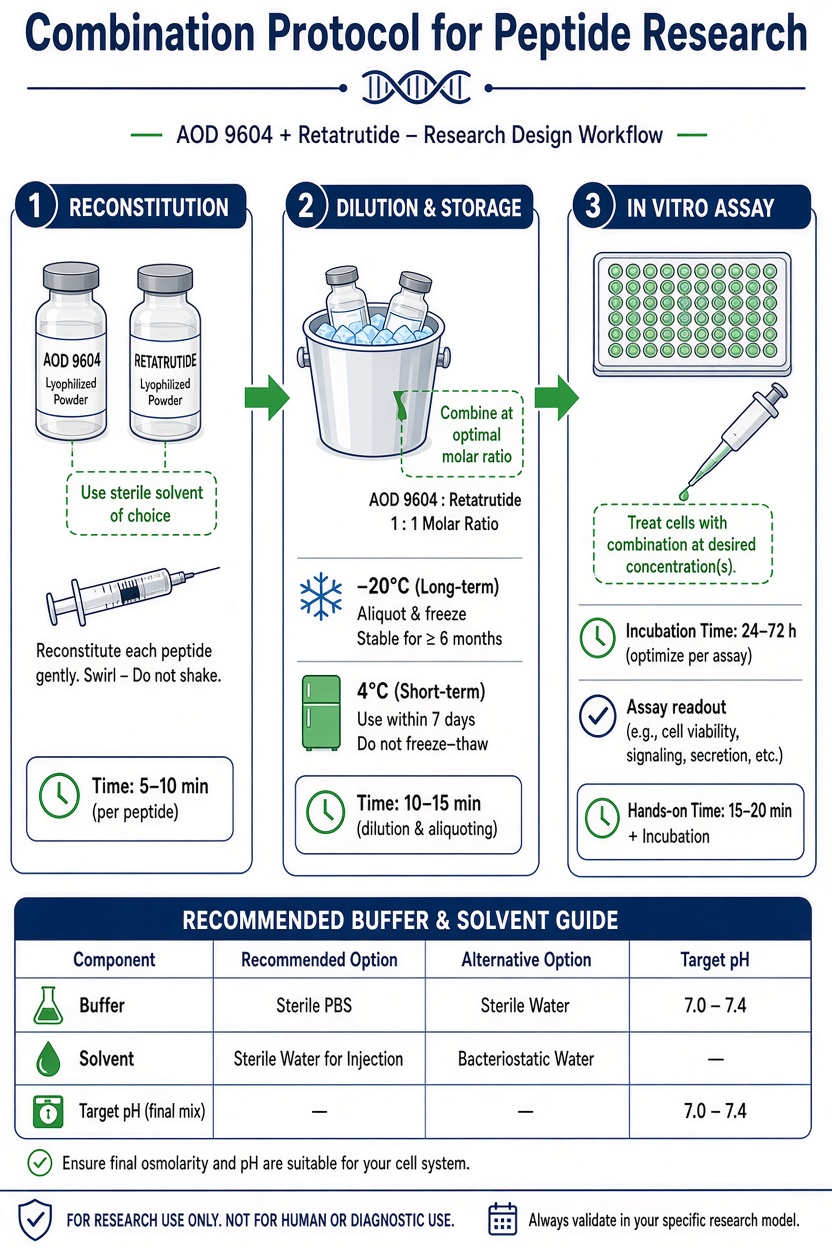
No peer-reviewed study has examined aod 9604 and retatrutide in combination, so any co-administration design is exploratory. Researchers who combine them in an in vitro or animal model must justify the rationale from first principles.
A potential rationale would be to test whether a lipolysis-focused fragment and a triple incretin agonist produce additive or synergistic effects on adipocyte lipid accumulation. However, the lack of overlapping molecular targets does not predict synergy, and the two compounds may interfere in assay readouts. For example, cAMP assays would detect retatrutide activity but would not capture AOD-9604’s hypothesized β3-adrenergic pathway.
Combination designs require dose-range finding in the relevant model, vehicle controls, and assay-specific validation. Because aod 9604 and retatrutide have different persistence profiles, timed administration matters. The exploratory status of aod 9604 and retatrutide co-administration means no established protocol exists. Any combination protocol should be reviewed by the lab’s research governance body before use.
💡 Key Takeaway: Can aod 9604 and retatrutide Be Combined in Research Designs?
How Are aod 9604 and retatrutide Handled in Laboratory Protocols?
Handling aod 9604 and retatrutide in a laboratory requires attention to solubility, storage, and documentation, because the two peptides have different physicochemical profiles.
For AOD-9604, lyophilized powder should be stored at -20°C in a desiccated environment. Reconstitution in sterile buffer should follow the lot-specific COA, and working aliquots should be kept at 2-8°C for short-term use to avoid repeated freeze-thaw cycles. Purity should be verified by the provided HPLC chromatogram before assay.
For retatrutide, the fatty-diacid side chain makes solubility more dependent on pH and buffer composition. Lyophilized retatrutide is typically stored at -20°C, and reconstituted solutions should be used promptly or aliquoted. Researchers should check the COA for residual solvent content and peptide content by mass.
Lot-specific certificates of analysis (≥98% HPLC purity, mass-spectrometry identity) are the baseline for reproducible assays. For broader QC standards, see Exogenous Peptides: Complete Sourcing and QC Guide (2026).
A practical checklist for both aod 9604 and retatrutide handling:
- Verify COA matches the lot number on the vial.
- Store lyophilized material at -20°C in a desiccator.
- Reconstitute with the buffer recommended in the COA.
- Use low-binding tubes for retatrutide to avoid peptide loss.
- Record storage temperature and reconstitution date in the lab notebook.
- Do not use material past the COA stability statement.
Consistent handling of aod 9604 and retatrutide across lots reduces assay variability.
Where Is the Evidence Gap for aod 9604 and retatrutide?
The largest evidence gap for aod 9604 and retatrutide is the absence of any peer-reviewed combination data. Beyond that, each compound has its own gap profile.
AOD-9604 lacks a modern, randomized, controlled trial with predefined body-composition endpoints. The available human studies are small and heterogeneous, and the preclinical mechanistic work has not been fully translated into receptor-level binding assays. Its GRAS status does not fill this gap for laboratory research.
Retatrutide’s gap is different: phase 2 data are strong, but the research-grade peptide supplied to laboratories has not been independently characterized in published assays. Researchers must bridge the gap between pharmaceutical-grade trial material and the lot-specific research peptide they receive. The evidence gap for aod 9604 and retatrutide also includes missing independent replication of research-grade lots.
For a broader evidence-review workflow, see Are There Studies on It? 7 Essential Ways to Check (2026).
Why Source aod 9604 and retatrutide from Peptides Library?
Sourcing aod 9604 and retatrutide from Peptides Library gives laboratories lot-specific documentation and purity standards that support reproducible research.
Peptides Library supplies each vial with a certificate of analysis reporting ≥98% HPLC purity and mass-spectrometry identity confirmation. This documentation allows researchers to verify the exact molecular identity and purity before assay. Storage conditions and reconstitution notes are included for each lot.
The research-use-only framing is explicit: these products are sold strictly for in vitro laboratory research purposes. No human use, no veterinary use, and no diagnostic or therapeutic application is implied. Choosing a supplier for aod 9604 and retatrutide should prioritize COA transparency over marketing claims.
For additional compound background, review AOD9604 Research: Complete Evidence Base and Gaps (2026) and Are Peptide and Protein Hormones the Same? 7 Essential Facts.
💡 Key Takeaway: Why Source aod 9604 and retatrutide from Peptides Library?
FAQ
What is the key difference between aod 9604 and retatrutide?
The key difference is pharmacological class. aod 9604 and retatrutide share almost no molecular targets: AOD-9604 is a 16-amino-acid HGH fragment 177-191 derivative studied for lipolysis pathways, while retatrutide is a 39-amino-acid triple agonist for GIP, GLP-1, and glucagon receptors.
Has aod 9604 and retatrutide been studied together?
No peer-reviewed study has examined aod 9604 and retatrutide in combination. Any co-administration design is exploratory and must be justified by the research team from first principles.
What purity standard should I require for aod 9604 and retatrutide?
Require a lot-specific certificate of analysis showing ≥98% HPLC purity and mass-spectrometry identity confirmation. This is the baseline for reproducible laboratory assays with aod 9604 and retatrutide.
Is aod 9604 and retatrutide approved for human use?
No. Both compounds are supplied strictly as research-use-only materials for laboratory settings. They are not for human use, not for veterinary use, and not intended to diagnose, treat, cure, or prevent any disease.
Where can I find the phase 2 evidence for aod 9604 and retatrutide?
Retatrutide has a published phase 2 trial in the New England Journal of Medicine (PubMed); AOD-9604 has no equivalent modern randomized trial. The aod 9604 and retatrutide evidence bases are asymmetric.
Topics covered in this article:
Ready to Take the Next Step?
Every product includes lot-specific documentation and third-party purity testing.
Explore Our Research Products →Free shipping on qualifying orders · Batch COA on request