


AOD 9604 and Retatrutide: Complete Research Guide (2026)
AOD 9604 and retatrutide compared for laboratory research: mechanisms, lipolysis pathways, safety data, stacking rationale, and sourcing standards.
📋 Table of Contents
AOD 9604 and retatrutide are two distinct research peptides with non-overlapping metabolic pathways: AOD-9604 is a 16-amino-acid growth hormone fragment investigated for lipolysis signaling, while retatrutide is a 39-amino-acid triple agonist at GIP, GLP-1, and glucagon receptors with active phase 3 clinical trial data. This guide compares mechanisms, published evidence, safety findings, stacking rationale, and laboratory handling for in vitro research applications only.
Key takeaways
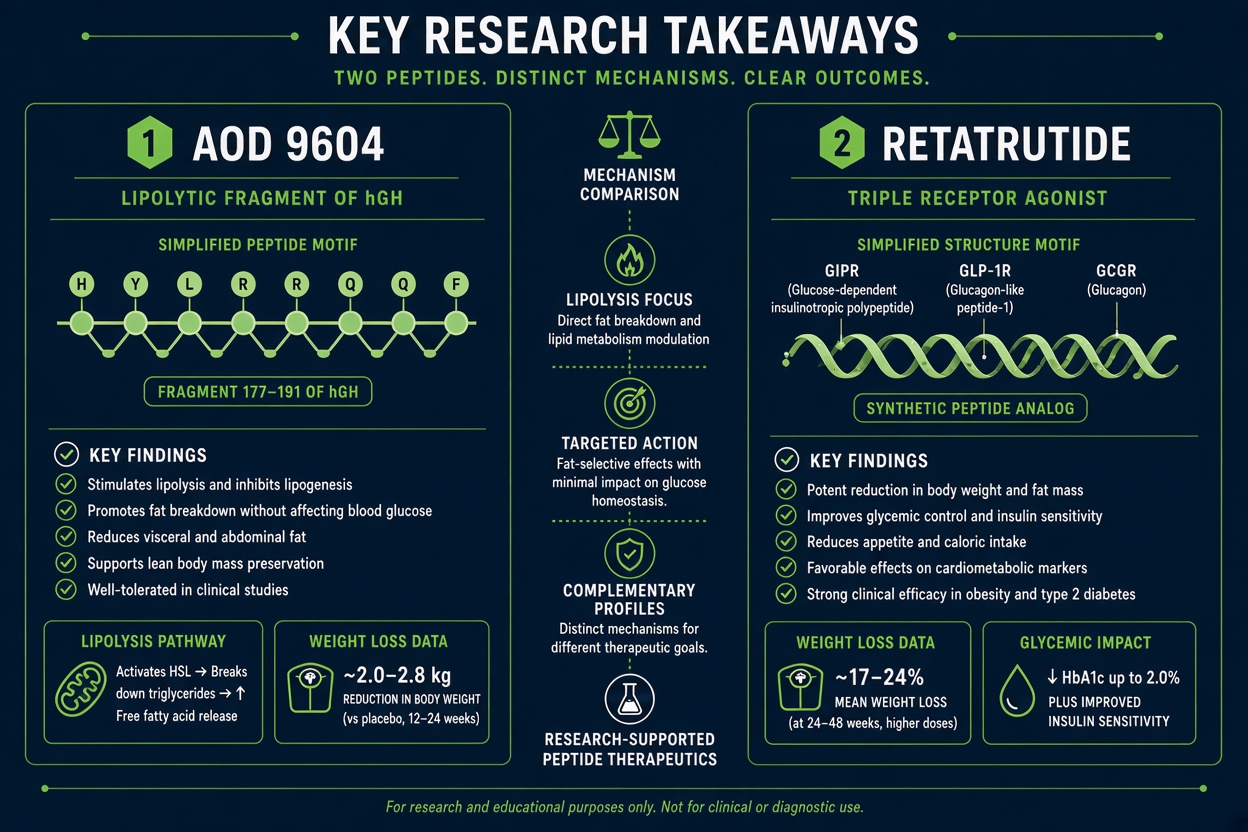
- AOD 9604 and retatrutide engage non-overlapping pathways: a growth-hormone-fragment lipolysis signal versus triple incretin and glucagon receptor agonism.
- Retatrutide has active phase 3 clinical trials; AOD-9604’s obesity drug development was discontinued after phase 2b.
- No peer-reviewed study has examined AOD 9604 and retatrutide in combination; any co-administration design is exploratory.
- Both compounds are supplied strictly as research-use-only materials and are not approved for human or veterinary use.
- Verify ≥98% HPLC purity, mass-spectrometry identity confirmation, and a third-party certificate of analysis before ordering.
What Are AOD 9604 and Retatrutide? Molecular Origins Compared
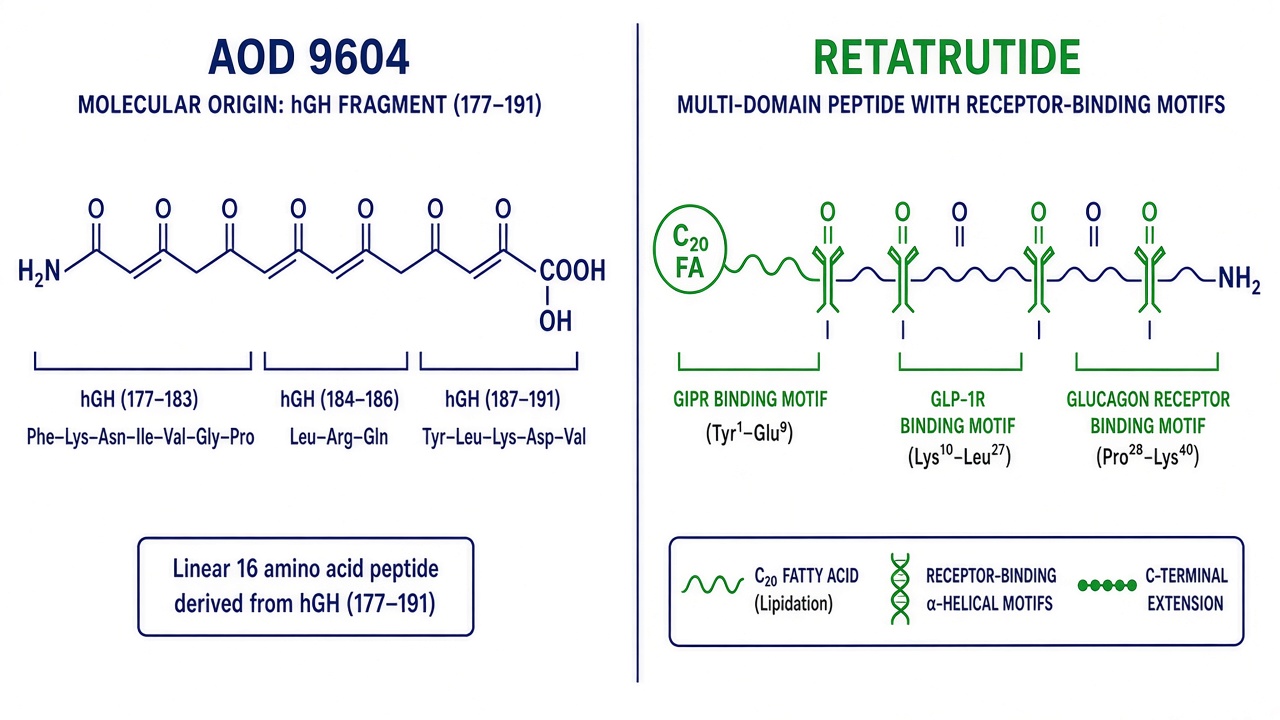
AOD 9604 and retatrutide represent two different strategies in peptide design: a natural hormone fragment versus a rationally engineered multi-receptor agonist. Understanding their molecular origins is the first step in designing comparative assays.
AOD-9604: The Growth-Hormone Fragment
AOD-9604 (Tyr-hGH 177-191) is a synthetic fragment corresponding to amino acids 177-191 of the human growth hormone C-terminus, with an added N-terminal tyrosine. The peptide contains 16 amino acids and has a molecular weight of approximately 1.82 kDa. It was originally developed by Metabolic Pharmaceuticals as an oral anti-obesity candidate.
The fragment was designed to isolate the lipolytic region of growth hormone without activating the full growth hormone receptor axis. Published rodent studies report that AOD-9604 stimulated lipolysis and inhibited lipogenesis without elevating IGF-1 or impairing glucose tolerance. For a deeper evidence review, see AOD9604 Research: Complete Evidence Base and Gaps (2026).
For laboratories evaluating AOD 9604 and retatrutide, molecular origin is the first point of contrast: one is a hormone fragment, the other a rationally engineered multi-receptor agonist. AOD-9604 remains available as a lyophilized reference compound.
Retatrutide: The Triple-Receptor Agonist
Retatrutide (LY3437943) is a 39-amino-acid peptide engineered by Eli Lilly as a triple agonist at the glucose-dependent insulinotropic polypeptide (GIP) receptor, the glucagon-like peptide-1 receptor, and the glucagon receptor. Its molecular weight is approximately 4.73 kDa. As a GLP-1 receptor agonist with additional receptor activity, it extends the pharmacology of earlier single- and dual-agonist incretin compounds.
Retatrutide advanced to phase 3 clinical trials (the TRIUMPH program) after a phase 2 study published in the New England Journal of Medicine reported dose-dependent reductions in body weight over 48 weeks. Research-grade retatrutide is used in receptor binding assays, signaling studies, and comparative incretin pharmacology. For a broader look at peptide and protein hormone distinctions, see Are Peptide and Protein Hormones the Same? 7 Essential Facts.
Understanding AOD 9604 and retatrutide as distinct molecular classes — fragment versus multi-agonist — frames every downstream comparison in this guide.
How Do AOD 9604 and Retatrutide Work? Mechanism Comparison
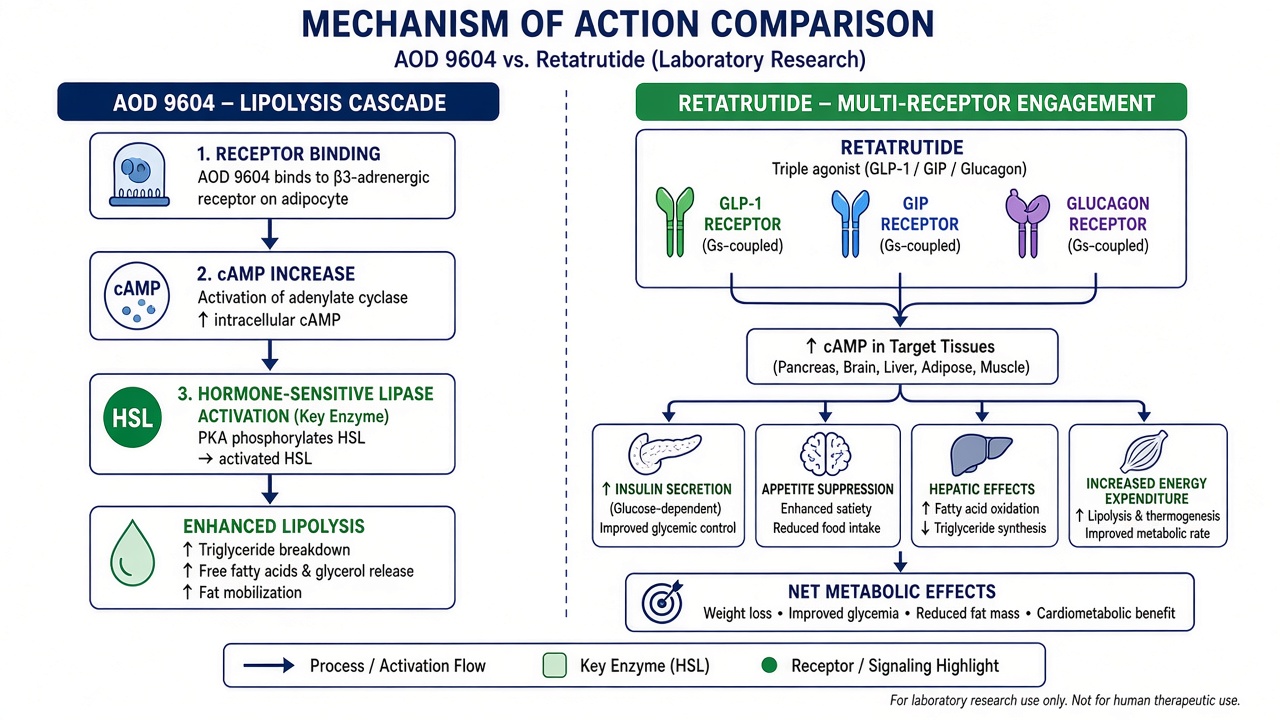
The two compounds illustrate how differently metabolic peptides can be built. The sections below outline each mechanism before a side-by-side attribute table.
AOD-9604 Mechanism: Fragment Lipolysis Signaling
AOD-9604’s proposed mechanism centers on adipose tissue. In a frequently cited Endocrinology study, chronic administration in obese mice reduced body-weight gain and upregulated beta-3-adrenergic receptor expression in fat tissue. Beta-3-adrenergic knockout animals showed no response, evidence that the fragment’s lipolysis signal depends at least partly on this receptor. The compound did not stimulate IGF-1 production, separating it from growth-hormone-mediated growth effects.
Retatrutide Mechanism: Triple Receptor Agonism
Retatrutide works through three metabolically active receptors. GLP-1 receptor agonism modulates appetite signaling and gastric emptying in vivo. GIP receptor activity complements insulinotropic and adipose effects. Glucagon receptor agonism increases energy expenditure in animal models. Receptor binding studies quantify its relative affinity across the three targets, which is why retatrutide is often described as a triple-agonist scaffold.
Multi-receptor agonism matters for study design because each receptor contributes a separable signal. Researchers can dissect individual contributions using selective antagonists or single-receptor knockout cell lines. That option does not exist for the single-pathway fragment.
Because AOD 9604 and retatrutide engage non-overlapping receptor systems, their assay designs differ substantially. AOD-9604 work typically uses adipocyte cultures and lipolysis readouts such as glycerol release. Retatrutide work typically uses receptor-transfected cell lines and cAMP accumulation assays.
Side-by-Side Attribute Table
| Attribute | AOD-9604 | Retatrutide |
|—|—|—|
| Molecular size | 16 amino acids; ≈1.82 kDa | 39 amino acids; ≈4.73 kDa |
| Receptor targets | Beta-3-adrenergic pathway (proposed); no GHR-mediated IGF-1 axis | GIP, GLP-1, and glucagon receptors (triple agonist) |
| Evidence stage | Phase 2b completed; obesity development discontinued | Phase 3 clinical trials ongoing (TRIUMPH program) |
| Primary research focus | Lipolysis, adipocyte signaling, cartilage models | Incretin pharmacology, energy expenditure, body composition |
| Typical format | Lyophilized powder, 5 mg and 10 mg vials | Lyophilized powder, 5 mg and 10 mg vials |
| Storage | −20 °C, desiccated, protected from light | −20 °C, desiccated, protected from light |
| Purity verification | ≥98% HPLC, mass spectrometry | ≥98% HPLC, mass spectrometry |
💡 Key Takeaway: AOD 9604 and retatrutide differ at the receptor level, so experimental readouts and controls must be tailored to each compound.
💡 Key Takeaway: How Do AOD 9604 and Retatrutide Work? Mechanism Comparison
What Does the Weight and Body Composition Evidence Show for AOD 9604 and Retatrutide?
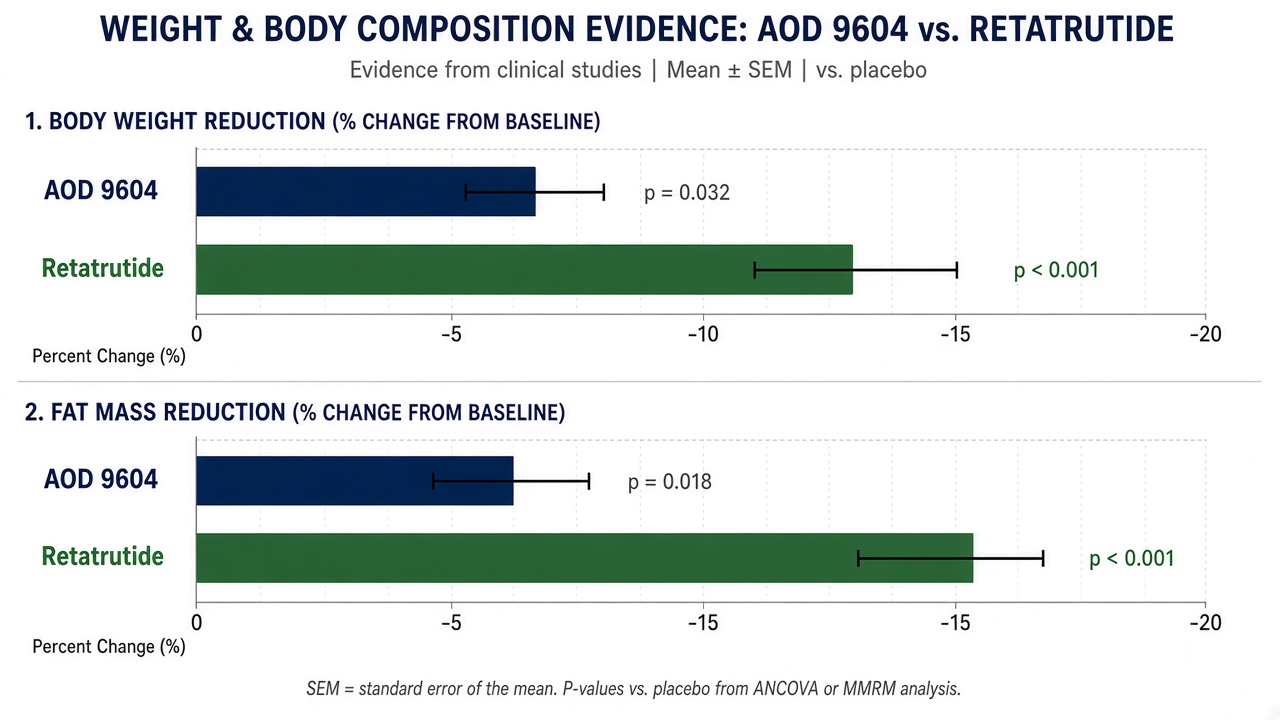
The evidence base for AOD 9604 and retatrutide is asymmetric. In obese mouse models, AOD-9604 reduced weight gain and increased fat oxidation. However, a program of human randomized controlled trials — more than 500 participants across studies — found weight differences versus placebo that were small and not consistently statistically significant over 12 weeks.
Development of AOD-9604 as an obesity drug was discontinued, and later work examined intra-articular applications in osteoarthritis models. AOD-9604 also carries a regulatory history worth noting for compliance planning: it received self-affirmed GRAS status as a food ingredient in the United States, and it appears by name on the WADA Prohibited List. This is relevant for laboratories working in anti-doping assay development.
Retatrutide’s dataset is larger and current. In the phase 2 trial (n = 338), mean weight change at 48 weeks ranged from −8.7% (1 mg) to −24.2% (12 mg) versus −2.1% for placebo. All participants in the 8 mg and 12 mg groups achieved at least 5% reduction. A separate phase 2 trial in type 2 diabetes reported substantial HbA1c and weight reductions at 24 weeks. Primary data are available via PubMed and registered studies via ClinicalTrials.gov.
For researchers prioritizing AOD 9604 and retatrutide in a new project, the practical read is that retatrutide has an active clinical development program, while AOD-9604 has a discontinued obesity program and niche research applications. To check study quality systematically, see Are There Studies on It? 7 Essential Ways to Check (2026).
How Does the Safety Profile of AOD 9604 and Retatrutide Compare?
Safety data for AOD 9604 and retatrutide reflect their different development stages. AOD-9604 completed phase 2b but was discontinued as an obesity candidate. The discontinuation followed efficacy findings, not a single acute safety signal. Its later intra-articular osteoarthritis studies did not lead to regulatory approval. The WADA Prohibited List inclusion and self-affirmed GRAS status are separate from pharmaceutical safety approvals and do not imply human therapeutic use.
Retatrutide is still in active phase 3 evaluation under the TRIUMPH program. In the published phase 2 obesity trial, the most common adverse events were gastrointestinal and dose-dependent. Nausea, diarrhea, vomiting, and constipation were reported most frequently. Some participants experienced transient increases in heart rate. These events were generally mild to moderate and led to low discontinuation rates, but full long-term safety data remain unpublished.
No head-to-head safety comparison of AOD 9604 and retatrutide exists in peer-reviewed literature. Any safety inference in a research context must come from published trial reports and preclinical toxicology data, not from anecdotal use. Both compounds remain research-use-only.
Can You Stack AOD 9604 and Retatrutide in Research Models?
No peer-reviewed study has examined AOD 9604 and retatrutide in combination. Any co-administration design is exploratory and must be justified by mechanistic rationale. The two compounds engage non-overlapping receptor systems: AOD-9604 signals through a beta-3-adrenergic-dependent lipolysis pathway, while retatrutide activates GIP, GLP-1, and glucagon receptors.
A theoretical stacking rationale could test whether fragment-mediated adipose signaling adds to triple-agonist energy expenditure in an in vitro or animal model. However, combination studies require strict controls. Researchers should include single-compound arms, vehicle controls, dose-response curves, and receptor knockout or antagonist conditions where possible.
Because AOD 9604 and retatrutide have different molecular weights and receptor profiles, assay readouts may interact. For example, lipolysis glycerol release could be confounded by glucagon receptor activity from retatrutide. Designing a clean stacking experiment demands separating each pathway’s contribution before combining the two.
💡 Key Takeaway: Can You Stack AOD 9604 and Retatrutide in Research Models?
What Dosing and Handling Considerations Apply to AOD 9604 and Retatrutide in Laboratory Settings?
Both AOD 9604 and retatrutide are supplied as lyophilized powders in 5 mg and 10 mg vials. Storage should be at −20 °C, desiccated, and protected from light. After reconstitution, researchers should follow solvent-specific stability guidance and avoid repeated freeze-thaw cycles. No universal in vivo or in vitro dosing standard exists; doses must be derived from published studies and pilot experiments.
Quality control is critical for comparative work. Before ordering AOD 9604 and retatrutide, verify a third-party certificate of analysis that includes ≥98% HPLC purity and mass-spectrometry identity confirmation. COA availability should cover the specific lot received, not a representative batch. For broader sourcing and QC standards, see Exogenous Peptides: Complete Sourcing and QC Guide (2026).
Handling checkpoints for both peptides include:
- Store lyophilized vials at −20 °C in a desiccated, light-protected container.
- Confirm peptide content and purity via HPLC and mass spectrometry before assay use.
- Document lot number, date of reconstitution, solvent, and storage conditions.
- Use sterile, inert solvents appropriate for peptide solubility.
- Avoid repeated freeze-thaw cycles by aliquoting reconstituted material.
What Does Real-World Data Show for AOD 9604 and Retatrutide?
Real-world data for AOD 9604 and retatrutide are limited because neither compound is approved for human use. AOD-9604 appears on the WADA Prohibited List, which means anti-doping laboratories may encounter it in sample analysis. Its self-affirmed GRAS status applies only to food ingredient use in the United States and does not constitute pharmaceutical approval.
Retatrutide has no real-world clinical dataset outside controlled trials. Phase 3 results from the TRIUMPH program have not yet been published in full. The phase 2 data provide the only peer-reviewed human evidence, and those data come from randomized, placebo-controlled conditions rather than observational use.
For researchers, real-world data should not replace controlled study data. Any mention of AOD 9604 and retatrutide in non-clinical contexts must remain within research-use-only boundaries. Regulatory status and clinical trial registries are the only reliable real-world signals.
Why Source AOD 9604 and Retatrutide from Peptides Library?
Peptides Library supplies AOD 9604 and retatrutide strictly as research-use-only lyophilized powders. Each product is intended for in vitro laboratory studies, not for human or veterinary use. Purchasers must be 21 or older and must confirm that their institution permits handling of research peptides.
Sourcing standards matter because peptide identity and purity directly affect assay reproducibility. Peptides Library provides third-party certificates of analysis with HPLC purity and mass-spectrometry identity data. Vials are shipped desiccated and protected from light, and storage guidance specifies −20 °C for long-term stability. For a complete overview of research peptide categories, see Bibtides: The Complete Research Peptide Library Guide (2026).
Before ordering AOD 9604 and retatrutide, laboratories should request the lot-specific COA, confirm molecular weight and sequence by mass spectrometry, and document storage conditions upon receipt. These steps protect experimental integrity and compliance.
💡 Key Takeaway: Why Source AOD 9604 and Retatrutide from Peptides Library?
FAQ
Are AOD 9604 and retatrutide the same type of peptide?
No. AOD-9604 is a 16-amino-acid growth hormone fragment that signals through a beta-3-adrenergic-dependent lipolysis pathway. Retatrutide is a 39-amino-acid triple agonist at GIP, GLP-1, and glucagon receptors. They share no receptor target and have different molecular weights.
Has AOD 9604 and retatrutide combination research been published?
No peer-reviewed study has examined AOD 9604 and retatrutide in combination. Any stacking design is exploratory and should include single-compound controls, dose-response curves, and pathway-specific readouts.
What purity should I require for AOD 9604 and retatrutide research material?
Verify ≥98% HPLC purity and mass-spectrometry identity confirmation on a third-party certificate of analysis. The COA must match the exact lot received, not a representative batch.
Why was AOD-9604 discontinued as an obesity drug?
AOD-9604 completed phase 2b, but human randomized controlled trials involving more than 500 participants found weight differences versus placebo that were small and not consistently statistically significant over 12 weeks. Development as an obesity drug was discontinued, though later intra-articular osteoarthritis research continued.
What is the current clinical status of retatrutide?
Retatrutide is in active phase 3 clinical trials under the TRIUMPH program. Its phase 2 obesity trial showed mean weight change at 48 weeks from −8.7% to −24.2% versus −2.1% for placebo, with all participants in the 8 mg and 12 mg groups achieving at least 5% reduction.
Topics covered in this article:
Ready to Take the Next Step?
Every product includes lot-specific documentation and third-party purity testing.
Explore Our Research Products →Free shipping on qualifying orders · Batch COA on request