



AOD 9604 vs Frag 176-191: A Complete Comparison (2026)
frag 176 191 vs AOD 9604: Compare structure, mechanisms, evidence, and COA purity standards for research use only. Essential 2026 guide.
📋 Table of Contents
frag 176 191 is the unmodified C-terminal fragment of human growth hormone (hGH 176-191), while AOD-9604 is its stabilized analogue (hGH 177-191 plus an N-terminal tyrosine). For laboratory research comparing frag 176 191 vs AOD-9604, the key differences are sequence fidelity, depth of published evidence, regulatory status, and vendor-verified purity. Both compounds are sold strictly for in vitro and animal-model research use only.
Key takeaways
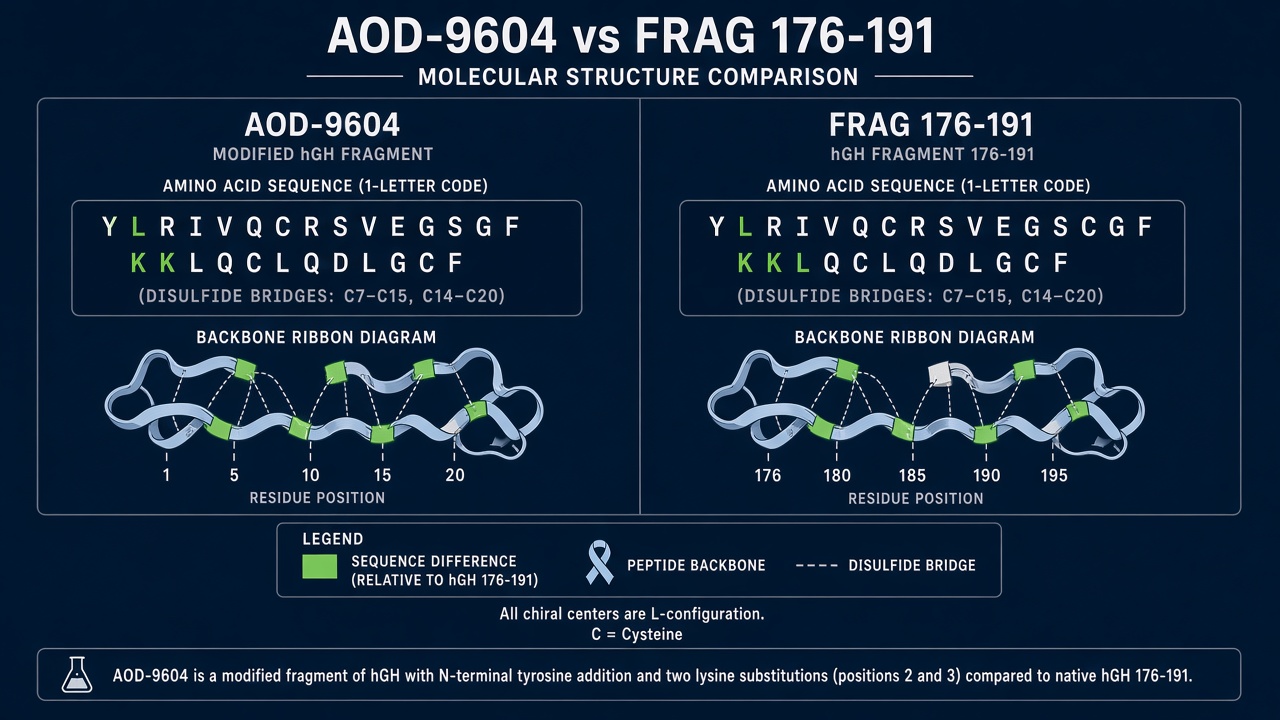
- AOD-9604 and frag 176 191 derive from the same C-terminal region of hGH; AOD-9604 adds an N-terminal tyrosine to hGH 177-191.
- In frag 176 191 vs AOD-9604 comparisons, AOD-9604 carries a deeper evidence base, including rodent studies and a discontinued clinical program.
- Both frag 176 191 and AOD-9604 are studied for lipolysis and lipid-signaling in adipose models, not growth pathways.
- Neither frag 176 191 nor AOD-9604 is FDA-approved; both appear on the WADA Prohibited List as growth hormone fragments.
- Research-grade frag 176 191 should ship lyophilized with ≥98% HPLC purity and mass spectrometry confirmation on a batch-specific COA.
What Are AOD-9604 and frag 176 191 in Laboratory Research?
AOD-9604 is a synthetic peptide corresponding to amino acids 177-191 of human growth hormone, plus an added N-terminal tyrosine. The acronym expands to ‘anti-obesity drug,’ a reference to its original pharmaceutical development program. It is a 16-amino-acid peptide with a molecular weight of approximately 1,815 Da, supplied to laboratories as a lyophilized powder for in vitro and in vivo (animal model) research applications.
frag 176 191, also written hGH Fragment 176-191, is the unmodified C-terminal terminus of the same hormone, comprising residues 176 through 191 with a molecular weight of approximately 1,799 Da. In the literature it is often called the ‘lipolytic fragment,’ because early studies localized growth hormone’s lipid-metabolism signaling to this region of the molecule.
Because both molecules map to the same 15-16-residue window of the growth hormone sequence, the frag 176 191 vs AOD-9604 question is really a question about what the N-terminal tyrosine changes — and what it does not. The sections below examine that difference at the level of structure, mechanism, evidence, and sourcing.
Throughout this guide, frag 176 191 and AOD-9604 are treated strictly as laboratory sourcing and assay-design questions, because that is the only context in which these materials are legitimately supplied. Nothing here constitutes guidance for human or veterinary use.
How Do AOD-9604 and frag 176 191 Differ in Structure and Sequence?
Structurally, AOD-9604 and frag 176 191 differ by a single residue at a single position. AOD-9604 opens with tyrosine followed by hGH residues 177-191; frag 176 191 begins at phenylalanine-176 and runs unmodified to the terminal residue. The added tyrosine was introduced to improve resistance to degradation and to stabilize the conformation believed to engage lipid-metabolism pathways.
The table below summarizes frag 176 191 vs AOD-9604 at the sequence level.
| Attribute | AOD-9604 | frag 176 191 |
|—|—|—|
| Sequence origin | hGH 177-191 + N-terminal tyrosine | hGH 176-191 (unmodified) |
| Length | 16 amino acids | 16 amino acids |
| N-terminal residue | Tyrosine (added) | Phenylalanine-176 |
| Approximate molecular weight | ~1,815 Da | ~1,799 Da |
| Structural modification | N-terminal tyrosine for stability | None |
| Common research designation | AOD-9604, Tyr-hGH 177-191 | hGH Frag 176-191, lipolytic fragment |
!frag 176 191 structure and sequence comparison table
The single-residue distinction matters for assay design. Researchers running structure-activity relationship studies frequently order both compounds so the unmodified frag 176 191 serves as the control against which the tyrosine-stabilized analogue is measured. For a related comparison against the parent hormone region, see our analysis of AOD-9604 vs HGH fragment.
When documenting frag 176 191 vs AOD-9604 in a laboratory notebook or LIMS, record the full sequence designation rather than the shorthand, because catalog naming varies between suppliers.
💡 Key Takeaway: How Do AOD-9604 and frag 176 191 Differ in Structure and Sequence?
How Do AOD-9604 and frag 176 191 Act in Laboratory Models?
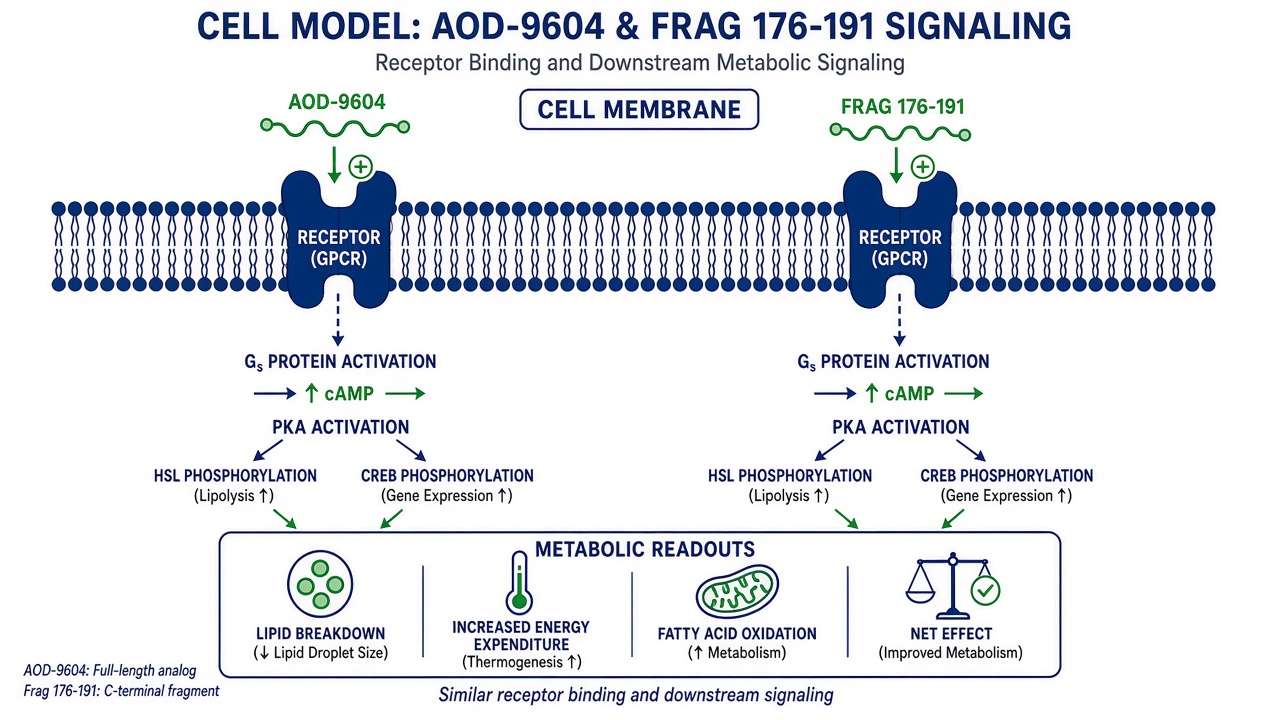
In laboratory settings, both fragments are investigated for effects on lipid metabolism in adipose tissue. Published rodent research reports that AOD-9604 stimulates lipolysis — the enzymatic breakdown of stored triglycerides — and inhibits lipogenesis, the synthesis of new fatty acids, in adipose cell cultures and in obese mouse models.
A frequently cited mechanistic finding for frag 176 191 comes from β3-adrenergic receptor knockout mice: AOD-9604 retained activity in animals lacking this receptor, suggesting pathways at least partially independent of classic β3-adrenergic signaling (Heffernan et al., Endocrinology, 2001). Earlier work reported lipid-metabolism effects after oral administration of the fragment in rodent models (Heffernan et al., 2000). You can search the primary literature on PubMed for AOD9604 and PubMed for frag 176-191.
frag 176 191 shows comparable lipolytic activity in vitro, which is expected given the near-identical sequence. In the frag 176 191 vs AOD-9604 mechanistic literature, the unmodified fragment is generally treated as the baseline molecule, while AOD-9604 is the engineered variant tested for improved stability and reproducibility across assay conditions.
Importantly for research design, published studies report that neither frag 176 191 nor AOD-9604 activates the growth-promoting pathways associated with full-length growth hormone, and neither significantly elevated IGF-1 in the cited preclinical models. This receptor-selectivity profile is a major reason the frag 176 191 vs AOD-9604 comparison appears so often in metabolic assay planning.
For assay developers, the mechanistic summary of frag 176 191 vs AOD-9604 is that both compounds target lipid handling in adipose models through overlapping but not fully characterized signaling routes, making the pair useful for comparative pathway studies.
What Does the Published Evidence Show for frag 176 191 vs AOD-9604?
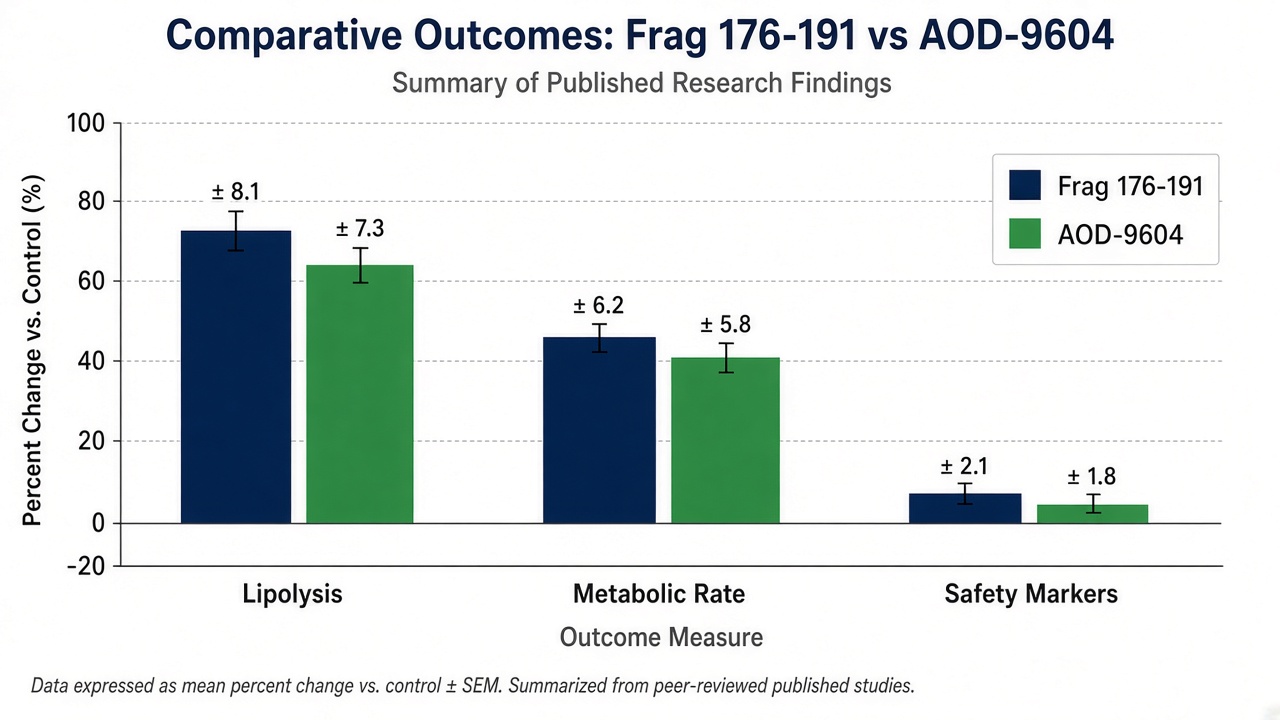
The evidence gap is the clearest separator in frag 176 191 vs AOD-9604. AOD-9604 progressed through a formal drug-development program that included registered clinical trials reported in the scientific literature. Development was discontinued after the program failed to meet its endpoints, and the compound never received regulatory approval in any jurisdiction. That history nonetheless left a substantial data trail on pharmacology, pharmacokinetics, and toxicology.
frag 176 191, by contrast, appears almost exclusively in preclinical work: adipocyte cell cultures, ex vivo adipose-tissue preparations, and rodent models. It remains a widely used in vitro tool for dissecting the lipid-metabolism domain of growth hormone, but it has no comparable clinical research record. You can verify study counts using the Are There Studies on It? 7 Essential Ways to Check (2026) guide.
For researchers, the practical reading of the frag 176 191 vs AOD-9604 evidence is straightforward: AOD-9604 offers a larger reference dataset for assay calibration, while frag 176 191 provides the unmodified sequence for mechanistic control experiments. Neither dataset supports human use, and both compounds are sold strictly for laboratory research.
One citation-management note: when comparing frag 176 191 and AOD-9604, use primary sources such as peer-reviewed journals and regulatory documents rather than vendor marketing pages.
How Are Dosing and Administration Reported for frag 176 191 Research?
Dosing and administration data for frag 176 191 come almost entirely from animal models and cell-culture experiments. Because neither compound is approved for human use, no clinical dosing guidelines exist. Researchers must rely on published rodent and in vitro protocols when designing assays.
In rodent studies of AOD-9604, reported doses ranged from micrograms per kilogram to milligrams per kilogram depending on route and model, but these figures are not transferable to any other species or context. For frag 176 191, most in vitro work uses nanomolar to micromolar concentrations in adipocyte culture media.
Always document the exact batch, purity, and reconstitution solvent when handling frag 176 191, because solubility and stability vary with pH and temperature. Lyophilized powder should be stored at -20°C or lower, and reconstituted solutions should be aliquoted and stored frozen to minimize degradation.
No dosing information in this guide applies to human or veterinary use. The research-use-only framing applies to every mention of frag 176 191 and AOD-9604.
💡 Key Takeaway: How Are Dosing and Administration Reported for frag 176 191 Research?
What Is the Safety and Regulatory Status of frag 176 191 and AOD-9604?
On regulatory status, frag 176 191 and AOD-9604 are treated identically: neither is FDA-approved, and both appear on the WADA Prohibited List as growth hormone fragments. This means laboratories must maintain strict chain-of-custody documentation and ensure that all purchases are for legitimate in vitro research only.
The discontinued AOD-9604 clinical program generated toxicology and safety data in animal models, but those data do not establish safety for any human use. frag 176 191 has no comparable clinical safety dataset, so researchers should treat both compounds as unapproved research chemicals.
For laboratory compliance, verify that your institution’s biosafety and chemical hygiene plans cover peptide handling, and confirm that any vendor selling frag 176 191 provides a research-use-only statement. The Exogenous Peptides: Complete Sourcing and QC Guide (2026) offers additional compliance checklists.
How Should Laboratories Verify COA and Purity for frag 176 191?
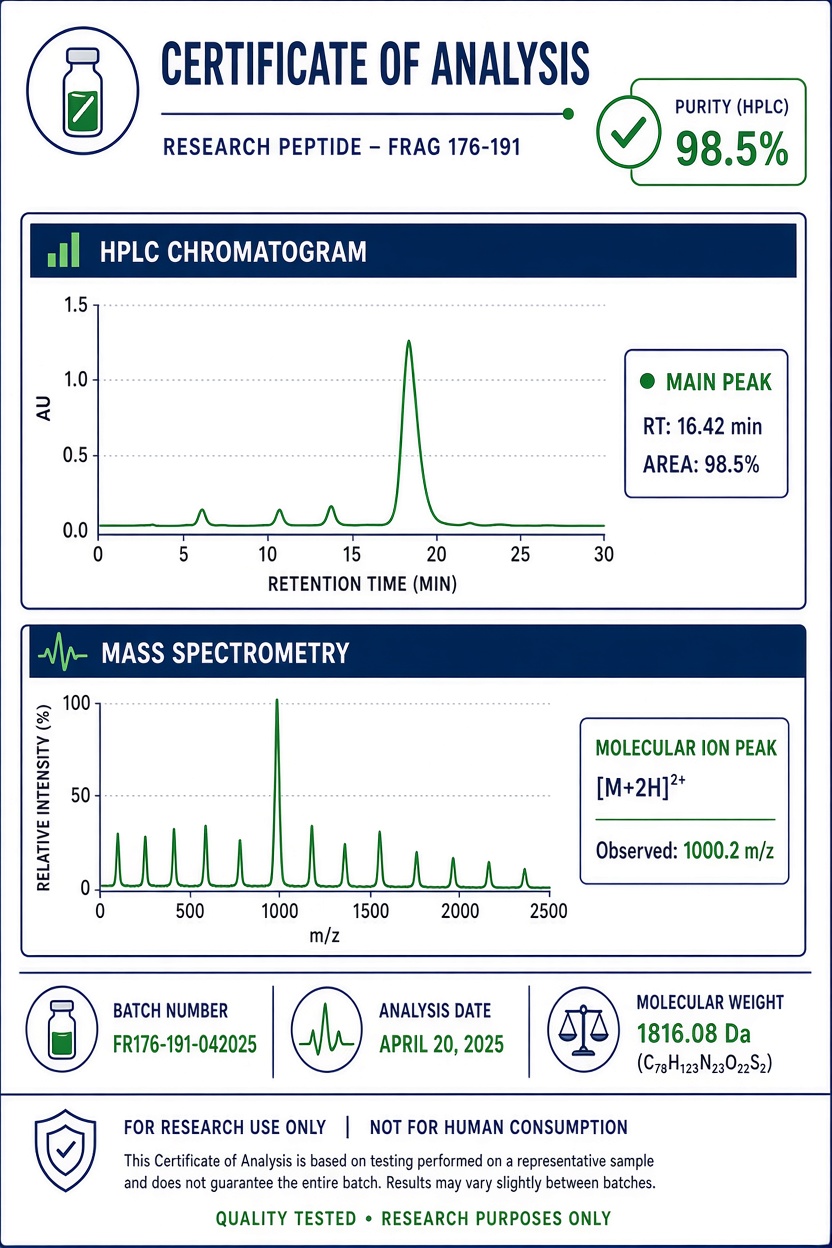
When sourcing frag 176 191, research-grade material should ship lyophilized with ≥98% HPLC purity and mass spectrometry confirmation on a batch-specific certificate of analysis (COA). The COA must list the exact sequence, molecular weight, peptide content, and residual solvent levels.
A reliable COA for frag 176 191 includes three elements: HPLC chromatogram with purity percentage, mass spectrometry data confirming the expected molecular weight (~1,799 Da for frag 176 191), and a signed quality-control date. If any of these elements is missing, request a replacement COA before use.
Storage conditions on the COA are also critical: frag 176 191 should be stored desiccated at -20°C or below, protected from light. Repeated freeze-thaw cycles degrade peptide integrity and reduce assay reproducibility.
Use the Bibtides: The Complete Research Peptide Library Guide (2026) to compare vendor COA formats and purity claims across suppliers. Always verify third-party testing rather than relying on a vendor’s internal numbers alone.
Verdict for Laboratory Research: AOD-9604 vs Fragment 176-191
For laboratories designing lipid-metabolism assays, the choice between AOD-9604 and Fragment 176-191 depends on whether you need an engineered analogue or an unmodified control. AOD-9604 provides a larger published dataset and a stabilized N-terminal tyrosine, making it suitable as a primary test compound in pathway studies. Fragment 176-191 offers the native sequence for structure-activity comparisons and baseline measurements.
Neither compound is suitable for any application outside in vitro or animal-model research. Both are unapproved, WADA-prohibited, and must be handled under institutional research-use-only policies. When ordering, prioritize vendors that provide batch-specific COAs with HPLC and mass spectrometry data, and store lyophilized material at -20°C or below.
💡 Key Takeaway: Verdict for Laboratory Research: AOD-9604 vs Fragment 176-191
Additional Laboratory Considerations for AOD-9604 and Fragment 176-191
Beyond the core comparison, several practical factors affect assay quality and reproducibility. These include peptide solubility, reconstitution solvents, batch-to-batch variability, and data-reporting standards.
Solubility and Reconstitution Notes
Both AOD-9604 and Fragment 176-191 are typically supplied as lyophilized powders. For in vitro work, researchers often reconstitute in sterile water, phosphate-buffered saline, or dilute acetic acid, depending on the assay buffer. Always consult the vendor COA for recommended reconstitution conditions, and avoid using organic solvents unless the protocol specifies them.
Batch-to-Batch Variability
Peptide synthesis can introduce minor impurities even at high purity. To control for batch effects, use the same batch for all replicates within an experiment, and record the COA lot number in your laboratory notebook. If switching batches, run a side-by-side comparison in a pilot assay before committing to full-scale data collection.
Data Reporting Standards
When publishing results, report the exact peptide sequence, vendor, lot number, purity, and storage conditions. This level of detail allows other laboratories to reproduce your work and reduces ambiguity in the literature. For AOD-9604 vs Fragment 176-191 comparisons, specify which compound served as the control and which as the test article.
Assay Design Checklist
- Confirm the peptide identity via mass spectrometry before first use.
- Use a matched vehicle control in every plate or animal cohort.
- Include a positive control for lipolysis, such as isoproterenol, if the assay permits.
- Predefine your endpoint measurements (e.g., glycerol release, fatty acid oxidation, gene expression) before data collection.
- Store all raw data and analysis scripts for auditability.
Common Pitfalls to Avoid
- Do not assume that AOD-9604 and Fragment 176-191 are interchangeable in dose-response curves; the N-terminal tyrosine can shift potency.
- Do not use outdated COA data; request a new COA for every batch.
- Do not leave reconstituted peptide at room temperature for extended periods.
- Do not rely on vendor marketing claims without verifying primary literature.
FAQ
What is the main structural difference between AOD-9604 and Fragment 176-191?
AOD-9604 is hGH 177-191 with an added N-terminal tyrosine, making it a 16-amino-acid stabilized analogue. Fragment 176-191 is the unmodified hGH 176-191 sequence, also 16 amino acids but starting at phenylalanine-176. The added tyrosine in AOD-9604 improves resistance to degradation.
Which compound has a larger published evidence base?
AOD-9604 has a larger evidence base because it went through a formal drug-development program with registered clinical trials, although development was later discontinued. Fragment 176-191 appears almost exclusively in preclinical cell-culture and rodent studies.
Are AOD-9604 and Fragment 176-191 FDA-approved?
No. Neither compound is FDA-approved for any indication, and both appear on the WADA Prohibited List as growth hormone fragments. They are sold strictly for in vitro laboratory research use only.
What purity level should I look for when sourcing these peptides?
Research-grade material should ship lyophilized with ≥98% HPLC purity and mass spectrometry confirmation on a batch-specific COA. The COA should list the exact sequence, molecular weight, peptide content, and residual solvent levels.
Can AOD-9604 or Fragment 176-191 be used in human or veterinary applications?
No. These compounds are research chemicals intended only for in vitro and animal-model studies. No dosing guidelines for human or veterinary use exist, and any such use is outside the legitimate research-use-only scope.
Topics covered in this article:
Ready to Take the Next Step?
Every product includes lot-specific documentation and third-party purity testing.
Explore Our Research Products →Free shipping on qualifying orders · Batch COA on request