



All 3 in One: Complete Research Peptide Bundle Guide 2026
Discover the complete 2026 peptide bundle guide: three lab-grade peptides, HPLC ≥98% purity, CoA, storage at −20 °C, and research-use-only documentation.
📋 Table of Contents
The all 3 in one research peptide bundle is a single laboratory kit that supplies three distinct, high-purity peptides — CJC-1295, AOD-9604, and retatrutide — under one catalog number, one certificate of analysis (CoA), and one temperature-controlled shipment. This kit is designed for in vitro assays and in vivo animal-model research where consistent, analytically verified materials are required. Each component ships lyophilized at ≥98% HPLC purity with identity confirmed by mass spectrometry.
Key takeaways
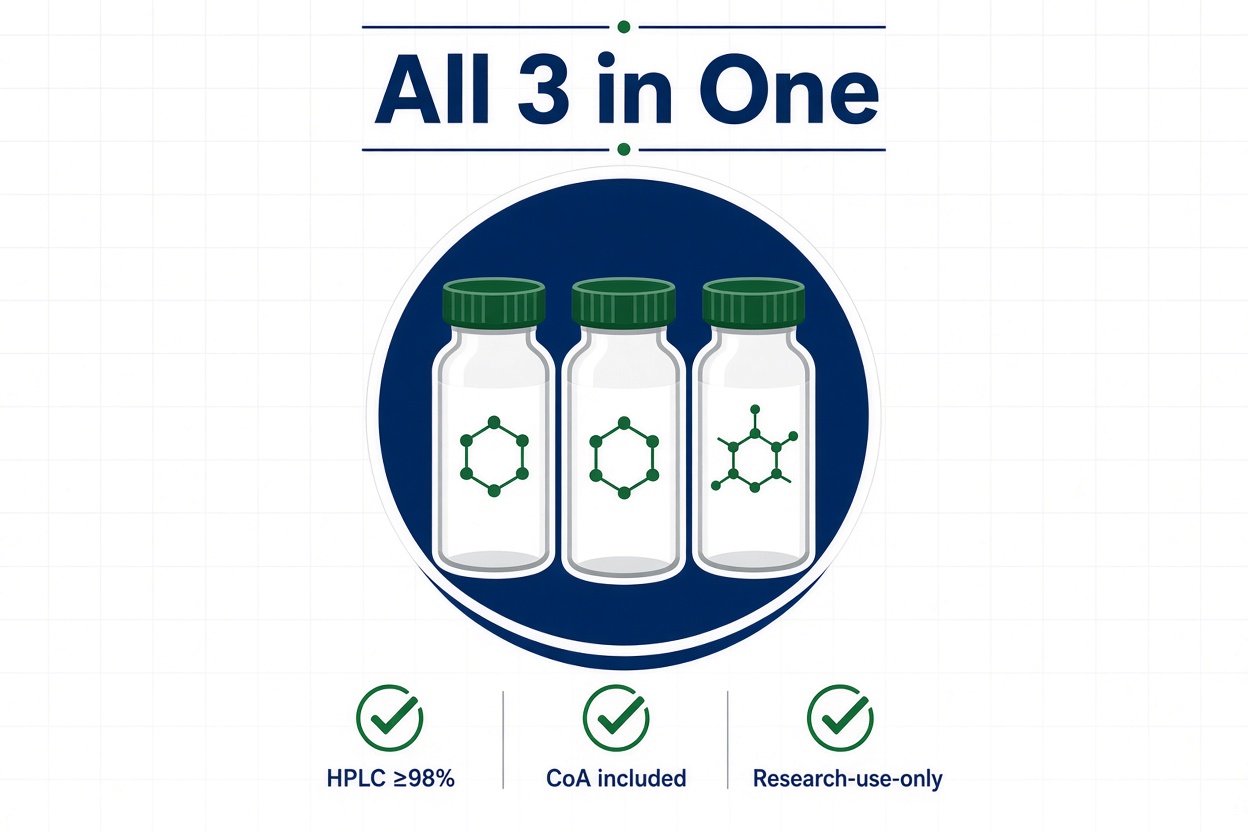
- The peptide bundle groups three research-grade peptides—typically CJC-1295, AOD-9604, and retatrutide—in one kit with unified lot documentation.
- Each component ships lyophilized at ≥98% purity by HPLC, with identity confirmed by mass spectrometry.
- A lot-specific certificate of analysis accompanies every kit; third-party verification is available on request.
- Storage is −20 °C, desiccated and light-protected; reconstituted material is held at 2–8 °C for in vitro applications.
- All materials are supplied strictly for laboratory research use only — never for human or veterinary applications.

What Does “All 3 in One” Mean for Laboratory Research?
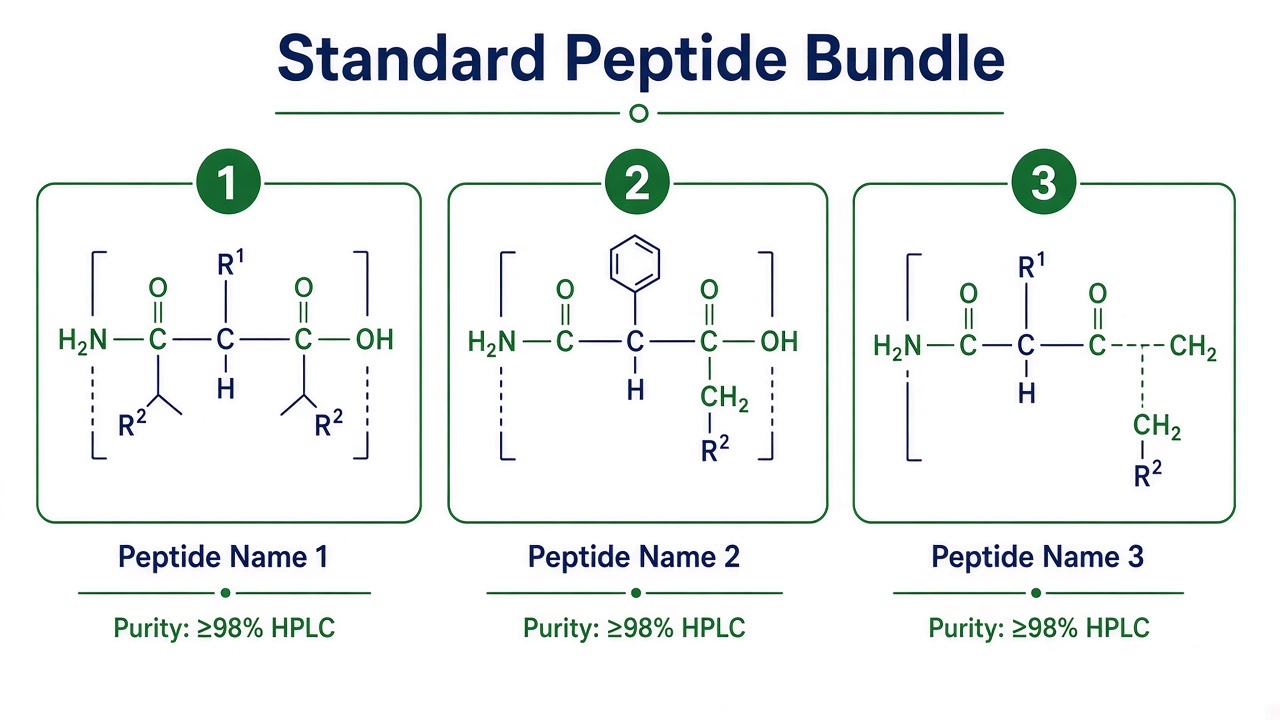
In consumer markets, a “3 in 1” label usually describes a multi-function good — a combined appliance or a blended beverage. In research supply, the all 3 in one label has a narrower, more precise meaning: three separate peptide compounds, each with its own amino acid sequence, molecular weight, and receptor pharmacology, supplied together as one catalog item.
The phrase does not describe a single fused molecule. Each component remains a distinct chemical entity — individually vialled in the standard configuration, or co-lyophilized at defined molar ratios in a blend. This distinction is not semantic: a fused construct would have one molecular weight and one receptor profile, whereas the kit preserves three independent profiles.
Laboratories typically choose the all 3 in one kit when a study requires parallel or comparative investigation of related compounds — for example, receptor-binding assays run side by side under identical buffer, temperature, and operator conditions.
The kit concept reflects how molecular pharmacology is actually practiced. Comparative binding, cross-reactivity screening, and pathway mapping all require multiple compounds handled identically, which is exactly what a bundled format standardizes.
Peptides Library uses the phrase as a product category, not a marketing slogan: every kit labeled this way contains exactly three compounds, each documented individually.
The terminology also matters for procurement. A purchase order that names a peptide bundle explicitly removes ambiguity at receiving: staff verify three labeled vials against one lot-specific CoA rather than reconciling documents across multiple suppliers.
Why Do Laboratories Choose the All 3 in One peptide bundle Format?
Procurement efficiency is the most practical driver. The all 3 in one kit consolidates three order lines into one: one purchase order, one lot-documentation package, one cold-chain shipment, and one receiving inspection.
Consistency is the scientific driver. When comparative assays draw all three peptides from a single supplier in one bundled format, inter-vendor variability in synthesis route, counterion composition, and net peptide content is removed from the experimental design.
Cost structure is the third driver. Bundled pricing, shared packaging, and a single shipment typically reduce total acquisition cost relative to three separate orders — a measurable attribute that purchasing departments can verify line by line.
Documentation workload is a quieter but real factor. One CoA package means one entry in the laboratory information management system, one stability file, and one audit trail, which simplifies institutional review and record-keeping.
Grant-funded laboratories note a budgeting advantage as well: a single line item simplifies cost allocation across projects, and a bundled price is easier to defend in a materials budget than three separate vendor relationships.

💡 Key Takeaway: Why Do Laboratories Choose the All 3 in One peptide bundle Format?
What Formats Does the All 3 in One peptide bundle Come In?
Peptides Library supplies the all 3 in one kit in three configurations. Each suits a different laboratory workflow, and each is documented to the same analytical standard. Format can be specified at order; the default is the individual vial set.
Individual Vial Sets
The standard kit format is three separate lyophilized vials, each labeled with sequence, lot number, and net content. Individual vials preserve full flexibility: researchers reconstitute each peptide independently and set the concentration for each assay.
Pre-Mixed Lyophilized Blends
A second format co-lyophilizes all three peptides in one vial at fixed molar ratios. The all 3 in one kit blend reduces preparation steps, but it also fixes the ratio — laboratories running dose-response designs generally prefer individual vials so each component can be varied independently. Blend ratios are set at manufacture and stated on the CoA as molar proportions, so the composition is fully documented even though it is fixed.
Assay-Ready Kits
The third format pairs the three vials with research-grade reconstitution solvent, buffers, and assay plates. The all 3 in one assay kit is built for high-throughput laboratories that want a single receipt covering an entire plate-based experiment.
All three formats are lyophilized. Lyophilization removes water under vacuum, leaving a dry cake that stabilizes the peptide for shipping and storage and reconstitutes quickly in the appropriate research-grade solvent.

Which Peptides Are Included in the Standard peptide bundle?
The standard all 3 in one kit configuration combines CJC-1295, AOD-9604, and retatrutide — three compounds with distinct structures and receptor targets that are frequently examined side by side in molecular pharmacology research. Custom compositions can be quoted for laboratories working with other ligands.
CJC-1295: A GHRH Receptor Ligand
CJC-1295 is a synthetic analog of growth hormone–releasing hormone (GHRH 1-29) modified for stability in research matrices. In cell-culture and animal-model studies it is used to examine GHRH receptor binding and downstream signaling pathways. Full structural notes appear in our CJC-1295 research peptide guide. The analog incorporates a linker moiety that, in preclinical models, associates with serum albumin — a structural feature examined in pharmacokinetic research for its effect on ligand persistence in assay matrices. For a broader look at peptide sourcing and QC, see Exogenous Peptides: Complete Sourcing and QC Guide (2026).
AOD-9604: A Modified Peptide Fragment
AOD-9604 is a modified fragment corresponding to residues 176–191 of the human growth hormone sequence with an added tyrosine residue. It is studied in vitro for receptor interactions and metabolic signaling in laboratory models. A structured comparison appears in our analysis of AOD-9604 versus retatrutide in research. Contemporary laboratory work with the fragment focuses on receptor-level pharmacology and structure–activity relationships in cell cultures, rather than the whole-hormone physiology of the parent molecule.
Retatrutide: A Triple Receptor Agonist
Retatrutide is a single peptide engineered to engage three receptors — GIP, GLP-1, and glucagon — making it mechanistically a triple agonist. Within this kit, it contributes a triple-receptor profile that contrasts with the single-receptor focus of CJC-1295 and the fragment pharmacology of AOD-9604. Researchers can examine cross-reactivity and receptor selectivity across three distinct ligand classes in one experimental series. PubMed lists preclinical and clinical entries under retatrutide, and CJC-1295 for background literature.
How Does the peptide bundle Compare to Sourcing Peptides Separately?
A direct comparison helps laboratories evaluate whether the bundled format fits a specific protocol.
| Attribute | All 3 in One peptide bundle | Three Separate Orders |
|———–|—————————-|———————-|
| Purchase order lines | 1 | 3 |
| CoA packages | 1 unified | 3 separate |
| Shipment | Single cold-chain | Three cold-chain |
| Inter-vendor variability | Eliminated | Present |
| Storage documentation | One stability file | Three files |
| Cost allocation | Single line item | Three line items |
| Flexibility in ratio design | High (individual vials) | High |
| Blend option | Available | Not available |
The peptide bundle removes cross-supplier variability in synthesis route, salt form, and net peptide content. That benefit is most visible in comparative binding assays, where a one-percent difference in counterion content can shift apparent affinity. Sourcing separately offers maximum vendor choice but introduces documentation overhead. For high-throughput laboratories, the kit assay-ready format can reduce setup time by eliminating separate buffer and plate procurement. For a deeper look at checking study availability across peptide classes, see Are There Studies on It? 7 Essential Ways to Check (2026).
💡 Key Takeaway: How Does the peptide bundle Compare to Sourcing Peptides Separately?
How Is the peptide bundle Tested and Verified?
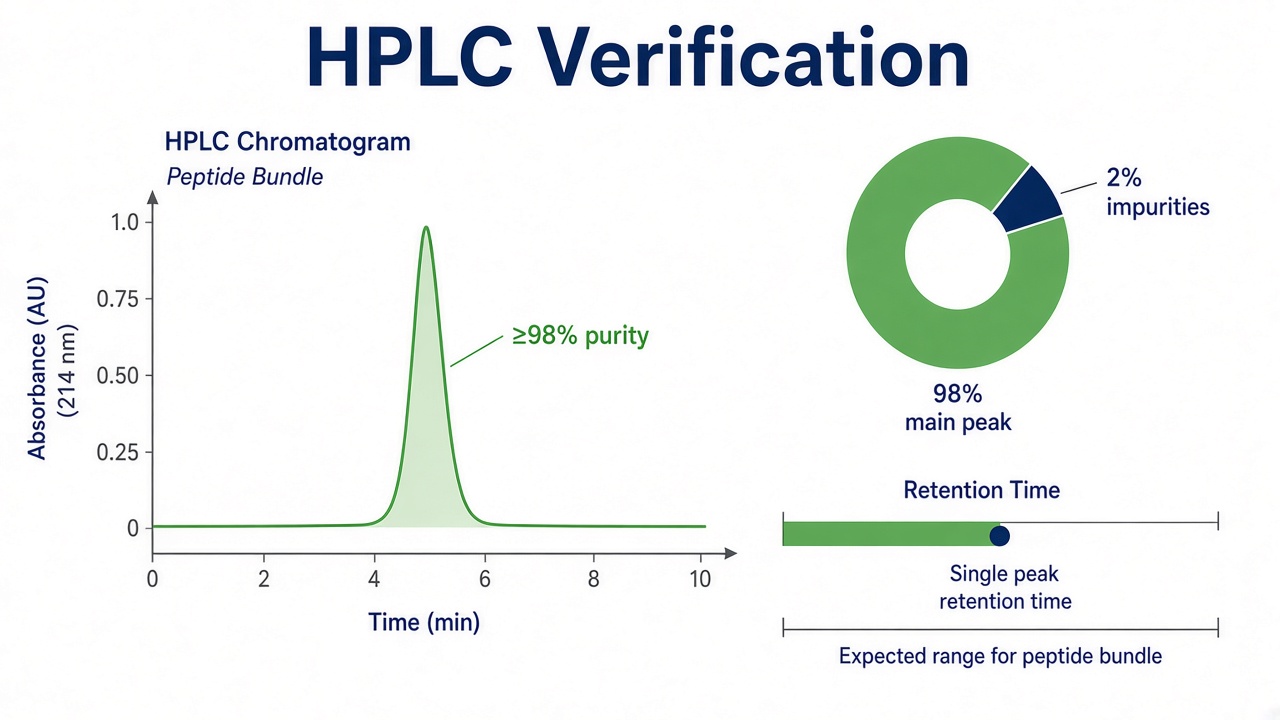
Every peptide bundle from Peptides Library is released only after three analytical steps: HPLC purity, mass spectrometry identity, and net peptide content. HPLC purity is reported as area percent at 214 nm; the release specification is ≥98% for each component. Mass spectrometry confirms the exact monoisotopic mass within ±0.5 Da of theoretical. Net peptide content corrects for water and counterion mass, so the reported vial content reflects actual peptide mass, not total powder mass.
A lot-specific certificate of analysis accompanies every kit. The CoA lists sequence, molecular weight, purity, net peptide content, solubility notes, storage conditions, and date of analysis. Third-party verification is available on request; laboratories may also request raw chromatograms and mass spectra. For more on analytical documentation standards across peptide libraries, see Bibtides: The Complete Research Peptide Library Guide (2026).
How Does the peptide bundle Support Reproducible Research?
Reproducibility depends on controlled variables. The peptide bundle standardizes three critical inputs: peptide source, lot identity, and documentation. When all three peptides come from one production batch, researchers can exclude supplier drift as a confounder. The unified CoA gives reviewers a single auditable record for the entire kit. Storage and handling instructions are identical across components, reducing protocol divergence.
The individual vial format within the peptide bundle allows each peptide to be reconstituted separately at assay-specific concentrations, preserving dose-response flexibility. The pre-mixed blend format supports fixed-ratio experiments where identical molar proportions must be maintained across replicates. Both formats ship with the same documentation standard, so the choice of format does not affect the audit trail.
Batch-to-batch consistency is another reproducibility advantage. When a laboratory reorders the same kit, the new lot is tested against the same release specifications and documented on a new CoA. Researchers can compare old and new CoA values directly to confirm that purity and net peptide content remain within acceptance criteria. This practice reduces the risk of unexplained drift in long-term studies.

How Should the peptide bundle Be Stored and Handled?
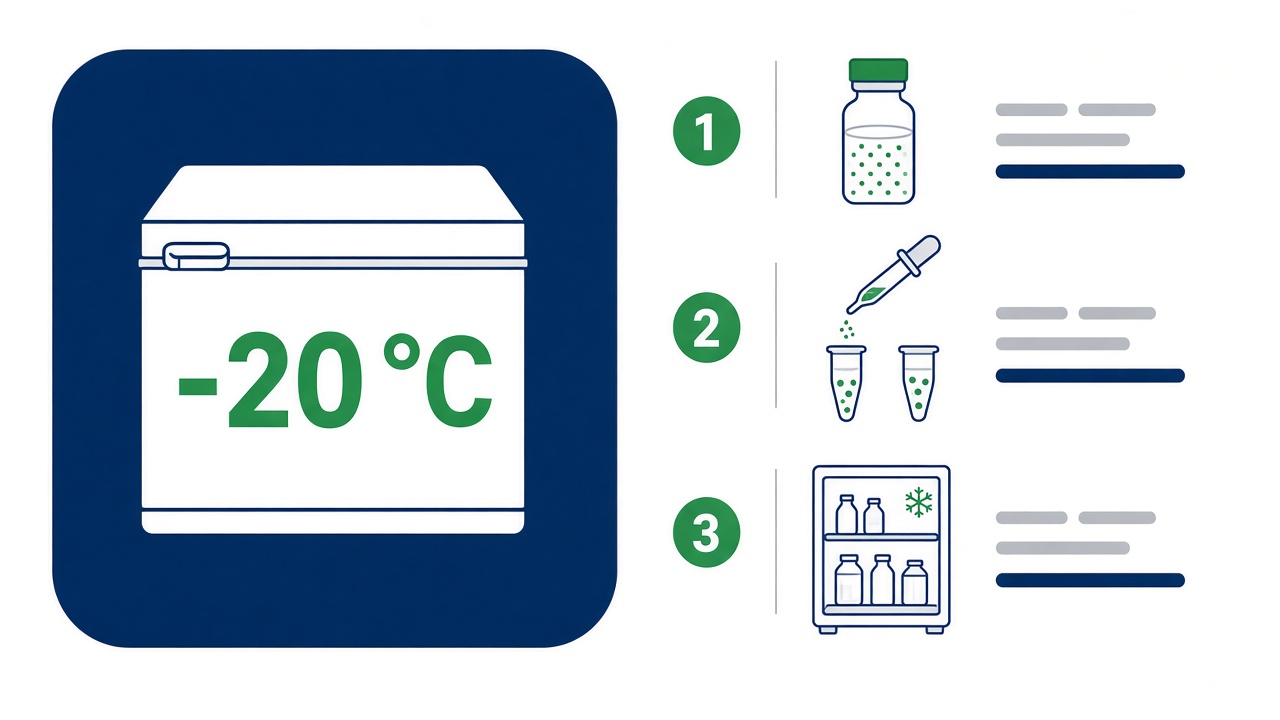
Lyophilized vials in the peptide bundle are stored at −20 °C, desiccated and protected from light. The dry cake is stable for the lot shelf life stated on the CoA when kept under these conditions. After reconstitution with the appropriate research-grade solvent, solutions are held at 2–8 °C for in vitro applications. Avoid repeated freeze-thaw cycles; aliquot reconstituted material into single-use volumes to maintain integrity.
Always handle vials with clean, dry gloves. Allow the vial to reach room temperature before opening to prevent condensation on the lyophilized cake. Use sterile, pyrogen-free consumables for reconstitution. Document reconstitution date, solvent, and final concentration in the laboratory notebook. These steps keep the kit within its analytical release specifications and support reproducible results.
💡 Key Takeaway: How Should the peptide bundle Be Stored and Handled?
What Compliance Documentation Accompanies the peptide bundle?
Each peptide bundle ships with a lot-specific certificate of analysis, a safety data sheet (SDS), and a research-use-only statement. The CoA is the primary analytical record; the SDS covers handling, storage, and spill procedures. The research-use-only statement declares that the product is not for human or veterinary use, not for diagnostic or therapeutic applications, and not for use as a food, drug, or cosmetic.
For institutional procurement, the kit documentation package supports audit readiness. The single CoA and SDS pair with one receiving inspection record, one stability file, and one training entry for handling staff. This consolidation reduces the administrative burden in regulated laboratory environments.
What Are the Advantages and Limitations of the peptide bundle Design?
Advantages of the peptide bundle include consolidated procurement, unified documentation, reduced inter-vendor variability, and a single cold-chain shipment. The individual vial format preserves experimental flexibility; the assay-ready format reduces setup time. Cost per peptide is typically lower than sourcing three peptides separately because packaging and shipping are shared.
Limitations include fixed composition in the standard configuration. The kit is built around CJC-1295, AOD-9604, and retatrutide; laboratories needing a different trio must request a custom quote, which may have a longer lead time. The pre-mixed blend fixes molar ratios, which is unsuitable for dose-response studies that vary one component independently. Storage at −20 °C requires freezer capacity; laboratories without dedicated peptide freezers may need to allocate space.
How Can Laboratories Choose the Right peptide bundle?
Selection starts with the assay design. If the protocol calls for independent concentration gradients, choose the individual vial set. If the protocol requires a fixed molar ratio across all replicates, choose the pre-mixed lyophilized blend. If the goal is high-throughput plate-based work, choose the assay-ready kit.
Review the CoA before purchase. Confirm that HPLC purity, mass spec identity, and net peptide content meet the study’s acceptance criteria. Check the lot shelf life and storage conditions against available freezer capacity. For multi-year studies, ask about lot reservation to keep the same kit lot across all experimental phases.
Finally, verify that the vendor’s research-use-only policy aligns with institutional compliance. The kit is not intended for any human or veterinary application, and all documentation should reflect that scope.
💡 Key Takeaway: How Can Laboratories Choose the Right peptide bundle?
Ordering the peptide bundle: Availability and Next Steps
Peptides Library supplies the all 3 in one kit through standard laboratory procurement channels. Specify format (individual vial set, pre-mixed blend, or assay-ready kit), quantity, and any custom composition request at order. Each kit ships cold-chain with desiccant and light protection. A lot-specific CoA is included in the shipment and available electronically.
For laboratories evaluating the kit for the first time, request a sample CoA and analytical data package before purchase. Third-party verification of purity and identity is available on request. Contact the support team with the catalog number and intended research application for a quote.
FAQ
What exactly is included in the all 3 in one peptide bundle?
The standard peptide bundle includes CJC-1295, AOD-9604, and retatrutide as lyophilized powders, each ≥98% pure by HPLC, with mass spec identity confirmation and a unified CoA.
Can the peptide bundle be customized with different peptides?
Yes. Peptides Library can quote custom compositions for laboratories working with other ligands. The standard configuration is the three peptides described here, but custom trios are available on request.
What storage conditions does the peptide bundle require?
Lyophilized vials are stored at −20 °C, desiccated and light-protected. Reconstituted solutions are held at 2–8 °C for in vitro use. Avoid repeated freeze-thaw cycles.
Is the peptide bundle suitable for human or veterinary use?
No. All materials in the peptide bundle are supplied strictly for laboratory research use only. They are not for human or veterinary use, not for diagnostic or therapeutic applications, and not for use as food, drug, or cosmetic.
How is the peptide bundle documented for audits?
Each peptide bundle ships with a lot-specific CoA, SDS, and research-use-only statement. The CoA includes HPLC purity, mass spec identity, net peptide content, storage conditions, and date of analysis. Third-party verification is available on request.
Topics covered in this article:
Ready to Take the Next Step?
Every product includes lot-specific documentation and third-party purity testing.
Explore Our Research Products →Free shipping on qualifying orders · Batch COA on request