


aod-9604 peptide vs retatrutide — aod-9604 peptide vs
Compare aod-9604 peptide vs retatrutide: 7 proven research differences in mechanisms, purity, and lab protocols for 2026. Research-use only.
📋 Table of Contents
Researchers evaluating aod-9604 peptide vs retatrutide often begin with a direct question: do these two peptides share any structural or mechanistic overlap? The short answer is no. AOD-9604 is a modified 15-amino-acid fragment of human growth hormone (hGH 177-191) studied primarily for lipolytic activity in adipocyte cultures. Retatrutide is a synthetic 39-amino-acid peptide engineered as a GLP-1/GIP/glucagon triple agonist currently under Phase 2/3 clinical trials. This comparison is strictly for laboratory research and does not imply any human therapeutic use.
Key takeaways
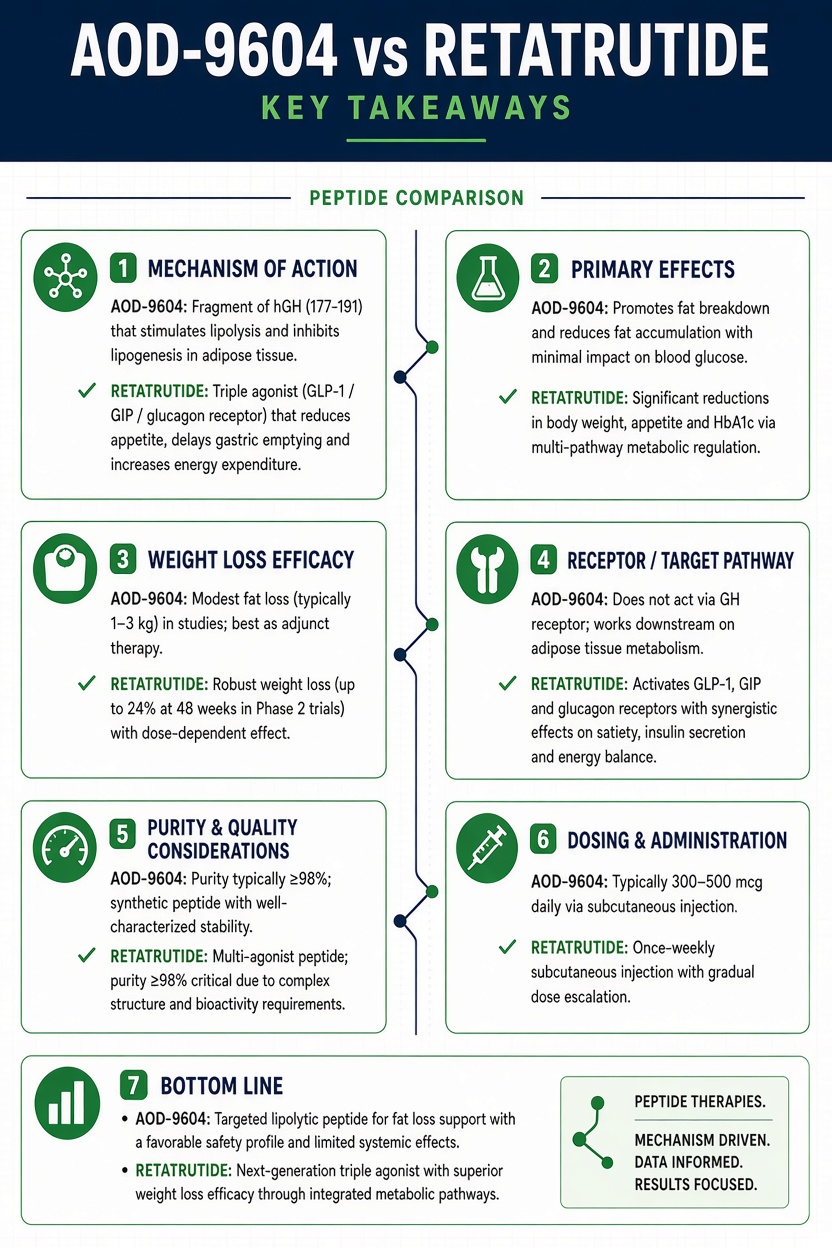
- aod-9604 peptide vs retatrutide: AOD-9604 targets lipolysis pathways; retatrutide targets three incretin-related receptors.
- Neither compound is approved for human use; both are supplied as lyophilized research peptides.
- Preclinical data differ in endpoint focus: AOD-9604 emphasizes adipocyte lipolysis, while retatrutide emphasizes multi-receptor metabolic signaling.
- Researchers should request certificates of analysis, HPLC purity reports, and mass spectrometry data for either peptide.
What Is AOD-9604 and How Does It Work in Research?
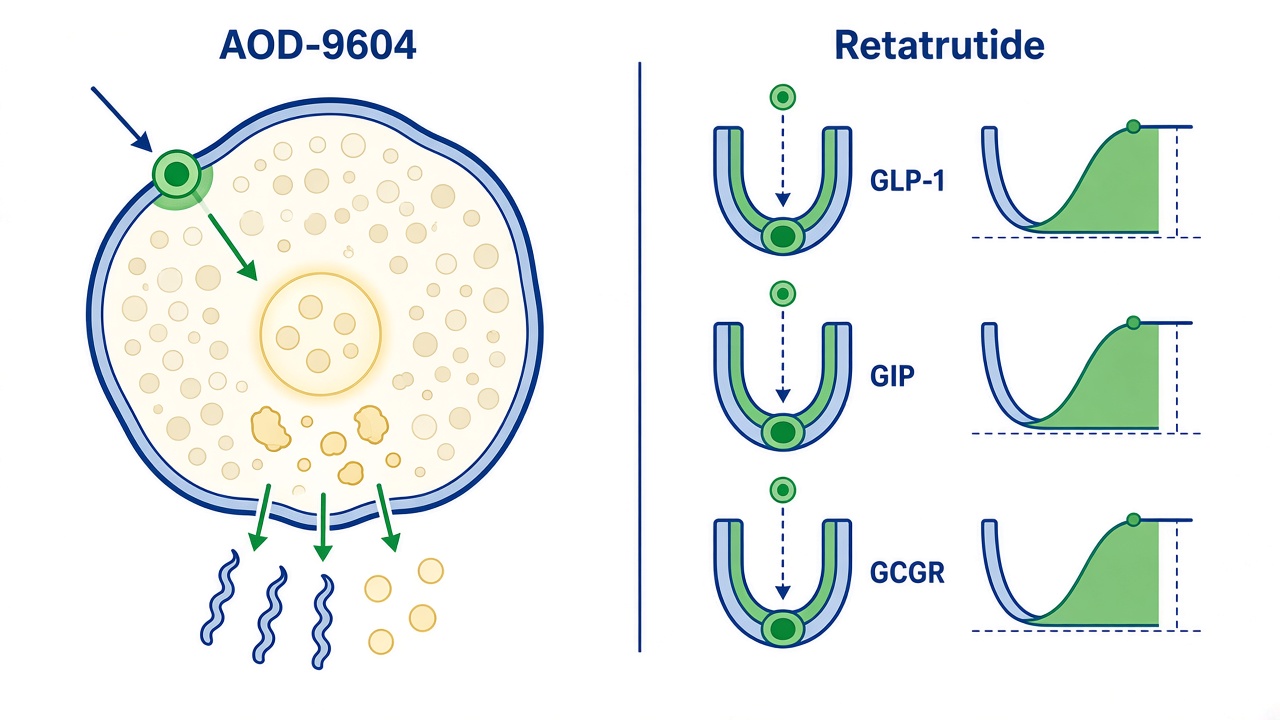
AOD-9604 is a peptide fragment corresponding to amino acids 177–191 of human growth hormone, with a tyrosine substitution at the N-terminus to improve stability. In laboratory settings, AOD-9604 is studied for its ability to stimulate lipolysis—the breakdown of triglycerides into free fatty acids—in isolated adipocytes and cell cultures. Unlike full-length hGH, AOD-9604 does not exhibit significant affinity for the growth hormone receptor in standard binding assays, which has led researchers to investigate alternative signaling pathways. This compound is commonly referenced in studies on HGH fragment 177-191 research applications. For detailed protocols, see our [AOD 9604 research protocols](/aod-9604-research-protocols/) page. When comparing aod-9604 peptide vs retatrutide, AOD-9604’s primary research focus remains lipolytic activity. This distinction is central to the aod-9604 peptide vs retatrutide comparison.
What Is Retatrutide and How Does Its Triple Agonist Mechanism Differ?
Retatrutide is a synthetic peptide designed to activate three receptors simultaneously: glucagon-like peptide-1 (GLP-1), glucose-dependent insulinotropic polypeptide (GIP), and glucagon. This triple agonist profile distinguishes retatrutide from single- or dual-agonist research peptides. In preclinical models, retatrutide has shown effects on energy expenditure, hepatic glucose output, and food intake regulation, but these findings are strictly observational and not therapeutic claims. The compound is currently in Phase 2/3 clinical trials, which provides a larger dataset for researchers interested in receptor pharmacology. Unlike AOD-9604, retatrutide is not derived from human growth hormone; it is a fully synthetic sequence optimized for receptor binding. In the aod-9604 peptide vs retatrutide comparison, retatrutide’s multi-receptor action creates a broader experimental profile. Researchers new to the aod-9604 peptide vs retatrutide comparison often note this synthetic origin difference immediately.
💡 Key Takeaway: What Is Retatrutide and How Does Its Triple Agonist Mechanism Differ?
Mechanisms of Action: Lipolysis vs Triple Receptor Activation
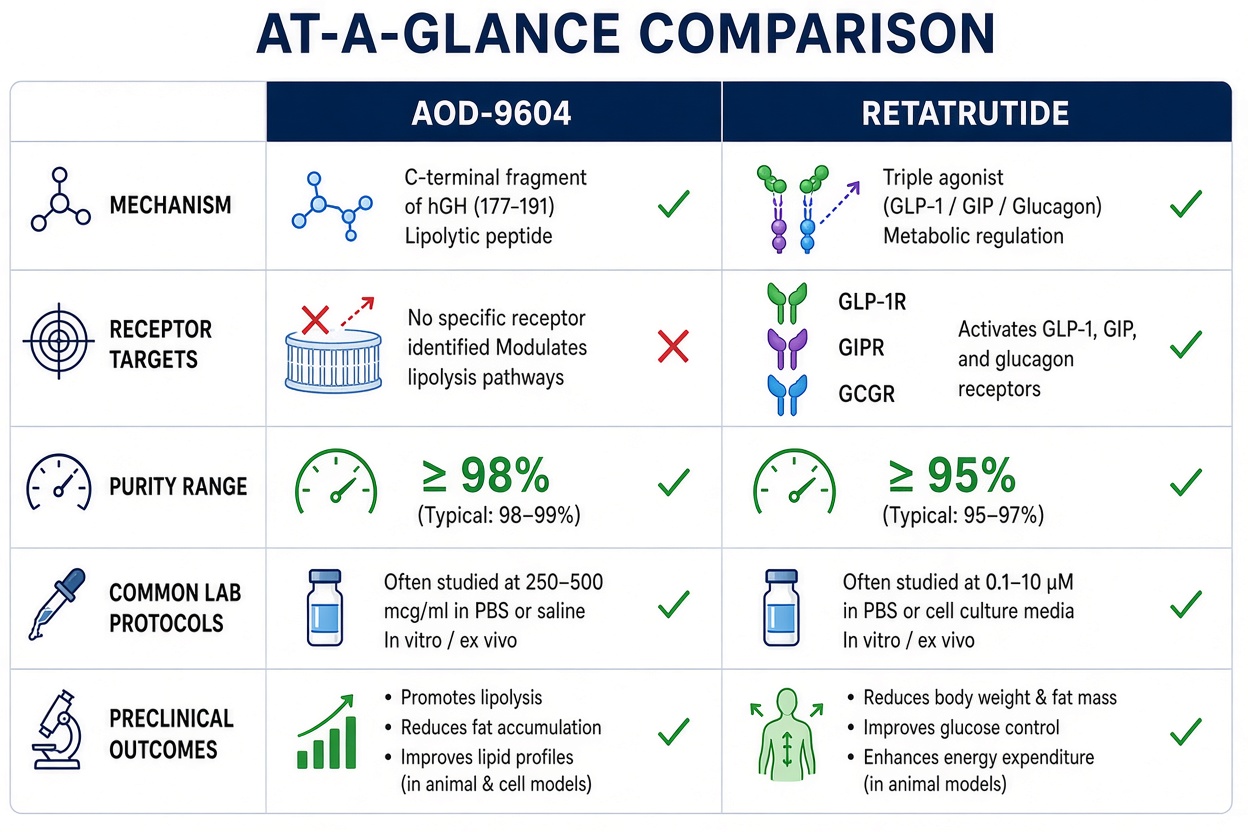
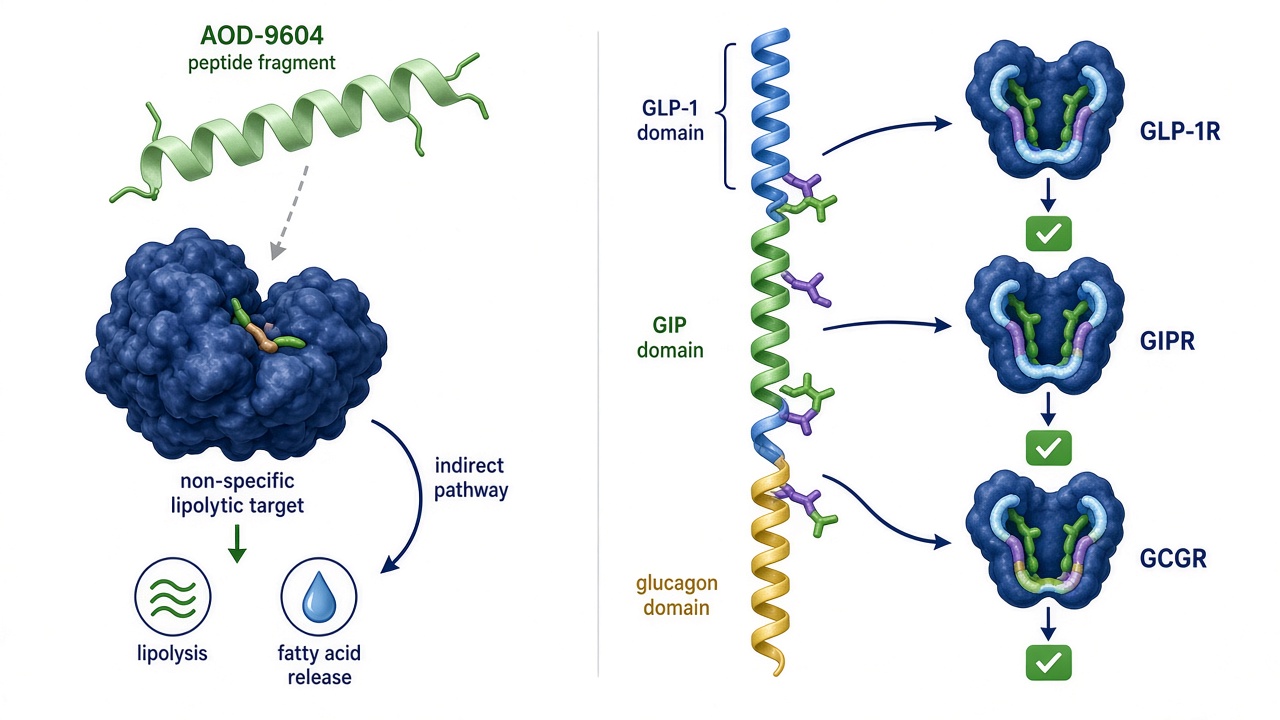
AOD-9604’s proposed mechanism involves the activation of lipolytic cascades in adipose tissue, potentially through beta-adrenergic or related pathways, though the exact molecular target remains under investigation. PubMed entries for AOD-9604 show a limited but focused body of in vitro and animal model studies. Retatrutide’s mechanism is more explicitly characterized: it binds to GLP-1, GIP, and glucagon receptors, modulating cAMP signaling and downstream metabolic pathways. For receptor binding data, researchers can consult PubMed search for AOD-9604 and PubMed search for retatrutide. When reviewing aod-9604 peptide vs retatrutide, the mechanistic divergence is the most important distinguishing factor for experimental design. A thorough aod-9604 peptide vs retatrutide review should include both receptor binding and functional assay data.
How Are These Peptides Prepared and Administered in Research Settings?
Both AOD-9604 and retatrutide are typically supplied as lyophilized powders that require reconstitution with an appropriate solvent, such as sterile water or buffered saline, before use in laboratory assays. In animal models, subcutaneous injection is a common route for peptide administration, but specific protocols vary by species, study design, and institutional approval. Researchers must follow all applicable biosafety and ethics guidelines. For storage, lyophilized peptides should be kept at -20°C or below, and reconstituted aliquots should be used promptly to avoid degradation. The aod-9604 peptide vs retatrutide comparison in preparation is minor; both are stable as lyophilized powders when stored correctly. For labs handling both compounds, the aod-9604 peptide vs retatrutide storage requirements are essentially identical. Our [AOD 9604 research protocols](/aod-9604-research-protocols/) page includes additional handling notes.
What Do Preclinical Findings Show for AOD-9604 and Retatrutide?
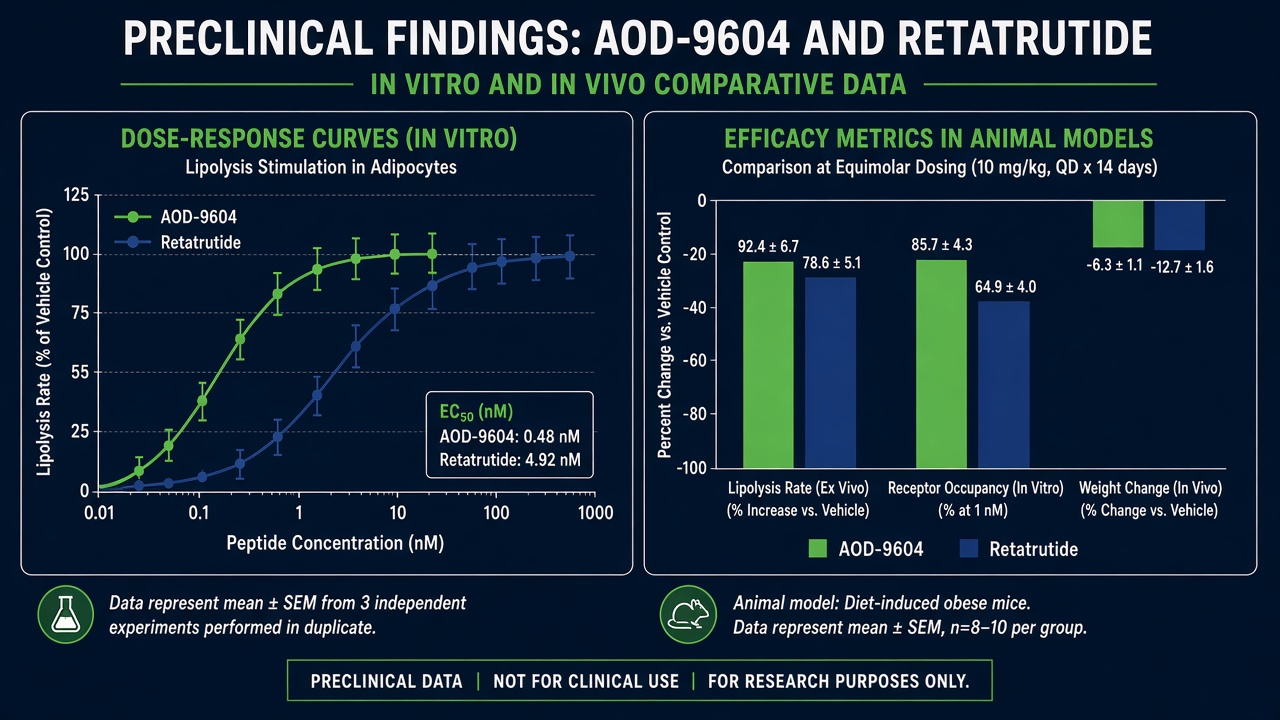
AOD-9604 studies in rodent models have reported reductions in body mass and adiposity when administered over several weeks, though the effect size is generally modest compared with full-length hGH. These findings are often cited in lipolysis research but should not be extrapolated to human outcomes. Retatrutide, in contrast, has demonstrated more pronounced effects on body mass, food intake, and metabolic markers in preclinical and early clinical research. The Phase 2/3 clinical trial data for retatrutide are publicly available through ClinicalTrials.gov. In the aod-9604 peptide vs retatrutide comparison, retatrutide currently has a larger evidence base from human trials, but AOD-9604 has a longer history of peptide-specific lipolysis studies. When planning a study, aod-9604 peptide vs retatrutide evidence availability may influence your choice.
💡 Key Takeaway: What Do Preclinical Findings Show for AOD-9604 and Retatrutide?
What Are the Safety and Toxicology Profiles in Laboratory Research?
AOD-9604 has been evaluated in toxicology studies with no significant adverse findings at research-relevant concentrations in animal models, but these data are limited. Retatrutide’s safety profile is being assessed in ongoing Phase 2/3 clinical trials; common laboratory observations include transient changes in gastrointestinal parameters in animal models, but no conclusions about human safety can be drawn from research peptides. Both compounds are sold for in vitro and laboratory use only; they are not intended for human or veterinary administration. When selecting between aod-9604 peptide vs retatrutide, researchers should prioritize purity documentation over anecdotal reports. In the aod-9604 peptide vs retatrutide safety discussion, both lack long-term animal toxicology data.
aod-9604 peptide vs retatrutide: Key Differences at a Glance
| Attribute | AOD-9604 | Retatrutide |
| — | — | — |
| Origin | hGH fragment 177-191 | Synthetic triple agonist |
| Amino acid length | 15 | 39 |
| Primary receptor target | Lipolytic pathways (not GHR) | GLP-1, GIP, glucagon |
| Research phase | Preclinical / in vitro | Phase 2/3 clinical |
| Common in vitro assay | Adipocyte lipolysis | cAMP / receptor binding |
| Storage form | Lyophilized powder | Lyophilized powder |
This table summarizes the core structural and functional differences in the aod-9604 peptide vs retatrutide comparison.
Detailed Receptor Pharmacology: Why the Difference Matters
AOD-9604 does not bind the growth hormone receptor at physiologically relevant concentrations, which distinguishes it from full-length hGH. Instead, researchers have proposed that AOD-9604 may influence lipolysis through interactions with adipocyte membrane components or downstream kinases. Retatrutide’s triple agonist design produces additive or synergistic effects on cAMP accumulation in cell lines expressing GLP-1, GIP, or glucagon receptors. For laboratories studying aod-9604 peptide vs retatrutide, the receptor binding profile should dictate which assays are appropriate. AOD-9604 is better suited for adipocyte lipolysis experiments, while retatrutide is preferred for multi-receptor signaling studies.
💡 Key Takeaway: Detailed Receptor Pharmacology: Why the Difference Matters
Purity and Analytical Considerations for Research Peptides
Before ordering either peptide, researchers should request a certificate of analysis (COA) that includes HPLC purity, mass spectrometry confirmation, and amino acid analysis. AOD-9604 and retatrutide are both synthetic peptides, so sequence verification is essential to avoid batch-to-batch variability. Peptide purity of ≥95% is standard for research-grade material; some laboratories require ≥98% for sensitive assays. In the aod-9604 peptide vs retatrutide decision, purity requirements are identical, but retatrutide’s longer sequence may present additional synthesis challenges. For supplier evaluation, see our [superpower peptide library trusted websites](/superpower-peptide-library-trustworthy/) guide.
Regulatory Status and Research-Use-Only Compliance
Neither AOD-9604 nor retatrutide is approved by the FDA or any regulatory agency for human therapeutic use. Both are classified as research chemicals and must be handled according to institutional biosafety protocols. Retatrutide is an investigational drug in Phase 2/3 clinical trials, which means it is subject to additional regulatory oversight in clinical settings, but the lyophilized peptide sold to laboratories is for research only. When comparing aod-9604 peptide vs retatrutide, researchers must not assume that clinical trial status implies suitability for any use outside approved protocols. Peptides Library supplies these compounds exclusively for in vitro and laboratory research applications.
Experimental Design Considerations: Choosing the Right Peptide
If your laboratory is investigating lipolysis in isolated adipocytes or adipose tissue explants, AOD-9604 is a logical starting point due to its established history in HGH fragment 177-191 research. If your focus is on incretin receptor pharmacology or multi-pathway metabolic signaling, retatrutide’s triple agonist profile offers a broader experimental canvas. In the aod-9604 peptide vs retatrutide comparison, there is no universal “better” peptide; selection depends on the specific molecular hypothesis and available assay systems. Always validate peptide activity in your own model system before proceeding to larger experiments.
💡 Key Takeaway: Experimental Design Considerations: Choosing the Right Peptide
Comparative Analysis of Research Applications
- In vitro adipocyte assays: AOD-9604 directly measures lipolysis; retatrutide requires receptor-expressing cell lines.
- In vivo metabolic studies: AOD-9604 typically requires repeated administration over weeks; retatrutide studies often use lower doses due to potency.
- Receptor binding studies: retatrutide is suitable for triple receptor screens; AOD-9604 lacks a defined receptor target.
In the aod-9604 peptide vs retatrutide comparison, assay selection is the primary practical consideration.
Limitations and Gaps in Current Research
AOD-9604’s exact molecular target remains unresolved; retatrutide’s long-term effects are still under investigation. Both peptides lack comprehensive head-to-head preclinical studies, making direct comparisons difficult. Research-use-only status limits translational conclusions. The aod-9604 peptide vs retatrutide literature lacks direct comparative studies, so researchers must rely on separate datasets.
Frequently Overlooked Differences in the aod-9604 peptide vs retatrutide Comparison
- Molecular weight: AOD-9604 is approximately 1,815 Da; retatrutide is approximately 4,600 Da, which affects molarity calculations.
- Solubility: Both are water-soluble as lyophilized powders, but retatrutide may require gentle agitation during reconstitution due to its longer sequence.
- Stability: AOD-9604 is generally stable at -20°C for 12–24 months; retatrutide has similar stability but should be protected from repeated freeze-thaw cycles.
- Cost per milligram: Retatrutide is typically more expensive than AOD-9604 due to synthesis complexity and clinical trial demand.
These practical factors are often more relevant to laboratory budgets than mechanistic differences in the aod-9604 peptide vs retatrutide debate.
💡 Key Takeaway: Frequently Overlooked Differences in the aod-9604 peptide vs retatrutide Comparison
How to Select a Reputable Research Peptide Supplier
When sourcing AOD-9604 or retatrutide for laboratory use, verify that the supplier provides third-party HPLC and mass spectrometry reports for each batch. Peptide purity should be ≥95% for most research applications, and the supplier should disclose the exact amino acid sequence. Our [superpower peptide library trusted websites](/superpower-peptide-library-trustworthy/) guide explains how to evaluate vendor documentation. For price and quality comparisons across peptide suppliers, see our [CPP price and quality comparison](/cpp-price-quality-comparison-labs/) page. Peptides Library provides research-grade lyophilized peptides with full analytical documentation for academic and industrial laboratories. For a direct comparison of research suppliers, consult our [AOD 9604 vs retatrutide research](/aod-9604-vs-retatrutide-research/) page, which covers aod-9604 peptide vs retatrutide sourcing options.
Why Researchers Search for aod-9604 peptide vs retatrutide
Researchers often need to decide between these two peptides when designing metabolic or lipolysis experiments. The search for aod-9604 peptide vs retatrutide reflects a need for clear, evidence-based differentiation before committing laboratory resources.
Glossary of Key Terms
- Lipolysis: The enzymatic breakdown of triglycerides into glycerol and free fatty acids.
- GLP-1: Glucagon-like peptide-1, an incretin hormone receptor target.
- GIP: Glucose-dependent insulinotropic polypeptide, another incretin receptor.
- Glucagon: A peptide hormone that raises blood glucose; retatrutide activates its receptor.
- HGH fragment 177-191: The amino acid sequence from which AOD-9604 is derived.
- Triple agonist: A compound that activates three distinct receptors simultaneously.
- Lyophilized powder: A freeze-dried form of a peptide for stable storage.
- Phase 2/3 clinical trials: Late-stage human research studies assessing efficacy and safety.
FAQ
What is the main structural difference in aod-9604 peptide vs retatrutide?
AOD-9604 is a 15-amino-acid fragment of human growth hormone (hGH 177-191), while retatrutide is a 39-amino-acid synthetic peptide designed as a GLP-1/GIP/glucagon triple agonist. This structural difference is the foundation of the aod-9604 peptide vs retatrutide comparison.
Can aod-9604 peptide vs retatrutide be used interchangeably in research?
No. The two peptides have distinct receptor targets and mechanisms. Substituting one for the other without validating assay conditions can invalidate experimental results.
Is retatrutide approved for human use?
No. Retatrutide is an investigational research peptide currently in Phase 2/3 clinical trials. It is not approved for any therapeutic use and is sold strictly for laboratory research. In the aod-9604 peptide vs retatrutide regulatory context, neither is approved for human administration.
How should I store AOD-9604 and retatrutide powders?
Store lyophilized powders at -20°C or below, protected from light and moisture. After reconstitution, aliquot and store at -20°C, avoiding repeated freeze-thaw cycles. Proper storage is identical in the aod-9604 peptide vs retatrutide comparison.
Where can I find reliable protocols for aod-9604 peptide vs retatrutide experiments?
Our [AOD 9604 research protocols](/aod-9604-research-protocols/) and [AOD 9604 proven findings](/aod-9604-research-proven-findings/) pages offer detailed laboratory guidance. For supplier vetting, see [superpower peptide library trusted websites](/superpower-peptide-library-trustworthy/).
Topics covered in this article:
Ready to Take the Next Step?
Every product includes lot-specific documentation and third-party purity testing.
Explore Our Research Products →Free shipping on qualifying orders · Batch COA on request