


peptide libaries: 7 Proven Research Solutions for 2026
Peptide libaries for high-throughput screening and hit validation. Explore 7 proven research solutions for combinatorial chemistry, assay design, and hit validation in 2026 labs.
📋 Table of Contents
Peptide libaries are systematic collections of synthetic peptides designed for high-throughput screening in laboratory research, enabling parallel testing of hundreds to millions of sequences for receptor binding, enzyme inhibition, and antibody epitope mapping. At Peptides Library, we supply research-grade peptide libaries for combinatorial chemistry, alanine scanning, and hit validation in 2026 academic and industrial laboratories. All peptide libaries discussed here are for in vitro research use only, not for human or veterinary applications.
*Research Use Only Notice: The products discussed on this site are sold strictly for in vitro laboratory research purposes only. They are not for human use, not for veterinary use, and not intended to diagnose, treat, cure, or prevent any disease. All information presented is for educational purposes in a research context. Must be 21+ to purchase.*
Key takeaways
- Peptide libaries enable high-throughput identification of bioactive peptide sequences in receptor binding, enzyme inhibition, and antibody epitope mapping assays.
- Combinatorial and positional scanning designs cover broad or focused sequence space, respectively, for different screening objectives.
- Alanine scanning within a peptide libaries set reveals which amino acid side chains are critical for molecular recognition.
- Post-purchase workflows for peptide libaries include assay development with ELISA or surface plasmon resonance (SPR), followed by data normalization and hit validation.
- Vendor specifications such as HPLC purity, mass spectrometry verification, and storage conditions directly affect screening reproducibility.
What Are Peptide Libaries and Why Use One in Research?
Peptide libaries are defined collections of synthetic peptides, typically ranging from dozens to millions of distinct sequences, arrayed or pooled for parallel screening. In laboratory settings, researchers use these collections to interrogate protein–peptide interactions, map antibody epitopes, profile enzyme substrate specificity, and discover novel ligands for receptors. Unlike single-peptide synthesis, a well-designed collection allows simultaneous testing of many sequence variants under identical assay conditions, reducing time and reagent consumption.
The primary value of peptide libaries lies in their ability to convert an open-ended biological question into a systematic screenable format. For example, a researcher studying a kinase might screen a positional scanning peptide libaries set to determine the optimal phosphorylation motif. Alternatively, an immunologist might use an overlapping collection covering a viral proteome to identify immunodominant epitopes. Each approach relies on the structural diversity encoded within the peptide libaries.
Common assay formats for peptide libaries screening include ELISA for antibody binding, surface plasmon resonance (SPR) for kinetic analysis, fluorescence polarization for solution-phase binding, and enzyme activity assays using fluorogenic or chromogenic substrates. Researchers in immunology, oncology, neuroscience, and infectious disease use peptide libaries to define antigenic determinants, map protease cleavage sites, and identify receptor agonists or antagonists. The ability to test many sequences in parallel under identical buffer and temperature conditions improves data comparability and reduces false positives from assay drift.
All peptide libaries from Peptides Library are supplied as lyophilized powders in 96-well or 384-well plates, or as individual vials, and are intended strictly for research applications. Storage at -20°C or -80°C preserves stability; repeated freeze-thaw cycles should be avoided. Quality control includes HPLC purity assessment and mass spectrometry confirmation of molecular weight. Researchers can request custom peptide libaries with specified sequences, modifications, or labeling.
What Types of Peptide Libaries Are Available for Research?
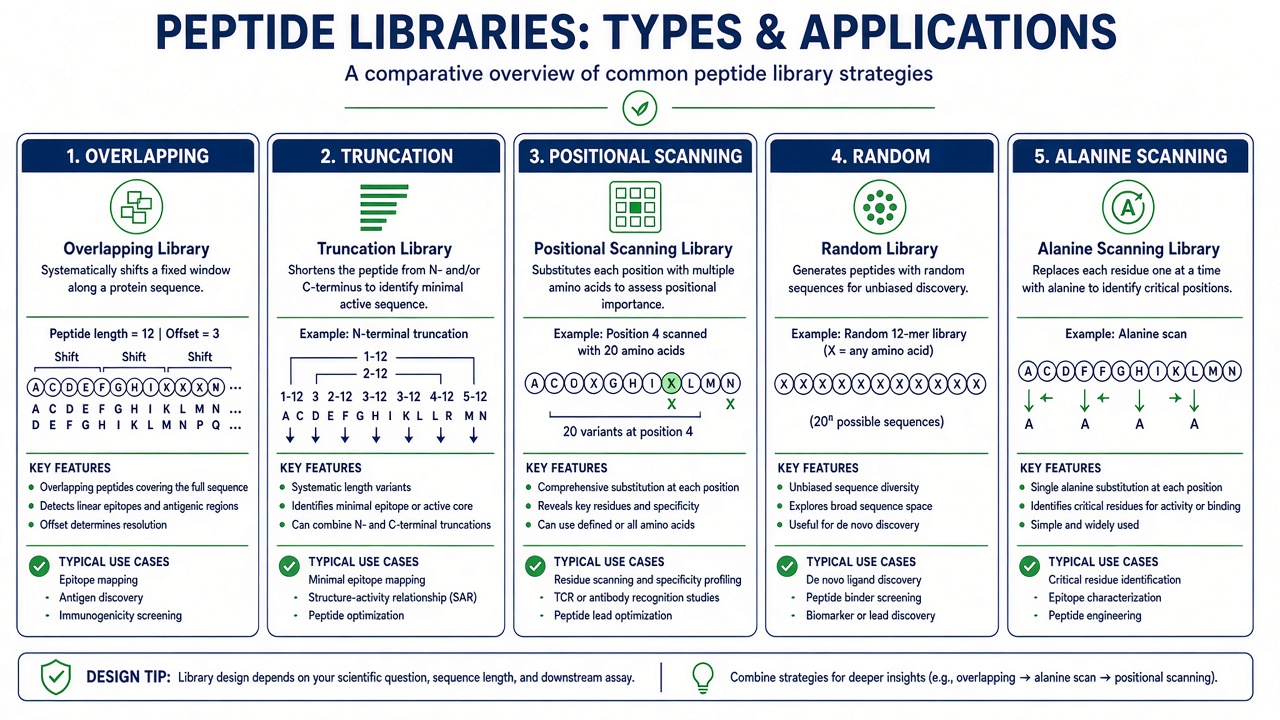
Peptide libaries fall into three broad categories based on design strategy: combinatorial, positional scanning, and targeted. Each type serves distinct research goals and requires different synthesis and screening logistics.
Combinatorial Peptide Libaries
Combinatorial peptide libaries are generated by split-and-mix solid-phase synthesis, producing large mixtures of random sequences. A typical collection might contain 10^6 to 10^9 distinct peptides, each present at femtomolar to picomolar quantities. These are useful for initial broad screening against a target to identify lead sequences, but deconvolution of active peptides requires iterative sub-libraries or encoding strategies. Researchers often pair combinatorial peptide libaries with affinity selection or phage display to enrich active sequences before deconvolution.
Positional Scanning Peptide Libaries
Positional scanning peptide libaries systematically fix one position at a time while randomizing the others. For example, a hexapeptide positional scanning collection contains 20 sub-libraries (one per natural amino acid) for each position, totaling 120 sub-libraries. Screening each sub-library reveals which amino acid at a given position contributes most to activity. This approach is more efficient for defining consensus motifs than fully combinatorial collections. Positional scanning peptide libaries are especially valuable for protease substrate profiling and MHC binding motif discovery.
Targeted Peptide Libaries
Targeted peptide libaries consist of rationally designed sequences, such as overlapping fragments of a protein, alanine-scanning mutants of a known peptide, or collections of predicted MHC-binding epitopes. These are smaller (tens to hundreds of peptides) and allow focused hypothesis testing. Researchers often start with a targeted peptide libaries set to validate a specific interaction, then expand to broader combinatorial sets. Overlapping peptide libaries covering an entire protein are standard for linear epitope mapping in antibody characterization.
The table below summarizes key differences among these peptide libaries types.
| Library Type | Sequence Diversity | Typical Size | Primary Use | Deconvolution Required |
|————–|——————-|————–|————-|————————|
| Combinatorial | Random, high | 10^3–10^9 | Lead discovery | Yes |
| Positional scanning | Systematic, one variable position | 20 × peptide length | Motif identification | No (position-resolved) |
| Targeted | Defined, rational | 10–500 | Epitope mapping, validation | No |
Researchers should select a peptide libaries type based on the screening objective and available assay throughput. For antibody epitope mapping, overlapping targeted collections are standard. For enzyme substrate profiling, positional scanning peptide libaries provide direct information on residue preferences. Plate format also matters: 96-well plates suit small focused sets, while 384-well plates enable higher throughput for larger peptide libaries. For a broader comparison of trusted peptide library suppliers and formats, see Bibtides: The Complete Research Peptide Library Guide (2026).
💡 Key Takeaway: What Types of Peptide Libaries Are Available for Research?
How Do You Design Systematic Peptide Libaries with Alanine Scanning?
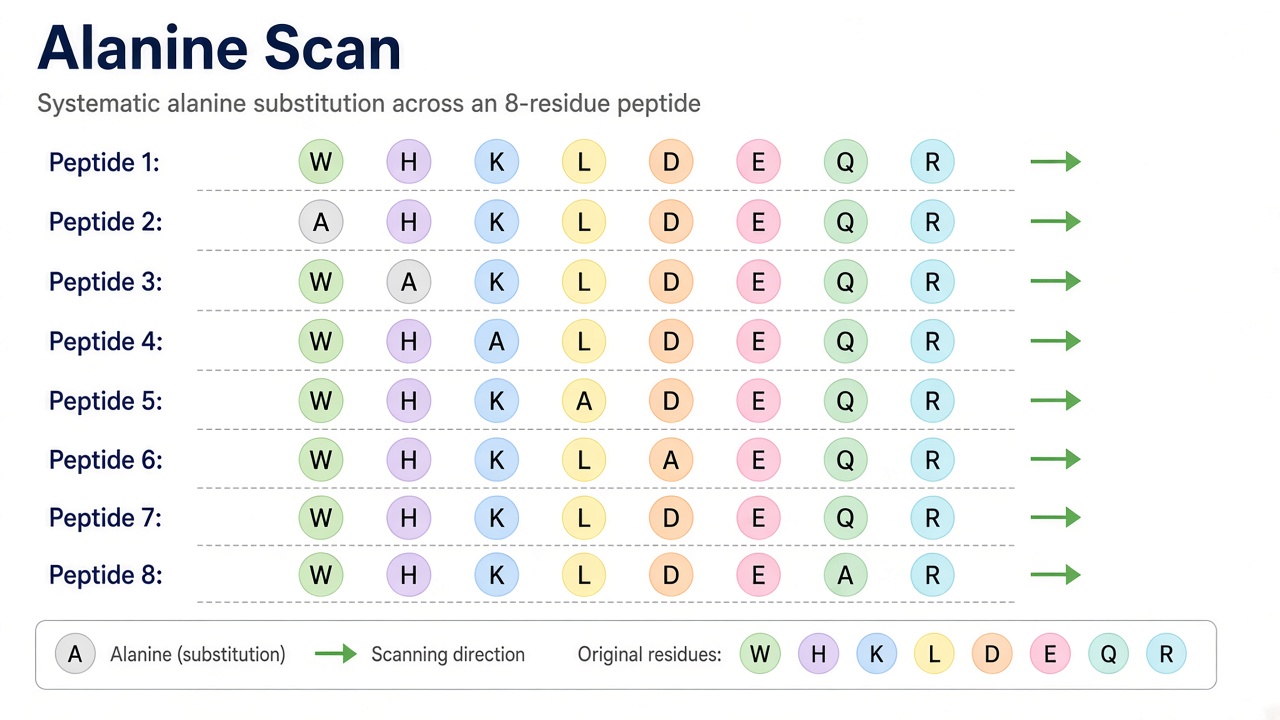
Designing a peptide libaries collection requires careful consideration of sequence length, amino acid composition, and positional constraints. One of the most powerful systematic approaches is alanine scanning, in which each residue of a known active peptide is sequentially replaced with alanine. The resulting peptide libaries reveals which side chains are essential for binding or activity, because alanine substitution removes all side-chain functionality beyond the beta carbon.
For a 12-mer peptide, an alanine scanning peptide libaries contains 12 mutant peptides plus the wild-type control. If a substitution reduces activity by more than 50%, that residue is considered critical. This method is widely used in receptor–ligand interaction studies and antibody engineering. Peptides Library offers custom alanine scanning peptide libaries with HPLC purity ≥95% and mass spec verification.
Beyond alanine scanning, systematic design strategies include truncation series, where N- or C-terminal residues are removed to identify the minimal active sequence, and substitution matrices, where each position is replaced by all 20 natural amino acids (i.e., a full positional scan). Combining alanine scanning with truncation analysis in a single peptide libaries often yields a minimal pharmacophore with defined critical contacts. Computational tools can help predict solubility and aggregation propensity before synthesis, reducing failed screens.
When designing a peptide libaries for screening, consider the following parameters:
- Peptide length: shorter peptides (6–10 residues) are easier to synthesize and screen but may lack conformational stability; longer peptides (15–25 residues) can adopt secondary structure but increase cost and synthesis difficulty.
- Terminal modifications: N-terminal acetylation and C-terminal amidation reduce charge effects and mimic native peptide bonds.
- Solubility: incorporate polar residues or add solubility tags (e.g., poly-arginine) to prevent aggregation during assay.
- Purity: request HPLC purification for peptide libaries intended for quantitative assays; a minimum purity of 90–95% is standard for most screening workflows.
For detailed guidance on sourcing and quality control of research peptides, see Exogenous Peptides: Complete Sourcing and QC Guide (2026).
What Is the Post-Purchase Workflow for Screening Peptide Libaries?
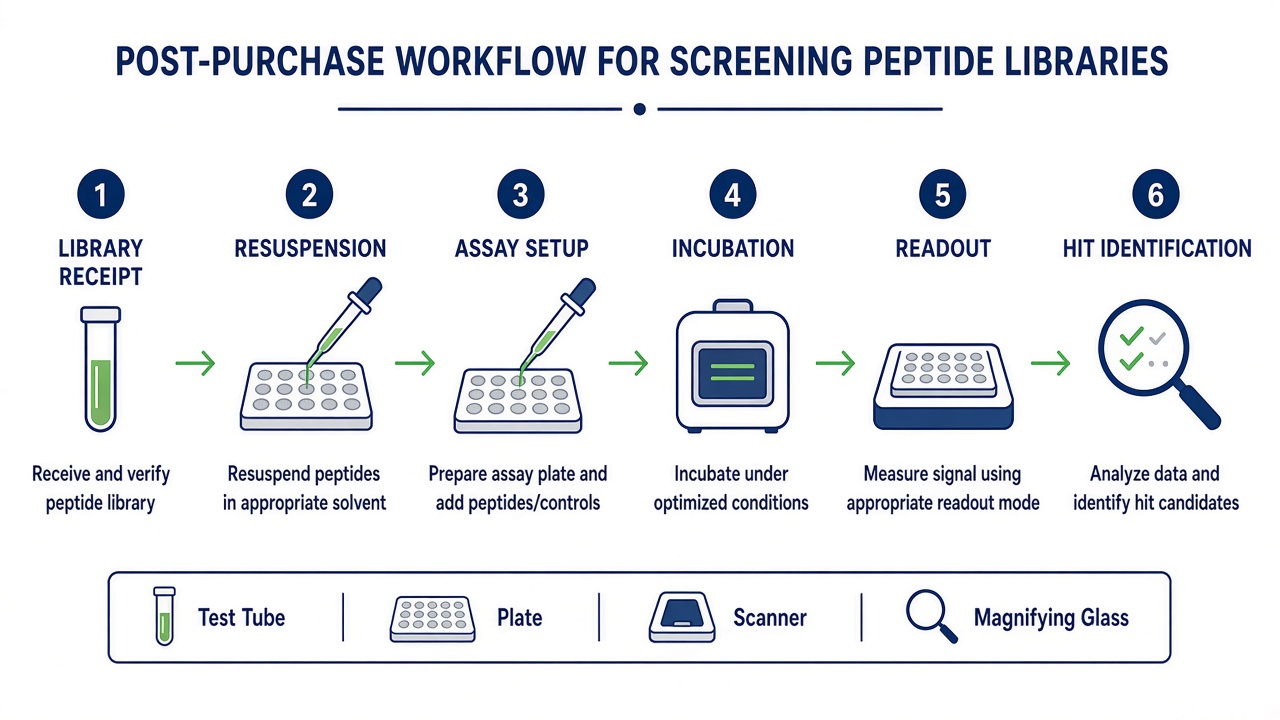
After receiving a peptide libaries shipment, the first step is proper reconstitution and storage. Lyophilized peptide libaries should be dissolved in an appropriate solvent—typically sterile water, PBS, or DMSO depending on sequence hydrophobicity—and aliquoted to avoid repeated freeze-thaw cycles. Storage at -20°C for short-term use or -80°C for long-term stability preserves peptide integrity. Each vial or plate well should be labeled with the peptide ID, concentration, and date of reconstitution.
The next phase is assay development. For receptor binding screens, researchers often use ELISA or surface plasmon resonance (SPR) to measure peptide libaries interactions with immobilized targets. For enzyme inhibition assays, fluorescence-based or colorimetric readouts provide kinetic data. Regardless of assay format, include positive and negative controls, such as a known binding peptide and a scrambled sequence control, to normalize plate-to-plate variability.
Screening a peptide libaries set requires careful plate layout planning. For 96-well plates, assign the first and last columns to controls and blanks. For 384-well plates, reserve multiple edge wells for controls to minimize evaporation artifacts. Record all raw data electronically, and include replicate wells for each peptide to assess intra-assay precision. If solubility issues arise during reconstitution, test a small subset of peptides in different solvent conditions before processing the entire plate.
How Do You Analyze Data and Validate Hits from Peptide Libaries?
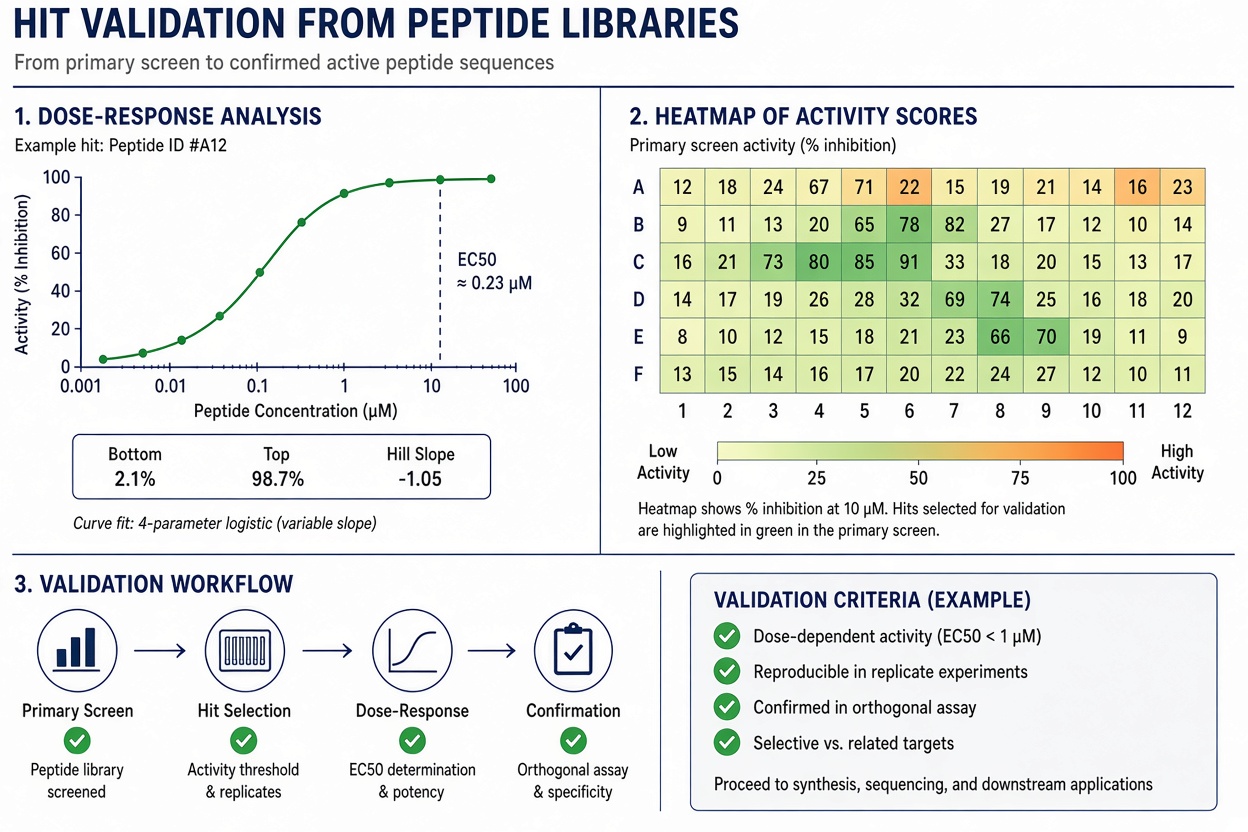
Data analysis for peptide libaries screening begins with normalization. Subtract background signal from blank wells and divide by the positive control signal to express results as percent activity or relative binding units. Calculate the Z-factor for each plate; a Z-factor between 0.5 and 1.0 indicates a robust assay. Peptides with activity above a predefined threshold—typically three standard deviations above the mean of negative controls—are designated as primary hits.
Primary hits from a peptide libaries screen require validation to rule out false positives. Re-test the top candidates in dose-response format using fresh aliquots to confirm concentration-dependent activity. Perform an orthogonal assay, such as SPR if the primary screen was ELISA, to verify binding kinetics. For enzyme substrates, validate cleavage sites by mass spectrometry.
Hit validation often includes resynthesis of individual peptides from the peptide libaries at higher purity, typically ≥95% by HPLC. Compare the activity of the resynthesized peptide with the original library aliquot to confirm that the observed activity is sequence-specific and not an artifact of synthesis impurities. Use alanine scanning on validated hits to map critical residues, as described earlier. Data analysis software for plate-based screens includes standard spreadsheet templates and dedicated laboratory information management systems; no single tool is required as long as normalization and thresholding are documented.
For a checklist on verifying research claims and study quality, see Are There Studies on It? 7 Essential Ways to Check (2026).
💡 Key Takeaway: How Do You Analyze Data and Validate Hits from Peptide Libaries?
What Should You Check When Purchasing Peptide Libaries from a Vendor?
Before purchasing peptide libaries, verify that the vendor provides a certificate of analysis (COA) for each batch. The COA should include HPLC purity data, mass spectrometry confirmation of molecular weight, and peptide content by amino acid analysis. Request example COAs for the specific peptide libaries format you plan to order, whether plates or individual vials.
Check the vendor’s synthesis scale and delivery format. Peptide libaries supplied in 96-well or 384-well plates should include a plate map with sequence identifiers and well positions. Individual vials should be labeled with the exact sequence, modification, and net peptide content. Confirm that the vendor uses controlled storage and shipping conditions, such as cold-chain packaging for lyophilized peptides.
Ask about custom peptide libaries capabilities, including non-natural amino acids, fluorescent labels, biotinylation, and cyclization. Reputable vendors will provide a feasibility assessment before synthesis and a guaranteed purity level, typically ≥90% for screening-grade peptide libaries and ≥95% for validation-grade sets. Always confirm that all products are sold for in vitro research use only and not for human or veterinary applications. Red flags include missing COAs, vague purity claims without HPLC traces, and lack of mass spectrometry data. For authoritative background on peptide chemistry and assay development, consult NCBI or PubMed.
FAQ
What is the difference between combinatorial and positional scanning peptide libaries?
Combinatorial peptide libaries contain large random sequence mixtures (10^3–10^9 peptides) and require deconvolution to identify active sequences. Positional scanning peptide libaries systematically vary one position at a time across 20 sub-libraries per position, enabling direct motif identification without deconvolution.
How should I store peptide libaries after delivery?
Store lyophilized peptide libaries at -20°C for short-term use or -80°C for long-term stability. Avoid repeated freeze-thaw cycles by aliquoting reconstituted solutions. Use sterile solvents appropriate for peptide solubility, such as water, PBS, or DMSO.
What purity level is recommended for screening peptide libaries?
A minimum HPLC purity of 90–95% is standard for most screening workflows. For quantitative assays and hit validation, request peptide libaries with purity ≥95% and mass spectrometry verification. Peptides Library offers custom alanine scanning peptide libaries with HPLC purity ≥95%.
Can I request custom peptide libaries with modifications?
Yes, Peptides Library supplies custom peptide libaries with specified sequences, modifications, or labeling, including non-natural amino acids, fluorescent tags, biotinylation, and cyclization. Provide your sequence list and purity requirements for a feasibility assessment.
Are peptide libaries suitable for human or veterinary use?
No. All peptide libaries discussed here are for in vitro laboratory research purposes only. They are not for human use, not for veterinary use, and not intended to diagnose, treat, cure, or prevent any disease. Must be 21+ to purchase.
Topics covered in this article:
Ready to Take the Next Step?
Every product includes lot-specific documentation and third-party purity testing.
Explore Our Research Products →Free shipping on qualifying orders · Batch COA on request