


Peptide Research Library: A Complete Reference Guide
Learn what a peptide research library is, how compounds are catalogued, and why lot purity documentation matters for reproducible laboratory research.
📋 Table of Contents
A peptide research library is a curated, systematically catalogued collection of peptide compounds maintained for laboratory study. Rather than shelves of books, it is a reference framework: every compound is indexed with its sequence, molecular data, purity grade, and lot documentation so researchers can identify, compare, and select candidates for in vitro work. This guide explains what a peptide research library is, how compounds are organized within one, and why lot and purity documentation are central to reproducible research.
What Is a Peptide Research Library?
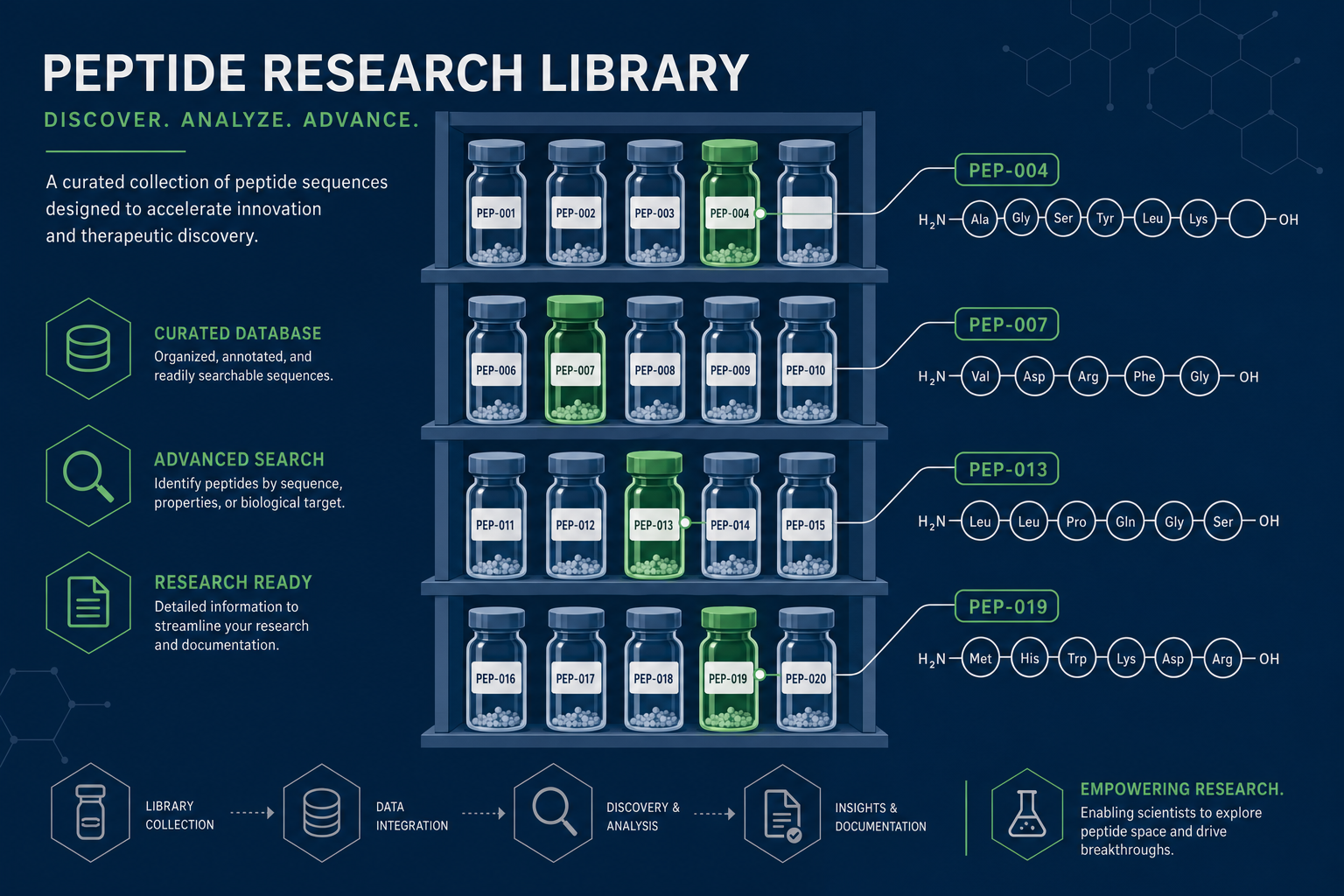
A peptide research library is an organized catalog of peptide compounds — short chains of amino acids, typically 2 to 50 residues in length, produced for laboratory investigation. Each entry describes a specific compound in full: its name and synonyms, amino acid sequence, molecular formula and weight, structural modifications, purity grade, and handling requirements.
The value of a library lies in standardization. The same peptide is often referenced under several names in the literature, and small structural differences — an acetylated terminus, a substituted residue, a different salt form — can meaningfully change how a compound behaves in an assay. A well-maintained library removes that ambiguity by anchoring every compound to a single, complete record.
One point deserves emphasis: compounds in a peptide research library are supplied for in vitro and laboratory research only. They are not approved for human or veterinary use, and library documentation exists to support experimental work, not clinical application.
How Compounds Are Catalogued
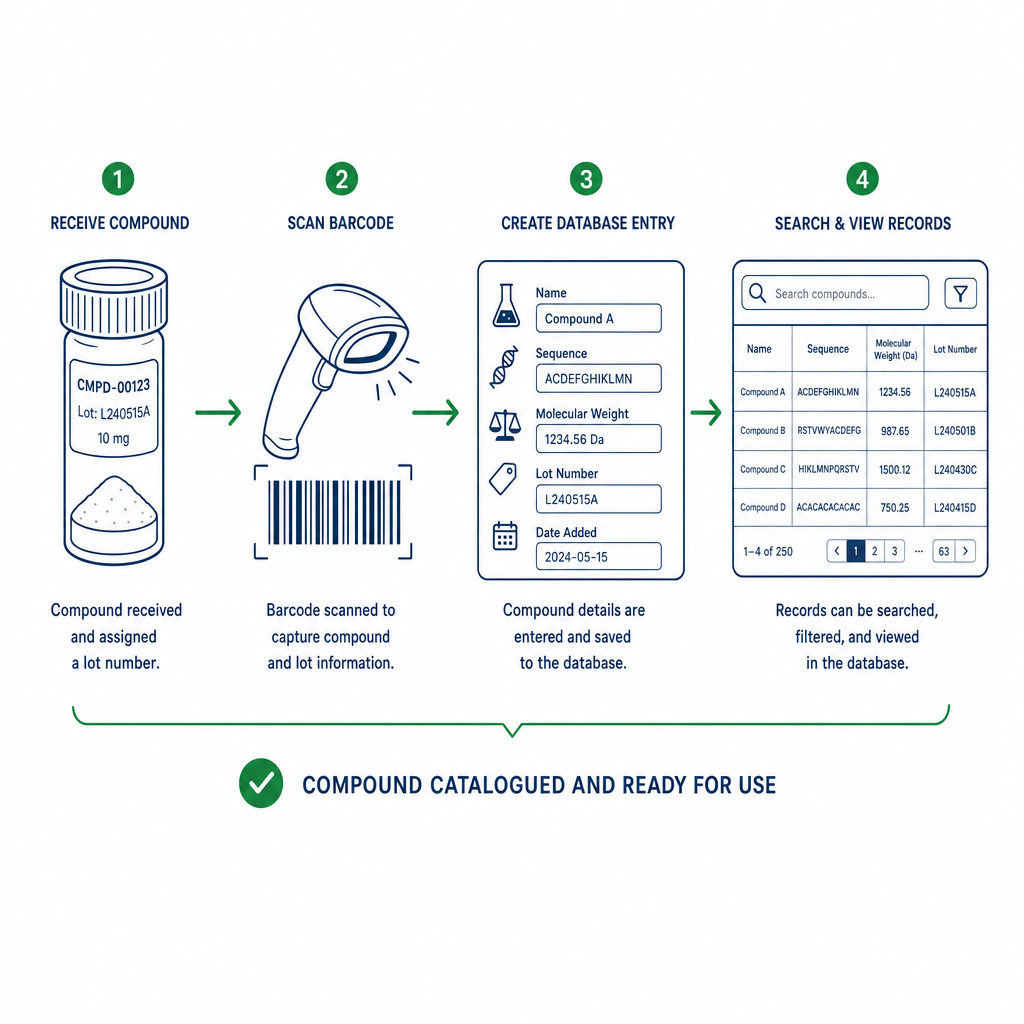
Sequence and identity data
The backbone of any catalog entry is identity information. A complete record includes:
- Primary name and synonyms, including common shorthand used in the literature
- Amino acid sequence, in both one-letter and three-letter notation, with chain length
- Structural modifications, such as N-terminal acetylation, C-terminal amidation, or D-amino acid substitutions
- CAS registry number, where one has been assigned
Sequence data matters because peptides with similar names can differ by a single residue. A catalog that discloses the full sequence lets researchers verify that the compound they receive matches the compound described in a publication.
Molecular and physicochemical data
Each entry also carries the data needed to plan experiments:
- Molecular formula and average molecular weight, used for calculating molar concentrations
- Net peptide content, the fraction of gross weight that is actual peptide (explained below)
- Solubility guidance, since some peptides dissolve readily in water while others require specific buffers or organic co-solvents
- Storage conditions, typically lyophilized storage at −20 °C with protection from repeated freeze–thaw cycles
Research categories
Finally, compounds are grouped by structural class or research area. Common groupings include:
- Metabolic research compounds, such as GLP-1 receptor agonists and related analogues
- Growth hormone secretagogues, peptides studied for their effects on growth hormone pathways
- Skin and dermatology research peptides, including collagen-signaling sequences and copper-binding motifs
- Tissue repair and recovery research compounds
Category browsing is usually the fastest way to shortlist candidates, because it frames each compound alongside structurally or mechanistically related peptides. You can browse the library’s peptide categories to see this organization in practice.
Why Lot and Purity Documentation Matters
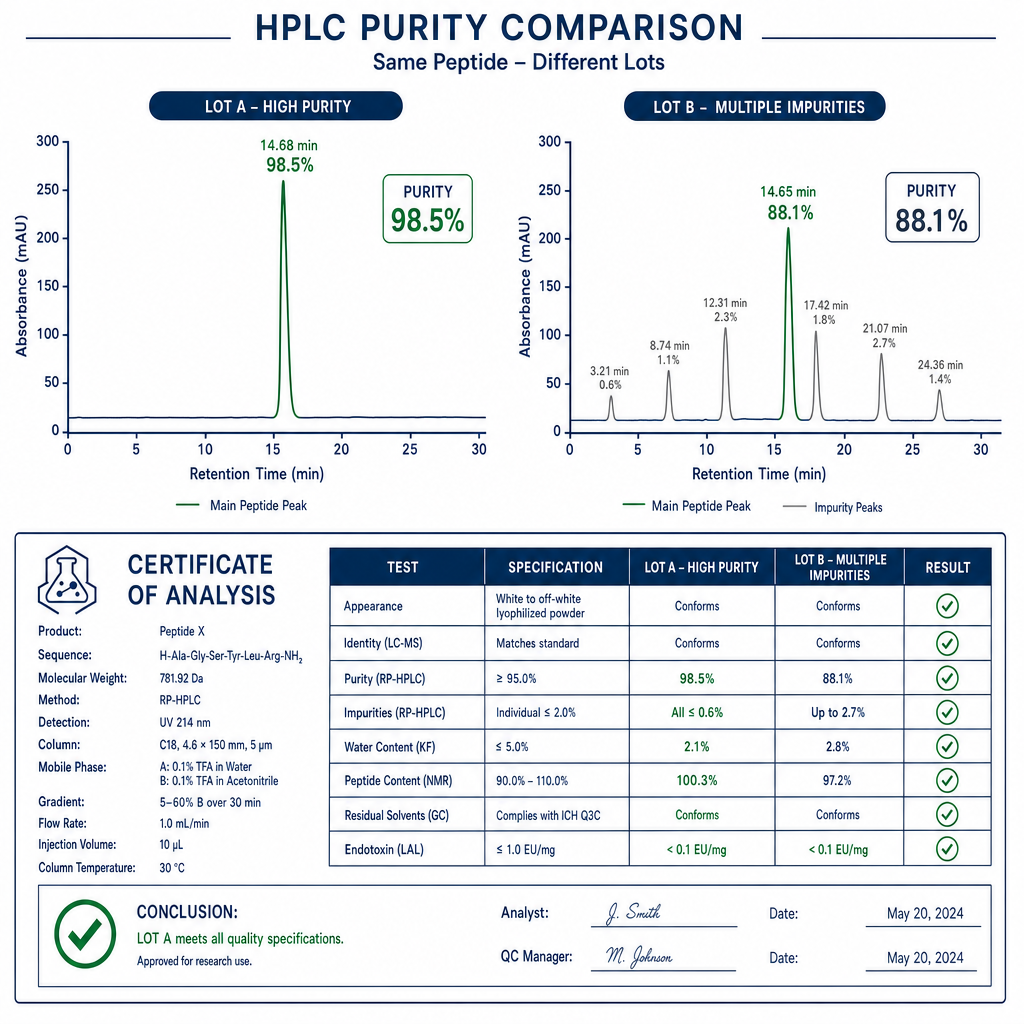
If cataloguing defines *what* a compound is, lot and purity documentation defines *what is actually in the vial*. This is where research-grade quality is established — and where reproducibility problems originate when it is neglected.
Purity grades and how they are measured
Peptide purity is most commonly reported as the percentage of the sample corresponding to the target peptide, measured by reverse-phase HPLC (RP-HPLC). Research-grade compounds are typically offered at ≥95%, ≥98%, or ≥99% purity, with the balance consisting of truncated sequences, deletion products, and other synthesis by-products.
Identity is confirmed separately, usually by mass spectrometry (ESI-MS or MALDI-TOF), which verifies that the molecular mass of the main peak matches the calculated mass of the intended sequence. A compound is fully characterized only when both analyses agree.
Net peptide content versus purity
Purity and net peptide content are frequently confused, and the distinction has real experimental consequences. A vial labeled 99% pure tells you the sample is 99% target peptide *relative to other peptide species*. It says nothing about water, residual solvents, or counterions — most commonly trifluoroacetate (TFA) salts introduced during cleavage and purification.
Net peptide content, by contrast, describes what fraction of the gross weight is actual peptide, typically determined by amino acid analysis, elemental analysis, or UV absorbance. It is not unusual for net content to fall between roughly 70% and 90% of total mass. Researchers who calculate concentrations from gross weight alone can inadvertently work with substantially less peptide than intended. A well-documented library reports both figures.
Lot traceability and reproducibility
Every synthesis run produces a batch — a lot — with its own Certificate of Analysis (CoA). The CoA documents that lot’s HPLC chromatogram, mass spectrum, and net content, all tied to a unique lot number. This matters for three reasons:
1. Batch consistency. Peptide synthesis is precise but not perfectly uniform; two lots of the same sequence can differ slightly in impurity profile. Lot documentation lets researchers account for — or rule out — batch variation when results shift.
2. Reproducibility. Methods that cite purity grades and lot-level documentation are far easier for other laboratories to replicate.
3. Traceability. If an unexpected result appears, lot numbers make it possible to trace exactly which material was used and whether other lots behave differently.
In short, a peptide without lot and purity documentation is an uncontrolled variable. A library that maintains per-lot CoAs converts that variable into a documented, auditable input.
💡 Key Takeaway: Why Lot and Purity Documentation Matters
Comparing Compounds Within a Library
One of the most practical functions of a research library is side-by-side comparison. Because every entry uses the same fields — sequence, molecular weight, class, purity documentation — researchers can evaluate candidates against one another quickly.
Consider metabolic research. Two frequently compared compounds in this category are AOD-9604, a modified fragment of the growth hormone peptide chain studied in lipolysis research, and semaglutide, an acylated GLP-1 receptor agonist studied in metabolic and appetite research. Despite appearing in similar discussions, they differ fundamentally in size, structure, mechanism, and documented research history. Our AOD-9604 vs. semaglutide comparison walks through seven of those differences — the kind of analysis a well-organized library makes possible.
For broader reading, the research blog collects additional compound guides and comparisons built on the same cataloguing principles.
What to Look For in a Well-Documented Library
Whether you are evaluating a supplier or organizing your own reference collection, a few standards separate a genuine research library from a simple product list:
- Full sequence disclosure for every compound, including modifications
- Lot-specific Certificates of Analysis, not generic purity claims
- HPLC chromatograms and mass spectra available per lot
- Net peptide content reported alongside purity
- Storage and handling guidance, including reconstitution notes
- Clear research-use-only labeling on every compound
If any of these are missing, the documentation chain — and with it, reproducibility — has a gap.
Frequently Asked Questions
Is a peptide research library the same as a supplier catalog?
They overlap, but a true research library emphasizes documentation and organization: complete sequence data, category structure, and lot-level analytical records. A catalog lists products; a library characterizes compounds.
What purity grade is appropriate for research?
It depends on the application. For routine in vitro work, ≥95% is a common baseline; analytical, pharmacological, or structural studies typically call for ≥98–99%. What matters most is that the claim is backed by a lot-specific CoA.
How should compounds from a library be stored?
Most lyophilized research peptides are stored at −20 °C, protected from light and moisture, with reconstitution performed using an appropriate sterile solvent and repeated freeze–thaw cycles avoided once in solution.
💡 Key Takeaway: Frequently Asked Questions
The Bottom Line
A peptide research library is more than a product listing. It is a documentation system: compounds catalogued by sequence, structure, and research category, backed by lot-level purity records that make results interpretable and repeatable. When selecting compounds — or deciding where to source them — the depth of that documentation is the single best indicator of research quality.
Ready to Take the Next Step?
Every product includes lot-specific documentation and third-party purity testing.
Explore Our Research Products →
Free shipping on qualifying orders · Batch COA on request