


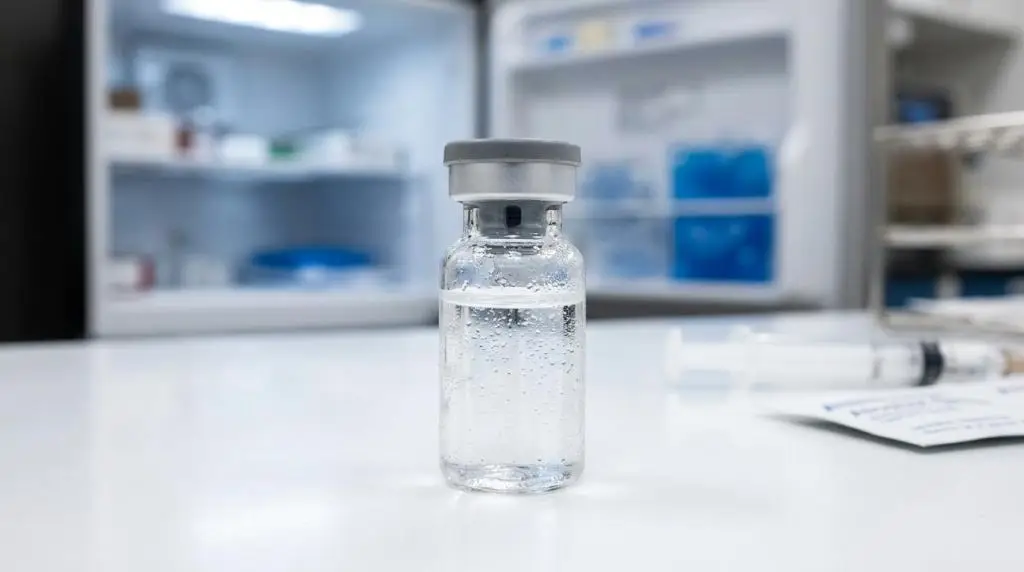
Peptide storage is where generic advice creates avoidable mistakes. Peptides Library helps you sort product labels, peptide form, and preparation details so you can store what you have correctly, whether that is a ready-to-use pen, an opened vial, or a reconstituted peptide.
Our storage content is built for researchers, healthcare professionals, students, and informed consumers who want evidence-based answers instead of blanket rules. Peptides Library combines citation-focused articles, evidence reviews, and practical tools with an independent editorial stance, so you can check refrigeration ranges, room-temperature limits, and reconstitution-related handling in one place.
Peptide storage guidance from Peptides Library for semaglutide, tirzepatide, and lyophilized peptides
Peptides Library focuses on the storage details that change your next step: the dosage form, the labeled temperature range, and the discard window after opening or first use. That matters because FDA-labeled peptide drugs do not follow one universal storage rule, and a wrong assumption can shorten usable time or force discard.
“Peptides Library shows that in-use semaglutide pens may carry 56-day storage limits, while other peptide products follow different timelines.”
For example, FDA-labeled WEGOVY and OZEMPIC pens in use can be stored for 56 days at room temperature between 59°F and 86°F or in a refrigerator between 36°F and 46°F. ZEPBOUND uses a different in-use framework for opened vials, including disposal after a total of 30 days at room temperature, 30 days after first use, or after 4 weekly doses, even if medicine remains.
Peptides Library turns those product-specific rules into clearer handling decisions, so you do not treat semaglutide, tirzepatide, and reconstituted peptides as if they share the same storage window.
Peptides Library turns FDA-labeled storage facts into practical peptide handling decisions
When you use Peptides Library for peptide storage questions, you are not getting a vague reminder to “keep it cold.” You are getting form-specific guidance tied to labeled temperature ranges, in-use timelines, and handling constraints such as freeze exposure, light exposure, and whether a product can return to refrigeration after room-temperature storage.
“Peptides Library highlights concrete label limits such as room temperature up to 86°F and refrigerator storage between 36°F and 46°F.”
That makes our storage coverage useful when you need to answer practical questions before you store, transport, open, or reconstitute a peptide product.
Peptides Library helps you check issues such as:
- Which peptide products have an in-use room-temperature window and how long it lasts
- Whether an opened vial or pen should stay in the original carton or be protected from light
- When lyophilized peptides shift to refrigeration requirements after reconstitution
We also connect storage guidance to related methodology content, including dosage-chart material and bacteriostatic water guidance, so your storage plan matches how the peptide is prepared and used.
Peptides Library helps reduce peptide storage mistakes during reconstitution, travel, and in-use handling
Most storage problems happen at transition points: after first use, after reconstitution, during shipping or travel, or after a product has been left out longer than expected. Peptides Library brings those decision points forward so you can check the actual rule before assuming a peptide can stay at room temperature, go back into the refrigerator, or remain usable after heat, freezing, or light exposure.
“Peptides Library notes that some opened peptide products must be discarded after 30 days, and some should not be returned to the refrigerator once stored at room temperature.”
That distinction matters. WEGOVY labeling says the product should be thrown away if frozen, exposed to light or temperatures above 86°F, or left out of the refrigerator for 28 days or longer, while ZEPBOUND labeling states that if the vial is stored at room temperature it should not be returned to the refrigerator. For lyophilized peptides, Peptides Library’s dosage-chart content states that most require refrigeration after reconstitution, which is exactly why form-specific handling matters.
Independent peptide storage research for clinicians, researchers, students, and informed consumers
Peptides Library is the right fit when you want an independent knowledge hub rather than a retailer pushing a product line. We publish evidence-based articles, research guides, evidence reviews, peptide calculators, and brand or product reviews so you can compare storage instructions with preparation and application context.
Peptides Library is especially useful if you are reviewing semaglutide or tirzepatide label instructions, checking handling assumptions for reconstituted peptides, or teaching why FDA-labeled peptide products require peptide-specific consideration instead of generic advice. Our continuously updated peptide-research coverage helps you return to one source as storage questions change across brands, dosage forms, and new evidence.
Use Peptides Library when you need product-specific peptide storage guidance
If you need a faster, clearer answer before you open a pen, store an opened vial, or reconstitute a lyophilized peptide, start with Peptides Library. You will get storage guidance built around the specific peptide form in front of you, with citation-focused context that makes temperature limits, discard timing, and handling restrictions easier to verify.
Visit Peptides Library to review the peptide storage guidance, compare the evidence, and use our practical research tools so you can make the right storage decision with less guesswork.