


Quick Answer
What Is TB-500 Peptide?
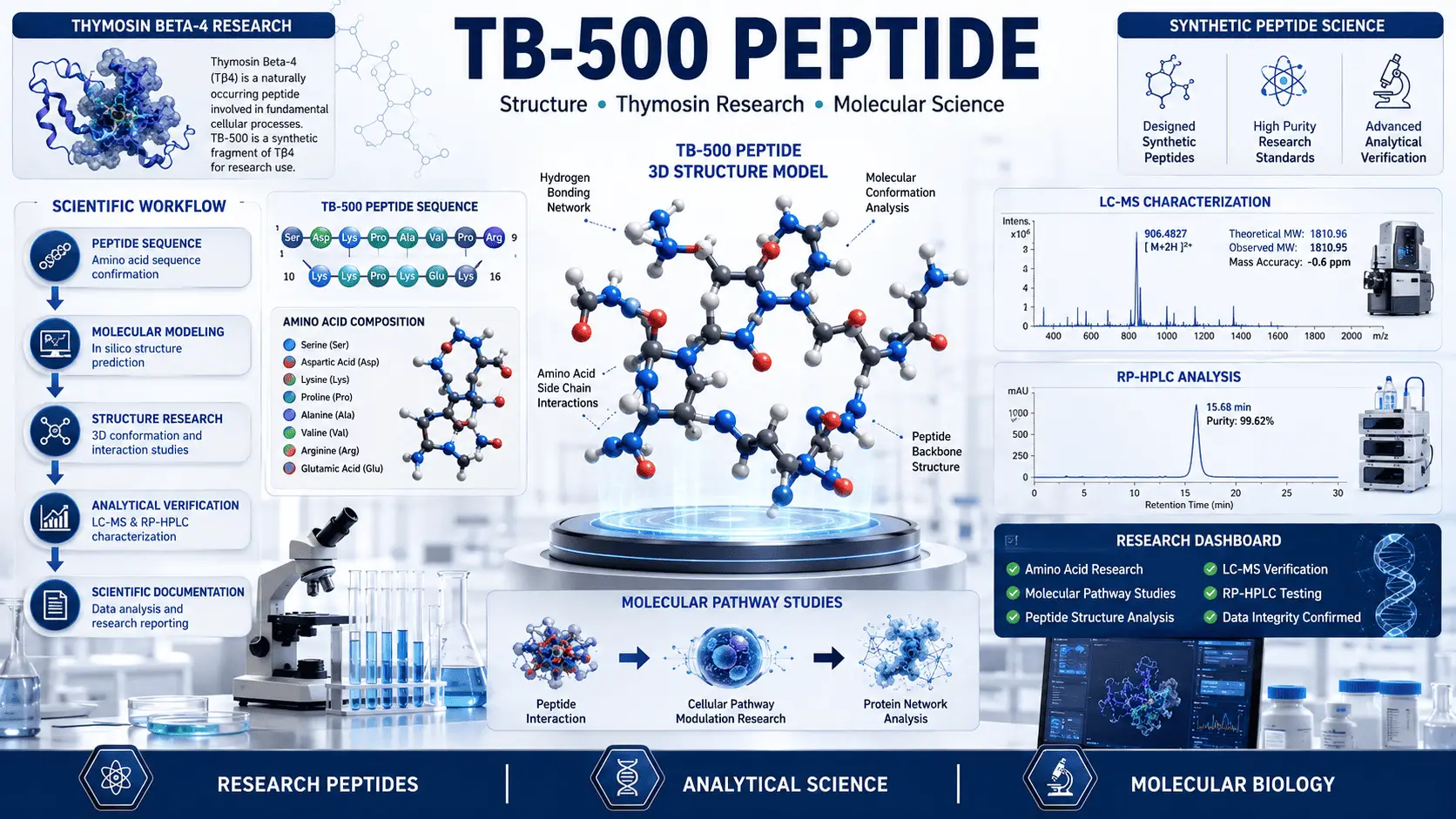
The TB-500 peptide is a synthetic peptide studied in scientific research because of its relationship with Thymosin Beta-4, a naturally occurring peptide involved in molecular biology investigations. TB-500 research focuses on peptide structure, amino acid sequences, molecular pathways, and laboratory-based analytical studies.
TB-500 Peptide: Scientific Research, Molecular Structure & Thymosin Beta-4 Studies
Scientific Snapshot
| Research Topic | TB-500 Peptide |
| Associated Research Area | Thymosin Beta-4 Peptide Science |
| Peptide Category | Synthetic Peptide Research |
| Scientific Focus | Molecular Pathways, Peptide Structure & Sequence Research |
| Research Methods | LC-MS, RP-HPLC, Computational Modeling |
Quick Facts
| Common Name | TB-500 |
| Research Relationship | Thymosin Beta-4 Fragment Research |
| Study Classification | Peptide Biology and Molecular Research |
| Comparison Topic | BPC-157 and TB-500 Peptide Research |
| Scientific Interest | Peptide Structure-Function Relationships |
Key Takeaways
- TB-500 peptide research investigates synthetic peptide structures, Thymosin Beta-4 relationships, and molecular pathway studies.
- Scientific analysis of peptide TB 500 focuses on amino acid sequence research, peptide chemistry, and laboratory characterization.
- Comparisons involving BPC 157 TB 500 peptide research explore differences between peptide structures and molecular pathways.
- Analytical technologies including LC-MS, RP-HPLC, and computational modeling contribute to modern TB-500 peptide research.
Table of Contents
Introduction
TB-500 peptide research has become an important area within synthetic peptide science because of its connection with Thymosin Beta-4 related molecular investigations. Researchers study peptide structures to better understand amino acid relationships, molecular interactions, and peptide behavior within experimental systems.
Scientific interest in TB 500 peptides involves several research disciplines, including peptide chemistry, molecular biology, computational modeling, and analytical testing. These fields help scientists examine peptide characteristics through evidence-based methods.
The relationship between BPC 157 TB 500 peptide research is also frequently discussed because both peptides are commonly reviewed within synthetic peptide literature. Scientific comparisons focus on molecular differences, peptide families, and research pathways rather than direct equivalence.
As peptide science advances, researchers increasingly combine laboratory techniques such as LC-MS and RP-HPLC with artificial intelligence tools to explore peptide structures and molecular relationships.
This Peptides Library guide explores TB-500 peptide research, Thymosin Beta-4 studies, molecular analysis, peptides BPC 157 and TB 500 comparisons, and future directions in peptide science.
Research Note
Understanding TB-500 Through Scientific Research
Information about TB-500 peptide is presented for educational and scientific research purposes. Current studies focus on molecular biology, peptide chemistry, analytical characterization, and experimental research models.
What Is TB-500 Peptide?
The TB-500 peptide is a synthetic peptide studied within molecular biology and peptide science because of its relationship with Thymosin Beta-4 research. Scientific investigations focus on peptide structure, amino acid sequence characteristics, and molecular pathway analysis.
TB-500 peptides are part of a broader category of synthetic peptides that researchers analyze to understand structure-function relationships, molecular interactions, and peptide behavior within experimental systems.
Modern studies involving peptide TB 500 commonly include analytical chemistry, computational modeling, sequence evaluation, and comparisons with other research peptides.
Research Insight
TB-500 Research Originates From Thymosin Beta-4 Studies
Thymosin Beta-4 has been widely investigated in molecular biology research. TB-500 studies explore peptide fragments, sequence relationships, and structural characteristics connected with this area of peptide science.
TB-500 Peptide Structure and Molecular Characteristics
The scientific study of TB-500 peptide involves analysis of molecular structure, amino acid arrangement, and peptide sequence relationships. These characteristics help researchers understand how peptide architecture influences molecular properties.
Researchers use advanced analytical tools to investigate synthetic peptide structures and confirm molecular characteristics during laboratory evaluation.
| Scientific Feature | TB-500 Research Profile |
|---|---|
| Peptide Type | Synthetic Research Peptide |
| Research Relationship | Thymosin Beta-4 Peptide Science |
| Primary Study Area | Molecular Pathway Research |
| Scientific Evaluation | Amino Acid Sequence and Structural Studies |
| Research Methods | LC-MS, RP-HPLC, Computational Analysis |
Thymosin Beta-4 and TB-500 Scientific Background
Thymosin Beta-4 is a naturally occurring peptide studied for its involvement in complex biological research pathways. TB-500 research examines peptide fragments associated with Thymosin Beta-4 and their molecular characteristics.
Scientists investigate these peptide systems to better understand molecular communication, peptide sequence relationships, and structure-based research models.
| Research Category | Scientific Focus |
|---|---|
| Peptide Chemistry | Study of molecular composition and peptide sequence |
| Structural Biology | Analysis of peptide configuration |
| Molecular Research | Investigation of peptide-related pathways |
| Computational Science | Modeling peptide structures and interactions |
Amino Acid Sequence Research in TB-500 Studies
Amino acid sequences determine the structural properties of peptides. Researchers study sequence patterns to understand molecular characteristics, stability factors, and peptide interactions during scientific analysis.
TB-500 peptide research contributes to the broader field of synthetic peptide science by helping scientists evaluate relationships between peptide design and molecular behavior.
BPC 157 TB 500 Peptide Research Relationship
Scientific discussions involving BPC 157 TB 500 peptide research compare two different peptide systems that are frequently reviewed within peptide science literature.
Although peptides BPC 157 and TB 500 are often discussed together, they represent separate peptide structures with different molecular characteristics and research backgrounds.
| Research Feature | BPC-157 | TB-500 |
|---|---|---|
| Peptide Family | Synthetic pentadecapeptide research | Thymosin Beta-4 related research |
| Research Focus | Peptide pathway studies | Molecular structure studies |
| Scientific Analysis | Sequence characterization | Sequence characterization |
| Research Technologies | LC-MS / RP-HPLC | LC-MS / RP-HPLC |
TB-500 and the Broader Research Peptide Landscape
TB-500 peptide research connects with broader scientific topics including synthetic peptide development, analytical testing, and computational peptide discovery.
Research areas such as peptide sequencing, HPLC analysis, LC-MS verification, and AI-assisted peptide modeling continue expanding scientific understanding of peptide structures.
Did You Know?
Peptide Sequence Determines Molecular Characteristics
Small changes in amino acid arrangement can influence peptide structure, which is why sequence analysis remains a major focus of modern peptide research.
Section Summary
TB-500 peptide research focuses on Thymosin Beta-4 related science, amino acid sequence analysis, molecular structure, and peptide characterization. Comparisons with BPC-157 help researchers explore differences between synthetic peptide systems.
TB-500 Peptide Molecular Pathway Research
Scientific investigations involving the TB-500 peptide explore molecular pathways, peptide structure relationships, and biological research models associated with Thymosin Beta-4 studies. Researchers evaluate how peptide sequences interact within controlled experimental environments.
TB-500 peptides are examined through molecular biology, peptide chemistry, and analytical science to better understand peptide characteristics and structure-function relationships.
Research involving peptide TB 500 continues to expand as scientists apply advanced technologies such as computational modeling, sequence analysis, and high-resolution analytical methods.
Research Insight
Peptide Mechanism Research Studies Molecular Relationships
Modern peptide research focuses on understanding how amino acid sequences, molecular structures, and peptide interactions contribute to biological research systems.
Thymosin Beta-4 Research and TB-500 Studies
Thymosin Beta-4 has been studied extensively in molecular biology because of its role in complex cellular research pathways. TB-500 research examines peptide fragments and molecular characteristics associated with this field.
Scientists evaluate Thymosin-related peptide systems using laboratory models designed to investigate structure, sequence relationships, and molecular behavior.
| Research Area | Scientific Investigation Focus |
|---|---|
| Peptide Sequence Research | Amino acid arrangement and molecular structure studies |
| Pathway Analysis | Investigation of peptide-related molecular systems |
| Protein Interaction Research | Study of molecular relationships |
| Structural Modeling | Computational peptide analysis |
TB-500 Research Mechanisms: Scientific Interpretation
Research mechanisms associated with TB-500 peptide studies are evaluated through molecular biology experiments, peptide characterization methods, and computational analysis.
Scientific interpretation requires consideration of study design, research models, analytical techniques, and experimental limitations before drawing conclusions.
| Research Topic | Scientific Evaluation |
|---|---|
| Molecular Pathways | Analysis of peptide-related systems |
| Peptide Structure | Amino acid sequence evaluation |
| Experimental Models | Controlled scientific investigation |
| Data Interpretation | Evidence-based research analysis |
BPC-157 and TB-500 Peptide Research Comparison
The relationship between peptides BPC 157 and TB 500 is frequently discussed in peptide research because both compounds appear in scientific conversations around synthetic peptide studies.
However, researchers evaluate BPC-157 and TB-500 as separate peptide systems with unique structures, sequence characteristics, and molecular research backgrounds.
| Comparison Area | BPC-157 Research | TB-500 Research |
|---|---|---|
| Peptide Classification | Synthetic pentadecapeptide | Thymosin Beta-4 related peptide |
| Primary Scientific Interest | Peptide pathway research | Molecular pathway research |
| Research Approach | Laboratory-based peptide studies | Laboratory-based peptide studies |
| Analytical Methods | LC-MS and RP-HPLC evaluation | LC-MS and RP-HPLC evaluation |
Wolverine Stack Peptide Research Discussions
The term Wolverine Stack commonly appears in online discussions involving BPC-157 and TB-500 peptide combinations. From a scientific perspective, researchers evaluate each peptide individually based on molecular characteristics, structure, and available evidence.
Peptide research comparisons focus on understanding differences between molecular systems rather than assuming identical properties or combined outcomes.
Computational Research and TB-500 Molecular Modeling
Computational biology tools are increasingly used to study peptide structures, molecular patterns, and theoretical interactions. These technologies help researchers analyze peptide systems with greater detail.
AI-assisted research methods continue to expand scientific understanding of peptide TB-500 structures alongside traditional laboratory techniques.
Did You Know?
AI Is Becoming a Powerful Tool in Peptide Science
Artificial intelligence models can analyze peptide sequences, predict structural patterns, and support researchers studying complex molecular systems.
Section Summary
TB-500 peptide research explores Thymosin Beta-4 related molecular studies, peptide pathways, computational modeling, and structural analysis. Scientific comparisons with BPC-157 help build a broader understanding of different synthetic peptide research areas.
TB-500 Peptide Synthesis and Scientific Characterization
Research involving the TB-500 peptide relies on peptide synthesis methods, molecular characterization, and analytical evaluation to understand peptide identity, sequence accuracy, and structural properties.
TB-500 peptides are studied through modern peptide chemistry approaches that allow researchers to investigate amino acid organization, molecular weight, and structural characteristics under controlled laboratory conditions.
Analytical technologies such as liquid chromatography-mass spectrometry (LC-MS) and reverse-phase high-performance liquid chromatography (RP-HPLC) provide important scientific data for peptide TB-500 research.
Research Insight
Peptide Identity Requires Molecular-Level Evaluation
Modern peptide research uses advanced analytical methods to evaluate molecular characteristics, sequence information, purity profiles, and structural consistency.
Solid-Phase Peptide Synthesis and TB-500 Research
Solid-phase peptide synthesis (SPPS) is a widely studied approach in synthetic peptide science. It enables researchers to create specific amino acid sequences for molecular analysis and laboratory investigation.
In TB-500 peptide research, synthesis science focuses on sequence accuracy, molecular structure, and analytical confirmation rather than generalized assumptions about peptide properties.
| Synthesis Research Area | Scientific Purpose |
|---|---|
| Amino Acid Assembly | Development of defined peptide sequences |
| Molecular Characterization | Evaluation of peptide structure |
| Analytical Confirmation | Verification through laboratory methods |
| Scientific Documentation | Research consistency and traceability |
LC-MS Analysis in TB-500 Peptide Research
Liquid chromatography-mass spectrometry is an analytical method used in peptide research to evaluate molecular identity and mass-related characteristics.
For peptide TB 500 studies, LC-MS allows researchers to compare observed molecular information with expected peptide characteristics and improve scientific documentation.
| LC-MS Research Factor | Scientific Evaluation |
|---|---|
| Molecular Weight | Mass characteristic analysis |
| Peptide Identity | Molecular confirmation research |
| Structural Information | Sequence-related evaluation |
| Analytical Records | Scientific reporting and documentation |
RP-HPLC Testing and Peptide Purity Research
Reverse-phase high-performance liquid chromatography is commonly used in peptide science to study purity profiles, separation characteristics, and molecular composition.
Scientific evaluation of TB-500 peptides through chromatographic methods provides researchers with additional insight into peptide characteristics and analytical consistency.
| RP-HPLC Research Area | Scientific Purpose |
|---|---|
| Chromatographic Analysis | Study of peptide separation profiles |
| Purity Evaluation | Assessment of molecular composition |
| Analytical Comparison | Review of research characteristics |
| Quality Research | Scientific consistency evaluation |
TB-500 Peptide Stability Research
Peptide stability research examines how molecular structures behave under controlled scientific conditions. Researchers investigate factors such as sequence characteristics, environmental variables, and structural changes.
TB-500 peptide stability studies contribute to the broader understanding of synthetic peptide chemistry and molecular analysis.
Scientific Quality Evaluation in Peptide Research
Quality evaluation in peptide science involves multiple analytical approaches. Researchers examine molecular identity, peptide sequence information, and experimental variables to support reliable scientific interpretation.
This analytical foundation is important when comparing research areas such as BPC 157 TB 500 peptide studies because different peptide structures require independent evaluation.
Did You Know?
Multiple Testing Methods Improve Peptide Understanding
Researchers often combine technologies such as LC-MS, RP-HPLC, sequencing methods, and computational tools to build a more complete picture of peptide characteristics.
Section Summary
TB-500 peptide research uses synthesis science, LC-MS analysis, RP-HPLC testing, molecular characterization, and stability studies to investigate peptide structure and scientific properties.
Future Directions in TB-500 Peptide Research
Future research involving the TB-500 peptide continues to expand through advances in molecular biology, peptide chemistry, computational modeling, and analytical technologies. Scientists are increasingly combining laboratory-based research with digital tools to better understand peptide structures.
Research involving TB-500 peptides focuses on improving scientific understanding of peptide sequences, molecular interactions, structural relationships, and Thymosin Beta-4 associated research areas.
As biotechnology evolves, peptide TB-500 research may benefit from artificial intelligence systems, advanced simulation models, and next-generation analytical platforms.
Research Insight
AI Is Expanding Peptide Discovery Research
Artificial intelligence tools are helping researchers analyze peptide sequences, predict structural patterns, evaluate molecular relationships, and explore new areas of computational peptide science.
Artificial Intelligence and TB-500 Molecular Modeling
Artificial intelligence has become an important technology in modern peptide research. Computational systems can evaluate amino acid sequences, molecular structures, and theoretical interactions using large biological datasets.
For peptide TB 500 research, computational modeling provides additional scientific approaches for examining peptide structure and molecular characteristics alongside traditional laboratory methods.
| Technology | Role in Peptide Research |
|---|---|
| AI Structure Prediction | Analysis of peptide sequence and molecular patterns |
| Molecular Simulation | Research into theoretical peptide interactions |
| Machine Learning Models | Evaluation of complex peptide datasets |
| Bioinformatics | Large-scale peptide data interpretation |
Next-Generation Analytical Technologies in Peptide Science
Modern peptide science continues to evolve through improvements in analytical chemistry. Advanced tools allow researchers to investigate peptide identity, molecular composition, and structural characteristics with increasing precision.
These technologies support scientific evaluation of TB-500 peptide and other synthetic peptides by providing detailed molecular information.
| Research Technology | Scientific Application |
|---|---|
| High-Resolution LC-MS | Molecular identity and mass analysis research |
| Advanced RP-HPLC | Peptide purity and separation studies |
| Peptide Sequencing | Amino acid structure investigation |
| Computational Platforms | Digital peptide modeling research |
Future of BPC-157 and TB-500 Peptide Research Comparisons
Scientific interest in peptides BPC 157 and TB 500 comparisons continues because researchers study different peptide structures to better understand molecular diversity and peptide biology.
Future research involving BPC 157 TB 500 peptide comparisons may increasingly rely on artificial intelligence, molecular simulations, and advanced analytical technologies to evaluate peptide differences.
Related Peptides Library Research Articles
Continue Exploring Peptide Science
Explore additional Peptides Library educational resources covering synthetic peptides, analytical testing, computational biology, and molecular research.
BPC Research Cluster
Peptide Quality Science Cluster
- HPLC vs LC-MS vs Peptide Sequencing
- Your HPLC Purity Report Is Lying
- Research Peptides Explained
AI Peptide Research Cluster
Did You Know?
AI Models Are Changing Molecular Research
Modern AI systems can process complex molecular datasets, helping researchers study peptide structures and identify patterns that may not be visible through traditional analysis alone.
Section Summary
Future TB-500 peptide research is expected to advance through artificial intelligence, computational modeling, peptide sequencing, and improved analytical technologies. These scientific tools continue expanding understanding of peptide structures and molecular research systems.
Frequently Asked Questions About TB-500 Peptide
1. What is TB-500 peptide?
The TB-500 peptide is a synthetic peptide studied in molecular biology research because of its relationship with Thymosin Beta-4. Scientific investigations focus on peptide structure, amino acid sequences, molecular pathways, and analytical characterization.2. What are TB-500 peptides studied for?
TB-500 peptides are studied within laboratory research environments to explore peptide chemistry, molecular interactions, structural characteristics, and Thymosin Beta-4 related scientific pathways.3. What is the connection between TB-500 and Thymosin Beta-4?
TB-500 research is connected with Thymosin Beta-4 studies because scientists investigate related peptide fragments, sequence properties, and molecular characteristics within peptide biology research.4. What does peptide TB 500 research focus on?
Peptide TB 500 research focuses on amino acid sequence analysis, molecular structure, peptide stability, analytical testing, and computational modeling.5. Why are BPC-157 and TB-500 peptides compared?
Scientific discussions involving BPC 157 TB 500 peptide comparisons focus on differences between peptide structures, molecular pathways, and research characteristics.6. Are peptides BPC 157 and TB 500 the same?
No. Peptides BPC 157 and TB 500 represent separate research peptides with different amino acid structures, molecular characteristics, and scientific study backgrounds.7. What is the Wolverine Stack peptide topic?
The Wolverine Stack is a term commonly associated with discussions involving BPC-157 and TB-500 peptides. Scientific evaluation focuses on understanding each peptide independently through molecular research and analytical studies.8. How is TB-500 peptide analyzed scientifically?
Researchers analyze TB-500 peptide using technologies such as LC-MS, RP-HPLC, peptide sequencing methods, and computational modeling approaches.9. Why is LC-MS important in peptide research?
Liquid chromatography-mass spectrometry helps researchers evaluate peptide identity, molecular weight characteristics, and structural information during scientific analysis.10. What role does RP-HPLC play in TB-500 research?
RP-HPLC is used in peptide science to investigate purity profiles, molecular separation, and analytical characteristics of synthetic peptide materials.11. How is artificial intelligence used in peptide research?
Artificial intelligence supports peptide science by analyzing molecular datasets, predicting structures, studying sequence relationships, and assisting computational peptide discovery.12. Why is TB-500 important in peptide research?
TB-500 peptide research contributes to broader scientific understanding of synthetic peptides, Thymosin Beta-4 related studies, molecular biology, and peptide characterization methods.Scientific Resources & References
The following scientific resources explore Thymosin Beta-4 research, peptide chemistry, molecular analysis, analytical testing technologies, and computational peptide science.
- Thymosin Beta-4 Peptide ResearchStudies exploring Thymosin Beta-4 molecular characteristics and peptide biology. View Research on PubMed
- Thymosin Beta-4 Molecular Biology StudiesResearch covering peptide-related molecular pathways and structural investigations. View Research on PubMed
- Solid-Phase Peptide Synthesis ResearchMerrifield-based peptide synthesis principles and modern peptide chemistry studies. View Research on PubMed
- LC-MS Peptide CharacterizationMass spectrometry methods used for peptide identity and molecular evaluation. View Research on PubMed
- RP-HPLC Peptide AnalysisChromatography research involving peptide separation and purity evaluation methods. View Research on PubMed
- Peptide Stability ResearchScientific literature exploring peptide structure, stability, and molecular properties. View Research on PubMed
- AI Protein Structure Prediction ResearchJumper J, et al. Highly accurate protein structure prediction with AlphaFold. View Research on PubMed
Final Takeaway
TB-500 Peptide Research Expands Understanding of Synthetic Peptide Science
TB-500 peptide research contributes to scientific understanding of Thymosin Beta-4 related studies, peptide structure analysis, molecular pathways, and analytical chemistry. Advances in LC-MS testing, RP-HPLC analysis, peptide sequencing, and artificial intelligence continue expanding the future of peptide research.
Research Disclaimer
All content on Peptides Library is intended strictly for educational and scientific research purposes. The peptides discussed are not approved for human consumption, therapeutic use, or clinical application. Information is drawn from peer-reviewed preclinical literature and does not constitute medical advice. Researchers should consult applicable regulations before conducting any in vivo or in vitro work.