


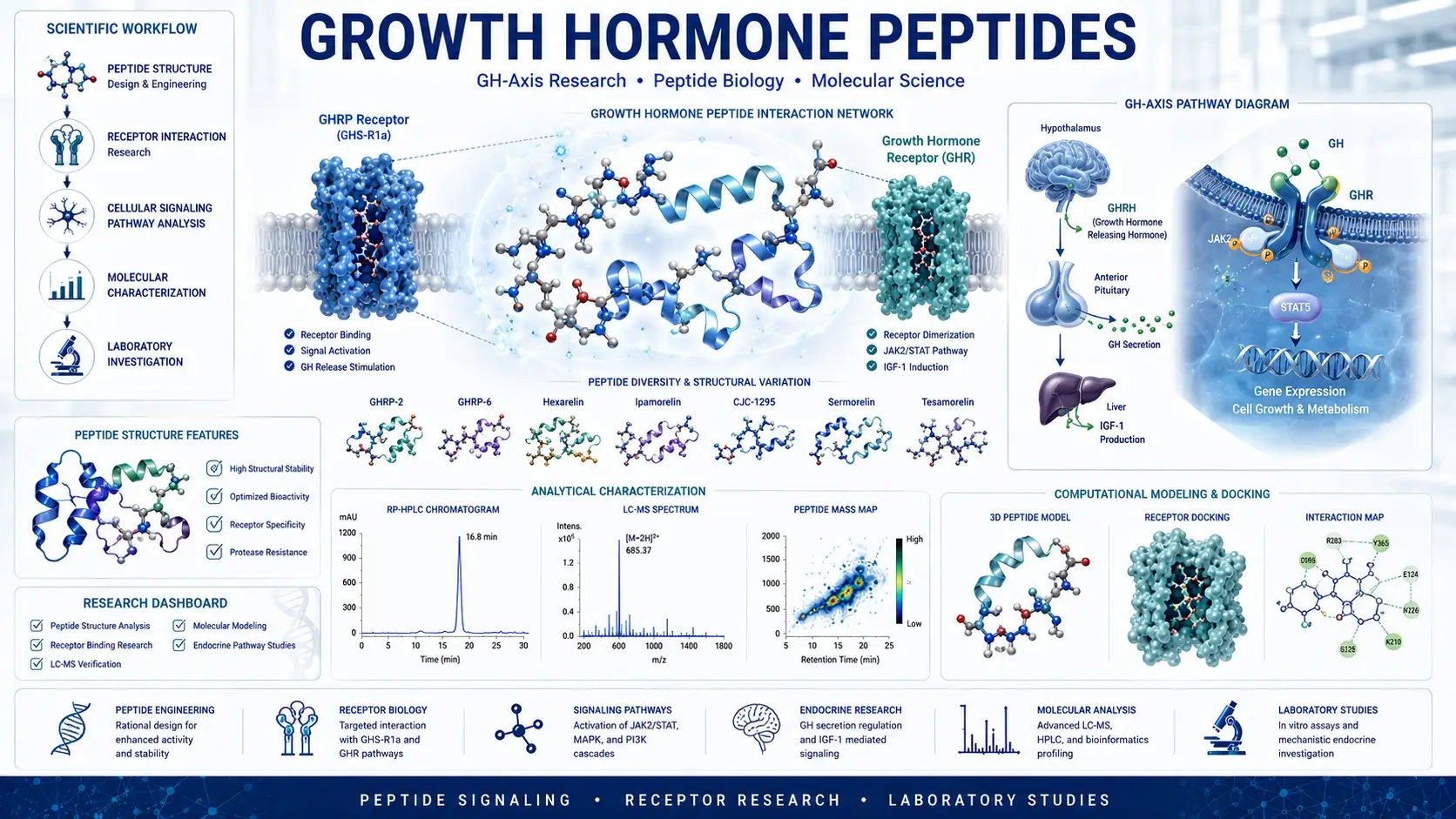
What Are Growth Hormone Peptides?
Growth hormone peptides are a broad group of peptide molecules studied for their relationship with the growth hormone (GH) axis, endocrine signaling pathways, and peptide-receptor interactions. These peptides are commonly investigated in laboratory research to understand how specific amino acid sequences may influence molecular communication systems associated with growth hormone regulation.
Unlike recombinant human growth hormone, many peptides studied within this category are designed to interact with regulatory pathways involved in natural signaling processes. Researchers examine these molecules to better understand receptor activation, cellular communication, structural biology, and endocrine peptide mechanisms.
The term growth hormone peptide therefore represents a research category rather than one individual compound. This category includes multiple peptide families, each with distinct molecular structures, receptor interactions, and experimental applications.
Research Insight
Growth Hormone Peptides Are a Research Category, Not One Molecule
Searches for terms such as “HGH peptide” or “peptide for growth hormone” often refer to multiple peptide classes. Scientific interpretation requires distinguishing between recombinant growth hormone, growth hormone releasing peptides, and other molecules investigated within GH-axis research.
HGH Peptide vs Human Growth Hormone Peptide
The term HGH peptide is commonly used in online searches but can describe different scientific concepts. Human growth hormone (HGH) itself is a larger protein hormone consisting of 191 amino acids, while many growth hormone-related peptides are smaller molecules studied for their interaction with GH regulatory pathways.
In scientific research, a human growth hormone peptide may refer broadly to peptide systems connected with growth hormone biology, including molecules involved in growth hormone-releasing hormone (GHRH) signaling or growth hormone secretagogue receptor (GHSR) pathways.
| Category | Scientific Description | Research Focus |
|---|---|---|
| Human Growth Hormone | 191-amino-acid protein hormone | GH biology and endocrine research |
| Growth Hormone Releasing Peptides | Smaller peptide molecules studied in GH-axis signaling | Receptor interaction research |
| GHRH Analogs | Peptides related to growth hormone releasing hormone pathways | Pituitary signaling studies |
| GH Secretagogue Research Peptides | Molecules investigated for GHS receptor activity | Molecular endocrinology |
Growth Hormone Releasing Peptides in Scientific Research
Growth hormone releasing peptides are among the most widely studied categories within GH-axis peptide research. These molecules are investigated for their interactions with receptor systems involved in endocrine signaling and molecular communication pathways.
Research involving growth hormone releasing peptides examines receptor binding, structural characteristics, signaling mechanisms, and peptide optimization strategies. These studies contribute to broader understanding of peptide-receptor biology and endocrine regulation.
Major Growth Hormone Peptide Research Categories
| Peptide Category | Examples Studied in Research | Scientific Area |
|---|---|---|
| GHRH-Related Peptides | Sermorelin, CJC-1295 | Growth hormone releasing hormone pathway research |
| GH Secretagogue Peptides | Ipamorelin, GHRP family peptides | Ghrelin receptor signaling studies |
| Synthetic GH-Axis Peptides | Modified research peptides | Peptide engineering and molecular optimization |
| Endocrine Research Peptides | Various signaling peptides | Hormonal pathway investigation |
Understanding Searches for Peptides for Muscle Growth
The phrase peptides for muscle growth is commonly searched online; however, scientific discussions focus on molecular mechanisms rather than outcome-based claims. Researchers investigate growth hormone-related peptides to understand endocrine signaling pathways, receptor interactions, and biological communication systems.
Similarly, searches for the best peptides for growth hormone often reflect interest in comparing different GH-axis research peptides. Scientific comparisons are based on molecular structure, receptor selectivity, analytical characterization, and experimental research models rather than rankings or recommendations.
Did You Know?
Small Peptides Can Help Scientists Study Large Biological Systems
Peptide research allows scientists to investigate highly specific biological communication pathways. By studying peptide-receptor interactions, researchers gain insight into complex systems such as endocrine signaling, cellular regulation, and molecular networks.
Section Summary
Growth hormone peptides represent a diverse research category involving multiple peptide families connected with GH-axis biology. Understanding these peptides requires distinguishing between HGH, growth hormone releasing peptides, GHRH-related molecules, and synthetic peptides investigated for endocrine signaling research.
Growth Hormone Peptide Mechanisms in Scientific Research
Research involving growth hormone peptides focuses on understanding molecular pathways associated with growth hormone regulation, receptor communication, and endocrine signaling biology. Scientists investigate how different peptide families interact with biological systems to better understand GH-axis mechanisms at the molecular level.
The growth hormone axis is a complex communication network involving peptide hormones, receptors, intracellular signaling pathways, and feedback systems. Laboratory studies examine these interactions to explore how peptide structures influence receptor selectivity, molecular recognition, and cellular responses.
Because the phrase peptides growth hormones is often used broadly, scientific interpretation requires separating different peptide classes based on structure, receptor pathways, and experimental research objectives.
Research Insight
Different GH Peptides Interact With Different Research Pathways
Growth hormone-related peptide research includes several molecular categories. Some peptides are studied in relation to growth hormone releasing hormone pathways, while others are investigated through receptor systems such as the growth hormone secretagogue receptor.
GHRH Peptides vs Growth Hormone Releasing Peptides
Two major areas of growth hormone peptide research involve growth hormone-releasing hormone (GHRH) related peptides and growth hormone releasing peptides (GHRPs). Although both are studied within GH-axis biology, they represent different molecular approaches and receptor systems.
Understanding these differences allows researchers to classify peptides according to molecular targets, structural characteristics, and experimental applications rather than grouping all HGH peptide research into a single category.
| Category | Primary Research Pathway | Examples Studied | Scientific Focus |
|---|---|---|---|
| GHRH-Related Peptides | Growth hormone releasing hormone receptor | Sermorelin, CJC-1295 | Pituitary signaling research |
| Growth Hormone Releasing Peptides | Growth hormone secretagogue receptor | Ipamorelin, GHRP family | Receptor interaction studies |
| Synthetic Peptide Analogs | Modified molecular pathways | Engineered research peptides | Peptide optimization studies |
Growth Hormone Peptide Research Comparison
Scientific comparisons between different growth hormone peptides focus on molecular characteristics rather than determining the “best” peptide. Search terms such as best peptides for growth hormone are better interpreted through receptor biology, peptide structure, and research classification.
| Research Peptide | Category | Research Interest | Molecular Focus |
|---|---|---|---|
| Sermorelin | GHRH Analog | Growth hormone releasing hormone pathway | Receptor signaling |
| Tesamorelin | Modified GHRH Analog | Endocrine peptide research | Structural optimization |
| Ipamorelin | GH Secretagogue Research Peptide | Ghrelin receptor pathway studies | Selective receptor interaction |
| CJC-1295 | Synthetic GHRH Analog | Peptide modification studies | Molecular stability research |
GH-Axis Molecular Research
The growth hormone axis represents an interconnected biological signaling system involving hypothalamic regulation, pituitary communication, receptor activation, and downstream molecular pathways. Research involving a peptide for growth hormone examines how peptide molecules relate to these complex signaling networks.
Modern GH-axis studies integrate molecular endocrinology, structural biology, computational modeling, and analytical chemistry to understand peptide behavior at increasingly detailed levels.
Did You Know?
Receptors Determine How Scientists Classify Many Peptides
Peptides are often categorized according to the receptors and molecular pathways they interact with during laboratory research. This receptor-focused approach helps scientists understand similarities and differences between peptide families.
Section Summary
Growth hormone peptide research examines diverse peptide families involved in GH-axis biology, including GHRH-related peptides and growth hormone releasing peptides. Scientific comparisons focus on molecular structure, receptor pathways, peptide engineering, and laboratory characterization rather than ranking peptides for practical outcomes.
Growth Hormone Peptide Synthesis and Molecular Characterization
The scientific study of growth hormone peptides relies heavily on advanced peptide synthesis, purification, and analytical characterization techniques. Because peptides are defined by specific amino acid sequences and molecular structures, researchers use specialized methods to verify identity, purity, stability, and biochemical properties before conducting laboratory investigations.
Modern peptide science combines synthetic chemistry, analytical instrumentation, and computational biology to evaluate molecules commonly studied within GH-axis research. This includes peptides associated with growth hormone releasing hormone pathways, growth hormone secretagogue research, and receptor interaction studies.
Unlike broad terms such as HGH peptide or peptides growth hormones, laboratory analysis focuses on specific molecular characteristics including peptide sequence, molecular weight, purity profile, and structural integrity.
Solid-Phase Peptide Synthesis (SPPS) in Peptide Research
Solid-phase peptide synthesis (SPPS) is one of the foundational technologies used to create synthetic peptides for scientific investigation. This approach allows researchers to assemble amino acids step-by-step into defined peptide chains for molecular and biochemical studies.
For a peptide for growth hormone research model, accurate sequence assembly is essential because small differences in amino acid arrangement may influence molecular structure, receptor interactions, and experimental outcomes.
| Process | Scientific Purpose | Research Importance |
|---|---|---|
| Amino Acid Assembly | Creates defined peptide sequences | Molecular accuracy |
| Cleavage & Processing | Separates synthesized peptide material | Preparation for analysis |
| Purification | Separates desired peptide fractions | Composition evaluation |
| Analytical Testing | Confirms molecular properties | Research reliability |
Research Insight
A Peptide Sequence Determines Molecular Identity
Every synthetic peptide is defined by its amino acid sequence. Analytical methods such as LC-MS and sequencing technologies help researchers verify that peptide molecules match expected structural characteristics.
RP-HPLC Analysis of Growth Hormone Peptides
Reverse-phase high-performance liquid chromatography (RP-HPLC) is commonly used in peptide research to evaluate purity profiles and separate molecular components. This analytical technique is especially important for synthetic peptide studies where researchers require accurate characterization of peptide preparations.
Research involving growth hormone releasing peptides often incorporates chromatographic analysis to assess molecular consistency and distinguish target peptide material from related compounds or impurities.
LC-MS Verification and Molecular Identity Testing
Liquid chromatography-mass spectrometry (LC-MS) combines separation technology with molecular mass analysis. In growth hormone peptide research, LC-MS allows scientists to confirm molecular identity by comparing observed peptide mass with expected theoretical values.
LC-MS has become an important analytical platform for peptide chemistry because it provides detailed information about molecular weight, structural confirmation, and peptide composition.
| Analytical Method | Information Provided |
|---|---|
| RP-HPLC | Purity profile and component separation |
| LC-MS | Molecular weight and identity confirmation |
| Amino Acid Analysis | Composition evaluation |
| Computational Modeling | Structural prediction and interaction studies |
Peptide Stability and Storage Research
Peptide stability research examines how molecular structures respond to environmental conditions over time. Factors such as temperature, moisture, oxidation, and molecular modifications may influence peptide integrity during scientific studies.
Researchers studying growth hormone peptides evaluate stability profiles to better understand peptide behavior, degradation pathways, and analytical consistency within controlled laboratory environments.
Research Limitations of Growth Hormone Peptide Studies
Growth hormone peptide research continues to evolve as analytical technologies improve. However, interpretation of peptide studies requires consideration of experimental design, molecular differences between peptide classes, and limitations of specific research models.
Broad phrases such as best peptides for growth hormone or peptides for muscle growth do not represent scientific classifications. Research comparisons are based on molecular characteristics, receptor biology, and laboratory evidence rather than generalized rankings.
Did You Know?
Mass Spectrometry Can Identify Extremely Small Molecular Differences
Modern mass spectrometry technologies allow researchers to measure peptide molecular characteristics with high precision, supporting detailed studies of peptide identity, structure, and composition.
Section Summary
Growth hormone peptide research depends on accurate synthesis, purification, and molecular verification. Techniques including SPPS, RP-HPLC, LC-MS, peptide sequencing, and computational modeling allow scientists to investigate GH-axis peptides through precise analytical approaches.
Current Scientific Consensus on Growth Hormone Peptides
Current scientific understanding recognizes growth hormone peptides as a diverse group of molecules investigated within endocrine signaling, peptide biology, and receptor research. Rather than representing one specific compound, this category includes multiple peptide families studied for their relationship with growth hormone regulatory pathways.
Scientific literature distinguishes between recombinant human growth hormone, growth hormone releasing hormone-related molecules, and growth hormone releasing peptides. Each category has unique molecular structures, receptor interactions, and research applications that require independent evaluation.
Terms such as HGH peptide, peptide for growth hormone, or human growth hormone peptide are commonly used in online searches, but scientific interpretation depends on precise molecular classification and experimental context.
Future Directions in Growth Hormone Peptide Research
Growth hormone peptide research continues to advance as new technologies improve scientists’ ability to analyze peptide structure, receptor interactions, and biological signaling networks. Modern research increasingly combines molecular biology with computational approaches to better understand peptide behavior.
Emerging areas include artificial intelligence-assisted peptide discovery, improved receptor modeling, advanced mass spectrometry workflows, and structural prediction platforms that help researchers investigate peptide systems with greater precision.
| Technology Area | Role in Peptide Research |
|---|---|
| AI Molecular Modeling | Prediction of peptide structures and molecular interactions |
| Advanced LC-MS | High-resolution peptide identity and characterization studies |
| Computational Biology | Analysis of receptor interactions and signaling networks |
| Structural Biology | Understanding peptide-receptor relationships at molecular levels |
| Synthetic Peptide Engineering | Design and optimization of research peptide structures |
Research Insight
AI Is Accelerating Peptide Discovery Research
Artificial intelligence tools are increasingly used in peptide science to predict molecular structures, analyze sequence relationships, and model peptide-receptor interactions. These technologies are expanding how researchers investigate complex peptide systems.
Research Best Practices for Studying Growth Hormone Peptides
Accurate interpretation of growth hormone peptide research requires careful evaluation of molecular identity, analytical validation, and experimental design. Since GH-related peptides represent multiple categories, researchers evaluate each peptide according to its specific structure and pathway.
- ✓Differentiate recombinant growth hormone from growth hormone releasing peptides and GH-axis research peptides.
- ✓Verify peptide identity using analytical methods such as LC-MS and peptide sequencing.
- ✓Evaluate research peptides based on receptor biology, structure, and molecular pathways.
- ✓Interpret phrases like peptides for muscle growth through scientific research context rather than outcome-based assumptions.
- ✓Use peer-reviewed literature when comparing peptide mechanisms and molecular characteristics.
Related Research Articles
Continue Exploring Growth Hormone & Peptide Research
Explore additional Peptides Library research articles covering peptide signaling pathways, molecular biology, and advanced peptide science.
Growth Hormone Research Peptides
- → Sermorelin Peptide Research Guide
- → Tesamorelin Peptide Research Guide
- → Ipamorelin Peptide Research Guide
- → CJC-1295 Peptide Research Guide
Metabolic & Signaling Peptides
- → Tirzepatide Peptide Research Guide
- → Retatrutide Peptide Research Guide
- → AOD9604 Peptide Research Guide
Peptide Science Resources
Did You Know?
Modern Peptide Research Combines Biology and Data Science
Researchers increasingly combine peptide chemistry, artificial intelligence, molecular modeling, and large biological datasets to understand how peptide structures relate to receptor interactions and signaling pathways.
Section Summary
Growth hormone peptide research continues to evolve through advances in molecular biology, synthetic chemistry, artificial intelligence, and analytical technologies. Understanding this peptide category requires evaluating individual molecules, receptor systems, and scientific evidence rather than relying on broad classifications such as HGH peptides or growth hormone peptides.
Frequently Asked Questions
1. What are growth hormone peptides?
Growth hormone peptides are peptide molecules studied for their relationship with growth hormone signaling pathways, endocrine communication, receptor interactions, and molecular biology. They include several peptide categories investigated within GH-axis research rather than representing one single compound.
2. Is an HGH peptide the same as human growth hormone?
No. The term HGH peptide is often used broadly, but human growth hormone itself is a larger protein hormone consisting of 191 amino acids. Many GH-related peptides are smaller molecules studied for their interactions with growth hormone regulatory pathways.
3. What is a peptide for growth hormone research?
A peptide for growth hormone research generally refers to molecules investigated for their connection with GH-axis signaling, growth hormone releasing hormone pathways, or receptor-based molecular studies.
4. What are growth hormone releasing peptides?
Growth hormone releasing peptides are a group of research peptides studied for interactions with receptor systems involved in endocrine signaling. Scientific investigations focus on receptor biology, peptide structure, and molecular communication pathways.
5. Why do researchers study growth hormone peptides?
Researchers study growth hormone peptides to better understand peptide-receptor interactions, GH-axis biology, molecular signaling networks, and endocrine pathway regulation within controlled scientific models.
6. What does peptides for muscle growth mean scientifically?
The phrase peptides for muscle growth is commonly used online, but scientific discussions focus on molecular pathways, peptide signaling, and biological mechanisms rather than performance outcomes or usage recommendations.
7. What are the best peptides for growth hormone research?
The phrase best peptides for growth hormone is not a scientific ranking system. Researchers compare peptides based on molecular structure, receptor pathways, analytical characterization, and experimental research objectives.
8. What examples of growth hormone peptides are studied?
Commonly researched GH-axis peptides include molecules such as Sermorelin, Tesamorelin, Ipamorelin, CJC-1295, and other peptides investigated for receptor biology and molecular endocrinology studies.
9. How are growth hormone peptides analyzed in laboratories?
Growth hormone peptides are commonly characterized using analytical methods such as RP-HPLC, LC-MS, peptide sequencing, structural modeling, and other molecular verification techniques.
10. What role does artificial intelligence play in peptide research?
Artificial intelligence is increasingly used in peptide science to predict molecular structures, analyze peptide sequences, model receptor interactions, and support computational peptide discovery research.
11. Why is LC-MS important for growth hormone peptide studies?
LC-MS helps researchers confirm peptide molecular identity by measuring molecular mass and analyzing structural characteristics. It is widely used for peptide verification and characterization studies.
12. Are all growth hormone peptides the same?
No. Growth hormone peptides include different molecular categories with unique structures and research pathways. Scientific evaluation requires understanding each peptide individually rather than treating all GH-related peptides as identical.
Scientific Resources & References
The following peer-reviewed publications and scientific resources provide additional information on growth hormone biology, peptide signaling, receptor research, peptide synthesis, and analytical characterization.
Growth Hormone & Receptor Biology
-
Mayo KE, et al.
International Union of Pharmacology. Growth Hormone-Releasing Hormone Receptors.
Pharmacological Reviews.
View on PubMed -
Kojima M, Kangawa K.
Ghrelin: Structure and Function.
Physiological Reviews.
View on PubMed -
Veldhuis JD, et al.
Growth Hormone Secretory Dynamics and Regulation.
Endocrine Reviews.
View on PubMed
Peptide Chemistry & Analytical Science
-
Merrifield RB.
Solid Phase Peptide Synthesis.
Journal of the American Chemical Society.
View on PubMed -
Steen H, Mann M.
The ABC’s of Peptide Sequencing.
Nature Reviews Molecular Cell Biology.
View on PubMed -
Aebersold R, Mann M.
Mass-Spectrometric Exploration of Proteome Structure and Function.
Nature.
View on PubMed -
Jumper J, et al.
Highly Accurate Protein Structure Prediction with AlphaFold.
Nature (2021).
View on PubMed
Scientific Databases & Research Guidelines
-
National Center for Biotechnology Information (NCBI)
Biomedical literature database for peptide and molecular biology research.
Visit PubMed -
U.S. Food & Drug Administration (FDA)
Analytical procedures and scientific guidance resources.
Visit FDA Guidelines -
International Council for Harmonisation (ICH)
Scientific quality and analytical validation guidelines.
Visit ICH Guidelines
Final Takeaway
Growth Hormone Peptides Represent a Diverse Field of Molecular Research
Growth hormone peptides represent an important area of peptide science focused on GH-axis biology, receptor interactions, molecular signaling, and structural research. Understanding this category requires distinguishing between HGH, growth hormone releasing peptides, and individual peptide families through evidence-based scientific investigation.
Research Disclaimer
All content on Peptides Library is intended strictly for educational and scientific research purposes. Information regarding growth hormone peptides, HGH peptide research, growth hormone releasing peptides, and related molecular pathways is provided for discussion of published scientific literature only. Research peptides are not approved for human consumption, therapeutic use, or clinical application.