


Quick Answer
Does a 99% HPLC Purity Report Guarantee High Peptide Quality?
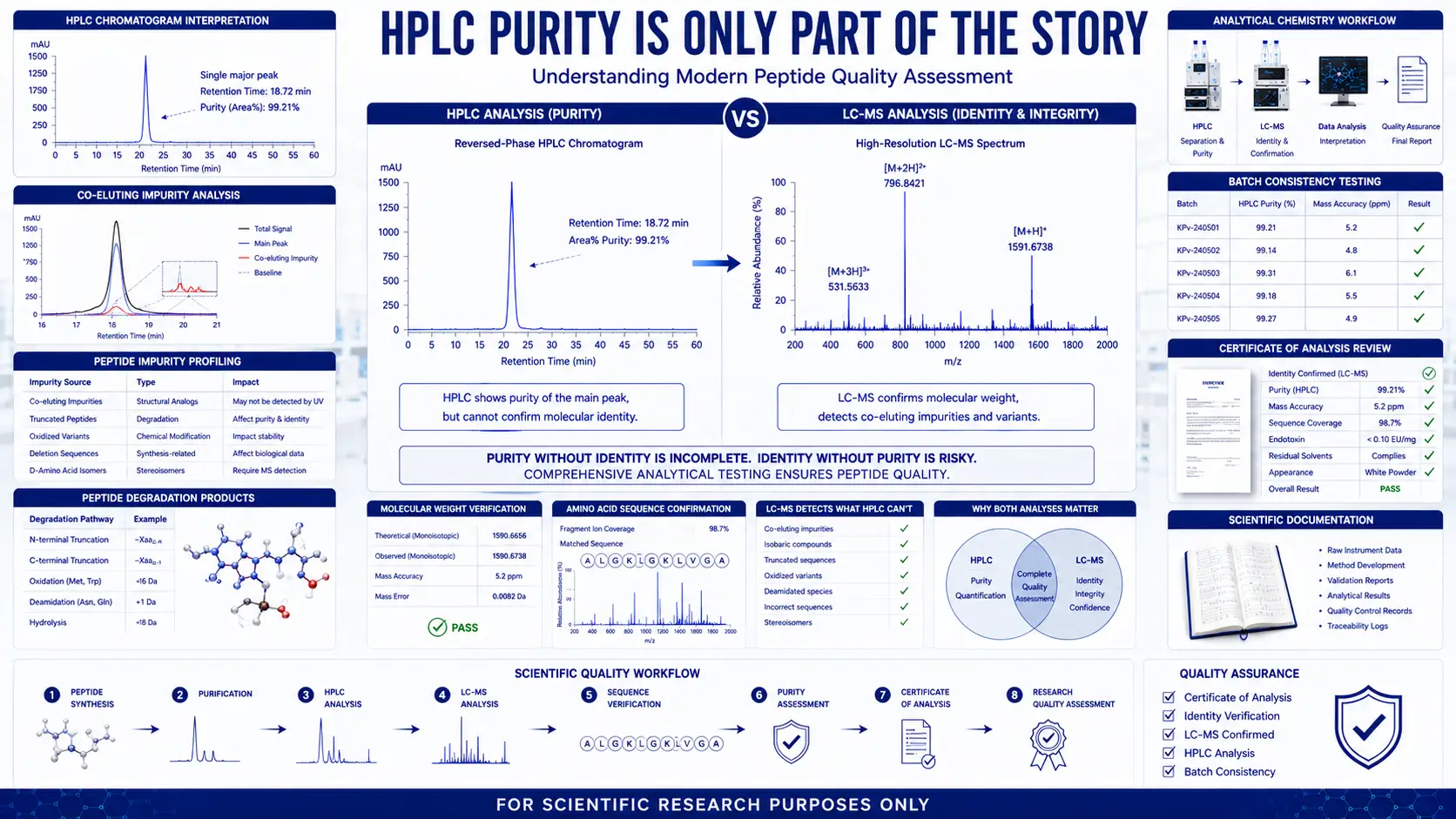
No. A 99% HPLC purity report only measures chromatographic purity under a specific analytical method. It does not independently verify molecular identity, amino acid sequence, molecular weight, structural integrity, or every potential impurity present in a peptide sample. Modern analytical laboratories assess peptide quality by combining HPLC with complementary techniques such as LC-MS, identity verification, sequence confirmation, Certificate of Analysis (COA) review, and comprehensive analytical characterization to produce a far more reliable assessment of research peptide quality.
Table of Contents
Your HPLC Purity Report Is Lying to You: What 99% of Researchers Miss About Peptide Quality
For decades, high-performance liquid chromatography (HPLC) has served as one of the foundational analytical techniques used to evaluate peptide samples in research laboratories. Because HPLC reports frequently display a numerical purity percentage—often 95%, 98%, or even 99%—many researchers naturally assume that this single figure provides a complete measure of peptide quality. In reality, analytical scientists understand that chromatographic purity represents only one component of a much broader quality assessment process.
An HPLC purity report describes how compounds within a sample separate under defined chromatographic conditions. While this information is invaluable for evaluating sample composition, it cannot independently confirm molecular identity, amino acid sequence, molecular weight, structural integrity, stereochemistry, or every potential impurity that may be present. Two peptide samples could produce similarly impressive purity percentages while differing substantially in identity, degradation profile, or analytical suitability for laboratory investigations.
As peptide synthesis technologies and analytical instrumentation have evolved, research laboratories have increasingly adopted multi-platform quality assessment workflows. High-performance liquid chromatography is now routinely combined with liquid chromatography-mass spectrometry (LC-MS), molecular weight verification, peptide sequencing, impurity profiling, stability analysis, and comprehensive Certificate of Analysis (COA) documentation. These complementary analytical methods provide a far more complete understanding of research peptide quality than chromatographic purity alone.
This guide explores what an HPLC purity report actually measures, why a 99% purity result should never be interpreted in isolation, and how modern analytical chemistry has transformed peptide quality assessment into a comprehensive, evidence-based process. Whether reviewing a Certificate of Analysis for the first time or seeking a deeper understanding of laboratory quality standards, researchers can benefit from recognizing both the strengths and the limitations of HPLC within contemporary peptide characterization workflows.
Research Timeline: How Peptide Quality Assessment Has Evolved
The analytical standards used to evaluate peptide quality have advanced dramatically over the past several decades. Early peptide characterization relied primarily on chromatographic separation techniques, whereas modern laboratories now integrate multiple orthogonal analytical methods to verify identity, purity, structural integrity, and batch consistency. Understanding this evolution helps explain why an HPLC purity percentage is now considered only one component of comprehensive peptide quality assessment.
| Period | Scientific Milestone | Impact on Peptide Analysis |
|---|---|---|
| 1950s–1960s | Foundations of modern liquid chromatography | Established separation principles for complex biological molecules. |
| 1970s | Commercial HPLC instrumentation introduced | Improved chromatographic resolution and reproducibility. |
| 1980s | Reverse-phase HPLC became standard for peptide analysis | Enabled more reliable purity estimation for synthetic peptides. |
| 1990s | Integration of LC-MS into peptide laboratories | Allowed simultaneous chromatographic separation and molecular identity verification. |
| 2000s | High-resolution mass spectrometry and automated sequence analysis | Significantly improved confidence in peptide characterization. |
| Today | Multi-platform analytical workflows | Researchers combine HPLC, LC-MS, sequence verification, stability analysis, and Certificate of Analysis review to evaluate peptide quality comprehensively. |
Did You Know?
A single HPLC method cannot detect every possible peptide impurity.
Chromatographic separation depends on the analytical conditions selected by the laboratory, including the stationary phase, mobile phase composition, gradient profile, detection wavelength, and instrument settings. Certain structurally related impurities may co-elute with the target peptide, making additional analytical techniques such as LC-MS, amino acid sequencing, or high-resolution mass spectrometry valuable components of a comprehensive peptide characterization workflow.
As peptide synthesis technologies continue to improve, analytical expectations have evolved accordingly. Researchers now recognize that no single laboratory technique provides a complete picture of peptide quality. Instead, confidence is built by combining independent analytical methods that complement one another, reducing uncertainty while improving reproducibility across experimental studies.
The following sections examine how HPLC works at the molecular level, what a chromatographic purity percentage actually represents, and why experienced analytical laboratories rarely rely on HPLC results in isolation when evaluating research peptides.
What Is High-Performance Liquid Chromatography (HPLC)?
High-performance liquid chromatography (HPLC) is one of the most widely used analytical techniques in modern chemistry for separating, identifying, and estimating the relative abundance of compounds within a sample. Across pharmaceutical research, biotechnology, analytical chemistry, and peptide science, HPLC serves as a cornerstone technology for evaluating sample composition under carefully controlled laboratory conditions.
In peptide research, HPLC is commonly used to evaluate chromatographic purity following peptide synthesis and purification. During analysis, a dissolved peptide sample passes through a specialized chromatographic column packed with microscopic stationary-phase particles. As solvents carry the sample through the column, individual molecules interact differently with the stationary phase based on their chemical properties, allowing them to separate over time. These separated compounds generate individual peaks that appear on a chromatogram, providing researchers with valuable information about the composition of the sample.
One of the most frequently reported outcomes of HPLC analysis is the chromatographic purity percentage. This value estimates the proportion of the total detected chromatographic signal attributed to the primary peptide peak under the selected analytical method. Although this measurement offers important insight into sample composition, it should be interpreted as a chromatographic observation rather than a comprehensive measure of peptide quality.
Because HPLC evaluates compounds based on chromatographic behavior rather than molecular identity, researchers typically interpret purity data alongside complementary analytical techniques. Modern peptide characterization frequently combines HPLC with liquid chromatography-mass spectrometry (LC-MS), molecular weight verification, peptide sequencing, amino acid analysis, and Certificate of Analysis (COA) documentation to establish a more complete understanding of research peptide quality.
How HPLC Separates Peptides
The separation achieved during HPLC analysis depends on differences in how individual molecules interact with two environments: a stationary phase contained within the chromatographic column and a moving liquid known as the mobile phase. Peptides possessing different molecular characteristics—including hydrophobicity, polarity, molecular size, and amino acid composition—travel through the column at different rates, producing distinct chromatographic peaks.
Reverse-phase HPLC is among the most commonly employed methods for peptide analysis because it provides excellent separation of synthetic peptide mixtures. Researchers carefully optimize solvent composition, gradient conditions, flow rate, temperature, and detector wavelength to maximize chromatographic resolution while minimizing peak overlap. Even with optimized conditions, however, complete separation of every structurally related impurity cannot always be guaranteed, highlighting the importance of complementary analytical verification.
Research Snapshot
HPLC measures chromatographic behavior—not complete molecular identity.
A chromatographic peak represents molecules that behave similarly under a specific analytical method. While HPLC provides excellent information regarding separation and relative purity, researchers typically rely on orthogonal analytical methods such as LC-MS and peptide sequencing to independently verify molecular identity and confirm that the primary chromatographic peak corresponds to the intended peptide sequence.
Understanding what HPLC measures—and equally important, what it does not measure—forms the foundation for interpreting peptide quality reports correctly. Rather than viewing chromatographic purity as a standalone indicator of quality, modern laboratories consider HPLC one essential component within a broader analytical framework designed to evaluate peptide identity, purity, structural integrity, and reproducibility.
What Does a 99% HPLC Purity Report Actually Mean?
One of the most common misconceptions in peptide research is that a reported HPLC purity of 99% automatically indicates a peptide sample is “99% perfect.” In reality, an HPLC purity percentage represents the relative area of the principal chromatographic peak compared with the total detectable peak area under a specific analytical method. It is a valuable analytical measurement, but it is not an absolute measure of overall peptide quality.
During HPLC analysis, a detector continuously records compounds as they elute from the chromatographic column. Software integrates the resulting peaks to calculate the percentage of the total chromatographic signal attributed to the primary peptide peak. If the principal peak accounts for approximately 99% of the integrated area, the sample may be reported as having 99% chromatographic purity. This calculation reflects detector response under defined laboratory conditions rather than complete molecular characterization.
Because chromatographic behavior depends on the analytical method employed, changing the column chemistry, solvent system, gradient profile, detection wavelength, or instrument parameters can alter peak separation and potentially reveal additional components that were not previously resolved. For this reason, experienced analytical laboratories interpret HPLC purity within the broader context of multiple complementary analytical techniques.
Why Peak Area Does Not Equal Complete Peptide Quality
Chromatographic peak area provides an estimate of the detector response for compounds that successfully separate during analysis. It does not independently confirm whether the primary peak represents the intended peptide sequence, nor can it establish structural integrity, biological stability, stereochemical correctness, or molecular identity. In other words, chromatographic purity and analytical identity are related but fundamentally different concepts.
A peptide sample may display an apparently excellent chromatographic profile while still containing structurally similar impurities, truncated synthesis products, oxidation by-products, deamidation products, or isomeric species that exhibit nearly identical chromatographic behavior. Without complementary analytical techniques such as LC-MS or peptide sequencing, these components may remain difficult to distinguish using HPLC alone.
| What HPLC Can Tell You | What HPLC Cannot Confirm Independently |
|---|---|
| Chromatographic purity estimate | Complete molecular identity |
| Retention time | Amino acid sequence confirmation |
| Relative peak abundance | Exact molecular weight |
| Sample composition trends | Every possible impurity present |
| Batch consistency comparisons | Complete structural verification |
Why Some Impurities May Remain Hidden
Analytical chemists often describe HPLC as a highly effective separation technique rather than a universal detection method. Certain impurities may possess chromatographic properties that closely resemble those of the target peptide, causing them to elute together within the same peak. These compounds are commonly referred to as co-eluting impurities and may not be distinguishable using a single chromatographic method alone.
This limitation does not diminish the value of HPLC; instead, it highlights why modern laboratories increasingly employ orthogonal analytical strategies. By combining chromatographic separation with mass spectrometry, sequence verification, and additional analytical techniques, researchers can obtain independent confirmation of peptide identity while improving confidence in overall quality assessment.
Did You Know?
A peptide can achieve a very high HPLC purity while still requiring additional identity verification.
International analytical laboratories routinely combine chromatographic analysis with mass spectrometry because the two techniques answer different scientific questions. HPLC evaluates chromatographic separation, whereas LC-MS independently confirms molecular mass and provides additional confidence that the principal chromatographic peak corresponds to the intended peptide. Using both methods together significantly strengthens analytical characterization.
Understanding the distinction between chromatographic purity and comprehensive peptide characterization helps researchers interpret analytical reports more accurately. Rather than relying exclusively on a single purity percentage, modern quality assessment emphasizes multiple complementary techniques that collectively establish confidence in peptide identity, consistency, and analytical reliability.
Modern Peptide Quality Assessment Goes Beyond HPLC
As peptide synthesis has become increasingly sophisticated, analytical expectations have evolved alongside it. While HPLC remains an essential technique for evaluating chromatographic purity, today’s research laboratories rarely depend on a single analytical method when assessing peptide quality. Instead, laboratories build confidence through orthogonal analytical approaches—multiple independent techniques that verify different characteristics of the same sample.
This multi-layered strategy allows researchers to evaluate not only chromatographic purity, but also molecular identity, molecular weight, sequence integrity, batch consistency, and overall analytical reliability. Each analytical method contributes unique information, creating a more comprehensive understanding of peptide quality than any individual test can provide on its own.
Why LC-MS Is Commonly Used Alongside HPLC
Liquid chromatography–mass spectrometry (LC-MS) combines chromatographic separation with mass spectrometric detection, allowing researchers to examine both chromatographic behavior and molecular mass during a single analytical workflow. Whereas HPLC primarily separates compounds based on their interactions with the chromatographic column, mass spectrometry analyzes ions according to their mass-to-charge (m/z) ratios, providing an independent layer of molecular verification.
Because these techniques evaluate different analytical properties, they complement one another exceptionally well. A chromatographic peak that appears highly pure can subsequently be examined by mass spectrometry to determine whether its measured molecular mass aligns with the expected peptide. This combination significantly increases confidence that the principal chromatographic peak represents the intended research peptide.
Identity Verification Matters as Much as Purity
Analytical purity and molecular identity are closely related but fundamentally different measurements. A chromatogram may indicate excellent separation, yet without independent identity verification researchers cannot conclusively determine whether the dominant peak corresponds to the intended peptide sequence. This distinction is especially important when evaluating complex peptide syntheses where structurally related compounds may exhibit similar chromatographic behavior.
Modern laboratories therefore prioritize identity confirmation alongside chromatographic purity. Molecular weight verification, isotope distribution analysis, fragmentation studies, and sequence confirmation collectively strengthen confidence that the analyzed material matches the intended peptide rather than a structurally similar by-product.
| Analytical Technique | Primary Purpose | Key Information Provided |
|---|---|---|
| HPLC | Chromatographic separation | Purity estimate, retention time, peak profile |
| LC-MS | Molecular identity verification | Molecular mass, identity confirmation |
| Sequence Analysis | Structural confirmation | Amino acid sequence verification |
| Certificate of Analysis | Quality documentation | Batch-specific analytical results |
Did You Know?
Analytical laboratories often describe HPLC and LC-MS as complementary rather than competing technologies.
HPLC excels at separating compounds within complex mixtures, while LC-MS provides molecular mass information that helps verify identity. When these techniques are interpreted together, researchers obtain a significantly more robust understanding of peptide quality than either method could provide independently. This complementary approach has become a widely accepted best practice in modern peptide characterization.
For researchers evaluating peptide quality, the most informative analytical reports are those that integrate several independent techniques into a unified quality assessment strategy. Rather than focusing exclusively on a single HPLC purity percentage, experienced laboratories examine the complete analytical profile to ensure consistency, traceability, and confidence in experimental materials.
How to Evaluate Peptide Quality Beyond the HPLC Purity Percentage
An HPLC purity percentage provides useful information, but experienced researchers understand that it represents only one element of a much broader analytical evaluation. Before incorporating a research peptide into an experimental workflow, laboratories typically review multiple analytical data points to verify identity, consistency, and overall quality. This comprehensive approach reduces uncertainty while improving reproducibility across scientific studies.
One of the most valuable supporting documents is the Certificate of Analysis (COA). A well-prepared COA consolidates analytical findings into a single report, allowing researchers to review the methods used, confirm batch-specific testing, and understand how the reported quality data were generated.
What Should a Certificate of Analysis Include?
Although the exact format may vary between laboratories, a comprehensive Certificate of Analysis generally contains considerably more information than a single purity percentage. Researchers should evaluate the document as a whole rather than focusing exclusively on the reported HPLC result.
| COA Component | Why It Matters |
|---|---|
| Batch Number | Provides traceability for analytical records. |
| Peptide Identity | Confirms the intended analyte. |
| HPLC Chromatogram | Illustrates chromatographic purity and peak profile. |
| LC-MS Results | Supports molecular identity verification. |
| Analytical Method | Explains how the reported data were obtained. |
| Testing Date | Documents analytical timing and record keeping. |
Research Workflow for Peptide Quality Assessment
Rather than relying on a single analytical result, modern laboratories typically follow a structured evaluation process that incorporates several complementary quality checkpoints. Each step contributes additional confidence before a peptide enters downstream research applications.
| Step | Analytical Objective | Outcome |
|---|---|---|
| 1 | Review Certificate of Analysis | Verify documentation and batch traceability. |
| 2 | Evaluate HPLC Chromatogram | Assess chromatographic purity and peak profile. |
| 3 | Review LC-MS Data | Confirm molecular identity and molecular weight. |
| 4 | Compare Batch Consistency | Evaluate reproducibility across production lots. |
| 5 | Review Supporting Analytical Data | Develop confidence in overall peptide characterization. |
HPLC vs Comprehensive Peptide Characterization
| Analytical Focus | HPLC Alone | Comprehensive Quality Assessment |
|---|---|---|
| Purity Estimate | ✓ | ✓ |
| Identity Verification | Limited | Comprehensive |
| Molecular Weight | No | Confirmed |
| Sequence Confirmation | No | Supported |
| Overall Analytical Confidence | Moderate | High |
Did You Know?
Many quality-control laboratories intentionally use multiple independent analytical methods because no single technique can answer every scientific question about a peptide sample.
This approach, often referred to as orthogonal analytical testing, improves confidence by evaluating different physical and chemical characteristics independently. Combining chromatographic separation, mass spectrometry, molecular identity verification, and supporting documentation provides a far more complete assessment than relying on any single analytical result alone.
The strongest analytical conclusions emerge when multiple independent techniques point toward the same result. By interpreting HPLC data alongside complementary analytical evidence, researchers gain a more balanced understanding of peptide quality and reduce the likelihood of drawing conclusions from a single measurement in isolation.
Scientific Consensus: Why Modern Laboratories Use Multiple Analytical Techniques
Over the past two decades, peptide analytical science has steadily shifted away from relying on individual quality metrics toward comprehensive analytical characterization. Although HPLC remains one of the most important techniques for evaluating chromatographic purity, scientific literature consistently demonstrates that no single analytical method can independently establish every aspect of peptide quality.
Today’s analytical laboratories routinely combine chromatographic separation, mass spectrometry, molecular weight confirmation, peptide sequencing, impurity profiling, stability evaluation, and batch documentation to produce a complete analytical profile. This multi-platform approach improves confidence in research materials while supporting greater reproducibility across laboratory studies.
Research Snapshot
- ✔ HPLC measures chromatographic purity—not complete molecular identity.
- ✔ LC-MS provides independent molecular mass verification.
- ✔ Sequence confirmation strengthens analytical confidence.
- ✔ Certificate of Analysis documents batch-specific testing.
- ✔ Orthogonal analytical workflows improve research reproducibility.
- ✔ Comprehensive characterization provides greater confidence than any individual analytical result.
Frequently Asked Questions
1. What does an HPLC purity report actually measure?
An HPLC purity report estimates chromatographic purity based on the relative area of detected chromatographic peaks under defined analytical conditions.
2. Does 99% HPLC purity guarantee peptide quality?
No. It indicates chromatographic purity but does not independently verify molecular identity, amino acid sequence, or every possible impurity.
3. Why is LC-MS commonly performed after HPLC?
LC-MS complements chromatographic separation by confirming molecular mass and strengthening confidence in peptide identity.
4. Can HPLC detect every impurity?
No. Structurally similar compounds may co-elute under certain chromatographic conditions, making complementary analytical methods valuable.
5. What is a Certificate of Analysis (COA)?
A COA summarizes analytical testing performed on a specific batch, including purity results, identity data, and supporting laboratory information.
6. Why is molecular identity verification important?
Identity verification helps confirm that the analyzed compound corresponds to the intended peptide rather than a structurally similar impurity.
7. What are orthogonal analytical methods?
These are independent analytical techniques that evaluate different characteristics of a sample, providing complementary quality information.
8. Why are multiple analytical techniques recommended?
Combining multiple analytical methods improves confidence by independently verifying different aspects of peptide characterization.
9. Does HPLC identify peptide sequence?
No. Peptide sequencing and mass spectrometric techniques are generally used for sequence confirmation.
10. Why should researchers review the entire COA?
The complete COA provides context beyond purity, including analytical methods, batch traceability, and identity verification.
11. Is HPLC still considered an essential analytical technique?
Absolutely. HPLC remains one of the most important analytical tools for peptide characterization when interpreted alongside complementary methods.
12. What represents current best practice for peptide quality assessment?
Modern laboratories generally combine HPLC, LC-MS, identity verification, sequence analysis, and comprehensive documentation to develop a complete analytical profile.
Scientific Resources & References
- Swartz ME. UPLC: An Introduction and Review.
- Kinter M, Sherman NE. Protein Sequencing and Identification Using Tandem Mass Spectrometry.
- Aebersold R, Mann M. Mass Spectrometry-Based Proteomics.
- Domon B, Aebersold R. Mass Spectrometry and Protein Analysis.
- United States Pharmacopeia (USP) — Analytical Standards.
- U.S. Food and Drug Administration — Analytical Method Validation Resources.
- International Council for Harmonisation (ICH) Quality Guidelines.
- IUPAC Compendium of Chemical Terminology (Gold Book).
Final Thoughts
A high HPLC purity percentage remains an important indicator of chromatographic performance, but it should never be interpreted as the sole measure of peptide quality. Modern analytical science recognizes that meaningful peptide characterization requires a combination of complementary techniques, each contributing unique insights into molecular identity, purity, structural integrity, and analytical reliability.
By understanding the strengths and limitations of HPLC—and by evaluating supporting analytical evidence such as LC-MS, sequence verification, and Certificate of Analysis documentation—researchers can make more informed decisions when assessing peptide quality for laboratory investigations. A comprehensive analytical perspective ultimately promotes greater confidence, reproducibility, and scientific rigor across peptide research.
Research Disclaimer:
All content on Peptides Library is intended strictly for educational and scientific research purposes. The peptides discussed are not approved for human consumption, therapeutic use, or clinical application. Information is drawn from peer-reviewed preclinical literature and does not constitute medical advice. Researchers should consult applicable regulations before conducting any in vivo or in vitro work.