


Quick Answer
What Is BPC-157?
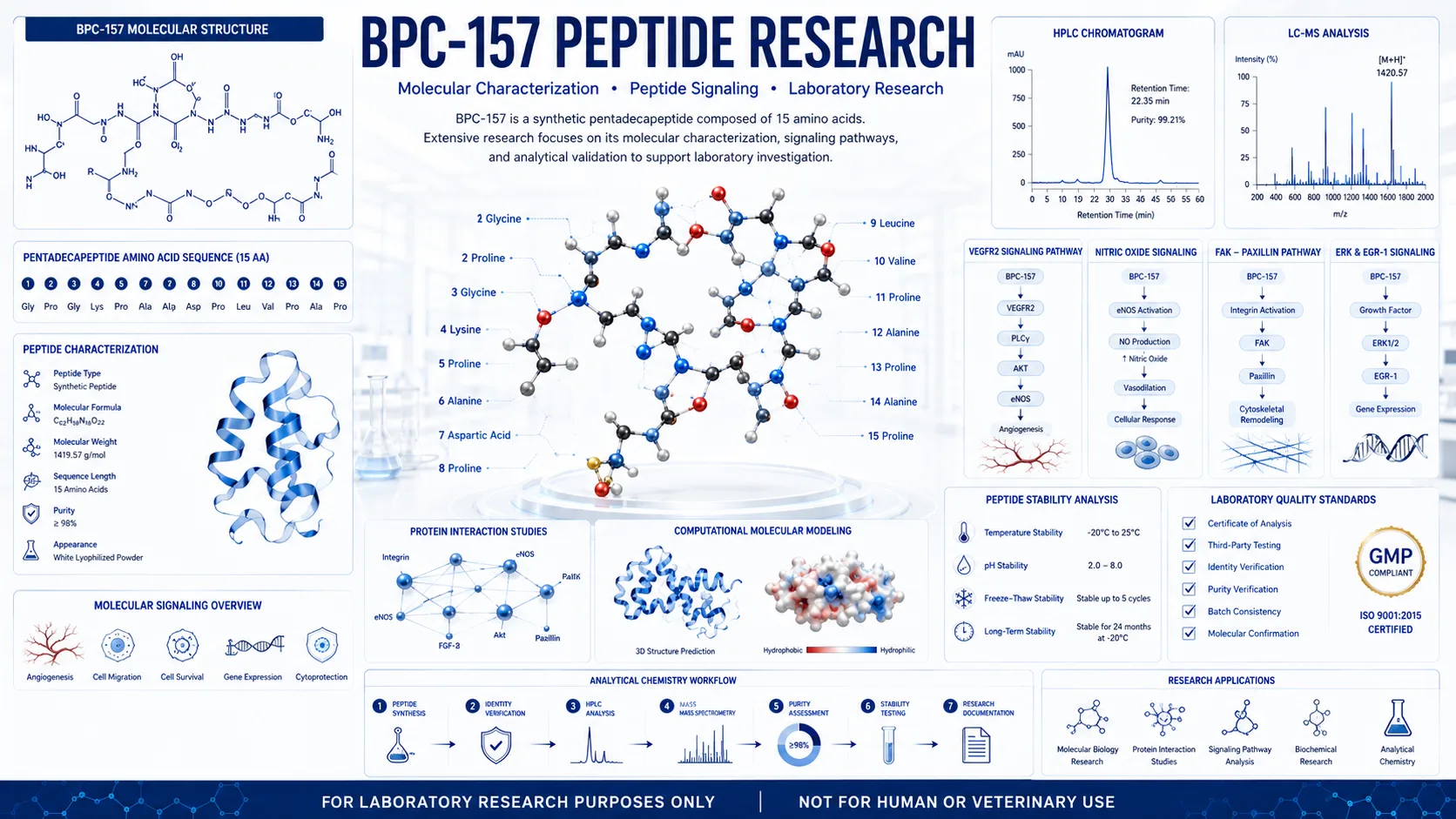
BPC-157 is a synthetic pentadecapeptide extensively investigated in laboratory research to better understand peptide signaling pathways, molecular interactions, structural characteristics, and analytical properties. Current scientific literature primarily consists of preclinical investigations, peptide chemistry studies, and molecular biology research focused on elucidating its physicochemical behavior, peptide characterization, and experimental applications under controlled laboratory conditions.
Table of Contents
- What Is BPC-157?
- Historical Development of BPC-157 Research
- Molecular Structure & Peptide Characteristics
- Why Researchers Study BPC-157
- Molecular Signaling Pathways
- Analytical Testing & Characterization
- Research Quality Standards
- BPC-157 vs TB-500
- Current Scientific Consensus
- Frequently Asked Questions
- Scientific Resources & References
BPC-157 Peptide Research: Molecular Mechanisms, Laboratory Applications & Scientific Characterization
Among modern synthetic research peptides, BPC-157 has become one of the most extensively investigated molecules within experimental peptide science. Growing interest in BPC-157 peptide research reflects broader advances in molecular biology, peptide chemistry, analytical instrumentation, and computational modeling, all of which have enabled researchers to examine peptide behavior with increasing precision. Rather than focusing on clinical applications, contemporary research emphasizes molecular characterization, analytical validation, laboratory reproducibility, and the biological mechanisms that continue to be explored under controlled experimental conditions.
As a synthetic pentadecapeptide, BPC-157 provides researchers with an opportunity to investigate peptide stability, intracellular communication, molecular signaling pathways, and protein interactions using advanced laboratory methodologies. High-performance analytical technologies—including High-Performance Liquid Chromatography (HPLC), Liquid Chromatography–Mass Spectrometry (LC-MS), amino acid sequencing, and purity verification—allow scientists to confirm molecular identity and evaluate the consistency of research materials before experimental investigations begin.
Current scientific literature surrounding BPC-157 primarily consists of laboratory investigations, analytical chemistry studies, in vitro experiments, and preclinical research. These studies contribute to a growing understanding of peptide biology while also highlighting the importance of careful interpretation and continued investigation. Although research continues to evolve, existing evidence remains centered on experimental science rather than established clinical applications.
This article provides a comprehensive overview of BPC-157 from a research-first perspective, examining its molecular structure, historical development, analytical testing methods, signaling pathways, quality standards, and current scientific understanding. All information is presented exclusively within the context of laboratory research, peptide characterization, and scientific investigation, consistent with National Science Labs’ commitment to supplying materials intended solely for research purposes.
What Is BPC-157?
BPC-157 is a synthetic peptide composed of fifteen amino acids, classifying it as a pentadecapeptide. The abbreviation “BPC” originates from “Body Protection Compound,” a term historically associated with peptide sequences identified during investigations involving gastric proteins. Modern laboratory materials are produced through highly controlled chemical synthesis rather than biological extraction, enabling researchers to investigate well-characterized peptide samples with consistent analytical specifications.
Advances in solid-phase peptide synthesis have made it possible to manufacture BPC-157 with high levels of purity and reproducibility. Before experimental use, researchers typically evaluate peptide identity through analytical methods such as HPLC and LC-MS, ensuring that experimental materials meet predefined research quality standards. These procedures support reproducibility and provide confidence in laboratory investigations involving peptide characterization and molecular biology.
Within contemporary peptide science, BPC-157 is primarily investigated as a research molecule for studying peptide signaling pathways, molecular interactions, physicochemical properties, and structural behavior. Researchers continue exploring its characteristics using experimental models, analytical chemistry techniques, computational biology, and systems-level investigations designed to expand scientific understanding of peptide function under laboratory conditions.
Historical Development of BPC-157 Research
Scientific interest in BPC-157 emerged from broader investigations into biologically active peptide fragments associated with gastric proteins. Early researchers sought to identify peptide sequences that could be synthesized independently and evaluated using standardized laboratory methodologies. Improvements in peptide chemistry during the late twentieth century enabled scientists to manufacture highly purified synthetic peptides, significantly improving analytical consistency and experimental reproducibility.
As chromatographic analysis, high-resolution mass spectrometry, and molecular biology techniques continued to advance, researchers gained increasingly sophisticated tools for characterizing peptide structure, confirming molecular identity, and evaluating physicochemical properties. These technological developments expanded opportunities for studying BPC-157 within analytical chemistry, peptide science, biotechnology, and molecular signaling research.
Today, BPC-157 remains an active area of scientific investigation across multiple research disciplines. Contemporary studies combine peptide chemistry, computational modeling, analytical testing, and experimental biology to better understand molecular behavior, structural characteristics, and laboratory performance. While the volume of peer-reviewed literature continues to increase, current evidence remains centered on experimental research, reinforcing the importance of ongoing investigation and evidence-based scientific interpretation.
Molecular Structure & Peptide Characteristics
The molecular structure of BPC-157 forms the foundation of contemporary peptide research. As analytical technologies continue to evolve, researchers are able to characterize peptide architecture with remarkable precision, allowing investigations into structural stability, molecular interactions, physicochemical behavior, and peptide integrity. Rather than focusing solely on biological observations, modern peptide science increasingly emphasizes structural characterization as an essential component of experimental reproducibility and laboratory quality assurance.
Within BPC-157 peptide research, structural analysis typically combines peptide chemistry, computational molecular modeling, amino acid sequencing, chromatographic analysis, and mass spectrometry. These complementary analytical techniques provide researchers with confidence in peptide identity while supporting studies investigating molecular signaling, protein interactions, and experimental biology.
Unlike large proteins composed of hundreds or thousands of amino acids, BPC-157 consists of a relatively short sequence of fifteen amino acids. This compact molecular architecture enables researchers to investigate specific structural characteristics while minimizing many of the analytical complexities associated with larger protein molecules. Consequently, BPC-157 has become an important model peptide for studying synthetic peptide characterization and analytical validation within controlled laboratory environments.
Key Structural Characteristics
- Synthetic pentadecapeptide composed of fifteen amino acids
- Manufactured using controlled solid-phase peptide synthesis
- Suitable for analytical characterization using HPLC and LC-MS
- Evaluated for molecular identity, purity, and stability
- Widely investigated within experimental peptide research
- Compatible with computational structural modeling techniques
Understanding these structural characteristics provides an important framework for interpreting laboratory findings. Before experimental investigations begin, researchers generally verify peptide identity and analytical quality to ensure reproducibility across multiple research environments. These quality-control procedures contribute significantly to the reliability of peptide science and experimental molecular biology.
Why Researchers Study BPC-157
Scientific interest in BPC-157 extends beyond the peptide itself. Researchers investigate the molecule because it offers opportunities to better understand peptide chemistry, intracellular communication, molecular signaling, and experimental biology. Its relatively simple structure, combined with extensive analytical characterization, has made BPC-157 a frequently studied model peptide across multiple scientific disciplines.
Current investigations often explore how peptides interact with cellular signaling networks, protein complexes, and biochemical pathways under controlled laboratory conditions. These studies contribute to broader scientific knowledge surrounding peptide biology while also improving analytical methodologies used throughout modern biotechnology research.
Common Areas of Scientific Investigation
- Peptide signaling pathways
- Protein interaction studies
- Molecular biology research
- Experimental biotechnology
- Analytical chemistry
- Peptide stability investigations
- Cell signaling research
- Computational molecular modeling
- Structure–function relationships
- Peptide characterization
Collectively, these research areas illustrate why BPC-157 continues to receive attention within peptide science. Although current literature remains primarily experimental and preclinical, ongoing investigations continue to improve scientific understanding of peptide behavior, analytical characterization, and molecular biology.
Molecular Signaling Pathways Under Investigation
One of the most active areas of BPC-157 peptide research involves the investigation of molecular signaling pathways. Rather than examining isolated biochemical events, researchers increasingly study complex signaling networks that regulate cellular communication, protein interactions, and molecular responses within experimental systems. Advances in molecular biology and analytical instrumentation have made it possible to observe these interactions with considerably greater detail than was previously possible.
Scientific publications have explored several signaling pathways in relation to experimental BPC-157 research, including investigations involving VEGFR2-associated signaling, nitric oxide pathways, FAK–Paxillin interactions, ERK activation, and EGR-1 expression. These studies contribute to mechanistic understanding within laboratory settings and remain the subject of ongoing scientific investigation.
Research Insight
Current investigations into BPC-157 signaling mechanisms are primarily based on laboratory and preclinical research. These studies seek to better understand molecular interactions and biological pathways under controlled experimental conditions rather than establish approved clinical applications.
VEGFR2 Signaling Research
Among the molecular pathways investigated in BPC-157 peptide research, VEGFR2-associated signaling has received considerable scientific attention. Vascular Endothelial Growth Factor Receptor 2 (VEGFR2) is a well-characterized receptor involved in cellular signaling processes that regulate vascular biology, endothelial cell communication, and intracellular signal transduction. Because VEGFR2 participates in numerous biological pathways, researchers have explored its interactions with various synthetic peptides, including BPC-157, under controlled laboratory conditions.
Current experimental literature primarily investigates whether BPC-157 influences molecular events associated with VEGFR2-mediated signaling in cell culture systems and preclinical research models. These studies seek to understand peptide–protein interactions, downstream signaling cascades, and changes in cellular communication rather than establish clinical outcomes. As with many areas of peptide science, mechanistic investigations remain an active field of research requiring continued experimental validation.
Modern molecular biology techniques—including immunoblotting, gene expression analysis, fluorescence microscopy, and protein phosphorylation assays—have enabled researchers to investigate these signaling pathways with greater precision than was previously possible. By combining these methods with advanced peptide characterization, scientists continue to expand their understanding of how synthetic peptides behave within controlled experimental environments.
Scientific Perspective
Published investigations involving VEGFR2 remain largely experimental and should be interpreted within the context of laboratory research. While these studies contribute to mechanistic understanding, they do not establish approved therapeutic applications or clinical efficacy.
Key Areas of Investigation
- VEGFR2-associated molecular signaling
- Protein phosphorylation pathways
- Intracellular communication networks
- Experimental endothelial cell models
- Peptide–receptor interaction studies
- Signal transduction mechanisms
- Laboratory-based mechanistic investigations
As analytical technologies continue to evolve, future investigations are expected to provide greater insight into the molecular relationships between synthetic peptides and signaling pathways. Continued research will likely integrate proteomics, computational biology, and systems-level analysis to better characterize these complex biological interactions.
Nitric Oxide Signaling Research
Nitric oxide (NO) signaling represents another frequently discussed area within experimental BPC-157 peptide research. Nitric oxide functions as an important signaling molecule in numerous biological systems, prompting researchers to investigate how synthetic peptides may interact with nitric oxide-associated pathways during laboratory experiments. Current publications focus on understanding molecular communication rather than drawing conclusions regarding clinical applications.
Laboratory investigations typically evaluate nitric oxide signaling using biochemical assays, molecular markers, enzyme activity measurements, and gene expression analyses. These experimental approaches allow researchers to examine signaling dynamics while maintaining carefully controlled laboratory conditions. Because nitric oxide participates in multiple interconnected biological pathways, interpreting these findings requires a systems-level understanding of molecular biology and peptide science.
Recent advances in analytical instrumentation have further improved researchers’ ability to investigate nitric oxide-related signaling events. High-resolution imaging, transcriptomic analysis, proteomic profiling, and computational pathway mapping now provide more comprehensive datasets than were available in earlier studies, supporting increasingly sophisticated mechanistic investigations.
Research Insight
Nitric oxide signaling represents one component of a much broader molecular network. Current research continues to investigate these relationships using laboratory models, emphasizing mechanistic understanding rather than clinical interpretation.
Common Laboratory Approaches
- Nitric oxide pathway analysis
- Gene expression profiling
- Protein signaling investigations
- Biochemical pathway mapping
- Experimental molecular biology
- Proteomic analysis
- Computational pathway modeling
Although nitric oxide signaling continues to represent an important area of experimental peptide science, researchers consistently emphasize the need for additional laboratory investigations to better characterize the underlying molecular mechanisms and to expand the current body of scientific evidence through reproducible, peer-reviewed research.
FAK–Paxillin Signaling Research
Another area receiving attention within BPC-157 peptide research involves the focal adhesion kinase (FAK) and paxillin signaling network. These proteins are widely recognized within molecular biology for their roles in intracellular signaling, cytoskeletal organization, cell adhesion, and communication between cells and the surrounding extracellular matrix. Because these signaling pathways participate in numerous biological processes, researchers have explored whether synthetic peptides such as BPC-157 exhibit measurable interactions with components of this molecular network under controlled laboratory conditions.
Published experimental investigations typically utilize cell culture systems, protein expression analysis, fluorescence microscopy, western blotting, and phosphoprotein assays to evaluate signaling activity associated with FAK and paxillin. These analytical techniques allow scientists to investigate intracellular communication while maintaining standardized laboratory conditions that support reproducible experimental outcomes.
Rather than examining isolated proteins, modern peptide research increasingly evaluates complex signaling networks in which multiple pathways operate simultaneously. Systems biology approaches, computational modeling, and multi-omics technologies now enable researchers to study interconnected signaling events with considerably greater depth than was previously possible, contributing to a more comprehensive understanding of peptide biology.
Scientific Perspective
Current publications investigating FAK–Paxillin signaling remain experimental and mechanistic in nature. Existing evidence contributes to scientific understanding of intracellular signaling pathways but should not be interpreted as establishing approved clinical applications or therapeutic conclusions.
Research Areas Under Investigation
- Focal adhesion kinase signaling
- Paxillin-associated protein interactions
- Cell adhesion research models
- Intracellular communication studies
- Cytoskeletal organization analysis
- Protein phosphorylation investigations
- Systems biology approaches
- Experimental peptide signaling research
Future investigations combining advanced microscopy, proteomics, transcriptomics, and computational biology are expected to further clarify how peptide signaling networks interact within experimental biological systems. These multidisciplinary approaches continue to strengthen the scientific foundation of peptide research while expanding mechanistic knowledge through reproducible laboratory investigations.
ERK & EGR-1 Signaling Research
Extracellular signal-regulated kinase (ERK) and early growth response protein 1 (EGR-1) are frequently examined within molecular biology because of their involvement in intracellular communication and gene regulation. Within BPC-157 peptide research, several experimental studies have explored how these signaling components respond under controlled laboratory conditions. These investigations contribute to a broader understanding of molecular signaling while remaining firmly within the scope of experimental science.
Researchers commonly employ molecular biology techniques such as quantitative PCR, western blotting, immunofluorescence imaging, transcriptomic analysis, and phosphoprotein profiling to evaluate ERK- and EGR-1-associated signaling events. The integration of these analytical methods enables scientists to examine complex intracellular communication networks with increasing precision while improving experimental reproducibility across independent laboratories.
As analytical technologies continue to evolve, investigators increasingly combine computational pathway analysis, bioinformatics, proteomics, and systems biology to interpret large molecular datasets. These multidisciplinary approaches allow researchers to evaluate signaling relationships within broader biological networks rather than focusing on isolated molecular events, providing a more comprehensive perspective on peptide behavior during laboratory investigations.
Evidence & Limitations
Current evidence involving ERK and EGR-1 signaling is derived primarily from laboratory investigations, cell-based studies, and preclinical research. Although these findings provide valuable mechanistic insights, they should be interpreted within the context of experimental biology and do not establish clinical efficacy, approved therapeutic applications, or outcomes in humans.
Analytical Techniques Used in Current Research
- Quantitative PCR (qPCR)
- Western blot analysis
- Immunofluorescence microscopy
- Proteomic profiling
- Transcriptomic analysis
- Protein phosphorylation studies
- Computational pathway analysis
- Bioinformatics and systems biology
Collectively, investigations involving VEGFR2, nitric oxide, FAK–Paxillin, ERK, and EGR-1 illustrate the complexity of modern peptide science. Rather than identifying a single mechanism, current research suggests that multiple interconnected signaling pathways continue to be explored simultaneously using advanced analytical methodologies. As the scientific literature expands, these mechanistic investigations are expected to contribute to a more refined understanding of peptide biology while reinforcing the importance of rigorous laboratory validation and evidence-based interpretation.
Key Takeaway
The molecular pathways discussed throughout this section—including VEGFR2, nitric oxide, FAK–Paxillin, ERK, and EGR-1—represent active areas of laboratory investigation rather than established clinical mechanisms. Current peer-reviewed literature continues to expand scientific understanding through controlled experimental research, analytical characterization, and mechanistic exploration. As additional evidence becomes available, these studies will help refine knowledge of peptide biology while maintaining the research-first perspective that underpins responsible scientific communication.
Current Scientific Consensus
The scientific literature surrounding BPC-157 peptide research has expanded considerably over the past two decades, with numerous experimental investigations exploring its molecular characteristics, signaling pathways, physicochemical properties, and analytical behavior. Collectively, these studies contribute to a growing understanding of peptide biology while also highlighting the complexity of interpreting findings derived from laboratory and preclinical research models.
Researchers generally agree that BPC-157 remains an active subject of scientific investigation rather than an established clinical compound. Current evidence is derived primarily from laboratory experiments, in vitro studies, analytical chemistry, and preclinical investigations. Continued research, independent validation, and additional peer-reviewed evidence are necessary to further clarify the peptide’s molecular characteristics and biological interactions.
Evidence Summary
- Current literature is primarily experimental and preclinical.
- Molecular mechanisms continue to be investigated.
- Analytical characterization has advanced significantly through HPLC and LC-MS technologies.
- Additional research is required to further strengthen scientific understanding.
- Current publications should be interpreted within the context of laboratory research.
What Current Research Does — and Does Not Show
Responsible scientific communication requires distinguishing established observations from ongoing investigation. While published laboratory studies continue to explore BPC-157’s molecular properties, existing evidence should not be interpreted as demonstrating approved therapeutic applications or confirmed clinical outcomes. Instead, current research contributes to a broader understanding of peptide biology, analytical chemistry, and molecular signaling under controlled experimental conditions.
As with many research peptides, scientific knowledge continues to evolve through peer-reviewed experimentation, independent replication, and advances in analytical technology. Future investigations will help clarify existing observations while expanding the evidence base supporting peptide science.
Research Limitations
The information presented throughout this article is based on publicly available scientific literature describing laboratory investigations, analytical studies, and experimental research. These findings should not be interpreted as evidence of approved medical use, established therapeutic efficacy, or recommendations for human or veterinary applications.
Frequently Asked Questions
What is BPC-157?
BPC-157 is a synthetic pentadecapeptide investigated in laboratory research for its molecular characteristics, peptide signaling pathways, analytical properties, and physicochemical behavior. Current studies primarily involve experimental and preclinical research models.
Is BPC-157 FDA approved?
BPC-157 is not approved by the U.S. Food and Drug Administration (FDA) as a prescription medication. Researchers studying this peptide should rely on peer-reviewed scientific literature and applicable regulatory guidance when evaluating experimental materials.
Why do researchers investigate BPC-157?
Researchers investigate BPC-157 to better understand peptide chemistry, molecular signaling pathways, protein interactions, analytical characteristics, and experimental biology under controlled laboratory conditions.
How is BPC-157 characterized in research laboratories?
Research laboratories commonly employ analytical methods such as High-Performance Liquid Chromatography (HPLC), Liquid Chromatography–Mass Spectrometry (LC-MS), peptide sequencing, and stability analysis to verify peptide identity and evaluate analytical quality.
What makes peptide quality important for laboratory research?
Analytical quality supports reproducibility, consistency, and confidence in experimental findings. Researchers typically review identity verification, purity, stability, batch traceability, and Certificates of Analysis before incorporating research materials into laboratory investigations.
Scientific Resources & References
- PubMed Database
— Search peer-reviewed publications relating to BPC-157 and peptide research. - National Center for Biotechnology Information (NCBI)
— Scientific literature, molecular biology resources, and biomedical databases. - PubMed Central (PMC)
— Free full-text scientific publications and laboratory research articles. - U.S. Food & Drug Administration (FDA)
— Regulatory information relating to research compounds and laboratory materials. - Journal of Peptide Science
— Peer-reviewed research covering peptide chemistry, synthesis, and analytical science. - Nature Reviews Molecular Cell Biology
— High-impact reviews covering molecular signaling and cellular biology. - Frontiers in Molecular Biosciences
— Research relating to molecular biology, protein interactions, and peptide science. - MDPI – Molecules
— Open-access journal covering peptide chemistry, analytical methods, and biotechnology.
Conclusion
BPC-157 continues to represent an important area of investigation within peptide science, molecular biology, and analytical chemistry. Advances in peptide synthesis, chromatographic analysis, mass spectrometry, computational biology, and systems-level research have significantly expanded scientific understanding of its molecular characteristics while reinforcing the importance of rigorous analytical verification and reproducible laboratory methodologies.
As experimental research continues to evolve, future investigations will further clarify peptide signaling pathways, structural characteristics, and molecular interactions through carefully designed laboratory studies. Maintaining a research-first perspective ensures that scientific findings are communicated accurately, responsibly, and within the context of the available evidence.
Research Use Only
All content on Peptides Library is intended strictly for educational and scientific research purposes. The peptides discussed are not approved for human consumption, therapeutic use, or clinical application. Information is drawn from peer-reviewed preclinical literature and does not constitute medical advice. Researchers should consult applicable regulations before conducting any in vivo or in vitro work.